127 résultats
18472111902160200374Jiemon Katsumura Akitaya Taiemon Ihachi Suharaya 1847. Soft Cover. Fine. Number of books: 9 books Jiemon Katsumura Akitaya Taiemon Ihachi Suharaya paperback
187150071Leipzig und Heidelberg C.F. Winter'sche Verlagshandlung 1871 1872. Recent marbled marbled boards. Spine gilt and with titlelabel in leather with gilt lettering: "Annalen der Pharmacie VIII Suppl. Band. In "Annalen der Chemie und Pharmacie. Hrsg. und Redigiert von Friedrich Wöhler Justus Liebig und Hermann Kopp" VIII. Supplementband. Pp. 4392 pp. entire volume offered. 2 small stamps on title-page. Mendelejeff's paper pp. 133-229 2 periodic tables on p. 149 a. 151. Internally fine and clean. <br/><br/><em>First printing of the first German translation of this milestone paper ONE OF THE GREAT CLASSICS OF CHEMISTRY in which Mendelejeff first coined the word "periodic" and in which he for the first time presented his great discovery of the periodicity of the elements in its full and complete form. At the same time the paper is the first to present his discoveries in a western language. In the paper he described and predicted the properties of a number of undiscovered elements - three of them were discovered in his lifetime. His periodic table was more complete than any of the preceding ones and more thoroughly founded on experiment. The periodicity of the elements he himself formulated as "Elements placed according to the value of their atomic weights present a clear periodicity of properties."The offered paper is the German translation of his paper which was issued in "Journal of the Russian Chemical Society" vol. 3 pp. 25-56 the same journal in which he first announced his discovery vol. 1 pp.66-77 1869 ."In March 1871 two years after his discovery of the law Mendeleev first named it "periodic". That summer he published in Justus Liebigs Annalen der Chemie his article "Die periodische Gesetzmässigkeit der chemischen Elemente." - the paper offered - which he later characterized as "the best summary of my views and ideas on the periodicity of the elements and the original after which so much was written later about this system. This was the main reason for my scientific fame because much was confirmed - much later.""DSB IX p. 289-90"Lothar Meyer and Dimitri Mendeleev independently discovered the periodic system but "Meyer did not publish this work until after the appearance of Mendeleev's first paper on the subject in 1869. His table was very similar to that of Mendeleev but it contained some improvements and was perhaps influential in causing some of the revisions made by Mendeleev in the second version of his table published in 1870. In general Meyer was more impressed by the periodicity of the physical properties of the elements while Medeleev saw more clearly the chemical consequences of the periodic law."Source Book in Chemistry p. 434.Horblitt "100 Books famous in Science" the Russian paper 1869 No 74. - Dibner "Heralds of Science" No 48 only the later book of 1891 - Partington IV: pp. 891-897. - Source Book in Chemistry pp. 442 ff. - PMM: 407 under Moseley. - Neville "Historical Chemical Library" II: p. 162 only the French edition from 1879. </em> hardcover
1871025478Paris: Gauthier-Villars 1871. First Edition . Original Blue Printed Wrappers. Very Good . 8 7/8" Tall. 40 Pp. Original Blue Printed Wrappers. Preserved Nicely In A Well Made Maroon Chemise And Slipcase With Morocco Spine Label Gilt. Inscribed And Signed By Pasteur " Hommage De L'autour / L. Pasteur" In Small Handwriting At Upper Right Of Front Cover. A Scarce Book In The Trade Particularly Scarce When Inscribed And Otherwise Unmarked As Here And A Very Early Inscription From Pasteur In Any Case. <br/> <br/> Gauthier-Villars unknown
181146030Paris Chez J. Klostermann fils 1811-12. Bound in 6 contemp. hcalf. Gilt spines slightly rubbed. Wear to top of spines. In: "Annales de Chimie ou Recueil de Mémoires concernant la Chemie" Tome 78 79 80 81 82 and 83. Entire volumes offered. The 14 parts: Tome 78: pp. 5-37 105-132 217-242. - Tome 79: pp. 113-142 233-264. - Tome 80: pp. 5-37 225-258. - Tome 81: pp. 5-36 278-303. - Tome 82: pp. 5-33 113-125 225-72. Tome 83: pp. 5-35 a. pp. 117-127. With in all 3 engraved plates. Some scattered brownspots. <br/><br/><em>The papers represents one of the first announcements of Berzelius' discovery of the fixed chemical proportions determining the weights and valencies of the various constituent elements in inorganic compounds. The papers were published at the same time in Swedish German both here in Annalen and in Schweiger's Journal and in French. By running many hundreds of analysis of chemical compounds he gave so many examples of the law of definite proportions that the world of chemistry could no longer doubt its validity and in so doing he gave experimental evidence to the atomic theory. He hereby laid a solid fundation for the further development of chemistry. A reprint is found in Ostwald's Klassiker der exakten Wissenschaften No. 35.According to Söderbaum Jac. Berzelius 2 p.12 "It was a giant work one of the most importent in the history of chemistry which was here presented. One is even more impressed when one remembers that it was a pioneer undertaking in every sense of the term. Analytic and synthetic methods existed before Berzelius' time to be sure but there were no precise methods of the sort which he required. They all had to be elaborated at the cost of time and labour."J. Erik Jorpes "Jac. Berzelius" p.45."In general Berzelius's efforts were directed toward the consolidation and extension of the atomic theory. He improved chemical analysis and determined the composition of a large number of compounds thus verifying the laws of constant and multiple proportions and furnishing the most accurate equivalent weights then available. By ingenious methods he arrived at the correct atomic composition of most common substances and thus was enabled to draw up in 1826 a table of atomic weights very nearly identical with the modern one."Leicester & Klicktein "A Source Book in Chemistry" p. 258.Parkinson "Breakthroughs" 1810-20 C. </em> unknown
181346988London Robert Baldwin 1813 a. 1814. 8vo. 2 contemp. hcalf. Marbled boards. Spines lacks and boards detached. In: "Annals of Philosophy; or Magazine of Chemistry Mineralogy Mechanics. By Thomas Thomson". Vol. II and Vol. III. Entire volumes offered. Berzelius' papers: pp. 276-284 357-368 the first paper in vol. II pp. 443-454 vol. II a. pp. 51-62 93-106 244-257 a. 353-364. vol. III. Internally fine and clean. <br/><br/><em> First printing of these milestone papers in the history of chemistry where Berzelius introduced his famous chemical symbolism whereby an element is generally represented by the first letter of its Latin name or in the event of elements having the same first letter by the first two letters. Even though his atomic symbols were introduced in 1813 see the note on p. 359 in the first paper it was quite a few years before Berzelius's symbols were adopted by the chemistry community. But once accepted they became the new international language of chemistry.Berzelius "contributed more to the development of the atomic theory and to the setting up of accurate values of the atomic weights than did any other worker of the time. Of his contributions moreover to the development of the atomic theory and the advancement of chemical science not the least valuable was the introduction of a chemical symbolism which with slight modification is in use at the present day. By giving his symbols a quantitative meaning - the symbol of an element representing one atomic proportion by weight - it was possible "to show briefly and clearly the number of elementary atoms in each compound and after the determination of their relative weights present the results of each analysis in a simple and easely retained manner". This symbolism was speedily adopted on the Continent but in England only after some considerable time."Findlay "A Hundred Years of Chemistry" p. 14.Parkinson "Breakthroughs" 1813 C. - Leicester & Klickstein "A Source Book in Chemistry" p. 258 ff. - Holmberg 1813:28 a. The volume contains other notable papers THOMAS THOMSON "On the Discovery of the Atomic Theory" pp. 329-338. and JOHN DALTON "Remarks on the Essay of Dr. Berzelius on the Cause of Chemical Proportions" pp. 174-180 Vol. III. </em> hardcover
181143628Halle Rengerschen Buchhandlung 1811 1811 1812. Without wrappers as published in "Annalen der Physik. Herausgegeben von Ludwig Wilhelm Gilbert" Bd. 37 Drittes u. Viertes Stück Bd. 38 Sechtes Stück Bd. 40 Zweites u. Drittes Stück. The entire issues offered 5 issues. With titlepage to vol. 37 38 a. 40. Pp. 233-480 a. 3 engraved plates. pp. 121-236 a. 2 engraved plates. pp. 117-348 a. 1 engraved plate. Berzelius's papers: pp. 249-337 a. 415-472.- Pp. 161-226. - Pp. 162-208 a. 235-330. <br/><br/><em>The papers represents one of the first announcements of Berzelius' discovery of the fixed chemical proportions determining the weights and valencies of the various constituent elements in inorganic compounds. The papers were published at the same time in German both here in Annalen and in Schweiger's Journal and in French. By running many hundreds of analysis of chemical compounds he gave so many examples of the law of definite proportions that the world of chemistry could no longer doubt its validity and in so doing he gave experimental evidence to the atomic theory. He hereby laid a solid fundation for the further development of chemistry.According to Söderbaum Jac. Berzelius 2 p.12 "It was a giant work one of the most importent in the history of chemistry which was here presented. One is even more impressed when one remembers that it was a pioneer undertaking in every sense of the term. Analytic and synthetic methods existed before Berzelius' time to be sure but there were no precise methods of the sort which he required. They all had to be elaborated at the cost of time and labour."J. Erik Jorpes "Jac. Berzelius" p.45."In general Berzelius's efforts were directed toward the consolidation and extension of the atomic theory. He improved chemical analysis and determined the composition of a large number of compounds thus verifying the laws of constant and multiple proportions and furnishing the most accurate equivalent weights then available. By ingenious methods he arrived at the correct atomic composition of most common substances and thus was enabled to draw up in 1826 a table of atomic weights very nearly identical with the modern one."Leicester & Klicktein "A Source Book in Chemistry" p. 258.Parkinson "Breakthroughs" 1810-20 C. </em> unknown
185848805Leipzig und Heidelberg C.F. Winter'sche Verlagshandlung 1858. 8vo. Later hcloth. Spine with gilt lettering. In: "Annalen der Chemie und Pharmacie. hrsg. von Friedrich Wöhler justus Liebig und hermann Kopp" Band CVI. With both titlepages. 8392 pp. a. 1 litographed plate shaved in outer margin ut not belonging to Kekule's paper. Entire volume offered. Kekule's paper: pp. 129-159. Internally clean. <br/><br/><em>First appearance of this milestone paper in organic chemistry in which he demonstrated the mutual linking together of carbon atoms developed the idea of affinity units later called "valence bonds" and thus making it possible to explain the formation of organic compounds containing large numbers of carbon atoms. This was "the final step in the development of modern structural formulas for organic compounds." Leicester & Klickstein p. 417"It was not till 1858 that a satisfactory theory of molecular constitution was advanced simultaneously and independently by thwo young chemists Friedrich August Kekulé and Archibald Scott Couper. The theory of molecular constitution put foreward.by Couper and Kekulé rested on two main postulates the quadriivalency of carbon.and the capacity of the carbon atom for mutual linking or combining together to form a carbon "chain". By this hypothesis of the mutual linking together of carbon atoms - which waslater confirmed by experiment - it was possible to explain the formation of organic compounds containing a large number of carbon atoms. On the foundation of their postulates two postulates moreover they showed how the molecular constitution or mutual linking together of the atoms of a compound could be represented diagrammatically and the relstions between different compounds made readily intelligible. In his classic paper "On a New Chemical Theory" the paper offered here in its first appearance advanced beyond Kekulé by representing the constitutions of the compounds by means of GRAPHIC FORMULA in which as at the present day the valencies pf the atoms are represented by lines.his formulae are similar to those at present in use."Findlay pp. 34 ff"The theory of Kekulé and Couper gave the chemists the means of solving the problems of chemical constitution; and by means of the graphic or constitutional formulae it became possible to represent the molecular constitution of known compounds and to foresee the possible existence of isomeric compounds."Findlay.Parkinson "Breakthroughs" 1858 C. - Ostwald's Klassiker No. 183. - Leicester & Klickstein "A Source Book in Chemistry" pp. 417-425. - Exhibition of First Editions of Epochal Achievements in the History of Science Berkeley 1934. No 57. </em> hardcover
182843317Leipzig Johann Ambrosius Barth 1828. Without wrappers as issued in "Annalen der Physik und Chemie. Hrsg.von Poggendorff" Bd. 12 Zweites Stück. Pp. 161-336 the entire issue offered Heft 2 together with the titlepage to 12. Band. Wöhler's paper: pp. 253-256. Clean and fine printed on good paper. <br/><br/><em>First appearance of this milestone paper marking the beginnings of organic chemistry in which Wöhler describes how he managed to synthezise urea from cyanate of ammonia. This broke down the old distinction between organic and inorganic substances. "This was the first synthesis of an organic compound and this accomplishment is generally regarded as the beginning of organic chemistry."Sparrow "Milestones of Science" p.37. The discovery destroyed the vitalistic theory which held that organic compounds could be produced only by living organisms and led eventually to the brilliant results that have been achieved in attempts to synthesize other organic compounds.Dibner: Heralds of Science no. 45. - Sparrow: Milestones of Science no. 197. - Garrison & Morton no. 671. See also DSB XIV p.475. </em> unknown
185242941London Richard Taylor and William Francis 1852 4to. No wrappers as extracted from "Philosophical Transactions" 1852 - Part II. With titlepage to Part II. pp. 417-444 textillustr. Fine and clean. <br/><br/><em>First appearance of an extremely importent paper in the histroy of chemistry as Frankland here introduced the concept of 'VALENCY' - he called it 'atomicity' - to explain the capacity of atoms to combine with other atoms. "This led not only to the Kekulé structures but also to the periodic table of Mendeléev since that table was based on the regular change of valence with atomic weight."Asimov."On May 10 1852 Frankland read to the Royal Society a paper on organic metallic compounds the paper offered in which he made the emperical observation that elements possessed fixed combining powers or "only room so to speak for the attachement of a fixed and definite number of the atoms of other elements." The expression "valence" or "Valency" began to be used by other chemists only after 1865 wheras Frankland tended to use the misleading term "atomicity".Frankland's teching position at the Royal College of Chemistry and his influence on the Department of Sciences and Art science examinations enembled him to spread the idea through the younger generation of British chemists."DSB V p. 126.The exact inception however of the theory of chemical valencies can be traced to an 1852 paper by Edward Frankland in which he combined the older theories of free radicals and "type theory" with thoughts on chemical affinity to show that certain elements have the tendency to combine with other elements to form compounds containing 3 i.e. in the three atom groups e.g. NO3 NH3 NI3 etc. or 5 i.e. in the five atom groups e.g. NO5 NH4O PO5 etc. equivalents of the attached elements. It is in this manner according to Frankland that their affinities are best satisfied. Wikepedia. </em> unknown
185844228Paris Victor Masson 1858. 8vo. Contemp. hcalf raised bands gilt spine. Light wear along edges. Small stamps on verso of titlepage. In: "Annales de Chimie et de Physique" 3e Series - Tome 53. 512 pp. a. 2 folded engarved plates.The entire volume offered. Couper's paper: pp. 469-489. Some scattered brownspots. <br/><br/><em>First appearance of this milestone paper in organic chemistry - a shorter note was published in Comptes Rendus in June 1858 - in which independently of Kekulé Couper introduces the CONCEPT OF BONDS represented as a dash or a dotted line in chemistry and also observes the very importent fact that carbon atoms forms the backbone of organic compounds."It was not till 1858 that a satisfactory theory of molecular constitution was advanced simultaneously and endependently by thwo young chemists Friedrich August Kekulé and Archibald Scott Couper. The theory of molecular constitution put foreward.by Couper and Kekulé rested on two main postulates the quadriivalency of carbon.and the capacity of the carbon atom for mutual linking or combining together to form a carbon "chain". By this hypothesis of the mutual linking together of carbon atoms - which waslater confirmed by experiment - it was possible to explain the formation of organic compounds containing a large number of carbon atoms. On the foundation of their postulates two postulates moreover they showed how the molecular constitution or mutual linking together of the atoms of a compound could be represented diagrammatically and the relstions between different compounds made readily intelligible. In his classic paper "On a New Chemical Theory" the paper offered here in its first appearance advanced beyond Kekulé by representing the constitutions of the compounds by means of GRAPHIC FORMULA in which as at the present day the valencies pf the atoms are represented by lines.his formulae are similar to those at present in use."Findlay pp. 34 ff"The theory of Kekulé and Couper gave the chemists the maeans of solving the problems of chemical constitution; and by means of the graphic or constitutional formulae it became possible to represent the molecular constitution of known compounds and to foresee the possible existence of isomeric compounds."Findlay.Parkinson "Breakthroughs" 1858 C.The volume contains another importent monumental memoir MARCELLIN BERTHELOT "Sur la Synthèse des Carbures D'Hydrogene" pp. 69-208. Here he prsents his review of his work in organic chemistry during the previous ten years. "In his conclusion Berthelot argued that chemistry differed from a descriptive science such as natural history by being creative and that in this it resembled the mathematical sciences."DSB </em> hardcover
180146023Paris Chez Fuchs An IX1801. Boundin 3 contemp. hcalf. Gilt spuines. Light wear along edges. In: "Annales de Chimie ou Recueil de Mémoires concernant la Chemie" Tome 36 37 and 38. Entire volumes offered. 336;3302;3342 pp. and 5 engraved plates. Berthollet's paper: pp. 302-317 pp. 151-181 221-252 pp. 3-29 113-134. <br/><br/><em>Together with the memoir printed at the same time in "Mémoires de l'Institut." this is the first appearance of B's groundbreaking work on the nature of chemical affinity and the fact that many factors influence chemical reactions comparing chemical affinity to the force of gravity. The paper was at the end of the year published separately.The theory set forth here "led directly to Prout's investigations which yielded a knowledge of definite chemical proportions and thus played a very importent part in preparing the way for the development of the Atomic Theory on which the whole modern chemistry is based."Duveen p. 75."Berthollet read a memoir on the general theory of affinities while he was still in Egypt. This was the starting point of his complete new system of chemistry first briefly sketched in Recherches sur les lois de l’affinité 1801 and later developed into the comprehensive two volume Essai de statique chimique. Here he attempted to provide a proper basis for chemistry so that its experimental results could be viewed in the light of theoretical first principles. Berthollet developed a theory and a model adequate for the understanding and the interpretation of the rapidly growing body of chemical knowledge in his time. He was aware that the positive work of constructing a new theory had yet to be performed after the shock of Lavoisier’s criticism of the old chemistry.DSB.Parkinson "Breakthroughs" 1801 C. </em> unknown
181349243London Robert Baldwin 1813. 8vo. Contemp. hcalf. Marbled boards. Spine lacks and boards loose. In: "Annals of Philosophy; or Magazine of Chemistry Mineralogy Mechanics. By Thomas Thomson". Vol. II. - VIII480 pp. a. 7 plates. Entire volume offered. Berzelius' paper: pp. 276-284 357-368. Some browning and brownspots to plates. <br/><br/><em>First printing of this milestone papers in the history of chemistry where Berzelius introduced his famous chemical symbolism the offered paper is the first on the subject - Leicester & Klickstein calls it the "Preliminary note whereby an element is generally represented by the first letter of its Latin name or in the event of elements having the same first letter by the first two letters. Even though his atomic symbols were introduced in 1813 see the note on p. 359 it was quite a few years before Berzelius's symbols were adopted by the chemistry community. But once accepted they became the new international language of chemistry. Berzelius "contributed more to the development of the atomic theory and to the setting up of accurate values of the atomic weights than did any other worker of the time. Of his contributions moreover to the development of the atomic theory and the advancement of chemical science not the least valuable was the introduction of a chemical symbolism which with slight modification is in use at the present day. By giving his symbols a quantitative meaning - the symbol of an element representing one atomic proportion by weight - it was possible "to show briefly and clearly the number of elementary atoms in each compound and after the determination of their relative weights present the results of each analysis in a simple and easely retained manner". This symbolism was speedily adopted on the Continent but in England only after some considerable time."Findlay "A Hundred Years of Chemistry" p. 14.Parkinson "Breakthroughs" 1813 C. - Leicester & Klickstein "A Source Book in Chemistry" p. 258 ff. - Holmberg 1813:28 a. </em> hardcover
187747000Paris Gauthier-Villars 1877. 4to. No wrappers. In: "Comptes Rendus Hebdomadaires des Séances de L'Academie des Sciences" Tome 85 No 26 entire issue offered. With htitle and titlepage to vol. 85. Titlepage with a stamp on verso seen on front. Pp. 1185-1248. Cailletet's paper: pp. 1213-1214. Pictet's paper: pp. 1214-1217. With an illustration of the apparatus in the text. <br/><br/><em>First printing of these two milestone papers in Low-temperature Chemistry. This process of liquefaction of oxygene was achieved independently in the same year by Cailletet and Pictet using different methods. Cailletet used the Joule-Thomson effect; oxygen was cooled while highly compressed then allowed to rapidly expand cooling it further resulting in the production of small droplets of liquid oxygen. Pictet's method was more elaborate using compounds pumps. This compound is shown on the illustration in the text.Parkinson "Breakthroughs" 1877 C. - Magee "Source Books in Physics" p. 192-93 Cailletet and pp. 194-96 Pictet. </em> unknown
185847569Paris Mallet-Bachelier 1858. 4to. No wrappers. In: "Comptes Rendus Hebdomadaires des Séances de L'Academie des Sciences" Tome 46 No 24. Pp. 1121- 1173 entire issue offered. Couper's paper: pp. 1157-1160. A faint dampstain to right margins. <br/><br/><em>First appearance of this milestone announcement in organic chemistry - a longer memoir was published in "Annales de Chimie et de Physique" later in the same year 1858 - in which independently of Kekulé Couper introduces the CONCEPT OF BONDS represented as a dash or a dotted line in chemistry and also observes the very importent fact that carbon atoms forms the backbone of organic compounds."It was not till 1858 that a satisfactory theory of molecular constitution was advanced simultaneously and endependently by thwo young chemists Friedrich August Kekulé and Archibald Scott Couper. The theory of molecular constitution put foreward.by Couper and Kekulé rested on two main postulates the quadriivalency of carbon.and the capacity of the carbon atom for mutual linking or combining together to form a carbon "chain". By this hypothesis of the mutual linking together of carbon atoms - which waslater confirmed by experiment - it was possible to explain the formation of organic compounds containing a large number of carbon atoms. On the foundation of their postulates two postulates moreover they showed how the molecular constitution or mutual linking together of the atoms of a compound could be represented diagrammatically and the relstions between different compounds made readily intelligible. In his classic paper "On a New Chemical Theory" the paper offered here in its first appearance advanced beyond Kekulé by representing the constitutions of the compounds by means of GRAPHIC FORMULA in which as at the present day the valencies pf the atoms are represented by lines.his formulae are similar to those at present in use."Findlay pp. 34 ff"The theory of Kekulé and Couper gave the chemists the maeans of solving the problems of chemical constitution; and by means of the graphic or constitutional formulae it became possible to represent the molecular constitution of known compounds and to foresee the possible existence of isomeric compounds."Findlay.Parkinson "Breakthroughs" 1858 C. </em> unknown
182143117London W. Bulmer and W. Nicol 1821. 4to. No wrappers as extracted from "Philosophical Transactions" 1821 - Part I. Pp. 47-74. Clean and fine. <br/><br/><em>First appearance of Faraday's first breakthrough in chemistry as he here synthesized for the first time chloro-carbons."In 1820 he Faraday produced the first known compounds of chlorine and carbon C2Cl6 and C2Cl4. These compounds had been produced by the substitution of chlorine for hydrogen in "olefiant gas" our modern ethylene. This was the first substitution reaction; such reactions in the hands of Charles Gerhardt and August Laurent in the 1840's were to be used as a serious challenge to the dualistic electrochemical theories of J.J. Berzelius." DSB IV p. 531.Parkinson "Breakthrough" 1820 C. </em> unknown
183342378London Richard Taylor 1833. 4to. No wrappers as extracted from "Philosophical Transactions" 1833 - Part II. Pp. 253-284. Clean and fine. <br/><br/><em>First appearance of a main paper in the history of chemistry. "Graham's major contribution to inorganic chemistry is presented in a paper entitled "Researcheson thee Arseniates Phosphates." 1833 the paper offered.his elucidation of the differences between the three phosphoric acids and his discovery of their polybasicity provided Liebig with the clue to the modern concept of polybasic acids."A Source Book in Chemistry p. 333."In the Preface to.Graham's papers.Dr. Angus Smith has indicated in precise.language Graham's position in that chain of thinkers which includes Leucippus Lucretius Newton and Dalton Thorpe"Thomas Graham the Scottish Chemist first president of the Chemical Society of London and one of the chief founders of physical chemistry. He formulated Graham's Law of diffusion relating the rate of diffusion of gases to their densities discovered and named the process of dialysis used for separating colloids from crystalloids studied the three forms of phosphoric and arsenics acids that led to the developpement of the concept of polybasic acids a major contribution to inorganic chemistry the paper offered. </em> unknown
182349580Leipzig Johann Ambrosius Barth 1823. 8vo. Contemp. hcalf. Gilt spine and with gilt lettering. Some scratches to spine. In: "Annalen der Physik und der Physikalischen Chemie. Hrsg. Ludwig Wilhelm Gilbert" Bd. 13 = Bd. 73 der Reihe. 12444 pp. 1 folded table and 5 engraved plates. Small stamp to verso of titlepages. Internally clean and fine. Wöhler's paper: pp. 157-172. <br/><br/><em>First printing of Wöhler's importent paper in which he in reality for the first time synthezised an organic substance leading to his historic preparation of "artificial" urea in 1828 "Ueber künstliche Bildung des Harnstoffs". This broke down the old distinction between organic and inorganic substances. "This was the first synthesis of an organic compound and this accomplishment is generally regarded as the beginning of organic chemistry."Sparrow "Milestones of Science" p.37 the 1828 paper."In his published paper the 1828 paper Wöhler referred to his work of 1823 the offered paper in which he had shown that cyanogen and aqueous ammonia yielded oxalic acid and a white crystalline solid that he now realized was urea. This and his new method he considered to be remarkable examples of the preparation "by art" of a substance of animal origin from inorganic materials."DSB.The volume contains other notable papers BECQUEREL: "Ueber die Electricitäts-Erregung durc Druck nach versuchen des herrn becquerel; ein bericht abgestatt. von Biot. Frei übersetzt von Gilbert" pp. 117-129. A pioneer paper on Piezoelectricity. SEEBECK "Notiz von neuen electrisch-magnetischen Versuchen des Herrn Seebeck. mitgeteilt von Hrn Oersted." pp. 430-32. Also papers by Heinr. Rose Döbereiner Lampadius Sertürner etc. etc. </em> unknown
1874D18934Paris 1874. Hardcover. Very Good. A pair of lovely manuscript books belonging to an E. Flamant on lectures by Professor Lallemant. 2 volumes approximately 126 leaves 8vo. In French. Written in black ink with finely executed in-text diagrams in ink. Each bound in contemporary cloth-backed decorative paper-covered boards. The lectures delivered at Ecole Normale included mechanics fluids atmospheric pressure and aerodynamics and include images of hot air balloons. <br/><br/> hardcover
1837g9054London: W. Lewis & Son. G : in good condition. Rebacked. Some dampstaining and age toning. Tape reinforcement at half title. Bookplate to front pastedown. 1837. First Edition limited to 250 copies. Quarter calf over black cloth cover. 240mm x 150mm 9" x 6". xliv addenda 685pp. Contains a list of subscribers. Heavy item - shipping supplement may apply for overseas. . W. Lewis & Son hardcover
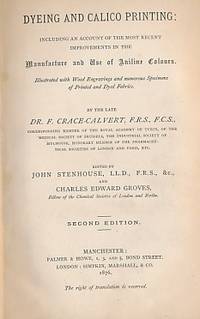
1876e8736Manchester: Palmer & Howe. Cover worn and detached from text block. Some age toning and offsetting from fabric specimens. Text block firm. 1876. Second Edition. Green hardback cloth cover. 230mm x 140mm 9" x 6". xxix 509pp ad. 'Illustrated with wood engravings and numerous Specimens of Printed and Dyed Fabrics'. Fold out table and laid on samples. Heavy item - shipping supplement may apply for overseas. . Palmer & Howe hardcover
186642719London Taylor and Francis 1866. 4to. No wrappers as extracted from "Philosophical Transactions" Vol. 156 - Part II pp. 399-439. 2 Textillustrations. <br/><br/><em>Firat appearance of a groundbreaking paper in physical chemistry in which Graham describes the fundamental mechanism for gas transport across a polymer membrane. The mechanism is known as solution-diffusion model and postulates a three-step process for gas transport through a polymer. </em> unknown
188744236Paris G. Masson 1887. 8vo. Contemp. hcalf raised bands gilt spine. Light wear along edges. Small stamps on verso of titlepage. In: "Annales de Chimie et de Physique" 6e Series - Tome 12. 576 pp. Entire volume offered. Moissan's paper: pp. 472-537. Many textillustrations of apparatus in woodcut. <br/><br/><em>First appearance of the paper in which Moissan describes his isolation and observation of the properties of fluorine gas and his succes in producing diamond with his pectacular arc method. Fo these achievements he was the first French to be awarded the Nobel Price in chemistry 1906.The existence of the element fluorine had been well known for many years but all attempts to isolate it had failed and some experimenters had died in the attempt."Moissan eventually succeeded in preparing fluorine in 1886 by the electrolysis of a solution of potassium hydrogen difluoride KHF2 in liquid hydrogen fluoride HF. The mixture was needed because hydrogen fluoride is a non-conductor. The device was built with platinum/iridium electrodes in a platinum holder and the apparatus was cooled to -50 °C. The result was to completely isolate the hydrogen produced from the negative electrode from the fluorine produced at the positive one.This is essentially still the way fluorine is produced today." Wikipedia.Partington IV p. 912. - Weeks "Discovery of teh Elements" p. 272 ff. - Parkinson "Breakthroughs" 1885 C. </em> hardcover
183848918Paris Crochard 1838. Contemp. hcalf. Raised bands spine gilt. In: "Annales de Chimie et de Physique Par MM. Gay-Lussac et Arago." 2e Series Tome 68. 448 pp. entire volume offered. Wöhler & Liebig's paper: pp. 225-336. Clean and fine. small stamps to verso of titlepage. <br/><br/><em>First French edition of this importent paper in the development of organic chemistry. It is the last joint paper of importence from "these two men .pioneers in the development of organic chemistry form a twin constellation in the chemical firmament"Alexander Findley in "A Hundred Years of Chemistry" p. 23. The paper is a translation of "Untersuchungen über die Natur der Harnsäure" published at the same time in Justus Liebigs Annalen der Chemie 1838 Wöhler and Liebig collaborated on one more major piece of work a study of uric acid. The paper offered. Wöhler suggested the subject and the idea seems to have come from his medical interests. Uric acid was not easily obtainable–snake excrement was the only substantial source–and relationships with urea and allantoin were suspected by Wöhler. As a student he had won a prize in 1828 for an essay on the conversion in the human body of chemicals taken orally and excreted in urine. The technique adopted by Liebig and Wöhler was to subject uric acid ad the derivatives they prepared to oxidation and reduction by reagents of different concentrations and strengths. Wöhler seems to have been the first to heat reagents together in sealed glass tubes but after an explosion he thought metal ones safer.Their 100-page paper described fourteen new compounds and their preparation and analysis.7 An attempt to establish a new radical called "uril" C8N4O4 was less successful. Perhaps even more significant than the sophisticated practical and theoretical organic chemistry was the new spirit revealed. Writing to Berzelius in 1828 Wöhler was doubtful whether animal substances could be prepared in the laboratory. In 1832 he began the paper on the benzoyl radical with a description of organic chemistry as "the dark region of organic nature." But in 1838 his work with Liebig led him to write at Liebig’s suggestion: "The philosophy of chemistry will conclude from this work that it must be held not only as probable but as certain that all organic substances insofar as they no longer belong to the organism will be prepared in the laboratory. Sugar salicin morphine will be produced artificially. It is true that the route to these and products is not yet clear to us because the intermediaries from which these materials develop are still unknown but we shall learn to know them."DSB. </em> hardcover
182844898Paris Crochard 1828. 8vo. Without wrappers. Extract from 'Annales de Chimie et de Physique' Series 2 - Volume 37. Pp. 330-334. <br/><br/><em>First appearance in French of this milestone paper marking the beginnings of organic chemistry in which Wöhler describes how he managed to synthezise urea from cyanate of ammonia. The French version here is translated from the German paper "Ueber künstliche Bildung des Harnstoffs." which was issued the same year 1828. This broke down the old distinction between organic and inorganic substances. "This was the first synthesis of an organic compound and this accomplishment is generally regarded as the beginning of organic chemistry."Sparrow "Milestones of Science" p.37. The discovery destroyed the vitalistic theory which held that organic compounds could be produced only by living organisms and led eventually to the brilliant results that have been achieved in attempts to synthesize other organic compounds.Dibner: Heralds of Science no. 45. - Sparrow: Milestones of Science no. 197. - Garrison & Morton no. 671. See also DSB XIV p.475. </em> unknown
185449415London Richard Taylor and William Francis 1854. 4to. No wrappers as extracted from "Philosophical Transactions" 1861 Vol. 151 - Part I. Pp. 183-224 textillustrations. <br/><br/><em>First printing of a groundbreaking paper in biochemistry and physiology as Graham here introduced the distinction between colloidal and crystalloid substances by his method of separating animal and other fluids."Although some isolated investigations on colloids had been carried out before Graham his publications in this field laid the foundations of colloid chemistry. In "On the Diffusion of Liquids" Graham applied to liquids the exact method of inquiry he had applied to gases twenty years before and he succeeded in placing the subject of liquid diffusion on about the same footing as that to which he had raised the subject of gaseous diffusion prior to the discovery of his numerical law. He showed that the rate of diffusion was approximately proportional to the concentration of the original solution increased with rise in temperature and was almost constant for groups of chemically similar salts at equal absolute not molecular concentrations and different with different groups."DSB.Garrison & Morton: 688. </em> unknown