3 018 résultats
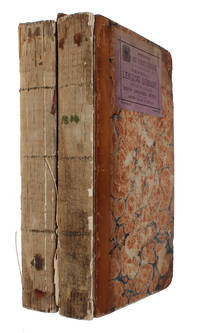
180146023Paris Chez Fuchs An IX1801. Boundin 3 contemp. hcalf. Gilt spuines. Light wear along edges. In: "Annales de Chimie ou Recueil de Mémoires concernant la Chemie" Tome 36 37 and 38. Entire volumes offered. 336;3302;3342 pp. and 5 engraved plates. Berthollet's paper: pp. 302-317 pp. 151-181 221-252 pp. 3-29 113-134. <br/><br/><em>Together with the memoir printed at the same time in "Mémoires de l'Institut." this is the first appearance of B's groundbreaking work on the nature of chemical affinity and the fact that many factors influence chemical reactions comparing chemical affinity to the force of gravity. The paper was at the end of the year published separately.The theory set forth here "led directly to Prout's investigations which yielded a knowledge of definite chemical proportions and thus played a very importent part in preparing the way for the development of the Atomic Theory on which the whole modern chemistry is based."Duveen p. 75."Berthollet read a memoir on the general theory of affinities while he was still in Egypt. This was the starting point of his complete new system of chemistry first briefly sketched in Recherches sur les lois de l’affinité 1801 and later developed into the comprehensive two volume Essai de statique chimique. Here he attempted to provide a proper basis for chemistry so that its experimental results could be viewed in the light of theoretical first principles. Berthollet developed a theory and a model adequate for the understanding and the interpretation of the rapidly growing body of chemical knowledge in his time. He was aware that the positive work of constructing a new theory had yet to be performed after the shock of Lavoisier’s criticism of the old chemistry.DSB.Parkinson "Breakthroughs" 1801 C. </em> unknown
1966006603New York:: Da Capo Press 1966. 5" wide by 7.5" tall. A bright square tight copy. Sharp corners. Inner hinges are perfect. Stamped "WITHDRAWN" on the rear endpaper. Text is clean and unmarked. No underlining. No highlighting. No margin notes. Translated from the French by M. Farrell M.D. From this edition's New Introduction by Dr. Jack Bulloff Ohio Academy of Science: "It was about 1910 that Kurnakov distinguished between the usually molecular materials that obeyed the law of definite proportions -- the 'daltonides' or the 'stoichiometric' chemical compounds -- and the nonstoichiometric solid-state materials undescribable in terms of the Daltonian concepts of atoms. Kurnakov called these variable composition materials 'Berthollides.' For before the ideas of Dalton 1766-1844 began a century's dominance of chemical thought they had been challenged by ideas espoused by Claude-Louis Berthollet 1748-1822." Bound in the original brown boards with an imitation leather spine lettered in shiny gold. . Reprint of 1809 first New Introduction. Hard Cover. Near Fine EX-LIBRARY./No jacket. xi iv 212pp. Da Capo Press Hardcover
20079782626University Science BooksU.S. 2007. This is an ex-library book and may have the usual library/used-book markings inside.This book has hardback covers. In fair condition suitable as a study copy. No dust jacket. Please note the Image in this listing is a stock photo and may not match the covers of the actual item1900grams ISBN:9781891389436 University Science Books,U.S. hardcover

20064138103University Science BooksU.S. 2006. This is an ex-library book and may have the usual library/used-book markings inside.This book has hardback covers. In good all round condition. No dust jacket. Please note the Image in this listing is a stock photo and may not match the covers of the actual item1900grams ISBN:9781891389436 University Science Books,U.S. hardcover
197924102D. Reidel Publishing Company. VG/NONE. 1979. Hardcover. 9027710635 . Hardback with very clean bright covers; pgs tight clean white unmarked. Lacks DJ. ; . D. Reidel Publishing Company, hardcover
181146030Paris Chez J. Klostermann fils 1811-12. Bound in 6 contemp. hcalf. Gilt spines slightly rubbed. Wear to top of spines. In: "Annales de Chimie ou Recueil de Mémoires concernant la Chemie" Tome 78 79 80 81 82 and 83. Entire volumes offered. The 14 parts: Tome 78: pp. 5-37 105-132 217-242. - Tome 79: pp. 113-142 233-264. - Tome 80: pp. 5-37 225-258. - Tome 81: pp. 5-36 278-303. - Tome 82: pp. 5-33 113-125 225-72. Tome 83: pp. 5-35 a. pp. 117-127. With in all 3 engraved plates. Some scattered brownspots. <br/><br/><em>The papers represents one of the first announcements of Berzelius' discovery of the fixed chemical proportions determining the weights and valencies of the various constituent elements in inorganic compounds. The papers were published at the same time in Swedish German both here in Annalen and in Schweiger's Journal and in French. By running many hundreds of analysis of chemical compounds he gave so many examples of the law of definite proportions that the world of chemistry could no longer doubt its validity and in so doing he gave experimental evidence to the atomic theory. He hereby laid a solid fundation for the further development of chemistry. A reprint is found in Ostwald's Klassiker der exakten Wissenschaften No. 35.According to Söderbaum Jac. Berzelius 2 p.12 "It was a giant work one of the most importent in the history of chemistry which was here presented. One is even more impressed when one remembers that it was a pioneer undertaking in every sense of the term. Analytic and synthetic methods existed before Berzelius' time to be sure but there were no precise methods of the sort which he required. They all had to be elaborated at the cost of time and labour."J. Erik Jorpes "Jac. Berzelius" p.45."In general Berzelius's efforts were directed toward the consolidation and extension of the atomic theory. He improved chemical analysis and determined the composition of a large number of compounds thus verifying the laws of constant and multiple proportions and furnishing the most accurate equivalent weights then available. By ingenious methods he arrived at the correct atomic composition of most common substances and thus was enabled to draw up in 1826 a table of atomic weights very nearly identical with the modern one."Leicester & Klicktein "A Source Book in Chemistry" p. 258.Parkinson "Breakthroughs" 1810-20 C. </em> unknown
181349243London Robert Baldwin 1813. 8vo. Contemp. hcalf. Marbled boards. Spine lacks and boards loose. In: "Annals of Philosophy; or Magazine of Chemistry Mineralogy Mechanics. By Thomas Thomson". Vol. II. - VIII480 pp. a. 7 plates. Entire volume offered. Berzelius' paper: pp. 276-284 357-368. Some browning and brownspots to plates. <br/><br/><em>First printing of this milestone papers in the history of chemistry where Berzelius introduced his famous chemical symbolism the offered paper is the first on the subject - Leicester & Klickstein calls it the "Preliminary note whereby an element is generally represented by the first letter of its Latin name or in the event of elements having the same first letter by the first two letters. Even though his atomic symbols were introduced in 1813 see the note on p. 359 it was quite a few years before Berzelius's symbols were adopted by the chemistry community. But once accepted they became the new international language of chemistry. Berzelius "contributed more to the development of the atomic theory and to the setting up of accurate values of the atomic weights than did any other worker of the time. Of his contributions moreover to the development of the atomic theory and the advancement of chemical science not the least valuable was the introduction of a chemical symbolism which with slight modification is in use at the present day. By giving his symbols a quantitative meaning - the symbol of an element representing one atomic proportion by weight - it was possible "to show briefly and clearly the number of elementary atoms in each compound and after the determination of their relative weights present the results of each analysis in a simple and easely retained manner". This symbolism was speedily adopted on the Continent but in England only after some considerable time."Findlay "A Hundred Years of Chemistry" p. 14.Parkinson "Breakthroughs" 1813 C. - Leicester & Klickstein "A Source Book in Chemistry" p. 258 ff. - Holmberg 1813:28 a. </em> hardcover
181346988London Robert Baldwin 1813 a. 1814. 8vo. 2 contemp. hcalf. Marbled boards. Spines lacks and boards detached. In: "Annals of Philosophy; or Magazine of Chemistry Mineralogy Mechanics. By Thomas Thomson". Vol. II and Vol. III. Entire volumes offered. Berzelius' papers: pp. 276-284 357-368 the first paper in vol. II pp. 443-454 vol. II a. pp. 51-62 93-106 244-257 a. 353-364. vol. III. Internally fine and clean. <br/><br/><em> First printing of these milestone papers in the history of chemistry where Berzelius introduced his famous chemical symbolism whereby an element is generally represented by the first letter of its Latin name or in the event of elements having the same first letter by the first two letters. Even though his atomic symbols were introduced in 1813 see the note on p. 359 in the first paper it was quite a few years before Berzelius's symbols were adopted by the chemistry community. But once accepted they became the new international language of chemistry.Berzelius "contributed more to the development of the atomic theory and to the setting up of accurate values of the atomic weights than did any other worker of the time. Of his contributions moreover to the development of the atomic theory and the advancement of chemical science not the least valuable was the introduction of a chemical symbolism which with slight modification is in use at the present day. By giving his symbols a quantitative meaning - the symbol of an element representing one atomic proportion by weight - it was possible "to show briefly and clearly the number of elementary atoms in each compound and after the determination of their relative weights present the results of each analysis in a simple and easely retained manner". This symbolism was speedily adopted on the Continent but in England only after some considerable time."Findlay "A Hundred Years of Chemistry" p. 14.Parkinson "Breakthroughs" 1813 C. - Leicester & Klickstein "A Source Book in Chemistry" p. 258 ff. - Holmberg 1813:28 a. The volume contains other notable papers THOMAS THOMSON "On the Discovery of the Atomic Theory" pp. 329-338. and JOHN DALTON "Remarks on the Essay of Dr. Berzelius on the Cause of Chemical Proportions" pp. 174-180 Vol. III. </em> hardcover
181143628Halle Rengerschen Buchhandlung 1811 1811 1812. Without wrappers as published in "Annalen der Physik. Herausgegeben von Ludwig Wilhelm Gilbert" Bd. 37 Drittes u. Viertes Stück Bd. 38 Sechtes Stück Bd. 40 Zweites u. Drittes Stück. The entire issues offered 5 issues. With titlepage to vol. 37 38 a. 40. Pp. 233-480 a. 3 engraved plates. pp. 121-236 a. 2 engraved plates. pp. 117-348 a. 1 engraved plate. Berzelius's papers: pp. 249-337 a. 415-472.- Pp. 161-226. - Pp. 162-208 a. 235-330. <br/><br/><em>The papers represents one of the first announcements of Berzelius' discovery of the fixed chemical proportions determining the weights and valencies of the various constituent elements in inorganic compounds. The papers were published at the same time in German both here in Annalen and in Schweiger's Journal and in French. By running many hundreds of analysis of chemical compounds he gave so many examples of the law of definite proportions that the world of chemistry could no longer doubt its validity and in so doing he gave experimental evidence to the atomic theory. He hereby laid a solid fundation for the further development of chemistry.According to Söderbaum Jac. Berzelius 2 p.12 "It was a giant work one of the most importent in the history of chemistry which was here presented. One is even more impressed when one remembers that it was a pioneer undertaking in every sense of the term. Analytic and synthetic methods existed before Berzelius' time to be sure but there were no precise methods of the sort which he required. They all had to be elaborated at the cost of time and labour."J. Erik Jorpes "Jac. Berzelius" p.45."In general Berzelius's efforts were directed toward the consolidation and extension of the atomic theory. He improved chemical analysis and determined the composition of a large number of compounds thus verifying the laws of constant and multiple proportions and furnishing the most accurate equivalent weights then available. By ingenious methods he arrived at the correct atomic composition of most common substances and thus was enabled to draw up in 1826 a table of atomic weights very nearly identical with the modern one."Leicester & Klicktein "A Source Book in Chemistry" p. 258.Parkinson "Breakthroughs" 1810-20 C. </em> unknown
1987050674Ibi / Kodak 1987. 1st Edition . Soft cover. Near Fine. 91 3 Pp. Spiral Bound Soft Cover. Near Fine. Undated But Circa 1987. <br/> <br/> Ibi / Kodak paperback
1995x-030645212XPlenum Pub Corp 1995. Hardcover. New. 1st edition. 349 pages. 10.25x7.00x1.00 inches. Plenum Pub Corp hardcover
2026x-1032274956Taylor & Francis Ltd 2026. Paperback. New. 308 pages. 8.25x0.68x11.00 inches. Taylor & Francis Ltd paperback
19979910360John Wiley and Sons 1997. This is an ex-library book and may have the usual library/used-book markings inside.This book has hardback covers. Clean from markings. In good all round condition. No dust jacket. Please note the Image in this listing is a stock photo and may not match the covers of the actual item950grams ISBN:9780471186229 John Wiley and Sons hardcover
1992015157New York: Wiley-Interscience 1992. Reprint . Hardcover. Very Good/No Jacket. 8vo - over 7¾" - 9¾" tall. x 452 pp. Fifth printing. An insignificant bump to the lower edge of the rear cover; otherwise a Fine unread copy. <br/> <br/> Wiley-Interscience hardcover
19975954345Wiley Vch 1997. This is an ex-library book and may have the usual library/used-book markings inside.This book has hardback covers. In good all round condition. Please note the Image in this listing is a stock photo and may not match the covers of the actual item750grams ISBN:9783527288120 Wiley Vch hardcover
1961007702Cambridge Massachusetts:: Privately Published. 1961. 5.5" wide by 8.5" tall. A solid reading/reference copy. Spine ends are a little frayed. Square and reasonably tight. WITHDRAWN stamp and a few other library markings. Text pages are clean. No underlining. No highlighting. No margin notes. This booklet contains four papers by this Massachusetts Institute of Technology author: 1 Two Notes on the Thermodynamics of Capillarity; 2 The Nature of Surface Pressure; 3 Theory of Young's Equation of Wetting; 4 Experiments on Young's Equation of Wetting. Bound in the original pale gray wraps lettered in shiny gold on the spine and front cover. Illustrated with a few figures/diagrams. Bibliographical references. . First Edition. Soft Cover. Good EX-LIBRARY. 76pp. Privately Published. Paperback
19965836349Oxford University Press 1996. This is an ex-library book and may have the usual library/used-book markings inside.This book has hardback covers. In good all round condition. No dust jacket. Please note the Image in this listing is a stock photo and may not match the covers of the actual item1300grams ISBN:0195094387 Oxford University Press hardcover
19894335975VCH 1989. This is an ex-library book and may have the usual library/used-book markings inside.This book has hardback covers. In poor condition suitable as a reading copy. No dust jacket. Library sticker on front cover. Please note the Image in this listing is a stock photo and may not match the covers of the actual item700grams ISBN:3527267824 VCH hardcover
19739993727Oxford Clarendon Press 1973. This is an ex-library book and may have the usual library/used-book markings inside.This book has hardback covers. In fair condition suitable as a study copy. No dust jacket. Rebound. Please note the Image in this listing is a stock photo and may not match the covers of the actual item900grams ISBN:0198551401 Oxford Clarendon Press hardcover
19733965226Oxford Clarendon Press 1973. This is an ex-library book and may have the usual library/used-book markings inside.This book has hardback covers. In poor condition suitable as a reading copy. No dust jacket. Please note the Image in this listing is a stock photo and may not match the covers of the actual item800grams ISBN:0198551401 Oxford Clarendon Press hardcover
19919914041Plenum Press 1991. This is an ex-library book and may have the usual library/used-book markings inside.This book has hardback covers. Clean from markings. In good all round condition. No dust jacket. Please note the Image in this listing is a stock photo and may not match the covers of the actual item600grams ISBN:0306438496 Plenum Press hardcover
20015838255Wiley-Vch 2001. This is an ex-library book and may have the usual library/used-book markings inside.This book has soft covers. In good all round condition. Please note the Image in this listing is a stock photo and may not match the covers of the actual item700grams ISBN:9783527304158 Wiley-Vch paperback
198353810CRC. Very Good with no dust jacket. 1983. Hardcover. 0849330645 . Exlibrary with usual library markings. Volume 1 297 pages published in 1983 volume 2 416 pages published in 1989 . CRC hardcover
20089963892John Wiley & Sons 2008. This is an ex-library book and may have the usual library/used-book markings inside.This book has soft covers. In good all round condition. Please note the Image in this listing is a stock photo and may not match the covers of the actual item2500grams ISBN:9780470810866 John Wiley & Sons paperback
19947099563Springer 1994. This is an ex-library book and may have the usual library/used-book markings inside.This book has soft covers. Book contains pen markings. In poor condition suitable as a reading copy. Please note the Image in this listing is a stock photo and may not match the covers of the actual item800grams ISBN:9780387947082 Springer paperback