3 018 résultats
1330698487.Gpaperback. Good. Access codes and supplements are not guaranteed with used items. May be an ex-library book. paperback
19935572450Oxford University Press 1993. This is an ex-library book and may have the usual library/used-book markings inside.This book has hardback covers. In poor condition suitable as a reading copy. Please note the Image in this listing is a stock photo and may not match the covers of the actual item950grams ISBN:9780198555605 Oxford University Press hardcover
1968CH-230New York: W.A. Benjamin 1968. Classic text presents the relation between the properties of free molecules and those of the solids they form; discusses the influence of impurities on the optical properties of molecular crystals; contains topics in the absorption spectra of pure crystals molecular vibrations fluorescence triplet excitons the excitation of mixed molecular crystals etc. 172 pgs. Illustrated. Stamp on outer edges and front endpaper; pocket remnant on front endpaper; small spine label on dustjacket; in mylar. Minimal shelfwear. . First Edition. Hard Cover. Very Good/Very Good. 8vo - over 7¾" - 9¾" tall. Ex-Technical Library. W.A. Benjamin Hardcover
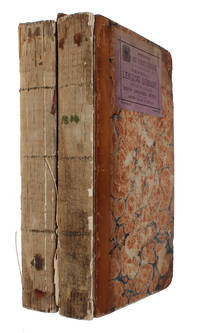
181349243London Robert Baldwin 1813. 8vo. Contemp. hcalf. Marbled boards. Spine lacks and boards loose. In: "Annals of Philosophy; or Magazine of Chemistry Mineralogy Mechanics. By Thomas Thomson". Vol. II. - VIII480 pp. a. 7 plates. Entire volume offered. Berzelius' paper: pp. 276-284 357-368. Some browning and brownspots to plates. <br/><br/><em>First printing of this milestone papers in the history of chemistry where Berzelius introduced his famous chemical symbolism the offered paper is the first on the subject - Leicester & Klickstein calls it the "Preliminary note whereby an element is generally represented by the first letter of its Latin name or in the event of elements having the same first letter by the first two letters. Even though his atomic symbols were introduced in 1813 see the note on p. 359 it was quite a few years before Berzelius's symbols were adopted by the chemistry community. But once accepted they became the new international language of chemistry. Berzelius "contributed more to the development of the atomic theory and to the setting up of accurate values of the atomic weights than did any other worker of the time. Of his contributions moreover to the development of the atomic theory and the advancement of chemical science not the least valuable was the introduction of a chemical symbolism which with slight modification is in use at the present day. By giving his symbols a quantitative meaning - the symbol of an element representing one atomic proportion by weight - it was possible "to show briefly and clearly the number of elementary atoms in each compound and after the determination of their relative weights present the results of each analysis in a simple and easely retained manner". This symbolism was speedily adopted on the Continent but in England only after some considerable time."Findlay "A Hundred Years of Chemistry" p. 14.Parkinson "Breakthroughs" 1813 C. - Leicester & Klickstein "A Source Book in Chemistry" p. 258 ff. - Holmberg 1813:28 a. </em> hardcover
181346988London Robert Baldwin 1813 a. 1814. 8vo. 2 contemp. hcalf. Marbled boards. Spines lacks and boards detached. In: "Annals of Philosophy; or Magazine of Chemistry Mineralogy Mechanics. By Thomas Thomson". Vol. II and Vol. III. Entire volumes offered. Berzelius' papers: pp. 276-284 357-368 the first paper in vol. II pp. 443-454 vol. II a. pp. 51-62 93-106 244-257 a. 353-364. vol. III. Internally fine and clean. <br/><br/><em> First printing of these milestone papers in the history of chemistry where Berzelius introduced his famous chemical symbolism whereby an element is generally represented by the first letter of its Latin name or in the event of elements having the same first letter by the first two letters. Even though his atomic symbols were introduced in 1813 see the note on p. 359 in the first paper it was quite a few years before Berzelius's symbols were adopted by the chemistry community. But once accepted they became the new international language of chemistry.Berzelius "contributed more to the development of the atomic theory and to the setting up of accurate values of the atomic weights than did any other worker of the time. Of his contributions moreover to the development of the atomic theory and the advancement of chemical science not the least valuable was the introduction of a chemical symbolism which with slight modification is in use at the present day. By giving his symbols a quantitative meaning - the symbol of an element representing one atomic proportion by weight - it was possible "to show briefly and clearly the number of elementary atoms in each compound and after the determination of their relative weights present the results of each analysis in a simple and easely retained manner". This symbolism was speedily adopted on the Continent but in England only after some considerable time."Findlay "A Hundred Years of Chemistry" p. 14.Parkinson "Breakthroughs" 1813 C. - Leicester & Klickstein "A Source Book in Chemistry" p. 258 ff. - Holmberg 1813:28 a. The volume contains other notable papers THOMAS THOMSON "On the Discovery of the Atomic Theory" pp. 329-338. and JOHN DALTON "Remarks on the Essay of Dr. Berzelius on the Cause of Chemical Proportions" pp. 174-180 Vol. III. </em> hardcover
SONG12595114720000-00-00. paperback. Used: Good. 0.00x0.00x0.00. Buy with confidence. Excellent Customer Service & Return policy. 0 paperback
SKU02119882014-01-01. Paperback. Good. Textbook May Have Highlights Notes and/or Underlining BOOK ONLY-NO ACCESS CODE NO CD Ships with Tracking paperback
18392940546Bernard Quaritch 1839. This is an ex-library book and may have the usual library/used-book markings inside.This book has hardback covers. In poor condition suitable as a reading copy. No dust jacket. Large 8vo with green binding. Gilt lettering on backstrip. Backstrips on volumes 1 and 2 are moderately torn in multiple places. Bumped corners. Break in the page block in volume 1 between pages 192 and 193. Minimal foxing on some pages. Interior is secure clean and clear. Trimmed. Please note the Image in this listing is a stock photo and may not match the covers of the actual item2700grams ISBN: Bernard Quaritch hardcover
1907036018New York: Charles Scribner's Sons 1907. First American Edition 1st Printing. Hardcover. Fine/Poor. Diagrams . X 123 Pp. Blue Cloth Gilt. First American Printing. Fine No Wear Gilt Brilliant No Marks In The Original Glassine Dj Chipped And Torn Some Loose Pieces Retained. Walther Hermann Nernst 1864 -1941 Was A German Chemist Known For His Work In Thermodynamics Physical Chemistry Electrochemistry And Solid State Physics. His Formulation Of The Nernst Heat Theorem Helped Pave The Way For The Third Law Of Thermodynamics For Which He Won The 1920 Nobel Prize In Chemistry. He Is Also Known For Developing The Nernst Equation In 1887. He Wrote His Thesis At Graz Where Boltzmann Was Professor Though He Worked Under The Direction Of Ettinghausen. They Discovered The Nernst Effect: That A Magnetic Field Applied Perpendicular To A Metallic Conductor In A Temperature Gradient Gives Rise To An Electrical Potential Difference. Next He Moved To Würzburg Under Kohlrausch Where He Submitted And Defended His Thesis. Ostwald Recruited Him To The First Department Of Physical Chemistry At Leipzig. Nernst Moved There As An Assistant Working On The Thermodynamics Of Electrical Currents In Solutions. Promoted To Lecturer He Taught Briefly At Heidelberg And Then Moved To Göttingen. There He Wrote A Celebrated Textbook Theoretical Chemistry Which Was Translated Into English French And Russian. He Also Derived The Nernst Equation For The Electrical Potential Generated By Unequal Concentrations Of An Ion Separated By A Membrane That Is Permeable To The Ion. After Eighteen Productive Years At Göttingen Investigating Osmotic Pressure And Electrochemistry And Presenting A Theory Of How Nerves Conduct He Moved To Berlin And Was Awarded The Title Geheimrat. In 1905 He Proposed His "New Heat Theorem" Later Known As The Third Law Of Thermodynamics. He Showed That As The Temperature Approached Absolute Zero The Entropy Approaches Zero - While The Free Energy Remains Above Zero. This Is The Work For Which He Is Best Remembered As It Enabled Chemists To Determine Free Energies And Therefore Equilibrium Points Of Chemical Reactions From Heat Measurements. Nernst Became Friendly With Kaiser Wilhelm Whom He Persuaded To Found The Kaiser Wilhelm Gesellschaft For The Advancement Of The Sciences With An Initial Capital Of Eleven Million Marks. Nernst's Laboratory Discovered That At Low Temperatures Specific Heats Fell Markedly And Would Probably Disappear At Absolute Zero. This Fall Was Predicted For Liquids And Solids In A 1909 Paper Of Albert Einstein's On The Quantum Mechanics Of Specific Heats At Cryogenic Temperatures. Nernst And Planck Lobbied To Establish A Special Professorship In Berlin And Nernst Donated To Its Endowment. In 1913 They Traveled To Switzerland To Persuade Einstein To Accept It; A Dream Job: A Named Professorship At The Top University In Germany Without Teaching Duties Leaving Him Free For Research. In 1911 Nernst And Max Planck Organized The First Solvay Conference In Brussels. Nernst Was Active In Scientific Projects In Support Of Wwi; Both His Sons Were Killed At The Front. In 1918 After Studying Photochemistry He Proposed The Atomic Chain Reaction Theory. It Stated That When A Reaction In Which Free Atoms Are Formed That Can Decompose Target Molecules Into More Free Atoms Would Result In A Chain Reaction. His Theory Is Closely Related To The Natural Process Of Nuclear Fission. In 1920 He And His Family Briefly Fled Abroad Because He Was One Of The Scientists On The Allied List Of War Criminals. Later That Year He Received The Nobel Prize In Chemistry In Recognition Of His Work On Thermochemistry. He Was Elected Rector Of Berlin University For 1921-1922. He Set Up An Agency To Channel Government And Private Funds To Young Scientists And Declined Becoming Ambassador To The United States. Later He Was A Vocal Critic Of Adolf Hitler And Nazism And Two Of His Three Daughters Married Jewish Men. After Hitler Came To Power They Emigrated One To England And The Other To Brazil. <br/> <br/> Charles Scribner's Sons hardcover
19933943929Gaussian Inc. 1993. This is an ex-library book and may have the usual library/used-book markings inside.This book has soft covers. In poor condition suitable as a reading copy. Please note the Image in this listing is a stock photo and may not match the covers of the actual item550grams ISBN:0963676903 Gaussian, Inc. paperback
19979627483Royal Society Of Chemistry 1997. This is an ex-library book and may have the usual library/used-book markings inside.This book has hardback covers. In good all round condition. No dust jacket. Please note the Image in this listing is a stock photo and may not match the covers of the actual item600grams ISBN:9780854047321 Royal Society Of Chemistry hardcover
19979784317Royal Society Of Chemistry 1997. This is an ex-library book and may have the usual library/used-book markings inside.This book has hardback covers. In good all round condition. No dust jacket. Please note the Image in this listing is a stock photo and may not match the covers of the actual item600grams ISBN:9780854047321 Royal Society Of Chemistry hardcover
0365061379.Gpaperback. Good. Access codes and supplements are not guaranteed with used items. May be an ex-library book. paperback
0365061395.Ghardcover. Good. Access codes and supplements are not guaranteed with used items. May be an ex-library book. hardcover
0428552080.Gpaperback. Good. Access codes and supplements are not guaranteed with used items. May be an ex-library book. paperback
0365645311.Ghardcover. Good. Access codes and supplements are not guaranteed with used items. May be an ex-library book. hardcover
0260429740.Ghardcover. Good. Access codes and supplements are not guaranteed with used items. May be an ex-library book. hardcover
042867321X.Ghardcover. Good. Access codes and supplements are not guaranteed with used items. May be an ex-library book. hardcover
0331357933.Ghardcover. Good. Access codes and supplements are not guaranteed with used items. May be an ex-library book. hardcover
0364941391.Ghardcover. Good. Access codes and supplements are not guaranteed with used items. May be an ex-library book. hardcover
1989009644St. Paul Minnesota: American Association of Cereal Chemists Inc. 1989. Fine condition. Bright clean square tight and unmarked. Sharp corners. Illustrated with charts diagrams and photos. "Following an overview of various types of food extrudes and their applications subjects dealt with include the engineering aspects of extrusion the properties of food materials and doughs coloring and flavoring extruded products and nutritional properties and safety of extruded foods." -- Book News. On this copy's endpaper is the signature of Dr. M. W. Rutenberg winner of the 1987 Wolfrom Award awarded to those individuals who have provided outstanding service to the Division of Carbohydrate Chemistry and/or to the field of Carbohydrate Chemistry. First Printing of the First Edition. Flexible leather covers. Fine condition. 8vo. 471pp . American Association of Cereal Chemists, Inc. hardcover
2013DADAX1849736898Royal Society of Chemistry 2013-07-11. 1. hardcover. New. 6.14x1.13x9.21. Buy with confidence. Excellent Customer Service & Return policy. Royal Society of Chemistry hardcover
19714579-nnew. unknown
19714579like new. unknown
2013SONG1849736898Royal Society of Chemistry 2013-07-11. 1. hardcover. Used: Good. 6.14x1.13x9.21. Buy with confidence. Excellent Customer Service & Return policy. Royal Society of Chemistry hardcover