Zurkinden, RudoldAntiquariat.de

365 résultats
1947811CG1947. Oel auf Leinwand. Bildausschnitt: 37 x 49 cm. + Wichtig: Für unsere Kunden in der EU erfolgt der Versand alle 14 Tage verzollt ab Deutschland / Postbank-Konto in Deutschland vorhanden +, Abb.
1947811CG1947. Oel auf Leinwand. Bildausschnitt: 37 x 49 cm.
19401564AGBerlin, o.J. (um 1940). Öl auf Leinwand. Bildformat: 67 x 79 cm. + Wichtig: Für unsere Kunden in der EU erfolgt der Versand alle 14 Tage verzollt ab Deutschland / Postbank-Konto in Deutschland vorhanden +, 1564AG
19401564AGBerlin, o.J. (um 1940). Öl auf Leinwand. Bildformat: 67 x 79 cm.
1998LFA-126723591Un ouvrage de 493 pages, format 150 x 210 mm, illustré, broché, publié en 1998, Flammarion, bon état
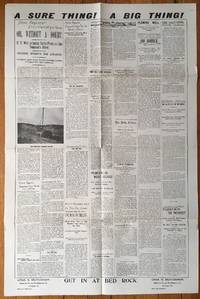
1902370Chicago 1902. Very good. Folded broadsheet 28 x 18.75 inches with several photographic reproductions. A couple of small separations along folds. A very scarce promotional from the early Wyoming oil boom. The Chicago firm of Charles O. Richardson here urges potential investors to "Get in at Bed Rock" and in particular promotes Richardson's interests in the Spring Valley Wyoming oil fields. Both sides of the large broadsheet reproduce numerous newspaper articles reporting new oil strikes across the state most in the area of Evanston with the dates and locations of the articles added in manuscript. Serious efforts to find oil began in Wyoming after statehood in 1890 with the first major oil boom not hitting until 1908; the present broadsheet therefore represents a rare and fascinating advertisement for the early industry in the state. OCLC locates only three copies at Yale the University of Oklahoma and SMU. unknown books
19832081402109200238Nipponkyobunsha 1983. Soft Cover. Fine. Number of pages: 236p Size: 19cm Number of books: 1 Nipponkyobunsha paperback
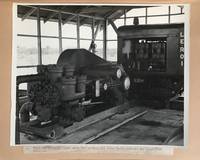
1943540Venezuela 1943. Very good. 48 original photographs each 8 x 10 inches. Quarto. Plain leather boards twin-bolt binding. Some photos detached from mounts some wear to covers but images generally fine with typed captions affixed beneath each photo. A rare photographic document of Venezuelan oil production in the early 20th century. This album contains nearly fifty large-format original images that depict the construction of a 157-mile crude oil pipeline from Las Mercedes Del Llano Guanico to a deep-sea terminal at Pamatacual in 1943 by the Sociedad Anonima Petrolera las Mercedes owned jointly by the Texas Company later Texaco and British-controlled Caracas Petroleum S. A. Venezuelan oil reserves attracted foreign investment as early as 1908: "In 1908 General Juan Vicente Gomez took power to become the strongest dictator of the 20th century with 27 years in office. He opened the gate to foreign oil investors.World War I was the trigger introducing Venezuela into the world oil market. After 1919 the investment and the exportation of Venezuelan oil increased tremendously. By 1922 Venezuela became an important supplier of oil in the world and biggest reserves of oil were discovered in the Lake of Maracaibo. During World War II Venezuela was the most secure provider of oil to the United States." -- Johannes Alvarez and James Fiorito Venezuelan Oil Unifying Latin-America. Venezuela increased its production 42 percent in 1943 and 1944 to satisfy the Allied demand for wartime oil. The images contained in the present album show various features of the pipeline oil wells and storage facilities at the inland stations as well as the path of the pipeline through the jungle to the sea. Several photos depict groups of men at work on the line in several locations. Another series of images depict views of the terminal station and the construction of its structures as well as its shipping facilities and the operations surrounding the loading of tankers there. From a research perspective this album is a fascinating look into the development of the now-critical oil industry in a lesser known region of mid-20th century Venezuela the involvement of American in this case Texan companies in South American industrial growth as well as the importance of South American resources to the United States war effort during World War II. We were unable to find any examples of large format photographs from the Venezuelan oil industry from this period in auction records or on the market. Photographs of Venezuelan oil production from outside of the Lake Maracaibo region where the bulk of early oil development occurred are equally difficult to locate. The printed title page suggests that more than one of these albums was produced but we are unable to uncover another example in OCLC or archived sales records. unknown books
1984SPN-534Fascicule agrafé 24x18, couverture illustrée en noir, [12] pages illustrées de photos en noir, bibliographie.
193418510Melbourne: Vacuum Oil Company 1934. soft cover. G. Sleeve in very good condition map split in two parts with a little edge wear overall good condition./No Jacket. Folding colour map in printed sleeve. Visit Melbourne Centenary 1934-5 printed on cover. Vacuum Oil Company paperback
1926312521Chicago: Universal Oil Products Company 1926. First edition. paperback. very good/no dustjacket. 8vo. pp. 93 previous owners name on front cover Universal Oil Products Company paperback
194172764Washington: GPO 1941. Paperback. Good. 382p. No separate wrapper. 24cm. First leaf creased at corner and has a few small chips Backstrip browned. "Printed for the use of the Special Committee." Also included is a folded copy of the separate brief five-page Preliminary Report by the Committee issued on September 11th 77th Congress. 1st Sessions. Senate Report No. 676. <br/><br/> GPO paperback books
197073326U. S. Government Printing Office 1970. Wraps. Very good. xiv 399 3 pages. Map. Appendices. Occasional footnotes. Figures. Tables. Index. Minor pencil erasure residue on title page. Cover has slight wear and soiling. On March 25 1969 the President created a Cabinet Task Force to conduct a comprehensive review of oil import restrictions; requested the Secretary of Labor to assume its chairmanship; named as the other members the Secretaries of State Treasury Defense Interior and commerce and the director of the Office of Emergency Preparedness; and added observers representatives of the Department of Justice Bureau of the Budget Council of Economic Advisers Office of Science and Technology Policy Office of the Special Trade Representatives and Federal Power Commission. Two of the members Secretary of the Interior and Secretary of Commerce did not associate themselves with this report and filed separate views. The Chairman of the Federal Power Commission also disassociated himself in full from the report and joined the two dissenting members in their expression of separate views. Secretary of the Interior Harold Ickes advocated the stockpiling of emergency crude oil in 1944. President Truman's Minerals Policy Commission proposed a strategic oil supply in 1952. President Eisenhower suggested an oil reserve after the 1956 Suez Crisis. The Cabinet Task Force on Oil Import Control recommended a similar reserve in 1970. But few events so dramatically underscored the need for a strategic oil reserve as the 1973-74 oil embargo. The cutoff of oil flowing into the United States from many Arab nations sent economic shockwaves throughout the Nation. In the aftermath of the oil crises the United States established the SPR. President Ford set the SPR into motion when he signed the Energy Policy and Conservation Act EPCA on December 22 1975. The legislation declared it to be U.S. policy to establish a reserve of up to one billion barrels of petroleum. The Gulf of Mexico was a logical choice for oil storage sites. More than 500 salt domes known to be an inexpensive and secure means of petroleum storage are concentrated along the coast. Also the Gulf Coast is the location of many U.S. refineries and distribution points for tankers barges and pipelines. In April 1977 the government acquired several existing salt caverns to serve as the first storage sites. Construction of the first surface facilities began in June 1977. On July 21 1977 the first oil - approximately 412000 barrels of Saudi Arabian light crude - was delivered to the SPR. Fill of the Nation's emergency oil reserve had begun. U. S. Government Printing Office paperback
1928117782No Place: Union Oil Company 1928. Softcover. very good. 43pp. Quarto. Original stiff card wrappers with fixed binding. Edges slightly rubber small tear to upper front. Illustrated with B/W photographs and diagrams. Tables tipped in at rear. very good Guide for painting promotional signs service stations and gas pumps held by the Union Oil Company. Includes instructions and example diagrams. Structural support tables tipped in at rear. An interesting piece of Americana. 1928 Union Oil Company paperback
1986149439Budapest: ICPS 1986. 38p. 8x5.5 inch wraps booklet faintest signs of age or handling. ICPS H-1415 / Documents on the struggle against chemical weapons volume II. ICPS unknown books
193113521931 Huile sur toile signée et datée 1931 (72/53 cm).
1980KOS01700644TBD 1980. Soft Cover. Fine. KOS01700644 TBD paperback
1945TAB0000042. 1945. In-12. Broché. Bon état, Couv. convenable, Dos satisfaisant, Intérieur frais. Huile sur toile. Dimensions : 60 x 74cm. Oeuvre datée et signée en bas à gauche. (P. Titeux de la Croix 45).. . . . Classification : 920.4-Huile
1927613j0194New Orleans: The Wesson Oil & Snowdrift People. Good. 1927. Reprint. Paperback. Features recipes using Snowdrift vegetable shortening. 45 pages. All recipes apportioned for six people. Appears to be a 1927 reprint. Clean and unmarked with light wear. A quality vintage copy.; 24mo . The Wesson Oil & Snowdrift People paperback
1962173982Rangoon Burma: The Burma Oil Co 1962 88 pages The cover has a bit of wear with a few small scuffs on the edges light tanning and fading. The page edges are lightly tanned and foxed. Books listed here are not stored at the shop. Please contact us if you want to pick up a book from Newtown. Paperback. Good. The Burma Oil Co paperback
19596408Northampton, Clarke and Sherwell / BP, o.J. [1959]. Leineneinband mit Schutzumschlag, Lex-8°, 158 S., mit zahlreichen Abbildungen; -Schutzumschlag mit einem Einriss, Einband gebräunt, sonst gutes Exemplar.
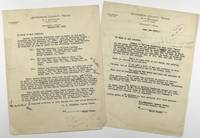
19321450Various places mostly Texas Tennessee Kentucky and Virginia 1932. Overall good plus. Eighty-five typed and manuscript letters including thirty mimeographed copies of a form response. Moderate chipping and wear to a few letters most previously folded but otherwise in strong condition. A fascinating collection of correspondence relating to spurious Depression-era claims on the famed Beaumont estate of Pelham Humphries 1810-1835. In 1834 Humphries a colonist in the disputed lands along the US border with Mexico filed a claim for a league some 4428 acres of land to the west of the Neches River a few miles south of what is now Beaumont in Jefferson County Texas. The land a patchwork of swamp and grassland good only for grazing was deemed valueless until oil was discovered there in 1901 by which time it had become known as Spindletop and the area became the epicenter of the Texas oil boom. <br/><br/>No one made more money than William Perry Herring McFadden 1856-1935 a rancher who had bought Spindletop in 1883 but ownership of the land was in dispute when he made the purchase. Humphries had died in obscurity possibly killed in a gunfight or perhaps hanged for stealing horses and there was no clear transfer of title. The first suit over the Humphries Land Grant was filed in 1880. McFadden purchased the rights of both parties in the suit but later claimants argued that neither had had a legitimate interest. When geologists stuck oil hundreds of people discovered their fortunate genealogy as a story swiftly spread that the heirs to the Humphries estate were due a share in the profits from the great companies that extracted oil from Spindletop. Numerous lawsuits followed beginning shortly after the discovery and continuing through the 2010s some extending over decades and involving thousands of claimants.<br/><br/>After one such suit entitled Anderson v. Lucas was settled in 1906 the Humphries story appears to have been forgotten for several decades before it emerged again during the depths of the Great Depression. Humphries reportedly hailed originally from Tennessee and in October 1931 the Knoxville Journal reported that members of the Humphreys family were gathering in Madisonville Tennessee to discuss their options. In November another meeting was held in Knoxville drawing over 200 attendees. Responding to the growing number of inquiries sent to his office W. T. Blackmon the Jefferson County Clerk wrote to the Knoxville Journal to set the record straight - "the Humphreys have absolutely no chance of getting $40000000 worth of oil land" the Journal summarized. "And so far as he is concerned he had rather hear no more about it. . He informed the Journal that he had quit opening letters from the Tennessee Humphreys." But Blackmon's letter had no effect. The next day the paper ran a piece in which Oscar Humphrey a stringer for the Associated Press voiced his suspicion at the clerk's response and urged people to fight for their millions.<br/><br/>The documents present here constitute Blackmon's file of inquiries from various Humphries claimants and their representatives all dated 1931 to 1932. A defiant letter here from Oscar Humphrey encloses clippings from the Knoxville Journal and informs Blackmon that "You may rest assured that I am going to have these stories reproduced in other papers in several cities in Tennessee and Georgia." The bulk of the archive consists of over fifty letters containing requests and claims from eleven states including Tennessee Virginia Kentucky Louisiana and Texas as well as the District of Columbia suggest that Humphrey's threat was not an idle one. Some of the letters are a few typed lines and comprise simple requests for information while others are handwritten and run on for pages with elaborate descriptions of the supplicant's claims and genealogy. Also present are carbon copies of general Blackmon's response which he adapted as a mimeographed form letter as well as copies of two more personalized . To dissuade inquirers from further correspondence his form letter notes that a full abstract of the survey of claims to Spindletop would cost "about $2500.00." Additional material here suggests that this may have been side scam Blackmon had with Earl Singleton the proprietor of the Jefferson County Abstract Company. At any rate the fresh rounds of claims on Spindletop delineated here came to nothing and Blackmon gave up his duties as County Clerk and accepted a new position as tax assessor and collector for Jefferson County the pursuit of tax delinquents perhaps seeming a restful occupation by comparison.<br/><br/>An excellent collection of documents detailing one episode in the long saga concerning the rights to the Spindletop fortune. unknown books
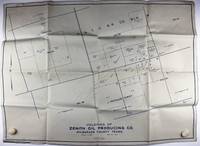
19291995Wichita Falls Tx: Montgomery & Ward 1929. Very good plus. Large blue line map approximately 22 x 29 inches. Folded. Very light tanning and a few small spots of soiling. Scattered contemporary pencil annotations. Unrecorded map showing the extent of mineral rights held in a section of Wilbarger County Texas by the Zenith Oil Producing Company and several competing interests. The county is located in North Texas on the border with Oklahoma west of the oil rich areas surrounding Wichita Falls and Burkburnett. Indeed the land here was mapped by a civil engineering firm from Wichita Falls Montgomery & Ward certainly not to be confused with the famed mail order and department store business. The Zenith Oil Producing Company for whom this map was created owned mineral rights in seven contiguous plots in the charted region but seems to have been active only for a short period of time at the end of the 1920s and solely in the area of Wichita Falls. We locate no other copies of the present map and only one other recorded example of a map by the Montgomery & Ward firm a 1931 plan of Wichita Falls. Montgomery & Ward unknown books
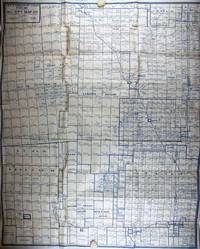
19301996Fort Worth: Oil City Map Co 1930. Very good. Large blue line map 34.25 x 27.5 inches. Folded. Scattered contemporary pencil annotations. Minor wear and a couple of short separations along fold lines. Small cut into neat line near upper right corner. Rare and detailed oil map of the oil fields in Shackelford and Callahan Counties just east of Abilene Texas. The map indicates the locations of well being drilled those producing gas wells dry holes and abandoned wells. The owners of the mineral rights are named and well as many of the surface owners which include various railroads and also the Lunatic Asylum. Deaf & Dumb Asylum Bayland Orphan Asylum and other institutions. A large number of the producing wells both oil and gas were owned by Texas Company Texaco the Magnolia Petroleum Co. but many major and small oil companies had obtained mineral rights on lands in the area when this map was produced. The area around the town of Moran as indicated by the number of wells in the vicinity was one of the major sites of oil production in Texas during the 1920s and was indicative of the spread of the oil business to the western and southern portions of the state during that decade. The publishers of this map the Oil City Map Company of Fort Worth were not particularly prolific -- we locate six examples of their other cartographic work all recorded in single institutional copies and no copies of the present map. Oil City Map Co unknown books
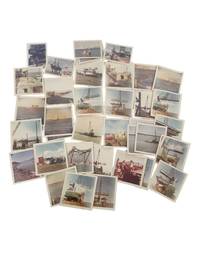
1970233331970. Texas and Kansas petroleum infrastructure photo archive 1970s and 1984 documenting the industrial system that linked Gulf Coast fabrication yards port facilities heavy marine transport offshore petroleum extraction and inland drilling in the mature oil fields of Kansas. The photographs show offshore structures moving from shore side assembly into open water service and a separate 1984 Kansas sequence inscribed "Lee's oil well" where a land based drilling rig trucks workers and rig floor equipment record oil production away from the coast. The archive places petroleum extraction within both the Gulf Coast industrial corridor that built and deployed offshore structures and the inland lease field where drilling remained dependent on mobile rigs pipe handling and small crews. Its value lies in that shift of scale from Galveston waterfront engineering and offshore installation to the working machinery of a Kansas well in the early 1980s.<br /> <br /> Photo archive of 42 chromogenic color photographs 3.5 x 5 inches Galveston Texas circa 1970s and Kansas 1984. The photographs center first on large offshore structures at several stages of completion and deployment including jack up rigs elevated decks cranes and a prominent circular helipad or radar platform mounted above the main deck. Several views show rigs still at dockside beside harbor pavement parked vehicles and industrial lifting equipment; others place the same or similar structures offshore standing above open water on extended legs or surrounded by service craft. One photograph includes a banner reading "Galveston Project Post USA" anchoring part of the sequence to a named project site while another frames the Galveston waterfront with dense ranks of harbor cranes and marine industrial equipment. Additional images show smaller fixed platforms a long yellow boom or gangway extending over water crane barges maneuvering beside offshore structures and a wider sea view with multiple platforms operating at once establishing repeated movement between fabrication yard port transfer and offshore installation. Six later Kansas photographs show "Lee's oil well" in 1984 including a land drilling rig in open field country truck mounted support equipment a lowered mast or rig component being moved into position workers on the rig floor handling chain and pipe a standing derrick and close views of the drill string hoisting line block and metal rig fittings.<br /> <br /> By the mid 1960s offshore oil had become central to both the U.S. energy economy and Texas coastal industry. Gulf Coast yards built and serviced the jackets pipe vessels and equipment that allowed companies to move farther offshore and later federal studies described fabrication yards as a core part of the offshore system that linked land based labor to offshore production. Texas held a special place in that expansion because its ports yards engineering firms and petroleum capital helped turn the Gulf into a permanent industrial frontier. Kansas had a different petroleum history beginning with commercial production in the 1890s and continuing through thousands of smaller lease fields where independent operators and mobile drilling crews extended the life of older oil districts. The 1984 "Lee's oil well" photographs add that inland production economy to the Galveston material showing how petroleum infrastructure depended not only on large coastal fabrication and marine transport but also on field rigs pipe work trucks and crew labor at individual wells. Light surface wear mild fading and minor edge wear; overall very good condition. A concentrated visual record of how American petroleum production moved between Gulf Coast offshore construction marine installation and inland drilling work in late twentieth century Texas and Kansas. unknown