Gay-Lussac, Louis-JosephBiblio.com
308 résultats
2329414544.Gpaperback. Good. Access codes and supplements are not guaranteed with used items. May be an ex-library book. paperback
2329414552.Gpaperback. Good. Access codes and supplements are not guaranteed with used items. May be an ex-library book. paperback
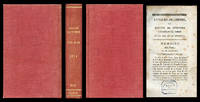
1812S14065no place:: G. De Turris 1812. 1812. 8vo. 110 2 pp. Some spotting. Modern quarter vellum boards black spine title. Very good. 171 'Memoirs on the Metals of Soda and Potash by Messrs. Gay-Lussac and Thenard. With researches on ammonia gas by Mr. Berthollet. Being Extracts from the Proceedings of the Society of Arcueil. Translated into Italian with notes by Mario Giardini.' There should be two issues of this pamphlet the other is described as having a pagination error at pp. 57-64 which is corrected here suggesting a second state which this should be. / Chemist L.J. Thenard collaborated with Gay-Lussac in the study of metals and together they arrived at the separation of sodium and potassium by chemistry which had already been achieved through Volta's battery. The book was dedicated to Francesco Carelli knight of the order of the Two Sicilies etc. by M. Giardini who recalled how Davy's recent discovery on the "nature of alkalis and alkaline earths "had attracted the attention of all European chemists and so he published this vol. p.5 which contains: Method employed by Mr. Davy Metodo Impiegato dal Sig. Davy p. 9 for the decomposition of soda ash and potash; Attempts Tentativi . . . p .11 employed by Davy to know the nature of alkaline earths; Extract of the memoirs read at the Inst. National from Mar. 7 to Feb. 27 1809 Estratto p. 18 by Messrs. Gay-Lussac and Thenard; Process for obtaining the metals of potash and soda Processo per ottenere I metallic p. 21 ; Properties of the metal of potash Proprieta del metallo della potassa; Properties of fluoric acid and particularly of its action on the metal of potash p. 48; Action of the metal of potash over oxides metal salts earthy alkaline p. 63; Of the metal of soda p. 68; Nature and properties of muriatic acid and oxygenated muriatic acid p. 71; Memoir on the analysis of ammonia p. 88 by Mr. Berthollet read at the Institute at Mar. 24 1808. / Crosland describes this Italian 'Society of Arcueil' as one of social standing and personal relationships – not a proper scientific association or academy as is typically thought of; rather in this case Napoleon's support of science is reflected with this loose associated body – here a 'society.' / "In the field of research Berthollet's work was above all a model for Gay-Lussac. On a personal level Berthollet was a pleasant man and a good friend; yet it was the man of science that Gay-Lussac took as his model. What mattered most was his conception of scientific activity. Even if his subject chemistry distanced him from the great mathematics on the one hand and biology on the other he remained open to a certain multidisciplinary approach. It was applied chemistry that interested him the kind that justifies the scientific approach by the search for applications in the tradition of the Encyclopedie." - Maurice Crosland Gay-Lussac savant et bourgeois p. 43. REFERENCES: See: Maurice Crosland The Society of Arcueil: A View of French Science at the Time of Napoleon I. Cambridge: Harvard University Press. 1967. [G. De Turris, 1812]. hardcover
1021832944.Gpaperback. Good. Access codes and supplements are not guaranteed with used items. May be an ex-library book. paperback
1020141778.Ghardcover. Good. Access codes and supplements are not guaranteed with used items. May be an ex-library book. hardcover
1814753Paris: Chez Crochard 1814. 1st Edition. FIRST EDITION FIRST PRINTING OF GAY-LUSSAC'S CLASSIC PAPER ON IODINE. Two volumes bound as one. The Dictionary of Scientific Biography notes this as one of Gay-Lussac's most important papers DSB Noted in DSB 5 327. In the late nineteenth century the chemist Wilhelm Ostwald winner of the 1909 Nobel Prize selected Gay-Lussac's paper as "one of the first and one of the best monographs of all time on a single element and its most important compounds and as such it has served as a model for many later pieces of research" Crosland Gay-Lussac: Scientist and Bourgeois 85. <br /> <br /> Louis Joseph Gay-Lussac 1778-1850 was a French chemist and physicist with a well-known rivalry with Humphry Davy. While J. C. Courtois discovered iodine in 1811— and while he recognized iodine to be a distinctive substance from its purple vapor — he confused its compound with hydrogen as that of hydrogen chloride. Gay-Lussac and Davy were asked to further explore the issue however they carried out their research virtually simultaneously making it somewhat difficult to assign priority. Davy's claim for the originality of his study of iodine depends upon his argument of knowledge prior to that of Gay-Lussac. While the publication history is confusing history credits Gay-Lussac DSB Vol. 5 p. 322. <br /> <br /> "In 1814 Davy did some further research on iodine but. in prolonged and detailed research he was outshone by Gay-Lussac who presented a full study of the new element in a major memoir read to the Institute on 1 August 1814" Crosland. Davy's work had been somewhat hurried and incomplete while Gay-Lussac's was anything but. When published this paper at 155 pages filled an entire issue of the Annales de chime" Crosland. <br /> <br /> Gay-Lussac's work in this paper was exceptionally detailed and he "deserves full credit for his detailed study of hydrogen iodine which he found to have a 50 percent hydrogen content by volume. He contrasted its thermal decomposition with the stability of hydrogen chloride. By the action of chlorine on iodine he prepared. iodine monochloride and trichlorise. After further careful study of the properties of iodine he prepared and examined a number of iodides and iodates. He prepared for the first time ethyl iodide by distilling together concentrated hydriodic acid with absolute alcohol" DSB Vol. 5 p. 322. <br /> <br /> In this paper his most important on the subject Gay-Lussac settled Courtois's confusion proving that the new substance was an element analogous of chlorine and it was Gay-Lussac who gave iodine the name iode from the Greek ioeides "violet colored". In a curious side-note some even saw Gay-Lussac's paper as wondrous including the "normally restrained German edition L. W. Gilbert who suggested that the memoir transports the reader into a sort of fairyland. In order to understand Gilbert's remarks the 20th century reader would have to forget his modern sophistication and try to recapture the childlike wonder which might be engendered on first seeing the black crystals of iodine transformed by heat into a beautiful violet vapor with no equal among contemporary dyestuffs" ibid. <br /> <br /> ALSO INCLUDED is the first publication of a paper read to the Institute of France in 1804 by the French chemist Armand Séguin. In it Séguin details his study of opium of the greatest import being his "technique for obtaining another substance from opium" Robinette 378. Séguin "did not know it but he was on the trail of one of the most far-reaching medical discoveries of all time" — morphine Booth Opium 68. Séguin's discovery was not published for a decade until the paper offered here by which time the chemist was in disgrace for embezzling drug supplies from the French army and his work was dismissed. In his speech and paper Séguin "reported finding ‘a very peculiar vegetable-animal material'" Robinette. Though the timing in muddled as by the time of publication other researchers had made similar discoveries writing in 1832 Pelletier argued strongly for Séguin's preeminence; that Séguin's "vegetable-animal material" was in fact the discovery of morphine: ‘M. Séguin signaled the existence of the most energetic principle of opium described the means of obtaining it and indicated its essential and distinctive characteristics so that he only lacked the naming of it ‘morphine' in order to be in possession of the honor of its discovery'" ibid. CONDITION & DETAILS: Paris: Chez Crochard. Volumes 91 and 92 bound as one. Ex-libris with NO spine markings and minimal interior markings small stamp on title page occassional text page blank front flyleaf. 8vo. 8.25 x 5.5 inches 206 x 137mm. 1 plate. Tightly and very solidly bound in maroon cloth with a gilt-lettered spine; minor scuffing to the edge tips. Moderate foxing throughout largely minor. title page is not detached but is loosening. Withal very good condition. Chez Crochard hardcover
181443080Paris Chez Crochard 1814. Contemp. hcalf. Spine gilt. Top of spine with wear. A few scratches to binding. In: "Annales de Chimie ou Recueil de Mémoires concernant la Chemie" Tome 91. - 336 pp. a. 1 engraved plate.the entire volume offered. Gay-Lussac's paper: pp. 5-160. Some scattered brownspots. <br/><br/><em>First printing of Gay-Lussac's classic paper on Iodine discovered 1811 by J.C. Courtois in which he showed that the new substance was an element analogous of chlorine and in which he named the substance Iode from the Greek ioeides meaning "violet colored".Gay-Lussac's and Davy's rechearches on iodine were carried out simultaneously which makes it difficult to assaign priority. Gay-Lussac was annoyed at Davy's introsion. His work however is considered as a model of experimental research. Leicester & Klickstein "A Source Book of Chemistry" p. 293."Gay-Lussac's major publication on iodine was not ready to be read to the Institute until August 1814 by which time not only Davy but Vaquelin had explored the subject fairly extensively. Gay-Lussac however deserves full credit for his detailled study of hydrogen iodide which he found to have a 50 percent hydrogen content by volume. He contrasted its thermal decomposition with the stability of hydrogen chloride. By the action of chlorine and iodine he pepared independently of Davy and at about the same time iodine monochloride and trichloride. After further carefull study of the properties of iodine he prepared and examined a number of iodides and iodates. He prepared for the first time ethyl iodide by distilling together concentrated hydriodic acid with absolute alcohol. The close analogy that he emphasized between chlorine and iodine led him to further investigation of the former and he discovered chloric acid by the action of sulfuric acid on a solution of barium chlorate."DSB V pp. 322-23. - Parkinson "Breakthroughs" 1814 C. - Duveen p. 237.The volume contains other importent chemical papers A. Séguin: "Premier-Second Mémoire sur le Quinquina" pp.273-284 a. 304-317 and 3 other papers by him one together with Lavoisier by Guyton-Morveau Payssé Colin etc. </em> unknown
183545505Paris Chez Crochard 1835. Without wrappers. In: "Annales de Chimie ou Recueil de Mémoires concernant la Chemie" Ser. II Tome 60 Cahier 2. Pp. 225-331. Entire issue offered. Gay-Lussac's paper: pp. 225-261 and 1 folded engraved plate. - <br/><br/><em>First printing. In 1824 Gay-Lussac extended earlier methods for the estimation of hypochlorite or chlorinated lime solution using indigo solution. He later improved on the method in the paper offered.by the use of standard solutions of certain reducing agents: arsenious oxide mercurous nitrate and potassium ferrocyanide and describing the apparatus depicted on the plate. </em> unknown
a107346aParis 1829 first edition. Crochard. Original binder's blue wraps with mounted manuscript paper spine label. Octavo. 448p. in volume. Gay-Lussac article on Les Poudres Fulminant on pp. 2-25. Several other important articles in same volume on other topics by : Poisson Robiquet Hennell Marianini Berzelius many others. In French. Some occasional light foxing throughout . Good no owner marks. . paperback
1020425598.Ghardcover. Good. Access codes and supplements are not guaranteed with used items. May be an ex-library book. hardcover
1278757929.Gpaperback. Good. Access codes and supplements are not guaranteed with used items. May be an ex-library book. paperback
1278304940.Gpaperback. Good. Access codes and supplements are not guaranteed with used items. May be an ex-library book. paperback
2011336090.Gpaperback. Good. Access codes and supplements are not guaranteed with used items. May be an ex-library book. paperback
2011336104.Gpaperback. Good. Access codes and supplements are not guaranteed with used items. May be an ex-library book. paperback
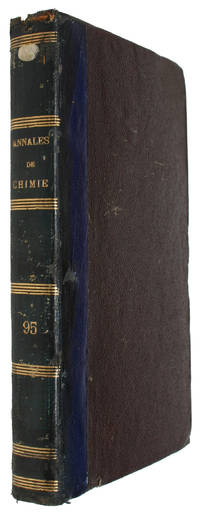
181543079Paris Chez Crochard 1815 Contemp. hcalf. Spine gilt. Top of spine with wear. A few scratches to binding. In: "Annales de Chimie ou Recueil de Mémoires concernant la Chemie" Tome 95. - 336 pp. the entire volume offered. Gay-Lussac's paper: pp. 136-231. Some scattered brownspots throughout. <br/><br/><em>First appearance of this milestone paper in organic chemistry in which Gay-Lussac describes the preparation the chemical reactions and the determination of the physical properties of prussic acid."One of the most importent contributions of Gay-Lussac was his work on hydro-cyanid acid and its compounds. In the course of his investigations on the combining volumes of gases he had prepared gaseous hydrogen cyanide. This led him to the study of related compounds and in 1815 he published a paper "Recherches sur l'acide prussique" the paper offered wherein he announced the discovery of cyanogen and chlor-cyanogen and the composition of hydrocyanic acid. His demonstartion that hydrogen cyanide contains no oxygen added another oxygen-free acid to those already known hydrogen halides and sulfide and contributed to the overthrow of Lavoisier's oxygen theory of acids. Gay-Lussac found that the cyano radicalthe first orgianic radical clearly recognized could act as an element analogous to chlorine passing unchanged through various reactions. This concept of an organic radical was importent to organic chemistry."Leicester & Klickstein "A Source Book of Chemistry" p. 293. - Partington IV p.85 a. p. 253. - Roy G. Neville p. 505. - Parkinson "Breakthroughs" 1815 C. </em> unknown
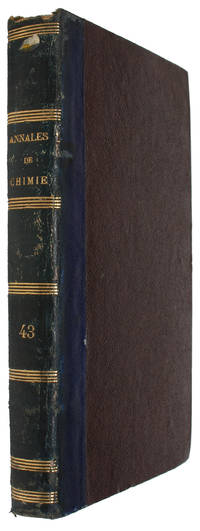
180243078Paris Chez Fuchs An X 1802. Contemp. hcalf. Spine gilt. Top of spine with wear. A few scratches to binding. In: "Annales de Chimie ou Recueil de Mémoires concernant la Chemie" Tome 43. 3324 pp. 2 engraved plates the entire volume offered. Gay-Lussac's paper: pp. 137-175. The first 20 leaves a bit brownspotted otherwise with a few marginal brownspots. 1 leaf pp. 197-98 torn with loss of some letters. Gay-Lussac's paper fine and clean. <br/><br/><em>First printing of this extremely important discovery in which Gay-Lussac first formulated the law Gay-Lussac's Law stating that if the mass and pressure of a gas are held constant then gas volume increases linearly as the temperature rises. This is sometimes written as V = k T where k is a constant dependent on the type mass and pressure of the gas and T is temperature on an absolute scale. In terms of the ideal gas law k = n R / P."In 1802 he Gay-Lussac showed that different gases all expanded by equal amounts with rise in temperature. Charles had made the same discovery some years earlier but had not published it; the credit therefore belongs to Gay-Lussac at least as much and probably more. This was an extremely importent discovery which Avogadro was to use within the decade to formulate hid long-neglected hypothesis that equal volumes of different gases at equal temperatures contained equal numbers of particles."Asimov.Magie "A Source Book in Physics" p.165-172 - Leicester & Klickstein "A Source Book of Chemistry" p. 374-379. - Parkinson "Breakthroughs" 1802 C.The volume contains other importent papers in chemistry by Humphrey Davy first French translation of his announcement of the finding of "Laughing Gas" Nitrous Oxide Parmentier Vauquelin Clement et Desormes Thenard Guyton Chenivix </em> unknown
180543298Paris Chez Bernard An XIII 1805. Contemp. hcalf. gilt spine. Top of spine with wear. In: "Annales de Chimie" Vol. 52. 358 pp. The entire volume offered. Gay-Lussac's paper: pp. 75-94 a. large foldet "Tableau des Observations". Internally clean printed on good paper. <br/><br/><em>First printing of the scientific account of Gay-Lussac's famous ascent in a hydrogen ballon in order to make observations on the composition of the air pressure and the earth's magnetic force. This voyage together with the voyage in the same year with Biot is the first ascents with a scientific purpose."Gay-Lussac made an ascent in a hydrogen ballon with Biot on 24 August 1804. The primary object of the ascent was to see whether the magnetic intensity at theearth's surface decreased with an increase in altitude. The concluded that it was constant up to 4000 meters. They also carried long wires to test the electricity of different parts of the atmosphere. Another object was to collect a sample of air from a high altitude to compare its composition with that of air at ground level. Gay-Lussac made a second ascent on 16. September 1804 the paper offered but this time by himself in order to lessen the weight of the balloon and thus reach a greater high.He was able to repeat observations of pressure temperature and humidity and also make magnetic measurements. He had taken two evacuated flasks which he opened to collect samples of air when he had attained an altitude of over 6000 meters. His subsequent analysiss of these samples showed that the portion of oxygen was identical with that in ordinary air. Gay-Lussac reached a calculated high of 7o16 meters above sea level a record not equaled for another half a century."DSB V p. 318.Brockett: 5164 a - Tissandier p. 23.The volume contains other importent papers Thenard "Mémoire sur la liqueur fumante e Cadet" Parmentier "Experiences et Observations sur la collage et la clarification des vins de la biere etc." Vauquelin "Analyse des topazes" Chenevix and others. </em> unknown
180843299Paris Chez Mad. Ve. Bernard 1808 Contemp. hcalf. gilt spine. Some scratches to binding. Verso of titlepage and plates with small stamps.In: "Annales de Chimie" Vol. 68. - 358 pp. a. 3 engraved plates. The entire volume offered. Gay-Lussac's a. Thenard's paper: pp. 169-174. <br/><br/><em>First announcement of the results that they had obtaines by treating boric acid with potassium showing that acid is composed of a combustible substance and oxygen. "Before regarding their proof of the existance of a new element as complete Gay-Lussac and Thenard wished not only to decomposed boric acid but to recompose it. On November 30 of the same year they were able to state in the 'Annales de Chemie et de Physique" the paper offered that "the composition of boracid s no longer problematical. In fact said they "we decompose and we recompose this acid at will" Weeks "Discovery of the Elements" p. 160. - Parkinson "Breakthroughs" 1808 C. - Bunch 1808.The volume contains other importent paper Davy's famous paper on electrolysis in first French translations Gayton-Morveau"Description d'un hygrometre pour le gaz." d¨'Arcet "Observations sur la potasse et sur la soude préparées à l'alcool" etc. </em> unknown
1437176240.Ghardcover. Good. Access codes and supplements are not guaranteed with used items. May be an ex-library book. hardcover
181043627Halle Rengerschen Buchhandlung 1810. Without wrappers as published in "Annalen der Physik. Herausgegeben von Ludwig Wilhelm Gilbert" Bd. 36 Neuntes Stück. The entire issue offered =Heft 9. Titlepage to vol. 36. Pp. 1-112. a. 2 engraved plates. Gay-Lussac's papers: pp. 6-36 a. pp. 37-51. <br/><br/><em>First German edition of this classic paper in chemistry in which he states the law that when two gases combine chemically they do so that the volumes are in the ratio of whole small numbers."In 1805 with Alexander von Humboldt he observed the already known fact that hydrogen and oxygen combines in the ratio of 2 to 1 by volume. Stimulated by this work he studied the reactions of other gases to see whether there were other simple relationshipas and in 1808 he announced the la of combining volumes which is now known as GAY-LUSSAC'S LAW This generalization obviously connected with some fundamental property of matter was in part responsible for Avogadro's hypothesis."Leicester & Klickstein.Parkinson "Breakthroughs" 1809 C. - Leicester & Klickstein "A Source Book in Chemistry" pp. 292 ff. </em> unknown
181849063Leipzig Barth 1818. No wrappers. In: "Annalen der Physik. Neue Folge. Herausgegeben von L.W. Gilbert" Bd. 28 Erstes Stück. Pp. 1-120 a. 1 engraved plate. Entire issue offered. Gay-Lussac's paper: pp. 29-53. <br/><br/><em>First German edition of Gay-Lussac's "Sur les combinaisons de l’azote avec l’oxigène" in which he identified 5 oxides of nitrogen."In 1809 Gay-Lussac carried out a study of the combining volumes of nitric oxide and oxygen. This was a more complex problem than he then realized but he returned to it in 1816 after criticism of his earlier work by Dalton; this time his results were of permanent value. He recognized five oxides of nitrogen." </em> unknown
180344130Halle Rengerschen Buchhandlung 1803. Without wrappers as extracted from "Annalen der Physik. Herausgegeben von Ludwig Wilhelm Gilbert" Bd. 12. Pp. 257-291 a. 1 folded engraved plate showing the experimental apparatus used. <br/><br/><em>First appearance in German of this extremely important paper in which Gay-Lussac first formulated the law the Gay-Lussac's Law stating that if the mass and pressure of a gas are held constant then gas volume increases linearly as the temperature rises. This is sometimes written as V = k T where k is a constant dependent on the type mass and pressure of the gas and T is temperature on an absolute scale. In terms of the ideal gas law k = n R / P."In 1802 he Gay-Lussac showed that different gases all expanded by equal amounts with rise in temperature. Charles had made the same discovery some years earlier but had not published it; the credit therefore belongs to Gay-Lussac at least as much and probably more. This was an extremely importent discovery which Avogadro was to use within the decade to formulate hid long-neglected hypothesis that equal volumes of different gases at equal temperatures contained equal numbers of particles."Asimov.Magie "A Source Book in Physics" p.165-172 - Leicester & Klickstein "A Source Book of Chemistry" p. 374-379. - Parkinson "Breakthroughs" 1802 C. </em> unknown
Paris, Gallimard 5 avril 1968. In-12, broché, couverture à rabats, 184 pp. Edition originale. Un des 30 exemplaires numérotés sur vélin pur fil Lafuma-Navarre seul tirage en grand papier, Bel exemplaire en parfait état. N° 19.
Paris, Gallimard, 1959. In-12, broché, non coupé, 220 pp. Edition originale. Un des 25 exemplaires numérotés sur vélin pur fil Lafuma-Navarre, seul tirage en grand papier avec 5 hors-commerce, N° 3 en parfait état.
Paris, Gallimard, 1963. In-12, broché, non coupé, 204 pp. Edition originale. Un des 20 exemplaires numérotés sur vélin pur fil Lafuma-Navarre, seul tirage en grand papier, en parfait état. N° 1.