GAY-LUSSAC ; ARAGO ; POISSON ; Félix SAVART ; BECQUEREL ; VAUQUELIN ; BALARD ; HUMBOLDT ; CollectifLivre Rare Book
503 résultats
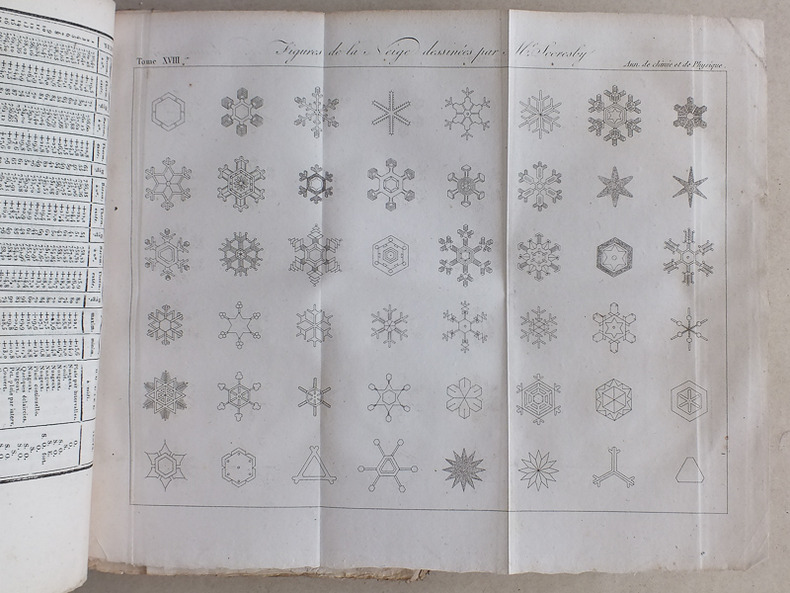
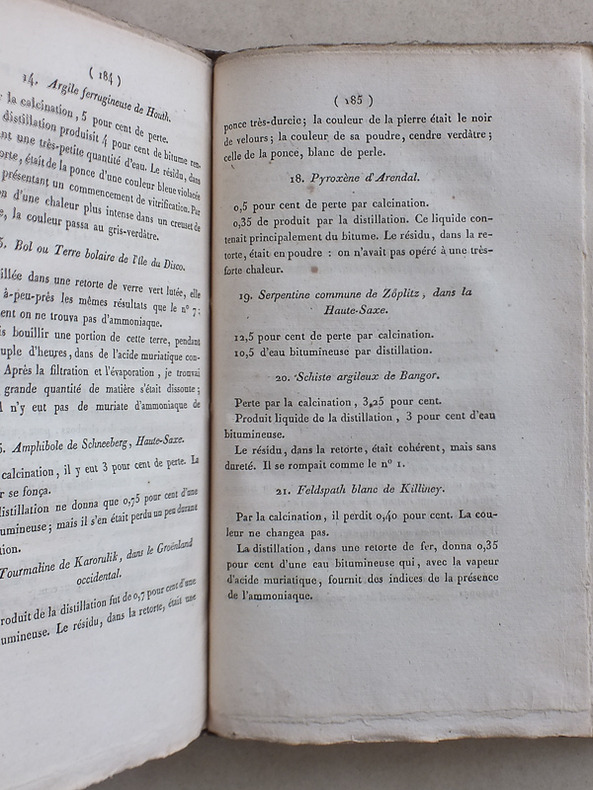
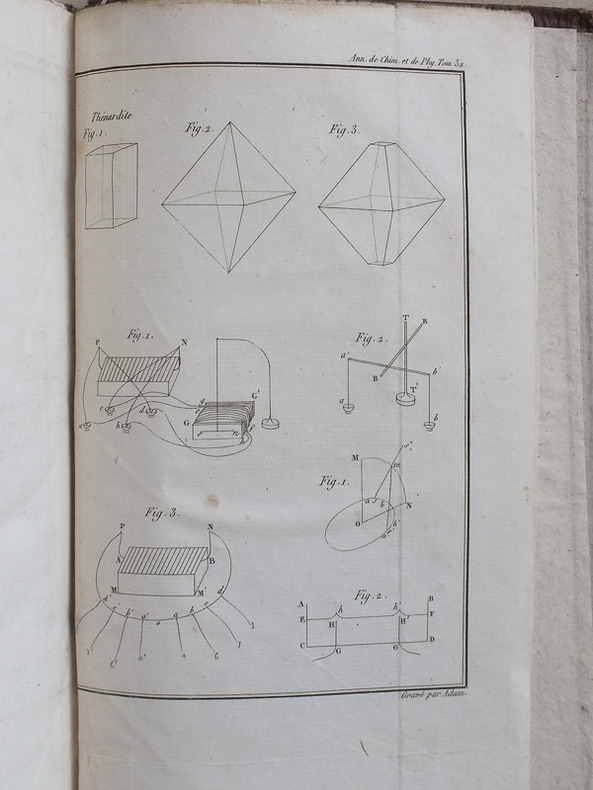
1826346441 vol. in-8 cartonnage marbré de l'époque, Chez Crochard, Paris, 1826, 448 pp. avec 4 planches dont 3 dépliantes et 1 tableau dépliant. Contient notamment : Note concernant les phénomènes magnétiques auxquels le mouvement donne naissance (Arago) - Mémoire sur la théorie du Magnétisme en mouvement (Poisson) - Du Pouvoir conducteur de l'Electricité dans les métaux, et de l'intensité de la force électro-dynamique en un point quelconque d'un fil métallique qui joint les deux extrémités d'une pile (Becquerel) ; Mémoire sur la Voix des Oiseaux (Savart) ; De l'emploi des corps gras comme hydrofuge dans la peinture sur pierre et sur plâtre, dans l'assainissement des lieux bas et humides (D'Arcet et Thénard) ; Quatrième mémoire sur les Canaux de navigation, considérés sous le rapport de la chute et de la distribution de leurs écluses (Girard) ; Analyse des cendres de l'Etna (Vauquelin) ; Sur le gisement du Platine (Humboldt) ; Analyse de monnaies d'argent romaines trouvées à Famars (Feneulle) ; Sur une substance particulière contenue dans l'eau de la mer (Balard)
1828346501 vol. in-8 cartonnage marbré de l'époque, Chez Crochard, Paris, 1828, 448 pp. avec 1 planche dépliante. Contient notamment : Sur les Piles secondaires de Ritter (Marianini) ; Extrait d'un Mémoire sur la Constitution mécanique des Fluides Elastiques (P. Prevost) ; Sur un Phénomène extraordinaire concernant l'influence continue qu'exerce le contact de métaux hétérogènes sur leurs propriétés chimiques, longtemps après que ce contact a cessé (Van-Beek) ; Du Dégagement de l'électricité qui résulte du frottement de deux métaux (Becquerel) ; Examen des Principes qui peuvent conduite à la connaissance des lois de l'équilibre et du mouvement des solides élastiques (Mlle Sophie Germain) ; Sur les Phénomènes des Volcans (Humphry Davy) ; Mémoire sur la Perte de tension qu'éprouvent les appareils voltaïques quand on tient le circuit fermé, et sur la manière dont ils recouvrent leur tension primitive (Marianini) ; etc...
1832346631 vol. in-8 cartonnage marbré de l'époque, Chez Crochard, Paris, 1832, 448 pp. avec 2 planches dépliantes. Contient notamment : Lettre adressé à M. Gay-Lussac par M. Faraday sur les Phénomènes électro-magnétiques ; Sur la Composition de l'Hydrogène phosphoré et ses combinaisons avec d'autres corps (H. Rose) ; De l'Action chimique produite par l'Induction électrique (Hachette) ; Note de M. Ampère sur une Expérience de M. Hippolyte Pixii, relative au Courant produit par la rotation d'un aimant, à l'aide d'un appareil imaginé par M. Hippolyte Pixii (Ampère) ; Mémoire sur les Phénomènes que présente un arc métallique plongeant par des surfaces inégales à ses extrémités dans deux portions séparées d'un même fluide lorsqu'il sert à conduire l'électricité de l'une à l'autre (Marianini) ; Du pouvoir d'Endosmose considéré comparativement dans quelques liquides organiques (Dutrochet) ; Recherches sur l'Origine de l'Azote qu'on retrouve dans la composition des Substances animales (Macaire et Marcet) ; etc...
ORD-4350Et des Tables qui l'accompagnent. Collardeau. 1824. In-16 carré, dos et coins toile verte, 2ff.n.ch. mais compris dans la pagination (Titre et note), 22pp. (Instruction), 1 ff.blanc, 16ff. (Table de la Force réelle des Liquides Spiritueux et Table de Richesse en Alcool), pagination reprise avec Mouillage des Liquides Spiritueux (pp.55-59 puis table (9pp.), 1ff.blanc, 6pp. (Barème Décimal) et 17ff. de table de ce même barème, 1ff.blanc. (les 3 ff.blancs ne sont pas compris dans la pagination).|Dos éclaté sans trop de perte, plats lgt salis, 5 lettres effacées au titre, qq.légères rousseurs, mais assez bon exemplaire.
183248164Paris, Imprimerie Royale, 1832, in-4, 88 pp, 6 pl, Broché, couverture d'attente bleue de l'époque, Première édition. Rare. 6 planches gravées sur métal représentant le matériel de l'essayeur construit par Collardeau. Le chimiste Gay-Lussac (1778-1850), professeur de physique à la Sorbonne et de chimie à l'École polytechnique était aussi vérificateur des monnaies. C'est pour cette dernière fonction qu'il apporta d'importantes modifications dans les essais des matières précieuses (or et argent). Pour remplacer l'ancien procédé par coupellation pour déterminer le titre des matière d'argent, il proposa un procédé nouveau qui consistait en une dissolution de sel marin titré (procédé dit par la voie humide). Exemplaire non coupé conservé dans sa couverture d'attente muette, usée. Bolton, 471; Cole, 509; Poggendorff I, 861; Partington IV, p. 85. Couverture rigide
1821346301 vol. in-8 cartonnage marbré de l'époque, Chez Crochard, Paris, 1821, 448 pp., 1 f. n. ch. ("Planche du Mémoire de M. Ampère") avec 6 planches dépliantes. Contient notamment : Note sur un appareil à l'aide duquel on peut vérifier toutes les propriétés des conducteurs de l'électricité voltaïque découvertes par M. Ampère - Suite de la note (Ampère) ; Sur l'attraction des Corps sphériques, et sur la répulsion des fluides élastiques (Laplace) ; Eclaircissement de la théorie des fluides élastiques (Laplace) ; Sur les mouvemens électro-magnétiques et la théorie du magnétisme (Faraday) ; Notes relatives au Mémoire de M. Faraday ; etc...
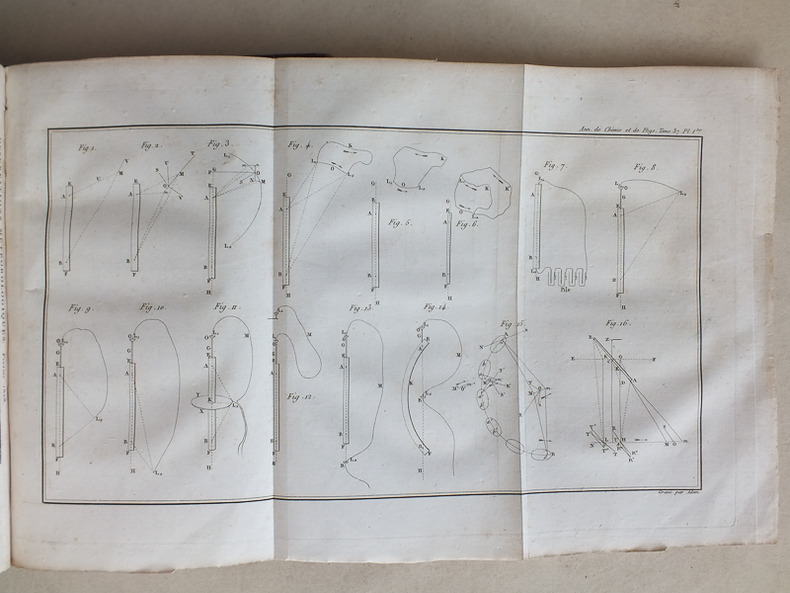
1824346371 vol. in-8 cartonnage marbré de l'époque, Chez Crochard, Paris, 1824, 448 pp. avec 5 planches dépliantes hors texte, Contient notamment : Des actions électro-motrices produites par le contact des métaux et des liquides, et d'un Procédé pour reconnaître, à l'aide des effets électro-magnétiques, les changemens qu'éprouvent certaines dissolutions au contact de l'air (Becquerel) ; Extrait d'un Mémoire sur la Théorie du Magnétisme (Poisson) ; Mémoire sur les Vibrations des Corps Solides, considérées en général (Félix Savart) ; Observations relatives à la température de l'Océan, à des grandes profondeurs ; Analyse des Cendres du Vésuve, tombées le 22 octobre 1822 (Vauquelin) ; Description minéralogique des aérolithes qui tombèrent près de Wiborg, en Finlande, le 13 décembre 1822 ; etc...
4257P., Levrault, 1824, (2), 51pp., 2 planches dépliantes, un volume in 8, cartonnage de l'époque
ria9780323775724_inpHardback. New. New Book; Fast Shipping from UK; Not signed; Not First Edition; N/A hardcover
181046377Paris, J. Klostermann, 1810. Contemp. hcalf. Spine gilt. Slightly rubbed. A few scratches to binding. Small stamps on verso of titlepage.In: ""Annales de Chimie, ou Recueil de Mémoires concernant la Chemie"" Tome 75. 336 pp. a. 2 folded engraved plates. Some scattered brownspots. The papers: pp. 27-77, 129-175, 256-263, 264-273, 274-289 a. 290-316.
181043627Halle, Rengerschen Buchhandlung, 1810. Without wrappers as published in ""Annalen der Physik. Herausgegeben von Ludwig Wilhelm Gilbert"", Bd. 36, Neuntes Stück. The entire issue offered (=Heft 9). Titlepage to vol. 36. Pp. 1-112. a. 2 engraved plates. Gay-Lussac's papers: pp. 6-36 a. pp. 37-51.
181046377Paris J. Klostermann 1810. Contemp. hcalf. Spine gilt. Slightly rubbed. A few scratches to binding. Small stamps on verso of titlepage.In: "Annales de Chimie ou Recueil de Mémoires concernant la Chemie" Tome 75. 336 pp. a. 2 folded engraved plates. Some scattered brownspots. The papers: pp. 27-77 129-175 256-263 264-273 274-289 a. 290-316. <br/><br/><em>First French version of Davy's "The Bakerian Lecture for 1809. On some new Electrochemical Researches on various Objects particularly the metallic Bodies from the Alkalies and Earth and on some Combinations of Hydrogene. Read November 16 1809." together with the controversy papers by Davy and Gay-Lussac & Thenard."Mr. Davy having from the commencement of his electro-chemical researches communicated the several steps of his progress to the Society The Royal Society takes the present opportunity of reporting the results of his further inquiries under four principal heads. First on the nature of the metals of the fixed alkalis. Second on the nature of Hydrogen and composition of ammonia. Thirdly on the metals of the earth; and Fourthly he makes a comparison between the antiphlogistic doctrine and a modified phlogistic hypothesis."Abstract. He further gives arguments for considering potassium and sodium which he discovered in 1808 as a element.""Gay-Lussac had a slight rivalry between himself and the creation scientist Sir Humphry Davy. Davy was chemically preparing Potassium and Sodium through an electrical current and this made Gay-Lussac and Thénard envious of his success. They too decided to perform the same task but they had no battery at their disposal as Davy had so they had to form another way to chemically prepare the two elements. In 1808 they used a red-hot iron fused to potash the water-soluble form of a manufactured salt containing potassium to perform this task a method that Davy admitted had its advantageous qualities. Gay-Lussac and Thénard were successful in preparing Potassium and continued to make a full analysis of its chemical properties and began to use it for their own experiments. In 1809 Davy performed the same task using it to reduce Boron in Boracic acid." </em> unknown
181043627Halle Rengerschen Buchhandlung 1810. Without wrappers as published in "Annalen der Physik. Herausgegeben von Ludwig Wilhelm Gilbert" Bd. 36 Neuntes Stück. The entire issue offered =Heft 9. Titlepage to vol. 36. Pp. 1-112. a. 2 engraved plates. Gay-Lussac's papers: pp. 6-36 a. pp. 37-51. <br/><br/><em>First German edition of this classic paper in chemistry in which he states the law that when two gases combine chemically they do so that the volumes are in the ratio of whole small numbers."In 1805 with Alexander von Humboldt he observed the already known fact that hydrogen and oxygen combines in the ratio of 2 to 1 by volume. Stimulated by this work he studied the reactions of other gases to see whether there were other simple relationshipas and in 1808 he announced the la of combining volumes which is now known as GAY-LUSSAC'S LAW This generalization obviously connected with some fundamental property of matter was in part responsible for Avogadro's hypothesis."Leicester & Klickstein.Parkinson "Breakthroughs" 1809 C. - Leicester & Klickstein "A Source Book in Chemistry" pp. 292 ff. </em> unknown
1832S14238Paris :: de l'impr. Royale 1832. 1832. 4to. 88 pp. 6 engraved folding plates of apparatus by Le Blanc; heavily foxed. Contemporary marbled boards with manuscript spine label; extremities somewhat shelf worn. Very good. 170 First edition of this work on the testing of silver materials using a wet method published by the Commission on Coins and Medals. / "Gay-Lussac made a major contribution to chemical analysis in 1832 when he introduced a volumetric method of estimating silver which he justly claimed was much more accurate than the centuries-old method of cupellation. He proposed two parallel procedures for this method one gravimetric which he said was the more accurate and one volumetric which had the advantage of simplicity. The principle of both methods was the precipitation of silver chloride. He prepared a standard solution of sodium chloride of such concentration that 100 milliliters precipitated rather less than one gram of silver. Another standard solution of sodium chloride one-tenth of the concentration of the first was also prepared. One gram of silver was accurately weighed and then dissolved in nitric acid; 100 milliliters of the concentrated sodium chloride solution was added and the precipitate of silver chloride was allowed to settle. The procedure was continued until further addition caused no precipitation. This final excess of sodium chloride was found exactly by back-titrating with standard silver nitrate solution. It was characteristic of Gay-Lussac's standard solutions that they could be used only for specific analysis and for given weights of a sample since the concentration of his solutions had no chemical basis related to equivalent weights. While therefore Gay-Lussac must be given credit for showing volumetric analysis to be convenient rapid and accurate the establishment of a general system of volumetric analysis had to wait until the achievements of Fredrik Mohr in the next generation of chemists." – DSB. REFERENCES: Bolton 1893 471; Cole 509; DSB V pp. 317-27; Edelstein 960; Ferchl 174; Neville I p. 504; Partington IV p. 85; Poggendorff I pp. 860-864 putting the imprint date for this item as 1833. See: Maurice Crosland Gay-Lussac: Scientist and bourgeois Cambridge University Press 1978 pp. 188-190 219-222. de l'impr. Royale, 1832. hardcover
1819346221 vol. in-8 cartonnage marbré de l'époque, Chez Crochard, Paris, 1819, 448 pp. avec deux planches dépliantes. Contient notamment : Sur les Chronomètres de MM. Bréguet ; Mémoire sur la théorie des instruments à vent (Poisson) ; Extrait d'un Mémoire sur la théorie analytique des assurances (Fourier) ; Mémoire sur l'action que les rayons de lumière polarisés exercent les uns sur les autres (Arago et Fresnel) ; Recherches sur quelques points importans de la théorie de la chaleur [Loi de Dulong et Petit ] (Petit et Dulong) ; Sur les aérolithes de la Chine (Abel-Rémusat), etc...
182419941Annales de Chimie et de Physique. Tome Vingt-Cinquième, avec 5 pl. dépliante, contient notamment : Exposé méthodique des Phénomènes Electro-dynamiques, et des lois de ces phénomènes (Ampère) - Des actions électro-motrices produites par le contact des métaux et des liquides, et d'un Procédé pour reconnaître, à l'aide des effets électro-magnétiques, les changemens qu'éprouvent certaines dissolutions au contact de l'air (Becquerel) 1 vol. in-8 relié , rel. d'époque demi-basane marron, Chez Crochard, Paris, 1824, 448 pp., De l'Imprimerie de Plassan, 15 rue de Vaugirard, s.d., 22 pp. (Exposé méthodique des phénomènes électro-dynamiques, et des lois de ces phénomènes), 2 ff. blancs
1828346491 vol. in-8 cartonnage marbré de l'époque, Chez Crochard, Paris, 1828, 448-viij pp. avec 2 planches dépliantes. Contient notamment : Sur les Propriétés électriques de la Tourmaline (Becquerel) ; Mémoire sur les Ethers composés (Dumas et Boullay) ; Sur l'Aluminium (Wöhler) ; Note sur l'Action mutuelle d'un Aimant et d'un Conducteur voltaïque (Ampère) ; Recherches expérimentales sur la Faculté conductrice des corps minces soumis à l'action de la chaleur ; et Description d'un nouveau Thermomètre de contact (Fourier) ; Mémoire sur l'Equilibre et le Mouvement des Corps élastiques (Poisson) ; Nouvelles Recherches sur l'Endosmose et l'Exosmose (Dutrochet) ; Analyse des Circonstances qui déterminent le sens et l'intensité du courant électrique dans un élément voltaïque (Auguste de La Rive) ; etc...
1814753Paris: Chez Crochard 1814. 1st Edition. FIRST EDITION FIRST PRINTING OF GAY-LUSSAC'S CLASSIC PAPER ON IODINE. Two volumes bound as one. The Dictionary of Scientific Biography notes this as one of Gay-Lussac's most important papers DSB Noted in DSB 5 327. In the late nineteenth century the chemist Wilhelm Ostwald winner of the 1909 Nobel Prize selected Gay-Lussac's paper as "one of the first and one of the best monographs of all time on a single element and its most important compounds and as such it has served as a model for many later pieces of research" Crosland Gay-Lussac: Scientist and Bourgeois 85. <br /> <br /> Louis Joseph Gay-Lussac 1778-1850 was a French chemist and physicist with a well-known rivalry with Humphry Davy. While J. C. Courtois discovered iodine in 1811— and while he recognized iodine to be a distinctive substance from its purple vapor — he confused its compound with hydrogen as that of hydrogen chloride. Gay-Lussac and Davy were asked to further explore the issue however they carried out their research virtually simultaneously making it somewhat difficult to assign priority. Davy's claim for the originality of his study of iodine depends upon his argument of knowledge prior to that of Gay-Lussac. While the publication history is confusing history credits Gay-Lussac DSB Vol. 5 p. 322. <br /> <br /> "In 1814 Davy did some further research on iodine but. in prolonged and detailed research he was outshone by Gay-Lussac who presented a full study of the new element in a major memoir read to the Institute on 1 August 1814" Crosland. Davy's work had been somewhat hurried and incomplete while Gay-Lussac's was anything but. When published this paper at 155 pages filled an entire issue of the Annales de chime" Crosland. <br /> <br /> Gay-Lussac's work in this paper was exceptionally detailed and he "deserves full credit for his detailed study of hydrogen iodine which he found to have a 50 percent hydrogen content by volume. He contrasted its thermal decomposition with the stability of hydrogen chloride. By the action of chlorine on iodine he prepared. iodine monochloride and trichlorise. After further careful study of the properties of iodine he prepared and examined a number of iodides and iodates. He prepared for the first time ethyl iodide by distilling together concentrated hydriodic acid with absolute alcohol" DSB Vol. 5 p. 322. <br /> <br /> In this paper his most important on the subject Gay-Lussac settled Courtois's confusion proving that the new substance was an element analogous of chlorine and it was Gay-Lussac who gave iodine the name iode from the Greek ioeides "violet colored". In a curious side-note some even saw Gay-Lussac's paper as wondrous including the "normally restrained German edition L. W. Gilbert who suggested that the memoir transports the reader into a sort of fairyland. In order to understand Gilbert's remarks the 20th century reader would have to forget his modern sophistication and try to recapture the childlike wonder which might be engendered on first seeing the black crystals of iodine transformed by heat into a beautiful violet vapor with no equal among contemporary dyestuffs" ibid. <br /> <br /> ALSO INCLUDED is the first publication of a paper read to the Institute of France in 1804 by the French chemist Armand Séguin. In it Séguin details his study of opium of the greatest import being his "technique for obtaining another substance from opium" Robinette 378. Séguin "did not know it but he was on the trail of one of the most far-reaching medical discoveries of all time" — morphine Booth Opium 68. Séguin's discovery was not published for a decade until the paper offered here by which time the chemist was in disgrace for embezzling drug supplies from the French army and his work was dismissed. In his speech and paper Séguin "reported finding ‘a very peculiar vegetable-animal material'" Robinette. Though the timing in muddled as by the time of publication other researchers had made similar discoveries writing in 1832 Pelletier argued strongly for Séguin's preeminence; that Séguin's "vegetable-animal material" was in fact the discovery of morphine: ‘M. Séguin signaled the existence of the most energetic principle of opium described the means of obtaining it and indicated its essential and distinctive characteristics so that he only lacked the naming of it ‘morphine' in order to be in possession of the honor of its discovery'" ibid. CONDITION & DETAILS: Paris: Chez Crochard. Volumes 91 and 92 bound as one. Ex-libris with NO spine markings and minimal interior markings small stamp on title page occassional text page blank front flyleaf. 8vo. 8.25 x 5.5 inches 206 x 137mm. 1 plate. Tightly and very solidly bound in maroon cloth with a gilt-lettered spine; minor scuffing to the edge tips. Moderate foxing throughout largely minor. title page is not detached but is loosening. Withal very good condition. Chez Crochard hardcover
1823346351 vol. in-8 cartonnage marbré de l'époque, Chez Crochard, Paris, 1823, 448 pp., avec 5 planches hors texte dont 4 dépliantes. Contient notamment : Sur la Vitesse du Son (Poisson) ; Sur les Causes des différences que l'on observe dans les savons, sous le rapport de leur degré de dureté ou de mollesse et sous celui de leur odeur ; et sur un nouveau groupe d'acides organiques (Chevreul) ; Lettre de M. Léopold de Buch à M. A. de Humboldt renfermant le Tableau géologique de la partie méridionale du Tyrol ; Sur le Titane (H. Rose) ; Réponse de M. Fresnel à la lettre de M. Poisson ; Note sur le phénomène des Anneaux colorés (Fresnel ) ; Examen du Sang et de son action dans les divers phénomènes de la vie (Prévost et Dumas) ; Du Développement de l'électricité par le contact de deux portions d'un même métal, dans un état suffisamment inégal de température ; des piles voltaïques construites avec des fils d'un même métal et même avec un seul fil, et de quelques Effets électriques qui naissent dans les combinaisons chimiques (Becquerel) ; Nouveaux résultats électro-chimiques (Becquerel) ; Sur le Gisement du granite dans la vallée de Fiemme (Alex. de Humboldt et Léopold de Buch) ; etc...
180344130Halle, Rengerschen Buchhandlung, 1803. Without wrappers as extracted from ""Annalen der Physik. Herausgegeben von Ludwig Wilhelm Gilbert"", Bd. 12. Pp. 257-291 a. 1 folded engraved plate showing the experimental apparatus used.
180344130Halle Rengerschen Buchhandlung 1803. Without wrappers as extracted from "Annalen der Physik. Herausgegeben von Ludwig Wilhelm Gilbert" Bd. 12. Pp. 257-291 a. 1 folded engraved plate showing the experimental apparatus used. <br/><br/><em>First appearance in German of this extremely important paper in which Gay-Lussac first formulated the law the Gay-Lussac's Law stating that if the mass and pressure of a gas are held constant then gas volume increases linearly as the temperature rises. This is sometimes written as V = k T where k is a constant dependent on the type mass and pressure of the gas and T is temperature on an absolute scale. In terms of the ideal gas law k = n R / P."In 1802 he Gay-Lussac showed that different gases all expanded by equal amounts with rise in temperature. Charles had made the same discovery some years earlier but had not published it; the credit therefore belongs to Gay-Lussac at least as much and probably more. This was an extremely importent discovery which Avogadro was to use within the decade to formulate hid long-neglected hypothesis that equal volumes of different gases at equal temperatures contained equal numbers of particles."Asimov.Magie "A Source Book in Physics" p.165-172 - Leicester & Klickstein "A Source Book of Chemistry" p. 374-379. - Parkinson "Breakthroughs" 1802 C. </em> unknown
1821346291 vol. in-8 cartonnage marbré de l'époque, Chez Crochard, Paris, 1821, 448 pp. avec un tableau dépliant et une planche dépliante. Contient notamment : Rapport fait à l'Académie des Sciences par M. Arago, le lundi 4 juin 1821, sur un Mémoire de M. Fresnel relatif aux couleurs des lames cristallisées douées de la double réfraction - Notes sur le calcul des teintes que la polarisation développe dans les lames cristallines (Fresnel) ; IIe Note (Fresnel) ; Remarques de M. Biot sur un Rapport lu, le 4 juin 1821, à l'Académie des Sciences, par Mm. Arago et Ampère ; Examen des remarques de M. Biot (Ampère) ; Sur la manière d'analyser les mines de nickel, et sur une nouvelle combinaison du nickel avec l'arsenic et le soufre (Berzelius) ; Note sur le sulfate de Quinine (Robiquet) ; Analyse comparée des excrémens d'un rossignol du coeur d'un boeuf dont il a été nourri (Braconnot) ; Sur la pierre météorique qui est tombée dans le département de l'Ardèche, le 15 juin 1821 ; etc...
1817733K4Paris: Chez Crochard Libraire 1817. Leather. Good. 8" by 5". None. An uncommon volume of this French scientific journal illustrated with a demonstrative folding plate and containing a scarce work by French mathematician Joseph Fourier. Uncommon. Volume six of series two Series two was published between 1816 and 1840 and was made up of seventy five issues. With two plates to the rear of the work one of which is folding. Lacking the publisher's advertisements as usual. Annales de Chimie et de Physique was a scientific journal first published in France in 1789. The work was published for over one hundred years and was a pioneering work containing articles from some of the most influential scientists of the period. This particular edition is of note as it contains the work Questions sur la Théorie-Physique de la Chaleur rayonnante by French mathematician Joseph Fourier. In a half calf binding with marbled boards. Externally smart with bumping to the extremities. Rubbing to the boards and extremities. Joints are cracked but firm. Bookplate to front pastedown. Internally firmly bound. Pages are generally bright and clean with marginal age toning and scattered spots slightly heavier to the first and last few pages. Good Chez Crochard Libraire hardcover
7493P., Imprimerie royale, Mars 1824. In 4° demi-chagrin dos à nerfs orné, 31 pp. avec deux planches.
a88726Paris 1830 Crochard. In French. Hardcover. Small Octavo 448p. 3 foldout plates of scientific equipment original pale blue plain paper binder wraps. Articles include: Berzelius "Recherches sur un Nouveau Mineral" Becquerel "Memoire sur de Nouveaux Effets Elector-Chimiques Propres a Produire des Combinaisons" Becquerel "Sur un Procede Electro Chimique pour Retirer le Manganese" several articles by J. Liebig etc. Good light wear light foxing. . hardcover