Gay-Lussac, Joseph-LouisBiblio.com
296 résultats
1020425598.Ghardcover. Good. Access codes and supplements are not guaranteed with used items. May be an ex-library book. hardcover
1278757929.Gpaperback. Good. Access codes and supplements are not guaranteed with used items. May be an ex-library book. paperback
1278304940.Gpaperback. Good. Access codes and supplements are not guaranteed with used items. May be an ex-library book. paperback
2011336090.Gpaperback. Good. Access codes and supplements are not guaranteed with used items. May be an ex-library book. paperback
2011336104.Gpaperback. Good. Access codes and supplements are not guaranteed with used items. May be an ex-library book. paperback
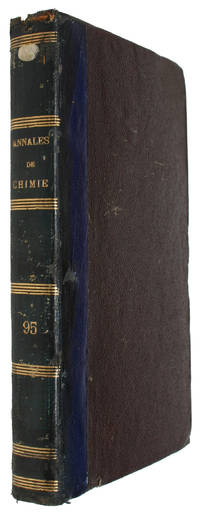
181543079Paris Chez Crochard 1815 Contemp. hcalf. Spine gilt. Top of spine with wear. A few scratches to binding. In: "Annales de Chimie ou Recueil de Mémoires concernant la Chemie" Tome 95. - 336 pp. the entire volume offered. Gay-Lussac's paper: pp. 136-231. Some scattered brownspots throughout. <br/><br/><em>First appearance of this milestone paper in organic chemistry in which Gay-Lussac describes the preparation the chemical reactions and the determination of the physical properties of prussic acid."One of the most importent contributions of Gay-Lussac was his work on hydro-cyanid acid and its compounds. In the course of his investigations on the combining volumes of gases he had prepared gaseous hydrogen cyanide. This led him to the study of related compounds and in 1815 he published a paper "Recherches sur l'acide prussique" the paper offered wherein he announced the discovery of cyanogen and chlor-cyanogen and the composition of hydrocyanic acid. His demonstartion that hydrogen cyanide contains no oxygen added another oxygen-free acid to those already known hydrogen halides and sulfide and contributed to the overthrow of Lavoisier's oxygen theory of acids. Gay-Lussac found that the cyano radicalthe first orgianic radical clearly recognized could act as an element analogous to chlorine passing unchanged through various reactions. This concept of an organic radical was importent to organic chemistry."Leicester & Klickstein "A Source Book of Chemistry" p. 293. - Partington IV p.85 a. p. 253. - Roy G. Neville p. 505. - Parkinson "Breakthroughs" 1815 C. </em> unknown
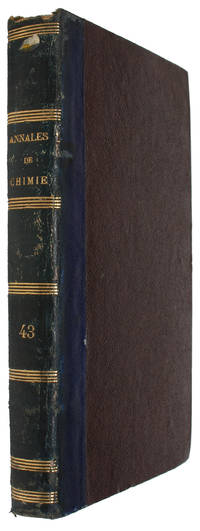
180243078Paris Chez Fuchs An X 1802. Contemp. hcalf. Spine gilt. Top of spine with wear. A few scratches to binding. In: "Annales de Chimie ou Recueil de Mémoires concernant la Chemie" Tome 43. 3324 pp. 2 engraved plates the entire volume offered. Gay-Lussac's paper: pp. 137-175. The first 20 leaves a bit brownspotted otherwise with a few marginal brownspots. 1 leaf pp. 197-98 torn with loss of some letters. Gay-Lussac's paper fine and clean. <br/><br/><em>First printing of this extremely important discovery in which Gay-Lussac first formulated the law Gay-Lussac's Law stating that if the mass and pressure of a gas are held constant then gas volume increases linearly as the temperature rises. This is sometimes written as V = k T where k is a constant dependent on the type mass and pressure of the gas and T is temperature on an absolute scale. In terms of the ideal gas law k = n R / P."In 1802 he Gay-Lussac showed that different gases all expanded by equal amounts with rise in temperature. Charles had made the same discovery some years earlier but had not published it; the credit therefore belongs to Gay-Lussac at least as much and probably more. This was an extremely importent discovery which Avogadro was to use within the decade to formulate hid long-neglected hypothesis that equal volumes of different gases at equal temperatures contained equal numbers of particles."Asimov.Magie "A Source Book in Physics" p.165-172 - Leicester & Klickstein "A Source Book of Chemistry" p. 374-379. - Parkinson "Breakthroughs" 1802 C.The volume contains other importent papers in chemistry by Humphrey Davy first French translation of his announcement of the finding of "Laughing Gas" Nitrous Oxide Parmentier Vauquelin Clement et Desormes Thenard Guyton Chenivix </em> unknown
180543298Paris Chez Bernard An XIII 1805. Contemp. hcalf. gilt spine. Top of spine with wear. In: "Annales de Chimie" Vol. 52. 358 pp. The entire volume offered. Gay-Lussac's paper: pp. 75-94 a. large foldet "Tableau des Observations". Internally clean printed on good paper. <br/><br/><em>First printing of the scientific account of Gay-Lussac's famous ascent in a hydrogen ballon in order to make observations on the composition of the air pressure and the earth's magnetic force. This voyage together with the voyage in the same year with Biot is the first ascents with a scientific purpose."Gay-Lussac made an ascent in a hydrogen ballon with Biot on 24 August 1804. The primary object of the ascent was to see whether the magnetic intensity at theearth's surface decreased with an increase in altitude. The concluded that it was constant up to 4000 meters. They also carried long wires to test the electricity of different parts of the atmosphere. Another object was to collect a sample of air from a high altitude to compare its composition with that of air at ground level. Gay-Lussac made a second ascent on 16. September 1804 the paper offered but this time by himself in order to lessen the weight of the balloon and thus reach a greater high.He was able to repeat observations of pressure temperature and humidity and also make magnetic measurements. He had taken two evacuated flasks which he opened to collect samples of air when he had attained an altitude of over 6000 meters. His subsequent analysiss of these samples showed that the portion of oxygen was identical with that in ordinary air. Gay-Lussac reached a calculated high of 7o16 meters above sea level a record not equaled for another half a century."DSB V p. 318.Brockett: 5164 a - Tissandier p. 23.The volume contains other importent papers Thenard "Mémoire sur la liqueur fumante e Cadet" Parmentier "Experiences et Observations sur la collage et la clarification des vins de la biere etc." Vauquelin "Analyse des topazes" Chenevix and others. </em> unknown
180843299Paris Chez Mad. Ve. Bernard 1808 Contemp. hcalf. gilt spine. Some scratches to binding. Verso of titlepage and plates with small stamps.In: "Annales de Chimie" Vol. 68. - 358 pp. a. 3 engraved plates. The entire volume offered. Gay-Lussac's a. Thenard's paper: pp. 169-174. <br/><br/><em>First announcement of the results that they had obtaines by treating boric acid with potassium showing that acid is composed of a combustible substance and oxygen. "Before regarding their proof of the existance of a new element as complete Gay-Lussac and Thenard wished not only to decomposed boric acid but to recompose it. On November 30 of the same year they were able to state in the 'Annales de Chemie et de Physique" the paper offered that "the composition of boracid s no longer problematical. In fact said they "we decompose and we recompose this acid at will" Weeks "Discovery of the Elements" p. 160. - Parkinson "Breakthroughs" 1808 C. - Bunch 1808.The volume contains other importent paper Davy's famous paper on electrolysis in first French translations Gayton-Morveau"Description d'un hygrometre pour le gaz." d¨'Arcet "Observations sur la potasse et sur la soude préparées à l'alcool" etc. </em> unknown
1437176240.Ghardcover. Good. Access codes and supplements are not guaranteed with used items. May be an ex-library book. hardcover
181043627Halle Rengerschen Buchhandlung 1810. Without wrappers as published in "Annalen der Physik. Herausgegeben von Ludwig Wilhelm Gilbert" Bd. 36 Neuntes Stück. The entire issue offered =Heft 9. Titlepage to vol. 36. Pp. 1-112. a. 2 engraved plates. Gay-Lussac's papers: pp. 6-36 a. pp. 37-51. <br/><br/><em>First German edition of this classic paper in chemistry in which he states the law that when two gases combine chemically they do so that the volumes are in the ratio of whole small numbers."In 1805 with Alexander von Humboldt he observed the already known fact that hydrogen and oxygen combines in the ratio of 2 to 1 by volume. Stimulated by this work he studied the reactions of other gases to see whether there were other simple relationshipas and in 1808 he announced the la of combining volumes which is now known as GAY-LUSSAC'S LAW This generalization obviously connected with some fundamental property of matter was in part responsible for Avogadro's hypothesis."Leicester & Klickstein.Parkinson "Breakthroughs" 1809 C. - Leicester & Klickstein "A Source Book in Chemistry" pp. 292 ff. </em> unknown
181849063Leipzig Barth 1818. No wrappers. In: "Annalen der Physik. Neue Folge. Herausgegeben von L.W. Gilbert" Bd. 28 Erstes Stück. Pp. 1-120 a. 1 engraved plate. Entire issue offered. Gay-Lussac's paper: pp. 29-53. <br/><br/><em>First German edition of Gay-Lussac's "Sur les combinaisons de l’azote avec l’oxigène" in which he identified 5 oxides of nitrogen."In 1809 Gay-Lussac carried out a study of the combining volumes of nitric oxide and oxygen. This was a more complex problem than he then realized but he returned to it in 1816 after criticism of his earlier work by Dalton; this time his results were of permanent value. He recognized five oxides of nitrogen." </em> unknown
180344130Halle Rengerschen Buchhandlung 1803. Without wrappers as extracted from "Annalen der Physik. Herausgegeben von Ludwig Wilhelm Gilbert" Bd. 12. Pp. 257-291 a. 1 folded engraved plate showing the experimental apparatus used. <br/><br/><em>First appearance in German of this extremely important paper in which Gay-Lussac first formulated the law the Gay-Lussac's Law stating that if the mass and pressure of a gas are held constant then gas volume increases linearly as the temperature rises. This is sometimes written as V = k T where k is a constant dependent on the type mass and pressure of the gas and T is temperature on an absolute scale. In terms of the ideal gas law k = n R / P."In 1802 he Gay-Lussac showed that different gases all expanded by equal amounts with rise in temperature. Charles had made the same discovery some years earlier but had not published it; the credit therefore belongs to Gay-Lussac at least as much and probably more. This was an extremely importent discovery which Avogadro was to use within the decade to formulate hid long-neglected hypothesis that equal volumes of different gases at equal temperatures contained equal numbers of particles."Asimov.Magie "A Source Book in Physics" p.165-172 - Leicester & Klickstein "A Source Book of Chemistry" p. 374-379. - Parkinson "Breakthroughs" 1802 C. </em> unknown
181046377Paris J. Klostermann 1810. Contemp. hcalf. Spine gilt. Slightly rubbed. A few scratches to binding. Small stamps on verso of titlepage.In: "Annales de Chimie ou Recueil de Mémoires concernant la Chemie" Tome 75. 336 pp. a. 2 folded engraved plates. Some scattered brownspots. The papers: pp. 27-77 129-175 256-263 264-273 274-289 a. 290-316. <br/><br/><em>First French version of Davy's "The Bakerian Lecture for 1809. On some new Electrochemical Researches on various Objects particularly the metallic Bodies from the Alkalies and Earth and on some Combinations of Hydrogene. Read November 16 1809." together with the controversy papers by Davy and Gay-Lussac & Thenard."Mr. Davy having from the commencement of his electro-chemical researches communicated the several steps of his progress to the Society The Royal Society takes the present opportunity of reporting the results of his further inquiries under four principal heads. First on the nature of the metals of the fixed alkalis. Second on the nature of Hydrogen and composition of ammonia. Thirdly on the metals of the earth; and Fourthly he makes a comparison between the antiphlogistic doctrine and a modified phlogistic hypothesis."Abstract. He further gives arguments for considering potassium and sodium which he discovered in 1808 as a element.""Gay-Lussac had a slight rivalry between himself and the creation scientist Sir Humphry Davy. Davy was chemically preparing Potassium and Sodium through an electrical current and this made Gay-Lussac and Thénard envious of his success. They too decided to perform the same task but they had no battery at their disposal as Davy had so they had to form another way to chemically prepare the two elements. In 1808 they used a red-hot iron fused to potash the water-soluble form of a manufactured salt containing potassium to perform this task a method that Davy admitted had its advantageous qualities. Gay-Lussac and Thénard were successful in preparing Potassium and continued to make a full analysis of its chemical properties and began to use it for their own experiments. In 1809 Davy performed the same task using it to reduce Boron in Boracic acid." </em> unknown
37349Maurice Devries - édition originale s.d In-4 n.p. illustr. nombreux documents et lettres en fac-simile contrecollés ou joints sous pochettes intégrées couverture a rabats de l'éditeur exemplaire numéroté A64 nous joignons a l'ouvrage la lettre requette de Louis Pasteur de 1867 a Napoléon III une exortation a fonder un laboratoire afin de poursuivre ses travaux lettre double-page en fac-simile sous chemise imprimée unknown
197083752Paris: Gallimard 1970. Fine. Gallimard Paris 1970 12.50 x 20 cm broché First edition one of 25 numbered copies on pure laid paper the only deluxe copies. Two bookplates pasted on an endpaper. Handsome copy. Gallimard unknown
198784119Paris: Gallimard 1987. Fine. Gallimard Paris 1987 11.50 x 21 cm broché First edition one of 20 numbered copies on pure rag vellum from Rives the only deluxe copies. Two bookplates pasted on an endpaper. Handsome copy. Gallimard hardcover
180544123Halle Rengerschen Buchhandlung 1805. Without wrappers. In "Annalen der Physik. Herausgegeben von Ludwig Wilhelm Gilbert" Bd. 20 Fünftes Stück. The entire issue offered. Titlepage to vol. 20. Pp. 1-128. Biot's paper: pp. 1-18. - Gay-Lussac: pp. 19-37 - Humboldt & Gay-Lussac: pp. 38-92. - Sacharow: pp. 107-124. <br/><br/><em>These 4 accounts of the earliest scientific ascents with balloons had the same purposes namely to make observations on the composition of the air pressure and the earth's magnetic force. Brockett "Bibliography of Aeronautics" Nos 1856 a 6303 a a. 10654 a. </em> unknown
1017314292.Ghardcover. Good. Access codes and supplements are not guaranteed with used items. May be an ex-library book. hardcover
182022536Paris: Chez Crochard 1820. First Edition. Boards. Very Good. First Edition. 448 pages plus 5 plates 1 folding. 8vo. Contemporary quarter calf over marbled boards with black spine labels. Early label Coquard a Epinal on front pastedown. The entire volume of "Annales de Chimie et de Physique" Vol. Quinzieme XV 15 offered. Surface wear/damage to the leather finish resulting in minor loss to gilding and top label and minor fraying to the head/tail spine panel. Small spot of worming inside lower rear board at the gutter. Text generally bright and clean. <br /> <br /> This volume contains the original journal appearance of the separately issued "Memoires sur l'Action Mutuelle de Deux Courans Electriques" in three sections over two articles pp. 59-76 & 170-218. Section 1: "De l'Action mutuelle de deux courans electriques" pages 59-76 continued as "Suite Du Memoire sur l'Action mutuelle entre deux courans electriques entre un courant electrque et un aimant ou le globe terrestre et entre deux aimans" on pages 170-188. Section 2: "Direction des courans electriques par l'action du globe terrestre" on pages 188-196. Section 3: "De l'Action mutuelle entre un conducteur electrique et un aimant" pages 196-218. Plus plate number 4 in the rear which illustrates the articles. Boards. Ampere is today celebrated for his fundamental work in the new field of electrodynamics. The three part paper offered here established “the relationship between electric current-flow and magnetism and established the new science of electrodynamics.†Norman <br /> <br /> “In a four page circular dated Copenhagen July 21st 1820 H.C. Orsted communicated his great discovery that a closed voltaic circuit exerts forces on an adjacent magnetic needle. In more modern language: a current-carrying electric circuit gives rise to magnetic forces in its surroundings. Orsted had found the long sought affinity between electricity and magnetism. The letter reached Arago … who at the next meeting of Academie des Sciences on Sept. 11th 1820 with Ampere in attendance presented the letter and Orsted's experiment. It was indeed a memorable meeting. Already at the next weekly meeting on Sept. 18th Ampere delivered an explanation of Orsted's experiment and supported it with new experiments of his own. At every weekly meeting in the following months Ampere produced new results.†Ekelof<br /> <br /> 'In this first paper Sept. 18 he explains the law determining the position of the magnetic needle in relation to the electric current and he also makes known his intended experiments with spiral of helical wires which he predicts will acquire and retain the properties of magnets so long as the electrical current flows through them He constructed his spirals and helices and to the astonishment of all he produced magnets formed only of spools of copper wire traversed by electric currents.' Mottelay<br /> <br /> The Honeyman sale #82 notes that the paper offered here is "The first appearance of the first of a series of important papers reporting Ampere's discoveries on the electric current." Honeyman also had #83 the first separate appearance of these journal articles published as "Memoires sur l'Action mutuelle de deux courans electriques." which we believe had additional information not present in this journal appearance and hence is not a traditional "offprint" but a later state of the work. Norman notes that Ampere developed the science of electrodynamics over the next seven years publishing in a "bewildering array of journal articles offprints and revisions of earlier works.further noting some 'reprints' of Ampere's articles appear in as many as five different versions."<br /> <br /> This is an opportunity to own the original first printed appearance of Ampere's fundamentally important work in Electrodynamics. It would be an interesting collection to build the variations of Ampere's work over those seven years to see how his thought evolved. As far as we are aware there is no standard bibliographic reference for Ampere's work.<br /> <br /> LITERATURE<br /> Dibner Heralds of Science 62 first separate edition<br /> Honeyman Sale 82 original journal appearance<br /> Mottelay Bibliographical History of Electricity and Magnetism p. 472<br /> Norman 43 first separate edition. <br /> Ekelof Catalogue of Books and Papers in Electricity and Magnetism pp 284-286<br /> Sparrow Milestones of Science p33 first separate edition. Chez Crochard unknown
1820ZB1182545Paris: Crochard 1820. 448 pp. 3 folding plates; original printed paper wrappers covers chipped spine and margins darkened old paper label to the base of the spine library markings to the verso & recto of the half-title page else internally clean and tight. - If you are reading this this item is actually physically in our stock and ready for shipment once ordered. We are not bookjackers. Buyer is responsible for any additional duties taxes or fees required by recipient's country. Photos available upon request. Paris: Crochard unknown