296 résultats
180344130Halle Rengerschen Buchhandlung 1803. Without wrappers as extracted from "Annalen der Physik. Herausgegeben von Ludwig Wilhelm Gilbert" Bd. 12. Pp. 257-291 a. 1 folded engraved plate showing the experimental apparatus used. <br/><br/><em>First appearance in German of this extremely important paper in which Gay-Lussac first formulated the law the Gay-Lussac's Law stating that if the mass and pressure of a gas are held constant then gas volume increases linearly as the temperature rises. This is sometimes written as V = k T where k is a constant dependent on the type mass and pressure of the gas and T is temperature on an absolute scale. In terms of the ideal gas law k = n R / P."In 1802 he Gay-Lussac showed that different gases all expanded by equal amounts with rise in temperature. Charles had made the same discovery some years earlier but had not published it; the credit therefore belongs to Gay-Lussac at least as much and probably more. This was an extremely importent discovery which Avogadro was to use within the decade to formulate hid long-neglected hypothesis that equal volumes of different gases at equal temperatures contained equal numbers of particles."Asimov.Magie "A Source Book in Physics" p.165-172 - Leicester & Klickstein "A Source Book of Chemistry" p. 374-379. - Parkinson "Breakthroughs" 1802 C. </em> unknown
0428263208.Ghardcover. Good. Access codes and supplements are not guaranteed with used items. May be an ex-library book. hardcover
181043627Halle Rengerschen Buchhandlung 1810. Without wrappers as published in "Annalen der Physik. Herausgegeben von Ludwig Wilhelm Gilbert" Bd. 36 Neuntes Stück. The entire issue offered =Heft 9. Titlepage to vol. 36. Pp. 1-112. a. 2 engraved plates. Gay-Lussac's papers: pp. 6-36 a. pp. 37-51. <br/><br/><em>First German edition of this classic paper in chemistry in which he states the law that when two gases combine chemically they do so that the volumes are in the ratio of whole small numbers."In 1805 with Alexander von Humboldt he observed the already known fact that hydrogen and oxygen combines in the ratio of 2 to 1 by volume. Stimulated by this work he studied the reactions of other gases to see whether there were other simple relationshipas and in 1808 he announced the la of combining volumes which is now known as GAY-LUSSAC'S LAW This generalization obviously connected with some fundamental property of matter was in part responsible for Avogadro's hypothesis."Leicester & Klickstein.Parkinson "Breakthroughs" 1809 C. - Leicester & Klickstein "A Source Book in Chemistry" pp. 292 ff. </em> unknown
181849063Leipzig Barth 1818. No wrappers. In: "Annalen der Physik. Neue Folge. Herausgegeben von L.W. Gilbert" Bd. 28 Erstes Stück. Pp. 1-120 a. 1 engraved plate. Entire issue offered. Gay-Lussac's paper: pp. 29-53. <br/><br/><em>First German edition of Gay-Lussac's "Sur les combinaisons de l’azote avec l’oxigène" in which he identified 5 oxides of nitrogen."In 1809 Gay-Lussac carried out a study of the combining volumes of nitric oxide and oxygen. This was a more complex problem than he then realized but he returned to it in 1816 after criticism of his earlier work by Dalton; this time his results were of permanent value. He recognized five oxides of nitrogen." </em> unknown
ria9780323775724_inpHardback. New. New Book; Fast Shipping from UK; Not signed; Not First Edition; N/A hardcover
1437176240.Ghardcover. Good. Access codes and supplements are not guaranteed with used items. May be an ex-library book. hardcover
1820ZB1182545Paris: Crochard 1820. 448 pp. 3 folding plates; original printed paper wrappers covers chipped spine and margins darkened old paper label to the base of the spine library markings to the verso & recto of the half-title page else internally clean and tight. - If you are reading this this item is actually physically in our stock and ready for shipment once ordered. We are not bookjackers. Buyer is responsible for any additional duties taxes or fees required by recipient's country. Photos available upon request. Paris: Crochard unknown
180843299Paris Chez Mad. Ve. Bernard 1808 Contemp. hcalf. gilt spine. Some scratches to binding. Verso of titlepage and plates with small stamps.In: "Annales de Chimie" Vol. 68. - 358 pp. a. 3 engraved plates. The entire volume offered. Gay-Lussac's a. Thenard's paper: pp. 169-174. <br/><br/><em>First announcement of the results that they had obtaines by treating boric acid with potassium showing that acid is composed of a combustible substance and oxygen. "Before regarding their proof of the existance of a new element as complete Gay-Lussac and Thenard wished not only to decomposed boric acid but to recompose it. On November 30 of the same year they were able to state in the 'Annales de Chemie et de Physique" the paper offered that "the composition of boracid s no longer problematical. In fact said they "we decompose and we recompose this acid at will" Weeks "Discovery of the Elements" p. 160. - Parkinson "Breakthroughs" 1808 C. - Bunch 1808.The volume contains other importent paper Davy's famous paper on electrolysis in first French translations Gayton-Morveau"Description d'un hygrometre pour le gaz." d¨'Arcet "Observations sur la potasse et sur la soude préparées à l'alcool" etc. </em> unknown
180543298Paris Chez Bernard An XIII 1805. Contemp. hcalf. gilt spine. Top of spine with wear. In: "Annales de Chimie" Vol. 52. 358 pp. The entire volume offered. Gay-Lussac's paper: pp. 75-94 a. large foldet "Tableau des Observations". Internally clean printed on good paper. <br/><br/><em>First printing of the scientific account of Gay-Lussac's famous ascent in a hydrogen ballon in order to make observations on the composition of the air pressure and the earth's magnetic force. This voyage together with the voyage in the same year with Biot is the first ascents with a scientific purpose."Gay-Lussac made an ascent in a hydrogen ballon with Biot on 24 August 1804. The primary object of the ascent was to see whether the magnetic intensity at theearth's surface decreased with an increase in altitude. The concluded that it was constant up to 4000 meters. They also carried long wires to test the electricity of different parts of the atmosphere. Another object was to collect a sample of air from a high altitude to compare its composition with that of air at ground level. Gay-Lussac made a second ascent on 16. September 1804 the paper offered but this time by himself in order to lessen the weight of the balloon and thus reach a greater high.He was able to repeat observations of pressure temperature and humidity and also make magnetic measurements. He had taken two evacuated flasks which he opened to collect samples of air when he had attained an altitude of over 6000 meters. His subsequent analysiss of these samples showed that the portion of oxygen was identical with that in ordinary air. Gay-Lussac reached a calculated high of 7o16 meters above sea level a record not equaled for another half a century."DSB V p. 318.Brockett: 5164 a - Tissandier p. 23.The volume contains other importent papers Thenard "Mémoire sur la liqueur fumante e Cadet" Parmentier "Experiences et Observations sur la collage et la clarification des vins de la biere etc." Vauquelin "Analyse des topazes" Chenevix and others. </em> unknown
1020425598.Ghardcover. Good. Access codes and supplements are not guaranteed with used items. May be an ex-library book. hardcover
1278757929.Gpaperback. Good. Access codes and supplements are not guaranteed with used items. May be an ex-library book. paperback
1278304940.Gpaperback. Good. Access codes and supplements are not guaranteed with used items. May be an ex-library book. paperback
2011336090.Gpaperback. Good. Access codes and supplements are not guaranteed with used items. May be an ex-library book. paperback
2011336104.Gpaperback. Good. Access codes and supplements are not guaranteed with used items. May be an ex-library book. paperback
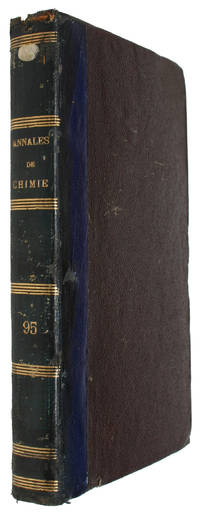
181543079Paris Chez Crochard 1815 Contemp. hcalf. Spine gilt. Top of spine with wear. A few scratches to binding. In: "Annales de Chimie ou Recueil de Mémoires concernant la Chemie" Tome 95. - 336 pp. the entire volume offered. Gay-Lussac's paper: pp. 136-231. Some scattered brownspots throughout. <br/><br/><em>First appearance of this milestone paper in organic chemistry in which Gay-Lussac describes the preparation the chemical reactions and the determination of the physical properties of prussic acid."One of the most importent contributions of Gay-Lussac was his work on hydro-cyanid acid and its compounds. In the course of his investigations on the combining volumes of gases he had prepared gaseous hydrogen cyanide. This led him to the study of related compounds and in 1815 he published a paper "Recherches sur l'acide prussique" the paper offered wherein he announced the discovery of cyanogen and chlor-cyanogen and the composition of hydrocyanic acid. His demonstartion that hydrogen cyanide contains no oxygen added another oxygen-free acid to those already known hydrogen halides and sulfide and contributed to the overthrow of Lavoisier's oxygen theory of acids. Gay-Lussac found that the cyano radicalthe first orgianic radical clearly recognized could act as an element analogous to chlorine passing unchanged through various reactions. This concept of an organic radical was importent to organic chemistry."Leicester & Klickstein "A Source Book of Chemistry" p. 293. - Partington IV p.85 a. p. 253. - Roy G. Neville p. 505. - Parkinson "Breakthroughs" 1815 C. </em> unknown
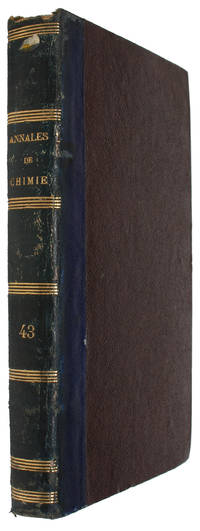
180243078Paris Chez Fuchs An X 1802. Contemp. hcalf. Spine gilt. Top of spine with wear. A few scratches to binding. In: "Annales de Chimie ou Recueil de Mémoires concernant la Chemie" Tome 43. 3324 pp. 2 engraved plates the entire volume offered. Gay-Lussac's paper: pp. 137-175. The first 20 leaves a bit brownspotted otherwise with a few marginal brownspots. 1 leaf pp. 197-98 torn with loss of some letters. Gay-Lussac's paper fine and clean. <br/><br/><em>First printing of this extremely important discovery in which Gay-Lussac first formulated the law Gay-Lussac's Law stating that if the mass and pressure of a gas are held constant then gas volume increases linearly as the temperature rises. This is sometimes written as V = k T where k is a constant dependent on the type mass and pressure of the gas and T is temperature on an absolute scale. In terms of the ideal gas law k = n R / P."In 1802 he Gay-Lussac showed that different gases all expanded by equal amounts with rise in temperature. Charles had made the same discovery some years earlier but had not published it; the credit therefore belongs to Gay-Lussac at least as much and probably more. This was an extremely importent discovery which Avogadro was to use within the decade to formulate hid long-neglected hypothesis that equal volumes of different gases at equal temperatures contained equal numbers of particles."Asimov.Magie "A Source Book in Physics" p.165-172 - Leicester & Klickstein "A Source Book of Chemistry" p. 374-379. - Parkinson "Breakthroughs" 1802 C.The volume contains other importent papers in chemistry by Humphrey Davy first French translation of his announcement of the finding of "Laughing Gas" Nitrous Oxide Parmentier Vauquelin Clement et Desormes Thenard Guyton Chenivix </em> unknown
1824EBS100401Annales de Chimie et de Physique 1824. 1st Edition. Hardcover. Very Good/No Jacket. VOLUME WITH FIRST PAPER TO DISCUSS GLOBAL WARNING AND FIRST PAPER TO IDENTIFY ISOMERISM. This volume contains "the first paper on global warming" by Fourier pp. 136-167 Fourier didn't yet know what molecular mechanisms were trapping the heat. But in this 1824 paper he surmised that over a long period of time the amount of heat held in by the atmosphere could change altered by both the Earth's natural evolution and human activity. "Wöhler's analysis of cyanates appeared in 1824 the paper offered shortly after Liebig's analysis of fulminates. Gay-Lussac then editor of the 'Annales de Chimie' noted that the analysis of cyanic and fulminic acid were identical - the first case of isomerism. This incident brought Wöhler and Liebig together and there followed many years of collaboration in which the two studied the chemistry of benzaldehyde and numerous other compounds." Klickstein "A Source in Chemistry." p. 309. 8vo 448 pp one folding plate at end; ¼ cont. leather over green marbled boards black spine labels label of bookseller. FULL VOLUME OF JOURNAL RATHER THAN EXTRACTED PAPERS. Overall VG. From Arthur C. Greenberg History of Chemistry Collection. Annales de Chimie et de Physique hardcover
a107346aParis 1829 first edition. Crochard. Original binder's blue wraps with mounted manuscript paper spine label. Octavo. 448p. in volume. Gay-Lussac article on Les Poudres Fulminant on pp. 2-25. Several other important articles in same volume on other topics by : Poisson Robiquet Hennell Marianini Berzelius many others. In French. Some occasional light foxing throughout . Good no owner marks. . paperback
182159787Paris Crochard 1821. No wrappers as extracted. In: "Annales de Chimie et de Physique Par MM. Gay-Lussac et Arago." tome 16 Cahier 4. Pp. 389-427. <br/><br/><em>First printing of the official raport on captain Freycinet's voyage. He sailed from Toulon on 17 September 1817 in L'Uranie with his wife Rose who secreted herself aboard and who wrote a separate account of the voyage. After refreshing at the Cape of Good Hope and Mauritius he landed at Shark Bay on 12 September 1818 where he set up an observatory thoroughly surveyed the inlets and the coastal districts and removed the plate left by Willem de Vlamingh which he had found and re-erected in 1801. He then sailed north to Timor. His accounts and description of the landscape and life and customs of that and other islands in the East Indies captivated the attention of people in Europe much more than his Australian reports and a widespread interest developed in the expedition. Leaving Timor on 27 November he sailed via the Moluccas the Carolines the Marianas and the Sandwich Islands and reached Port Jackson on 19 November 1819 the scientists on board adding constantly to their store of information on hydrography botany cartography and anthropology. After spending Christmas ashore they sailed on 26 December and falling in with the westerlies set a course for Cape Horn.On 13 February 1820 L'Uranie was wrecked on the Falkland Islands; the scientific records and notes were saved before the vessel foundered but 2500 of the 4175 plant specimens were lost. Freycinet returned to France in November 1820 and died on 18 August 1842. </em> unknown
182144122Paris Crochard 1821. No wrappers. In: "Annales de Chimie et de Physique Par MM. Gay-Lussac et Arago." tome 16 Cahier 4. Pp. 337-445. The entire issue offered. Rapport: pp. 389-427. <br/><br/><em>First printing of the official raport on captain Freycinet's voyage. He sailed from Toulon on 17 September 1817 in L'Uranie with his wife Rose who secreted herself aboard and who wrote a separate account of the voyage. After refreshing at the Cape of Good Hope and Mauritius he landed at Shark Bay on 12 September 1818 where he set up an observatory thoroughly surveyed the inlets and the coastal districts and removed the plate left by Willem de Vlamingh which he had found and re-erected in 1801. He then sailed north to Timor. His accounts and description of the landscape and life and customs of that and other islands in the East Indies captivated the attention of people in Europe much more than his Australian reports and a widespread interest developed in the expedition. Leaving Timor on 27 November he sailed via the Moluccas the Carolines the Marianas and the Sandwich Islands and reached Port Jackson on 19 November 1819 the scientists on board adding constantly to their store of information on hydrography botany cartography and anthropology. After spending Christmas ashore they sailed on 26 December and falling in with the westerlies set a course for Cape Horn.On 13 February 1820 L'Uranie was wrecked on the Falkland Islands; the scientific records and notes were saved before the vessel foundered but 2500 of the 4175 plant specimens were lost. Freycinet returned to France in November 1820 and died on 18 August 1842. </em> unknown
181046377Paris J. Klostermann 1810. Contemp. hcalf. Spine gilt. Slightly rubbed. A few scratches to binding. Small stamps on verso of titlepage.In: "Annales de Chimie ou Recueil de Mémoires concernant la Chemie" Tome 75. 336 pp. a. 2 folded engraved plates. Some scattered brownspots. The papers: pp. 27-77 129-175 256-263 264-273 274-289 a. 290-316. <br/><br/><em>First French version of Davy's "The Bakerian Lecture for 1809. On some new Electrochemical Researches on various Objects particularly the metallic Bodies from the Alkalies and Earth and on some Combinations of Hydrogene. Read November 16 1809." together with the controversy papers by Davy and Gay-Lussac & Thenard."Mr. Davy having from the commencement of his electro-chemical researches communicated the several steps of his progress to the Society The Royal Society takes the present opportunity of reporting the results of his further inquiries under four principal heads. First on the nature of the metals of the fixed alkalis. Second on the nature of Hydrogen and composition of ammonia. Thirdly on the metals of the earth; and Fourthly he makes a comparison between the antiphlogistic doctrine and a modified phlogistic hypothesis."Abstract. He further gives arguments for considering potassium and sodium which he discovered in 1808 as a element.""Gay-Lussac had a slight rivalry between himself and the creation scientist Sir Humphry Davy. Davy was chemically preparing Potassium and Sodium through an electrical current and this made Gay-Lussac and Thénard envious of his success. They too decided to perform the same task but they had no battery at their disposal as Davy had so they had to form another way to chemically prepare the two elements. In 1808 they used a red-hot iron fused to potash the water-soluble form of a manufactured salt containing potassium to perform this task a method that Davy admitted had its advantageous qualities. Gay-Lussac and Thénard were successful in preparing Potassium and continued to make a full analysis of its chemical properties and began to use it for their own experiments. In 1809 Davy performed the same task using it to reduce Boron in Boracic acid." </em> unknown
183545505Paris Chez Crochard 1835. Without wrappers. In: "Annales de Chimie ou Recueil de Mémoires concernant la Chemie" Ser. II Tome 60 Cahier 2. Pp. 225-331. Entire issue offered. Gay-Lussac's paper: pp. 225-261 and 1 folded engraved plate. - <br/><br/><em>First printing. In 1824 Gay-Lussac extended earlier methods for the estimation of hypochlorite or chlorinated lime solution using indigo solution. He later improved on the method in the paper offered.by the use of standard solutions of certain reducing agents: arsenious oxide mercurous nitrate and potassium ferrocyanide and describing the apparatus depicted on the plate. </em> unknown
1021832944.Gpaperback. Good. Access codes and supplements are not guaranteed with used items. May be an ex-library book. paperback
1020141778.Ghardcover. Good. Access codes and supplements are not guaranteed with used items. May be an ex-library book. hardcover
1814753Paris: Chez Crochard 1814. 1st Edition. FIRST EDITION FIRST PRINTING OF GAY-LUSSAC'S CLASSIC PAPER ON IODINE. Two volumes bound as one. The Dictionary of Scientific Biography notes this as one of Gay-Lussac's most important papers DSB Noted in DSB 5 327. In the late nineteenth century the chemist Wilhelm Ostwald winner of the 1909 Nobel Prize selected Gay-Lussac's paper as "one of the first and one of the best monographs of all time on a single element and its most important compounds and as such it has served as a model for many later pieces of research" Crosland Gay-Lussac: Scientist and Bourgeois 85. <br /> <br /> Louis Joseph Gay-Lussac 1778-1850 was a French chemist and physicist with a well-known rivalry with Humphry Davy. While J. C. Courtois discovered iodine in 1811— and while he recognized iodine to be a distinctive substance from its purple vapor — he confused its compound with hydrogen as that of hydrogen chloride. Gay-Lussac and Davy were asked to further explore the issue however they carried out their research virtually simultaneously making it somewhat difficult to assign priority. Davy's claim for the originality of his study of iodine depends upon his argument of knowledge prior to that of Gay-Lussac. While the publication history is confusing history credits Gay-Lussac DSB Vol. 5 p. 322. <br /> <br /> "In 1814 Davy did some further research on iodine but. in prolonged and detailed research he was outshone by Gay-Lussac who presented a full study of the new element in a major memoir read to the Institute on 1 August 1814" Crosland. Davy's work had been somewhat hurried and incomplete while Gay-Lussac's was anything but. When published this paper at 155 pages filled an entire issue of the Annales de chime" Crosland. <br /> <br /> Gay-Lussac's work in this paper was exceptionally detailed and he "deserves full credit for his detailed study of hydrogen iodine which he found to have a 50 percent hydrogen content by volume. He contrasted its thermal decomposition with the stability of hydrogen chloride. By the action of chlorine on iodine he prepared. iodine monochloride and trichlorise. After further careful study of the properties of iodine he prepared and examined a number of iodides and iodates. He prepared for the first time ethyl iodide by distilling together concentrated hydriodic acid with absolute alcohol" DSB Vol. 5 p. 322. <br /> <br /> In this paper his most important on the subject Gay-Lussac settled Courtois's confusion proving that the new substance was an element analogous of chlorine and it was Gay-Lussac who gave iodine the name iode from the Greek ioeides "violet colored". In a curious side-note some even saw Gay-Lussac's paper as wondrous including the "normally restrained German edition L. W. Gilbert who suggested that the memoir transports the reader into a sort of fairyland. In order to understand Gilbert's remarks the 20th century reader would have to forget his modern sophistication and try to recapture the childlike wonder which might be engendered on first seeing the black crystals of iodine transformed by heat into a beautiful violet vapor with no equal among contemporary dyestuffs" ibid. <br /> <br /> ALSO INCLUDED is the first publication of a paper read to the Institute of France in 1804 by the French chemist Armand Séguin. In it Séguin details his study of opium of the greatest import being his "technique for obtaining another substance from opium" Robinette 378. Séguin "did not know it but he was on the trail of one of the most far-reaching medical discoveries of all time" — morphine Booth Opium 68. Séguin's discovery was not published for a decade until the paper offered here by which time the chemist was in disgrace for embezzling drug supplies from the French army and his work was dismissed. In his speech and paper Séguin "reported finding ‘a very peculiar vegetable-animal material'" Robinette. Though the timing in muddled as by the time of publication other researchers had made similar discoveries writing in 1832 Pelletier argued strongly for Séguin's preeminence; that Séguin's "vegetable-animal material" was in fact the discovery of morphine: ‘M. Séguin signaled the existence of the most energetic principle of opium described the means of obtaining it and indicated its essential and distinctive characteristics so that he only lacked the naming of it ‘morphine' in order to be in possession of the honor of its discovery'" ibid. CONDITION & DETAILS: Paris: Chez Crochard. Volumes 91 and 92 bound as one. Ex-libris with NO spine markings and minimal interior markings small stamp on title page occassional text page blank front flyleaf. 8vo. 8.25 x 5.5 inches 206 x 137mm. 1 plate. Tightly and very solidly bound in maroon cloth with a gilt-lettered spine; minor scuffing to the edge tips. Moderate foxing throughout largely minor. title page is not detached but is loosening. Withal very good condition. Chez Crochard hardcover