296 résultats
181443080Paris Chez Crochard 1814. Contemp. hcalf. Spine gilt. Top of spine with wear. A few scratches to binding. In: "Annales de Chimie ou Recueil de Mémoires concernant la Chemie" Tome 91. - 336 pp. a. 1 engraved plate.the entire volume offered. Gay-Lussac's paper: pp. 5-160. Some scattered brownspots. <br/><br/><em>First printing of Gay-Lussac's classic paper on Iodine discovered 1811 by J.C. Courtois in which he showed that the new substance was an element analogous of chlorine and in which he named the substance Iode from the Greek ioeides meaning "violet colored".Gay-Lussac's and Davy's rechearches on iodine were carried out simultaneously which makes it difficult to assaign priority. Gay-Lussac was annoyed at Davy's introsion. His work however is considered as a model of experimental research. Leicester & Klickstein "A Source Book of Chemistry" p. 293."Gay-Lussac's major publication on iodine was not ready to be read to the Institute until August 1814 by which time not only Davy but Vaquelin had explored the subject fairly extensively. Gay-Lussac however deserves full credit for his detailled study of hydrogen iodide which he found to have a 50 percent hydrogen content by volume. He contrasted its thermal decomposition with the stability of hydrogen chloride. By the action of chlorine and iodine he pepared independently of Davy and at about the same time iodine monochloride and trichloride. After further carefull study of the properties of iodine he prepared and examined a number of iodides and iodates. He prepared for the first time ethyl iodide by distilling together concentrated hydriodic acid with absolute alcohol. The close analogy that he emphasized between chlorine and iodine led him to further investigation of the former and he discovered chloric acid by the action of sulfuric acid on a solution of barium chlorate."DSB V pp. 322-23. - Parkinson "Breakthroughs" 1814 C. - Duveen p. 237.The volume contains other importent chemical papers A. Séguin: "Premier-Second Mémoire sur le Quinquina" pp.273-284 a. 304-317 and 3 other papers by him one together with Lavoisier by Guyton-Morveau Payssé Colin etc. </em> unknown
182022536Paris: Chez Crochard 1820. First Edition. Boards. Very Good. First Edition. 448 pages plus 5 plates 1 folding. 8vo. Contemporary quarter calf over marbled boards with black spine labels. Early label Coquard a Epinal on front pastedown. The entire volume of "Annales de Chimie et de Physique" Vol. Quinzieme XV 15 offered. Surface wear/damage to the leather finish resulting in minor loss to gilding and top label and minor fraying to the head/tail spine panel. Small spot of worming inside lower rear board at the gutter. Text generally bright and clean. <br /> <br /> This volume contains the original journal appearance of the separately issued "Memoires sur l'Action Mutuelle de Deux Courans Electriques" in three sections over two articles pp. 59-76 & 170-218. Section 1: "De l'Action mutuelle de deux courans electriques" pages 59-76 continued as "Suite Du Memoire sur l'Action mutuelle entre deux courans electriques entre un courant electrque et un aimant ou le globe terrestre et entre deux aimans" on pages 170-188. Section 2: "Direction des courans electriques par l'action du globe terrestre" on pages 188-196. Section 3: "De l'Action mutuelle entre un conducteur electrique et un aimant" pages 196-218. Plus plate number 4 in the rear which illustrates the articles. Boards. Ampere is today celebrated for his fundamental work in the new field of electrodynamics. The three part paper offered here established “the relationship between electric current-flow and magnetism and established the new science of electrodynamics.†Norman <br /> <br /> “In a four page circular dated Copenhagen July 21st 1820 H.C. Orsted communicated his great discovery that a closed voltaic circuit exerts forces on an adjacent magnetic needle. In more modern language: a current-carrying electric circuit gives rise to magnetic forces in its surroundings. Orsted had found the long sought affinity between electricity and magnetism. The letter reached Arago … who at the next meeting of Academie des Sciences on Sept. 11th 1820 with Ampere in attendance presented the letter and Orsted's experiment. It was indeed a memorable meeting. Already at the next weekly meeting on Sept. 18th Ampere delivered an explanation of Orsted's experiment and supported it with new experiments of his own. At every weekly meeting in the following months Ampere produced new results.†Ekelof<br /> <br /> 'In this first paper Sept. 18 he explains the law determining the position of the magnetic needle in relation to the electric current and he also makes known his intended experiments with spiral of helical wires which he predicts will acquire and retain the properties of magnets so long as the electrical current flows through them He constructed his spirals and helices and to the astonishment of all he produced magnets formed only of spools of copper wire traversed by electric currents.' Mottelay<br /> <br /> The Honeyman sale #82 notes that the paper offered here is "The first appearance of the first of a series of important papers reporting Ampere's discoveries on the electric current." Honeyman also had #83 the first separate appearance of these journal articles published as "Memoires sur l'Action mutuelle de deux courans electriques." which we believe had additional information not present in this journal appearance and hence is not a traditional "offprint" but a later state of the work. Norman notes that Ampere developed the science of electrodynamics over the next seven years publishing in a "bewildering array of journal articles offprints and revisions of earlier works.further noting some 'reprints' of Ampere's articles appear in as many as five different versions."<br /> <br /> This is an opportunity to own the original first printed appearance of Ampere's fundamentally important work in Electrodynamics. It would be an interesting collection to build the variations of Ampere's work over those seven years to see how his thought evolved. As far as we are aware there is no standard bibliographic reference for Ampere's work.<br /> <br /> LITERATURE<br /> Dibner Heralds of Science 62 first separate edition<br /> Honeyman Sale 82 original journal appearance<br /> Mottelay Bibliographical History of Electricity and Magnetism p. 472<br /> Norman 43 first separate edition. <br /> Ekelof Catalogue of Books and Papers in Electricity and Magnetism pp 284-286<br /> Sparrow Milestones of Science p33 first separate edition. Chez Crochard unknown
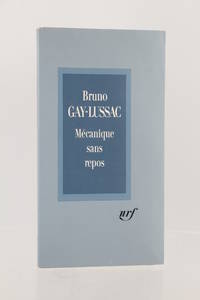
198784119Paris: Gallimard 1987. Fine. Gallimard Paris 1987 11.50 x 21 cm broché First edition one of 20 numbered copies on pure rag vellum from Rives the only deluxe copies. Two bookplates pasted on an endpaper. Handsome copy. Gallimard hardcover
1812S14065no place:: G. De Turris 1812. 1812. 8vo. 110 2 pp. Some spotting. Modern quarter vellum boards black spine title. Very good. 171 'Memoirs on the Metals of Soda and Potash by Messrs. Gay-Lussac and Thenard. With researches on ammonia gas by Mr. Berthollet. Being Extracts from the Proceedings of the Society of Arcueil. Translated into Italian with notes by Mario Giardini.' There should be two issues of this pamphlet the other is described as having a pagination error at pp. 57-64 which is corrected here suggesting a second state which this should be. / Chemist L.J. Thenard collaborated with Gay-Lussac in the study of metals and together they arrived at the separation of sodium and potassium by chemistry which had already been achieved through Volta's battery. The book was dedicated to Francesco Carelli knight of the order of the Two Sicilies etc. by M. Giardini who recalled how Davy's recent discovery on the "nature of alkalis and alkaline earths "had attracted the attention of all European chemists and so he published this vol. p.5 which contains: Method employed by Mr. Davy Metodo Impiegato dal Sig. Davy p. 9 for the decomposition of soda ash and potash; Attempts Tentativi . . . p .11 employed by Davy to know the nature of alkaline earths; Extract of the memoirs read at the Inst. National from Mar. 7 to Feb. 27 1809 Estratto p. 18 by Messrs. Gay-Lussac and Thenard; Process for obtaining the metals of potash and soda Processo per ottenere I metallic p. 21 ; Properties of the metal of potash Proprieta del metallo della potassa; Properties of fluoric acid and particularly of its action on the metal of potash p. 48; Action of the metal of potash over oxides metal salts earthy alkaline p. 63; Of the metal of soda p. 68; Nature and properties of muriatic acid and oxygenated muriatic acid p. 71; Memoir on the analysis of ammonia p. 88 by Mr. Berthollet read at the Institute at Mar. 24 1808. / Crosland describes this Italian 'Society of Arcueil' as one of social standing and personal relationships – not a proper scientific association or academy as is typically thought of; rather in this case Napoleon's support of science is reflected with this loose associated body – here a 'society.' / "In the field of research Berthollet's work was above all a model for Gay-Lussac. On a personal level Berthollet was a pleasant man and a good friend; yet it was the man of science that Gay-Lussac took as his model. What mattered most was his conception of scientific activity. Even if his subject chemistry distanced him from the great mathematics on the one hand and biology on the other he remained open to a certain multidisciplinary approach. It was applied chemistry that interested him the kind that justifies the scientific approach by the search for applications in the tradition of the Encyclopedie." - Maurice Crosland Gay-Lussac savant et bourgeois p. 43. REFERENCES: See: Maurice Crosland The Society of Arcueil: A View of French Science at the Time of Napoleon I. Cambridge: Harvard University Press. 1967. [G. De Turris, 1812]. hardcover
2329414544.Gpaperback. Good. Access codes and supplements are not guaranteed with used items. May be an ex-library book. paperback
2329414552.Gpaperback. Good. Access codes and supplements are not guaranteed with used items. May be an ex-library book. paperback
1354985419.Ghardcover. Good. Access codes and supplements are not guaranteed with used items. May be an ex-library book. hardcover
197083752Paris: Gallimard 1970. Fine. Gallimard Paris 1970 12.50 x 20 cm broché First edition one of 25 numbered copies on pure laid paper the only deluxe copies. Two bookplates pasted on an endpaper. Handsome copy. Gallimard unknown
1020318805.Ghardcover. Good. Access codes and supplements are not guaranteed with used items. May be an ex-library book. hardcover
1832S14238Paris :: de l'impr. Royale 1832. 1832. 4to. 88 pp. 6 engraved folding plates of apparatus by Le Blanc; heavily foxed. Contemporary marbled boards with manuscript spine label; extremities somewhat shelf worn. Very good. 170 First edition of this work on the testing of silver materials using a wet method published by the Commission on Coins and Medals. / "Gay-Lussac made a major contribution to chemical analysis in 1832 when he introduced a volumetric method of estimating silver which he justly claimed was much more accurate than the centuries-old method of cupellation. He proposed two parallel procedures for this method one gravimetric which he said was the more accurate and one volumetric which had the advantage of simplicity. The principle of both methods was the precipitation of silver chloride. He prepared a standard solution of sodium chloride of such concentration that 100 milliliters precipitated rather less than one gram of silver. Another standard solution of sodium chloride one-tenth of the concentration of the first was also prepared. One gram of silver was accurately weighed and then dissolved in nitric acid; 100 milliliters of the concentrated sodium chloride solution was added and the precipitate of silver chloride was allowed to settle. The procedure was continued until further addition caused no precipitation. This final excess of sodium chloride was found exactly by back-titrating with standard silver nitrate solution. It was characteristic of Gay-Lussac's standard solutions that they could be used only for specific analysis and for given weights of a sample since the concentration of his solutions had no chemical basis related to equivalent weights. While therefore Gay-Lussac must be given credit for showing volumetric analysis to be convenient rapid and accurate the establishment of a general system of volumetric analysis had to wait until the achievements of Fredrik Mohr in the next generation of chemists." – DSB. REFERENCES: Bolton 1893 471; Cole 509; DSB V pp. 317-27; Edelstein 960; Ferchl 174; Neville I p. 504; Partington IV p. 85; Poggendorff I pp. 860-864 putting the imprint date for this item as 1833. See: Maurice Crosland Gay-Lussac: Scientist and bourgeois Cambridge University Press 1978 pp. 188-190 219-222. de l'impr. Royale, 1832. hardcover
0274254298.Ghardcover. Good. Access codes and supplements are not guaranteed with used items. May be an ex-library book. hardcover
1169688667.Ghardcover. Good. Access codes and supplements are not guaranteed with used items. May be an ex-library book. hardcover
1390321932.Gpaperback. Good. Access codes and supplements are not guaranteed with used items. May be an ex-library book. paperback
46449048like new. unknown
1391431014.Ghardcover. Good. Access codes and supplements are not guaranteed with used items. May be an ex-library book. hardcover
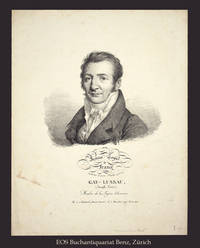
1822373DG1822. O. O. ca. 1822. Lithographie Brustbild von Julien Boilly. Bildformat: 24 x 19 cm. Blattformat: 275 x 355 cm. Angestaubt u. etwas fleckig. unknown
116871169X.Ghardcover. Good. Access codes and supplements are not guaranteed with used items. May be an ex-library book. hardcover
182845506Paris Chez Crochard 1828. Without wrappers. In: "Annales de Chimie ou Recueil de Mémoires concernant la Chemie" Ser. II Tome 39 Cahier 4. Pp. 337-444 Entire issue offered. Gay-Lussac's paper: pp. 337-368 and 1 engraved plate. <br/><br/><em>First printing of this paper in which he describes acide normale "normal acid" as a standard solution of l00 grams of sulfuric acid diluted to one liter. Gay-Lussac used litmus as an indicator and describes accurately the color transition in different reactions. </em> unknown
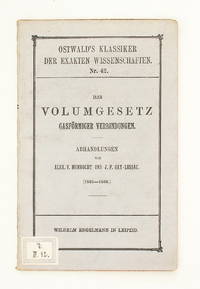
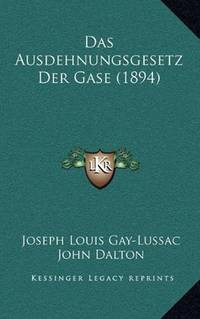
000326Wilhelm Engelmann Leipzig 1893. Kl.-Oktav 190 x 120 mm Org.-Pappband 42 S. umseitig farbiger Schnitt sehr leichte Gebrauchspuren aber insgesamt gut erhalten. Ostwald's Klassiker der exakten Wissenschaften; 42. - Inhalt / content: A. v. Humboldt Gay-Lussac: Versuche über die eudiometrischen Mittel und über das Verhältniss der Bestandtheile der Atmosphäre - Gay-Lussac: Ueber die Verbindungen gasförmiger Körper eines mit dem andern - Ostwald: Anmerkungen. - 604 SOD Ostwald's Klassiker der exakten Wissenschaften; 42. - Inhalt / content: A. v. Humboldt Gay-Lussac: Versuche über die eudiometrischen Mittel und über das Verhältniss der Bestandtheile der Atmosphäre - Gay-Lussac: Ueber die Verbindungen gasförmiger Körper eines mit dem andern - Ostwald: Anmerkungen. - 604 SOD Wilhelm Engelmann, Leipzig, 1893. unknown
0469108835.Ghardcover. Good. Access codes and supplements are not guaranteed with used items. May be an ex-library book. hardcover
1167554019.Gpaperback. Good. Access codes and supplements are not guaranteed with used items. May be an ex-library book. paperback
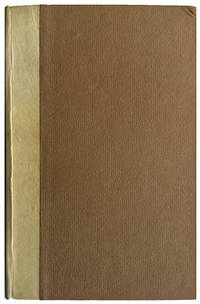
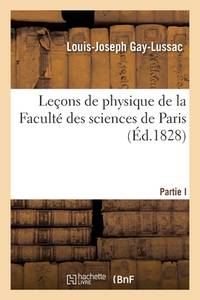
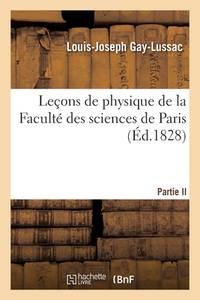
1828e5919Paris: Pichon et Didier. Worn condition. Covers detached; boards rubbed and marked. Spines missing. Sporadic browning and foxing. Ex.-lib. Royal College of Surgeons in Ireland. 1828. First Edition. Half leather marbled board cover. 210mm x 140mm 8" x 6". xix 540pp; 510pp. Volumes comprise 33 lectures. Text in French. Heavy item - shipping supplement may apply for overseas. . Pichon et Didier hardcover
0259500720.Gpaperback. Good. Access codes and supplements are not guaranteed with used items. May be an ex-library book. paperback
0265462215.Ghardcover. Good. Access codes and supplements are not guaranteed with used items. May be an ex-library book. hardcover
034105030X.Ghardcover. Good. Access codes and supplements are not guaranteed with used items. May be an ex-library book. hardcover