[LONDON] STEREOSCOPIC CO[MPANY] LTDBiblio.com
36 résultats
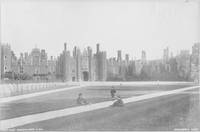
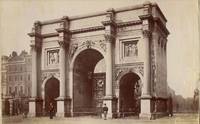
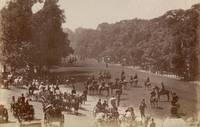
60800c.1880s. . Albumen print. Mounted on card.<br /> The London Stereoscopic and Photographic Company was begun in 1854 by George Swan Nottage. It specialised in the mass production of stereoscopic photographs where two almost identical photographs merged to form a three dimensional picture. The Company published many thousands of views during the 1850s and 1860s and became one of the largest photographic publishing companies in the world.<br /> [c.1880s]. unknown
60803c.1860s. . Albumen print. Mounted on card.<br /> The London Stereoscopic and Photographic Company was begun in 1854 by George Swan Nottage. It specialised in the mass production of stereoscopic photographs where two almost identical photographs merged to form a three dimensional picture. The Company published many thousands of views during the 1850s and 1860s and became one of the largest photographic publishing companies in the world.<br /> [c.1860s]. unknown
60795. Albumen print. Small tear on right side. Mounted on card.<br /> The London Stereoscopic Company was begun in 1854 by George Swan Nottage. It specialised in the mass production of stereoscopic photographs where two almost identical photographs merged to form a three dimensional picture. The Company published many thousands of views during the 1850s and 1860s and became one of the largest photographic publishing companies in the world.<br /> unknown
60797. Albumen print. Tear on top left corner. Mounted on card.<br /> The London Stereoscopic Company was begun in 1854 by George Swan Nottage. It specialised in the mass production of stereoscopic photographs where two almost identical photographs merged to form a three dimensional picture. The Company published many thousands of views during the 1850s and 1860s and became one of the largest photographic publishing companies in the world.<br /> unknown
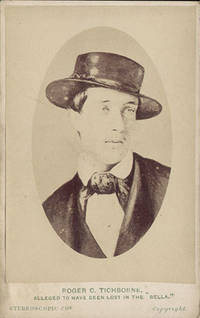
187111211871. Albumen photograph. 100mm by 62mm. Roger C Tichborne Alleged to have been lost in the 'Bella'.'<br /> Photo of reverse available on request. Ink inscription on the reverse which reads 'Purchased in July 1871'.Roger Charles Doughty-Tichborne 1829-1854 was the eldest son of Sir James Tichborne 10th Bt and his wife Harriette-Felicite Roger was raised in Paris by his mother until his father brought him to England in 1845. Educated at Stonyhurst College he later joined the 6th Dragoon Guards. He spent his leave with his uncle Sir Edward Doughty 9th Bt and aunt Katherine at Tichborne House where he fell in love with his cousin Katherine 'Kattie' Doughty. Her parents resisted the romance and later suggested they wait until Kattie came of age. With this delay Roger left the army in 1853 to travel in South America. He was last seen boarding a ship the Bella bound for Kingston Jamaica from Rio de Janeiro in 1854. The ship was wrecked with no known survivors. unknown
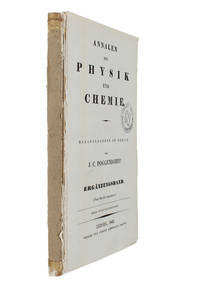
184249144Leipzig Johann Ambrosius Barth 1842. No wrappers. In: In "Annalen der Physik und Chemie. Hrsg. von J.C. Poggendorff" Ergänzungsband Nach Bd. LI einzuschalten Stück 1. With titlepage to the volume Erg.-Bd. Pp. 1-192 a. 3 plates. Entire issue offered. Wheatstones paper: pp. 1-48. Brownspots to inner margin on the first page otherwise clean. Stamp to titlepage and verso of plates. <br/><br/><em>First appearance in German of this classic paper in physiological optics in which Wheatstone discovered the stereoscopic vison of the human eye.Stereopsis was first described by Wheatstone in 1838 published first in the Transactions. In 1840 he was awarded the Royal Medal of the Royal Society for his explanation of binocular vision a research which led him to make stereoscopic drawings and construct the stereoscope. He showed that our impression of solidity is gained by the combination in the mind of two separate pictures of an object taken by both of our eyes from different points of view. Thus in the stereoscope an arrangement of lenses or mirrors two photographs of the same object taken from different points are so combined as to make the object stand out with a solid aspect. Sir David Brewster improved the stereoscope by dispensing with the mirrors and bringing it into its existing form with lenses."As the inventor of the stereoscope later developed by Brewster Wheatstone found himself - to his own surprise - the first since Leonardo da Vinvi to discuss depth perception in terms of the different image received by the eye."DSB XIV p. 290.Garrison & Morton No. 1498. Also with K.E. von baer "ueber das Klima von Sitcha und den russischen besitzungen an der Nordwestküste von Amerika" pp. 129-154. </em> unknown
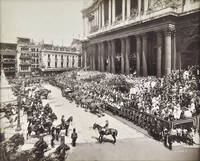
872551897. . Albumen print mounted. Fine photograph with very good tonal range. <br />Dimensions: photograph 24 x 29cm mount 41 x 44.5cm.<br /> Photograph showing Queen Victoria's Diamond Jubilee procession in front of St. Paul's Cathedral London. <br /> 1897. unknown
40072London Stereoscopic and Photographic Company 1862. Stereoscopic albumen print photograph 80 x 80 mm each image arched format on yellow mount 84 x 173 mm; recto with printed title: The International Exhibition of 1862: No. 141 - N. E. Transcept and Australian Gold Case; under magnification the sign on the case reads: The Stamping Machine / Victoria - Australia / GOLD / Eastern Annex; both of the prints and the mount are in fine condition. One of a series of views of the display of gold from the Colony of Victoria at the International Exhibition in London in 1862 published by the exhibition's official photographers the London Stereoscopic and Photographic Company. A different photograph taken from the same vantage point includes a diorama with wax figures illustrating men at work on the diggings. The centrepiece of the Victorian display also not shown in this particular view was a 44-feet-high gilded obelisk a symbol of the enormous quantity of gold which had been mined in Victoria in the ten years or so since the gold rush had commenced. Part of the Tasmanian display can be seen in the middle ground: a thylacine pelt hanging vertically can clearly be discerned directly to the right of the whale jawbone at the centre of the image. unknown
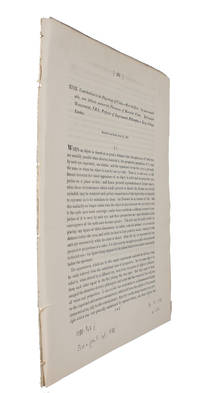
183842847London Richard and John E. Taylor 1838 a. 1852. 4to. No wrappers as extracted from "Philosophical Transactions" 1838 - Part II. Pp. 371-394 and 2 engraved plates. Light browning to plates. 1852- Part I. pp. 1-17 and 1 engraved plate. A dampstain to plate. <br/><br/><em>First appearance of these classic paper in physiological optics in which Wheatstone discovered the stereoscopic vison of the human eye.Stereopsis was first described by Wheatstone in 1838 in the paper offered. In 1840 he was awarded the Royal Medal of the Royal Society for his explanation of binocular vision a research which led him to make stereoscopic drawings and construct the stereoscope. He showed that our impression of solidity is gained by the combination in the mind of two separate pictures of an object taken by both of our eyes from different points of view. Thus in the stereoscope an arrangement of lenses or mirrors two photographs of the same object taken from different points are so combined as to make the object stand out with a solid aspect. Sir David Brewster improved the stereoscope by dispensing with the mirrors and bringing it into its existing form with lenses."As the inventor of the stereoscope later developed by Brewster Wheatstone found himself - to his own surprise - the first since Leonardo da Vinvi to discuss depth perception in terms of the different image received by the eye."DSB XIV p. 290.Garrison & Morton No. 1498. </em> unknown
189569607Germany: Verlag von Leopold Voss 1895. STEREOSCOPIC CARDS. Stereoscopical Pictures for the use of squint-eyed people. A Set of 26 Stereoscopic Cards with a Collapsible Stereoscope Viewer. Germany: Verlag von Leopold Voss n.d.c.a. 1895.<br> <br> Early edition possibly 3rd revised edition. A set of 26 lovely chromolithograph stereoscopic cards including one which allows for two sides to be slid back and forth. Accompanied by a collapsible Stereoscope with which to view the cards. This was used in the diagnosis and theraputic care of children with optical difficulties. 7 1/4 x 3 3/4 inches; 190 x 95 mm. Each card is numbered 1-26. The cards are housed in a small faux leather box. Box with the stamp of "August. F. W. Vogt of Amsterdam." The stereoscope is in matching faux leather and is able to fold flat. A very nice attractive set with cute color pictures mainly of animals and children. A few cards with letters that create the names Elise Africa and Rafael. Previous owner's inscription on inside on the box. Some minor rubbing to edges of the box and the stereoscope. Overall very good.<br> <br> This set though without any printed labels or the instructional leaflet matches other copies of Kroll's and can be identified as possible the third revised edition as this was the first edition to include a sliding card according to a listing in 1896's "Zeitschrift für Psychologie und Physiologie der Sinnesorgane 10." Journal of Psychology and Physiology of the Sense Organs 10 Published by Arthur Konig. According to Konig<br> <br> "The reappearance of a new edition of these stereoscopic images attests to the wide circulation they have achieved. They are designed for use by children with intermittent strabismus who are intended- through exercises performed with the aid of these plates-to gradually and permanently correct the faulty alignment of their eyes. In preparing this new edition the guiding principle was in essence to stimulate the impulse toward the stereoscopic fusion of the image halves more strongly than in previous editions. Serving this purpose are 12 new plates which contain- partly- images featuring congruent main figures alongside incongruent secondary figures and- partly- text-based exercises designed according to the same fundamental principle. A newly added image allows for the adjustment of the distance between its two halves.<br> <br> "A stereoscope or stereo viewer is a device used for viewing a pair of stereoscopic separate images mounted on a stereograph card. These images depict a left-eye and right-eye view of the same scene hosted on a card that when viewed through a stereoscope appear as a single three-dimensional image. This apparatus consisted of two prismatic lenses and a wooden extension which held the stereo card at the correct distance from the viewer. The lenses made the image appear larger and more distant as well as shifting their position so that the two images fuse into one stereo window. A view-limiting feature such as a divider is usually present on stereoscopes to prevent each eye by being distracted by the image intended for the other eye. Sir David Brewster debuted his lenticular stereoscope at the Great Exhibition of 1851 in England. Brewster is credited as the inventor of the stereoscope and stereographs intended for use by the general public. Oliver Wendell Holmes made further contributions to the stereoscope by introducing a handheld stereoscopic viewer in 1861 that was both streamlined and more economical than what had previously been available. The hype over this novel form of entertainment led to an industry in producing images for public consumption. Stereographs stereoviews stereo cards and stereo pairs were produced and sold by the thousands. They usually included the pair of images on piece of cardstock of cardboard along with some explanatory text. Stereographers traveled the world to capture images that would appear in 3D back home on the Victorian parlor. Subjects included famous people and places historic events dramatic recreations beautiful settings and flower arrangements among other things. By the last quarter of the nineteenth century viewing stereographs was a popular form of entertainment in Victorian homes. Almost as common as a television set is today each American home typically had a collection of stereographs and a hand-held or table-stand stereoscope through which to view them." Smithsonian Museum.<br> <br> HBS 69607.<br> <br> $2000. [Verlag von Leopold Voss] unknown
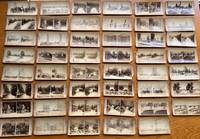
189046701890. Albumen stereoview photograph. 87mm by 177mm card. A rare series of 47 views of Melbourne. Titled 'New Series' on right hand side of the card. Printed and inscribed titles on the right hand side. Titles : Collins St 2 Fountain Fountain MGC Rockwork MGC Yarra Boat Houses Russell St Swanston St University Fitzroy Gardens 6 Collins St East Railway Bridge EM Exhibition 2 Studley Park 2 Abbotsford 4 St Kilda C 2 Kew Road Studley Park Price's Bridge Gates Lawn St Kilda Museum Collins St City Women's Hospital Wilson Hall Burke & Wills Port Melbourne Pier Swanston Street Library Botanical Gardens 10. Reverse has ink stamp of Melbourne Stereoscopic Company 744 Lygon St North Carlton Stockwell Photo. and previous owner's name in pencil. CONDITION : Some fading and faint soiling. A handful with broken / missing corners not affecting the photographs. unknown