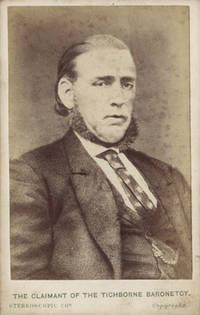
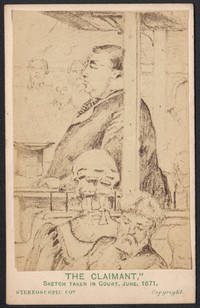
The Claimant Sketch taken in Court June 1871. CDV
187212601872. Albumen photograph. 102mm by 62mm. Carte de visite portrait of Arthur Orton 1834-1898 The Tichborne Claimant. unknown
Sebra Prints · Australie220,00 $AU≈ 145,00 €
36 résultats
46750Albumen print photograph carte de visite format 102 x 63 mm mount; recto of mount with printed signature of Robert Moffatt to lower margin; verso with the back mark of the London Stereoscopic & Photographic Company; both the print and the mount are in excellent condition. 'Robert Moffatt Ormiston East Lothian Scotland December 21 1795-Leigh Kent England August 8 1883 was a missionary and a linguist who worked in South Africa and Botswana for more than 60 years. Of modest parentage he had an elementary education and was raised as a Presbyterian on strict religious principles by his mother a Scotswoman née Anne Gardiner. He first worked as a gardener in Scotland and England. Influenced by Methodism he determined to become a missionary and in 1816 joined the London Missionary Society LMS. He had already met and become engaged to Mary Smith who came from Lancashire near Manchester. He was sent out to South Africa where he arrived in Cape Town on January 13 1817. His fiancée however due to her father’s objections did not join him for another three years. He was to begin his service in Great Namaqualand south of the Orange River but at first was refused permission to travel there by the local authorities. Therefore he began instead to study Dutch at Stellenbosch University until January 1818 when he began work in Great Namaqualand. He had an early success in the conversion of local ruler Jager Christian Afrikaner circa 1800-1823 a Hottentot freebooter this while traveling in South West Africa now Namibia and Bechuanaland now Botswana. In April 1819 in Cape Town he met with an LMS deputation investigating LMS work in Southern Africa. They invited him to act as their interpreter in Dutch. He traveled with them until the Fifth Frontier War of 1819 forced them to stop. At the same time his fiancée arrived from England and they were married in Cape Town in December 1819. She was to prove a strong loyal and dedicated companion. The delegation persuaded him to work amongst the Tswana Bechuana and he settled at first at Dithakong in 1821 among the Tlhaping a Tswana people. Unrest swept this region as a result of the wars of the Zulu Chief Shaka but invaders were driven off by armed Griquas led by Andries Waterboer. Unsettled conditions continued until 1829. At that time Moffatt baptized his first converts. In this same year he established what was to prove a lifelong friendship with Mzilikazi chief of the Matabele. Having moved to Kuruman he began to translate the Bible into the Tlhaping dialect. He took the manuscript to Cape Town where with his own hands he prepared it for printing on the government press. He then acquired a printing press which he took to Kuruman by ox-wagon where he produced more religious literature. He had however to travel to Britain to have his translation of the New Testament published in 1840. While in London in 1841 he met with David Livingstone whom he persuaded to travel to Africa. It was from Kuruman that Livingstone began his African travels in 1849. Meanwhile back in Kuruman he continued to translate and print the Old Testament. The result was the first translation of the Bible into any South African language. In 1857 he led a mission to meet with Mzilikazi in Matabeleland. Suspicious of his influence Afrikaner burghers prepared to attack Kuruman. A request to the British govemor at the Cape Sir George Grey led to a successful appeal to Pretorius not to make the attack. Moffatt then remained at Kuruman working on a translation of Pilgrim’s Progress. In 1870 Moffatt and his wife retired to England where she died at Brixton in 1871. He died in 1883. His son John Smith Moffatt continued his work in Botswana and his daughter Mary married David Livingstone. Kuruman had been the northernmost European outpost in southern Africa and played a key role in the establishment of relations with the more northerly peoples. Although involved with diplomatic relations Moffatt’s work was essentially evangelical in character.' Keith Irvine Dictionary of African Christian Biography   unknown
187212601872. Albumen photograph. 102mm by 62mm. Carte de visite portrait of Arthur Orton 1834-1898 The Tichborne Claimant. unknown
187211261872. Albumen photograph. 102mm by 65mm. Carte de visite portrait of Arthur Orton 1834-1898 The Tichborne Claimant.<br /> CONDITION : Some slight spotting and soiling. unknown
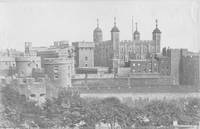
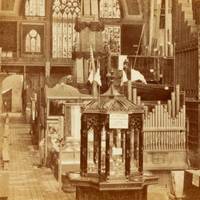
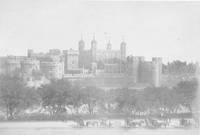
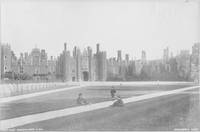
60802. Albumen print. Mounted on card.<br /> The London Stereoscopic and Photographic Company was begun in 1854 by George Swan Nottage. It specialised in the mass production of stereoscopic photographs where two almost identical photographs merged to form a three dimensional picture. The Company published many thousands of views during the 1850s and 1860s and became one of the largest photographic publishing companies in the world.<br /> unknown
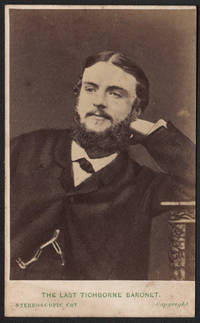
187212621872. Albumen photograph. 102mm by 62mm. Portrait of Sir Alfred Joseph Doughty-Tichborne 11th Bt 1839-1866. CONDITION : Faint foxing in title area. Trimmed very slightly on right hand side. unknown
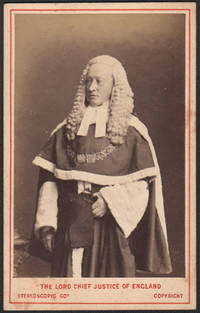
18701161870. Albumen photograph. 100mm by 62mm. Sir Alexander James Edmund Cockburn 12th Baronet QC 1802-1880 was a Scottish lawyer politician and judge. As Lord Chief Justice he heard some of the leading causes celebres of the 19th century including the Tichborne Trial.<br /> CONDITION : Faint foxing in title area. unknown
60801c.1860s. . Albumen print. Mounted on card.<br /> The London Stereoscopic and Photographic Company was begun in 1854 by George Swan Nottage. It specialised in the mass production of stereoscopic photographs where two almost identical photographs merged to form a three dimensional picture. The Company published many thousands of views during the 1850s and 1860s and became one of the largest photographic publishing companies in the world.<br /> [c.1860s]. unknown
40072London Stereoscopic and Photographic Company 1862. Stereoscopic albumen print photograph 80 x 80 mm each image arched format on yellow mount 84 x 173 mm; recto with printed title: The International Exhibition of 1862: No. 141 - N. E. Transcept and Australian Gold Case; under magnification the sign on the case reads: The Stamping Machine / Victoria - Australia / GOLD / Eastern Annex; both of the prints and the mount are in fine condition. One of a series of views of the display of gold from the Colony of Victoria at the International Exhibition in London in 1862 published by the exhibition's official photographers the London Stereoscopic and Photographic Company. A different photograph taken from the same vantage point includes a diorama with wax figures illustrating men at work on the diggings. The centrepiece of the Victorian display also not shown in this particular view was a 44-feet-high gilded obelisk a symbol of the enormous quantity of gold which had been mined in Victoria in the ten years or so since the gold rush had commenced. Part of the Tasmanian display can be seen in the middle ground: a thylacine pelt hanging vertically can clearly be discerned directly to the right of the whale jawbone at the centre of the image. unknown
60800c.1880s. . Albumen print. Mounted on card.<br /> The London Stereoscopic and Photographic Company was begun in 1854 by George Swan Nottage. It specialised in the mass production of stereoscopic photographs where two almost identical photographs merged to form a three dimensional picture. The Company published many thousands of views during the 1850s and 1860s and became one of the largest photographic publishing companies in the world.<br /> [c.1880s]. unknown
60803c.1860s. . Albumen print. Mounted on card.<br /> The London Stereoscopic and Photographic Company was begun in 1854 by George Swan Nottage. It specialised in the mass production of stereoscopic photographs where two almost identical photographs merged to form a three dimensional picture. The Company published many thousands of views during the 1850s and 1860s and became one of the largest photographic publishing companies in the world.<br /> [c.1860s]. unknown
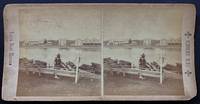
189047371890. Albumen stereoview photograph. 87mm by 177mm card. Depicts James Edwards & Sons boat builders business on the other side of the Yarra. James Edwards was first listed in Melbourne directories in 1869. <br /> <br /> Titled 'New Series' on right hand side of the card. Printed title on the right hand side. Reverse has ink stamp of Melbourne Stereoscopic Company 744 Lygon St North Carlton Stockwell Photo. and previous owner's name in pencil. <br /> <br /> CONDITION : Some fading and faint soiling. Faint mark in sky of left hand photo. Bottom right corner of the card missing. unknown