LAPLACE Pierre Simon, marquis de:Livre Rare Book
264 résultats
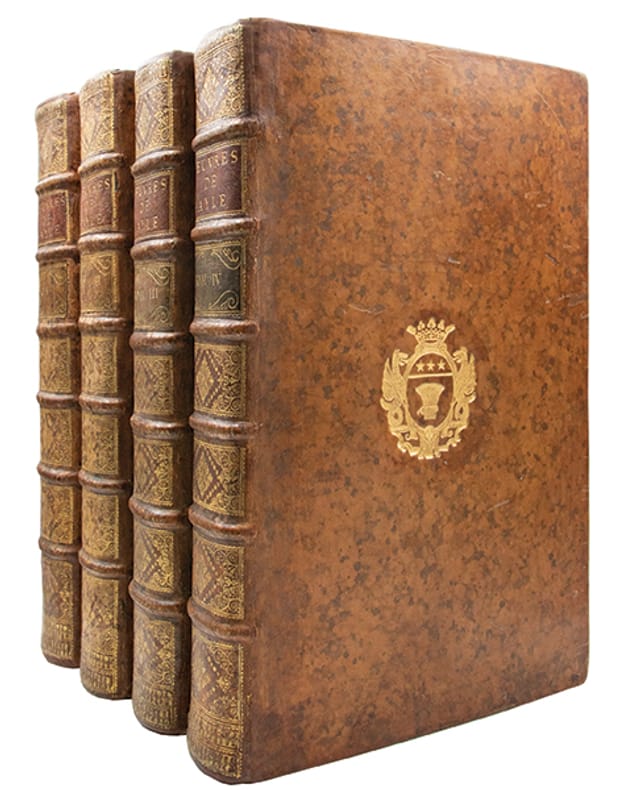
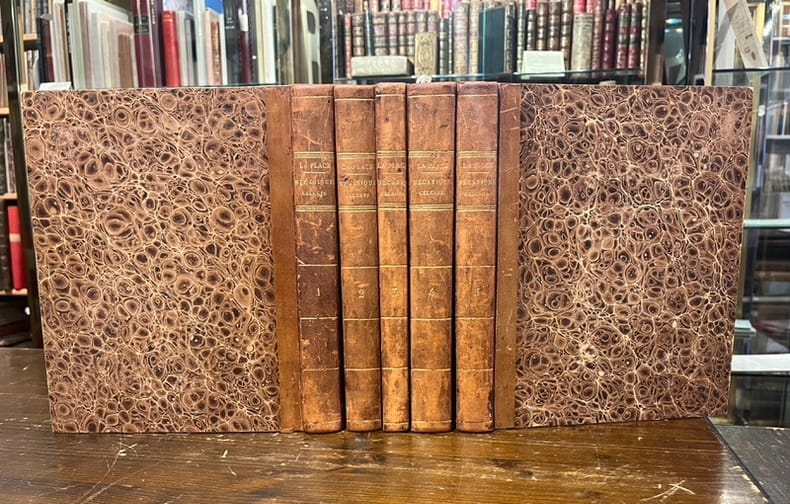
179814397Paris, J.B.M. Duprat; Bachelier, 1798-1825. 5 volumes in-4 de XXXII-368; [4]-382; XXIV-303-[1]; XL-347-[1]-[2]-65-[1]-[2]-78-[2]; VIII-419-[1] pages, demi-veau brun, dos lisses ornés de filets dorés, tranches jaunes.
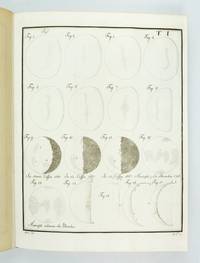
1796ST20813Helmstedt: Printed and commissioned by C. G. Fleckeisen 1796. FIRST EDITION. 275 x 225 mm. 10 3/4 x 9". XVI 250 2 pp. <br/> Contemporary brown paste paper boards smooth spine with red roan label. WITH 10 ENGRAVED PLATES one folding by "G. T." after Schröter. Honeyman 2825; de la Lande p. 635; Poggendorff II 846; cf. DSB XII p. 226 NDB XXIII 590 Schröter and 510 Schrader. See also Sheehan and Baum "Observations and inference: Johann Hieronymous Schroeter 1745-1816" Journal of the British Astronomical Association vol.105 no.4 p.171-175. Joints and extremities somewhat rubbed boards with a hint of chafing occasional very minor foxing including to the final plate half a dozen leaves with faint dampstain to head edge but a really excellent copy the other plates clean and bright the text especially clean and fresh and the binding entirely sound.<br/> <br/> This is a very rarely seen early work on the topography of Venus written by the astronomer who first observed the planet's so-called phase anomaly and illustrated with 10 folding plates. One of a series of "fragments" Schröter published--the others concerning the sun the moon Saturn and Mercury--"Aphroditographische Fragmente" discusses the author's observations of Venus' surface at the same time coining the term "Aphroditographie" in reference to the Greek version of the goddess' name. The most important observation contained in our work concerns the phases of Venus: like the moon Venus appears to wax and wane when observed through a telescope. However due to the thickness of its atmosphere the planet will always appear less full than mathematical calculations indicate it should be. This phenomenon known as Venus' phase anomaly--or the Schröter Effect--first observed by the man who gave it its name in 1793 is discussed in detail in this text which is accompanied by highly detailed plates. Eight of these are focused on Venus primarily depicting its phases; another is a diagram of the telescope; and the other depicts the Orion Nebula to which there is a short addendum. Schröter 1745-1816 built a state-of-the-art observatory at Lilienthal in Lower Saxony equipped with the largest telescopes available at the time. One such instrument which he built in his own workshop was an impressive 27-foot telescope discussed in the present work which has sometimes been incorrectly credited to Schröter's colleague William Herschel 1738-1822. Schröter made systematic long-term observations of the surfaces of the moon and planets something DSB tells us he was the first to do. Not everything he discovered or asserted turned out to be true. Based on his findings he posited the existence of a mountain range on Venus' surface and suggested a rotation period for the planet. Both subsequently were disproven modern scientists have suggested that Schröter's "mountain" may have been an overly optimistic observation of a cloud formation but like the rest of his work they demonstrated the commitment to observational astronomy that leads astronomy historians William Sheehan and Richard Baum to call Schröter "the man who laid the foundations of planetology and modern selenography." His long and impressive astronomical career came to an unfortunate end in 1813 when during the Napoleonic invasion the French reportedly set fire to his observatory. His library instruments unpublished notes and copies of many of his works which were published in small runs at his expense were said to have been destroyed in the fire a fact that may partly explain the current rarity of our book. We have been able to trace at auction only an ex-library copy of the book with significant condition problems that sold in 1981 for a hammer price of £260; the fact that such an unattractive copy came from the distinguished Honeyman collection reinforces how difficult the work is to obtain. Printed and commissioned by C. G. Fleckeisen unknown
1783340504W. Strahan, J.F. And C Rivington, A. Hamilton etc., London 1786, 1779,1781 + 1783. mehr als 1000 Seiten je Band mit Titelkupfer in Band 1 und mit 145 (von 146) teils gefalteten Kupferstich-Tafeln sowie 78seitigem Index im Tafelband, (more than 1000 pages per volume with title copper in volume 1 and 145 (of 146) partly folded plates (copperplate engravings) and with 78-page index extensive index in the plate volume), 2° (40 x 24 cm), Originalganzledereinbände der Zeit mit Rückentitel, fachmänisch restauriert, Papier ganz vereinzelt leicht braunfleckig, Innendeckel mit Exlibris, insgesamt sehr gute Exemplare mit sauberen Tafeln, (Original all-leather bindings of the period with spine title, professionally restored, paper with occasional slight brown spots, overall very good copies with clean plates),
17445061DBPadova, Nella Stamperia del Seminario, appresso Gio: Manfrè, (pubbl. dal abbate Gius Toaldo), 1744. 4°. (4) Bl., LXXXVIII, 601 S; (2) Bl., 564 S.; (2) Bl., 486 S.; (4) Bl., 342 S., (1) Bl., mit vielen Vignetten, Holzschnitt Abbildungen und Diagrammen im Text, Porträt von Galileo Galilei von Zucchi, gefalteter Kupfertafel. Kalblederbände mit Rückenvergoldung, Rückentitel und Supralibros. + Wichtig: Für unsere Kunden in der EU erfolgt der Versand alle 14 Tage verzollt ab Deutschland / Postbank-Konto in Deutschland vorhanden +, 5061DB|5061DB_2|5061DB_3|5061DB_4 4 Bände. [4 Warenabbildungen]
179820855Paris, J.B.M. Duprat; Bachelier, 1798-1805. 4 volumes relié en deux tomes in-4 demi-vélin de XXXII-368; [4]-382 et XXIV-304; 24; 40-347-[1]; [2]-65-[1]; 78-[2] pages, dos lisses, étiquette de titre brune. Reliure XIXe. Collation: vol. 1: a-d4; A-Z4; Aa-Zz4. vol. 2: []2; A-Z4; Aa-Zz4; Aaa4; Bbb3 (le feuillet Bbb4 semble être un feuillet blanc). vol. 3: a-c4; A-Z4; Aa-Pp4. suppl. 1: A-C4. vol. 4: a-e4; A-Z4; Aa-Vv4; Xx2. suppl. 2: []1; AH4; I2 (le second feuillet est la planche dépliante). suppl. 3: A-K4.
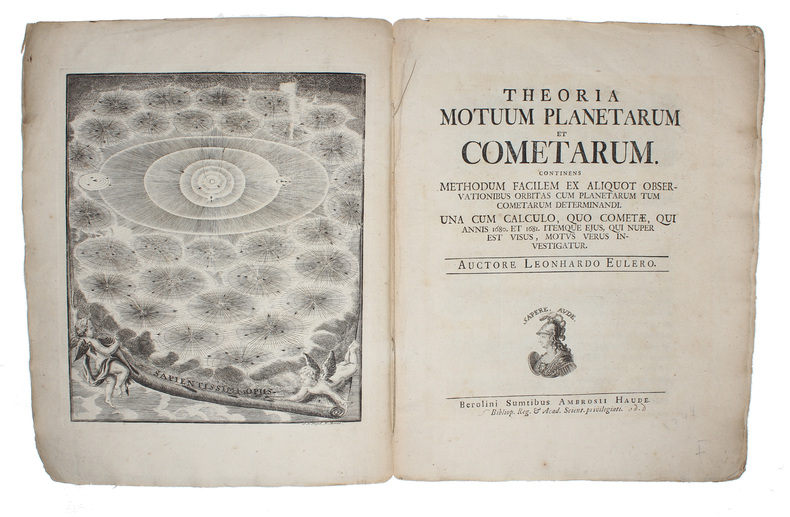
174438114Berlin: Ambrosii Haude, 1744. 4to. (246x199mm). Uncut in original marbled paper wrappers. Spine strip nearly worn away, but sewing still strong. A fine copy in its original and untouched state. Large engraved frontispiece showing comets orbiting the sun and planets, 187 pp. and 4 copper engraved folding plates. A4 (pp.7-8) canceled - catchword continues. Complete.
174955564BBParis, chez David l'ainé., 1749. 4°. XXXVVV p., 2 p.n.ch., 184 p et 4 planches dépliantes. Demi-basane brune, dos lisse orné de filets et fleurons dorés, non rogné (reliure XXe).
176138885Augspurg, Eberhard Kletts Wittib., 1761. Contemporary white-dyed sheepskin. Spine with a bit of surface wear, old hand-written paper-label to spine. XXVIII, 317 pp. A stamp inside front free end-paper. Light browning, scattered marginal brownspots, but in general a fine copy. A few leaves in ""Vorrede"" misbound.
170247776Oxoniae (Oxford), E Theatro Sheldoniano, 1702. Folio. Contemporary full calf, raised bands, rectangular blindtooled frames and central panel ""mirror"" on covers, Cambridge-style binding. leather at joints cracked, but cords intact so that covers not loose. Corners a bit bumped. Light wear to spine ends. Spine a bit rubbed. Pastedowns and flyleaves with browning. Title-page with large engraved vignette (Sheldon Theater). (12),494,(2) pp. With numerous textdiagrams. Very light browning to titlepage and a few marginal brownspots to last leaf, a fine clean copy, printed on good paper with wide margins.On the verso of the title-page is pasted the book plate of Sir William Baird of Newbaith. He habitually pasted his armorial bookplate on the verso of the title-pages of the books in his large and fine library.
176879412BB[München:, Akademische Buchhandlung, 1768.]. quer- 8°. 8 S. [ 217-224] 2 Ausfaltpläne, neuer Pappband in Leimpapier (altersmässig leicht gebräunt; Titelblatt etwas angestaubt; Vorsatz mit kleinem Besitzerstempel und Standortbezeichnung mit Rotstift; Vorsatz hinten etwas Farbspuren des Einbandes; Pläne auf der Rückseite etwas fleckig; auf beiden Plänen durchgehend 3 alt
1737380701737 5 tomes en 4 volumes in-folio (391 x 250 mm), plein veau blond marbré de lépoque, dos à 6 nerfs guillochés or, ornés de caissons richement fleuronnés et cloisonnés, armes dorées au centre des plats, pièces de titre et de tomaison de veau havane et blond, coiffes et coupes filetées or, tranches rouges. A La Haye, par la Compagnie des Libraires [i.e. en France], 1737.
1772PHO-2432Paris, Charles-Antoine Jombert, 1772. In-4 (25,5x20cm), 2ff.-170 pp.-1f., Veau marbré époque, dos lisse orné avec pièce de titre en maroquin rouge, triples filets aux plats avec fleurs en écoinçons, tranches marbrées bleues. Dos frotté, début de fentes, petit trou de ver au dernier plat, petit travail de ver en marge, mouillure par intermittence. Complet avec 1 grand plan, 1 tableau dépliant et 3 planches hors texte.
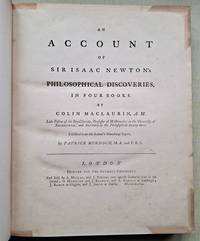
1748023048London: Printed for the Author's Children 1748. Large quarto pp 6 20 page subscriber's list xx 392 with six folding tables the title page with a little toning to the edges a few slight blemishes here and there but a remarkably clean copy overall internally contemporary half calf and marbled boards slightly rubbed and scuffed but a good sound binding. The RARE large paper copy measures 223mm x 290mm. Colin Maclaurin was a Scottish mathematician who made important contributions to geometry and algebra. He is also known for being a child prodigy and holding the record for being the youngest professor. A mathematician and younger contemporary of Newton's Maclaurin believed in Newton's theory of calculus and in the relationship between natural philosophy and mathematics. In this work which was published posthumously by subscription Maclaurin writes on Newton's discoveries and methods of investigation and also includes a long history of natural philosophy. "Though a number of other general expositions of Newton's thought were published during the eighteenth century MacLaurin's Account has long been recognized as the leading authoritative statement of mainstream Newtonianism" DNB. . First Edition. Half Leather. Very Good. Printed for the Author's Children Hardcover
1723030380Lugduni Batavorum Apud Petrum Vander Aa 1723. 1st Edition 1st Printing. Hardcover. Very Good. Seventeen Folding Plates. Title Page 16 413 Pp 15 Pp Catalogus Librorum Followed By 17 Folding Plates At End Each With Many Figures. Full Vellum Early 18Th Century Blind Stamped Design At Center Of Covers Spine Stamped In Gilt. Hand Marbled Papers On Pastedowns All Edges Colored Red. Text Block 17.5 Cm Tall. Latin Exposition Of Newtonian Philosophy Addressed To Students. A Very Nice Example In Original Vellum Light Wear At Spine Ends A Few Tiny Holes In Bottom Spine Edge Of Rear Cover And In Gutter Edge At Bottom Of Plates 16 And 17 Not Affecting Text Or Illustrations. Red Color Of Edges Of Page Blocks Is Almost Entirely Unfaded And Still Shiny. No Marks Or Bookplates. Per Wikipedia Willem Jacob 'S Gravesande 1688 - 1742 Was A Dutch Lawyer And Natural Philosopher Chiefly Remembered For Developing Experimental Demonstrations Of The Laws Of Classical Mechanics. As Professor Of Mathematics Astronomy And Philosophy At Leiden University He Helped To Propagate Isaac Newton's Ideas In Continental Europe. In 1715 'S Gravesande Visited London As Part Of A Dutch Delegation Sent To Welcome The Hanoverian Succession In Great Britain. In London 'S Gravesande Met Both King George I And Isaac Newton And Was Elected A Fellow Of The Royal Society.In 1717 He Became Professor Of Mathematics And Astronomy In Leiden. From That Position He Was Instrumental In Introducing Newton's Work To The Netherlands. 'S Gravesande's Main Scientific Work Is Physices Elementa Mathematica Experimentis Confirmata Sive Introductio Ad Philosophiam Newtonianam "Mathematical Elements Of Natural Philosophy Confirmed By Experiments; Or An Introduction To Newtonian Philosophy" Published In Leiden In 1720. In That Book He Laid The Foundations For The Teaching Of Newtonian Mechanics Through Experimental Demonstrations. He Presented His Work Before Audiences That Included Voltaire And Albrecht Von Haller. The Book Was Soon Translated Into English By John Theophilus Desaguliers Curator Of Experiments For The Royal Society. In 1722 He Published The Results Of A Series Of Experiments In Which Brass Balls Were Dropped From Varying Heights Onto A Soft Clay Surface. He Found That A Ball With Twice The Speed Of Another Would Leave An Indentation Four Times As Deep From Which He Concluded That The Correct Expression For The "Live Force" Of A Body In Motion What Is Modernly Called Its "Kinetic Energy" Is Proportional To Its Mass And The Square Of Its Velocity. <br/> <br/> Lugduni Batavorum Apud Petrum Vander Aa hardcover
178256995London, Lockyer Davis, and Peter Elmsly, 1782. 4to. In recent marbled paper wrappers. Extracted from ""Philosophical Transactions"", vol. 71, read April 26, 1781. Including title-page of volume. Leaves reinforced in margin. (2), V-VII, 492-501 pp. + three folded plates.
1732W88386Amsterdam, Isaak Tirion 1732 2 parts in 1 volume, I: [2bl], [viii], 194, [x] pp.+ 13 engraved folding plates, II: [iv], xxiii, [i] pp.+ 3 large folding engraved plates, 21cm., contemporary full vellum binding, few foxing and light browning, modern ex-libris-stamp at front endpaper, very good condition, rare, [John Theophilus Desaguliers, 1683-1744, natural philosopher, scientist and a prominent freemason, born in La Rochelle (Fr.), fled to England in 1683 after the revocation of the edict of Nantes. He was a member of the Royal Society of London (since 1714), a friend of Isaac Newton and is considered as the inventor of the Planetarium], W88386
1752PHO-2500Amsterdam et Leipzig, Arkstée & Merkus, 1752, 2 volumes in-4 (26x22cm), 11 ff.-554 pp. et 1f.-316 pp.-7ff.-309 pp.-3pp., Veau marbré époque dos à nerfs orné avec pièces de titre et tomaison, tranches jaspées. Frottements, coins usés, accroc coiffe sup. Tome 2, 4 feuillets blanc brunis, 9 planches brunies, 1 avec déchirure réparée.
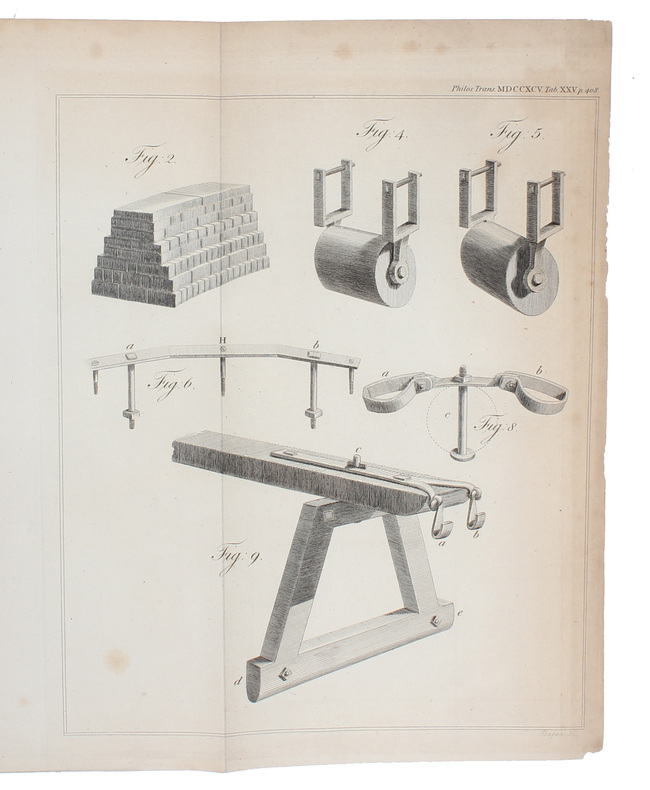
179557071London, Peter Elmsly, 1795. 4to. In recent marbled paper wrappers. Extracted from ""Philosophical Transactions"". Including title-page of volume. Leaves reinforced in margin. Light offsetting from folded plates as usual. Plate depicting the full telescope with professional repair to lower right corner. (4), 347-410 pp. + 19 folded plates.
17276641ABNürnberg, P. C. Monath, 1727. 7 Bll. 336 + 24 S. + 4 Bll. OPgm. d. Zeit., Abbildung
173450434Dresden et Leipzig, Frederik Hekelius, 1734. Folio. Contemp. full mottled calf. Upper half of spine rebacked. Raised bands. Lower part of spine gilt. A crack to leather at lower part of fronthinge, cover not loose. Engraved portrait. (16),452 pp. and 28 engraved plates on 26 sheets. A dampstain in upper part of inner margins throughout, otherwise clean and wide-margined. The plates with some browning.
17522822A Berlin, chez George Conrad Walther, 1752. In-4 de (28)-404 pp., maroquin brun, dos orné à 5 nerfs, encadrement sur les plats, pièce de titre en maroquin vert (reliure de l'époque).
172163741CBLeipzig, Verlag Philipp Wilhelm Stock, 1721. 4°. 19 x 15,5 cm. 115 Seiten. Marmorierter Pappband der Zeit mit goldgeprägtem Titel auf schwarzem Lederrückenschild sowie mit rotem Sprengschnitt. [7 Warenabbildungen]
177281984Verlag des Buchladens der Realschule, Berlin 1765 - 1772. 8 Bl., 488 S. mit 5 gefaltete Kufpertafeln - 11 Bl., 815 S., 58 Bl. (Mondtafeln) und 11 gefaltete -Kupfertafeln - - 10 Bl., 569 S. und 16 gefaltete Kupfertafeln, 8°, Pappbände der Zeit mit Rückentitel auf (teils fragmentarischem) Rückenschild, Bibliotheks-Exemplare (ordnungsgemäß entwidmet) mit Papier-Rückenschildern, Stempel auf Titel, Einbände leicht berieben und bestoßen (Kapitale stärker), Papier vereinzelt gering braunfleckig, insgesamt gutes und innen sauberes Exemplar,
17027998A Paris, chez Jean Moreau, 1702. In-12 de (24)-277-(9) pp, 5 planches, veau brun, dos orné à nerfs, pièce de titre en maroquin rouge (reliure de l'époque).
1753PHO-10961753 , à Paris de l'Imprimerie Royale , in-4 (260 x 200 mm) , relié plein veau marbré époque , dos à nerf orné ave pièce de titre rouge , tranches rouge , léger accidents aux coiffes , une charnière fendillée , bel exemplaire illustré d'un bandeau gravé par Gobin d'après le peintre Flotte de Saint-Joseph, et 7 planches dépliantes : 6 cartes gravées par Dheulland, un tableau de calculs astronomiques.