650 résultats
1938051768San Francisco Ca: The Astronomical Society Of The Pacific 1938. 1st Edition . Soft cover. Near Fine. Pp 189-256. Printed Wrappers. Bright And Clean Near Fine No Marks. <br/> <br/> The Astronomical Society Of The Pacific paperback
2004538958New York: Springer 2004. Hardcover with printed boards no dust jacket in very good condition. Board edges corners and spine ends are bumped. Pages and text are clear and unmarked throughout. LW. Hardcover. Very Good/No Dust Jacket. Used. Springer Hardcover
047443Chicago: University of Chicago Press 1942. 1st Edition 2nd Printing. Soft cover. Good/As New. X 251 Pp. Violet Large Format Softcover Lettered In Black. Stated Second Printing 1942. Wear With Fraying At Top And Bottom Edges Of Spine Panel. No Marks. Small Stain From Old Tape Reinforcement Across Bottom Of Spine. <br/> <br/> University of Chicago Press paperback
1965193991965. Hardcover. Good. Hardcover/pub.1965/Gd. condition/561 pages - This text is the story of the physical universe as we understand it today. Here is the background against which astronomers do their work here is the phys ical setting in which men and women live. KE619399 hardcover
elala2369cFrance: c1800. 2 parts in 1. 8vo. ff. 90. vellum over paste-board worn tears in vellum several gatherings sprung [cFrance: c1800?] hardcover
1966E4.198US Navy 1966. Book. Good . Post-Bound. 4to - over 9¾ - 12" tall. systems and flight instruction. toning to edges corner bump. US Navy Paperback
2007__0309107342Natl Academy Pr 2007. Paperback. New. 54 pages. 10.75x8.50x0.25 inches. Natl Academy Pr paperback
2021mon0002959637National Academies Press 2021-05-05. Paperback. Very Good. 1.0000 9.7500 7.0000. National Academies Press paperback
1995TOB223-58193-A-2.35Washington D. C.: National Academies Press. Very Good-. 1995. 1st Edition Unstated; No Printing Stated. Paperback. Physics In A New Era; 6.25 X 0.75 X 9 inches; 198 pages; minor foxing on the top exterior edge of textblock only. Very Good condition otherwise. No other noteworthy defects. No markings. ; - Your satisfaction is our priority. We offer free returns and respond promptly to all inquiries. Your item will be carefully cushioned in bubble wrap and securely boxed. All orders ship on the same or next business day. Buy with confidence. . National Academies Press paperback
1735016015Nuremburg / Nuernberg / Nurnberg circa 1735: G. C. Eimmarti / Officina Homanniana 1735. Reprint . Triple Mat Board. Fine. A Fine Colored Reprint Of An Exceptionally Decorative Astronomical Map Image 15 1/2" X 13 1/2" Not A Flat Copy Or Poster Heavy Raised Ink On Heavy Textured Paper With Faux Laid Lines No Center Fold Discernible. Beautifully Colored Probably Hand Colored. The Finest Possible Copy But Not An Eighteenth Century Original.Nicely Matted With Triple Mat Boards In Different Colors. <br/> <br/> G. C. Eimmarti / Officina Homanniana unknown
1984AS-38Tucson Arizona: University of Arizona Press 1984. Comprehensive classic text presents deatiled topics covering ring systems; dynamical processes; origin and evolution of planetary rings; solar nebula and the planetary disk; unsolved problems in planetary ring dynamics; dust-magnetosphere interactions; rings in astronomy and cosmology 1600-1900; rings of Uranus; Saturn's rings: properties and processes; ethereal rings of Saturn and Jupiter; dynamics of narrow rings; waves in planetary rings; atlas of Saturn's rings; etc. 784 pgs. Illustrated including a color fold-out chart of Saturn's rings. Minimal shelfwear. First Edition. Hard Cover. Fine. 8vo - over 7¾" - 9¾" tall. University of Arizona Press Hardcover
1968SDBOX45-SB11092019-222National Academy Press Washington DC 1968-01-01. Paperback. Good. Good with wear and markings. Looks like an interesting title! National Academy Press, Washington, DC paperback
2008061939New York: Nova Science Publishers Inc 2008. Cloth. Like New/No d/j as Published. 4to - over 9¾" - 12" tall. Type: Book This new book presents leading-edge research on Mars which is the fourth planet from the Sun in the Solar System. The planet is named after Mars the Roman god of war. It is also referred to as the 'Red Planet' because of its reddish appearance as seen from Earth. A terrestrial planet Mars has a thin atmosphere and surface features reminiscent both of the impact craters of the Moon and the volcanoes valleys deserts and polar ice caps of Earth. It is the site of Olympus Moons the highest known mountain in the solar system and of Valles Marineris the largest canyon. In addition to its geographical features Mars' rotational period and seasonal cycles are likewise similar to those of the Earth Mars has two moons Phobos and Deimos which are small and irregularly shaped.These may be captured asteroids similar to 5261 Eureka a Martian Trojan asteroid. Mars can be seen from Earth with the naked eye. Its apparent magnitude reaches -2.9 a brightness surpassed only by Venus the Moon and the Sun though for much of the year Jupiter may appear brighter to the naked eye than Mars. 300pp. Nova Science Publishers Inc hardcover
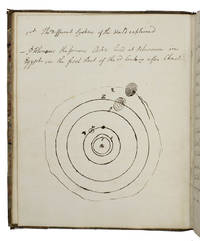
1820ABC_45977England 1820. Late 18th-century half calf marbled sides. 4to. Manuscript volume of notes on practical astronomy and mathematics in English written in ink on Dutch paper with a Maid of Dordrecht watermark without countermark. The leaves are numbered from the front 101 and 26 leaves of text and diagrams 39 blank leaves in the middle last 26 leaves in reverse order illustrated with several astronomical and mathematical diagrams including one of a solar system. A fascinating manual of astronomy written in English particularly as it relates to the form of the motions of the heavens dating from the period 1780-1825 probably from the beginning of that range. It is written in a single hand with the exception of one page though with some variations indicating that different parts of the MS were written at different times. The MS could have been prepared for personal use or as part of public tuition probably the former. The writer summarizes the subject matter of the manual on the first leaf: Astronomy is that part of Natural Philosophy which treats of the Phenomena of the heavenly Bodies. It is divided into 2 Parts Physical and Plain: by the latter we discover their Motions from the Apparent Motions; by the former the Causes of these real Motions. The manuscript comprises three parts with distinct subject matter. The first part covers the motion of the earth around the sun and its rotation about its axis with the consequences for the apparent motions of the sun and the heavens; with the moon and its phases and motion; and with lunar and solar eclipses. There are several references to John Keills An introduction to the true astronomy London 1721 or later editions. The second part principally discusses section 11 of Newtons Principia 1713 or later editions in particular as it relates to the motion of the moon. This part ends with a short section on algebra particularly polynomials which seems to have been composed more haphazardly than the remainder of the text. The third part which runs backwards starting from the end of the notebook gives demonstrations of various results in Book I of Principia notably the theorem that the orbits of the bodies in the solar system do not precess if and only if the central attractive force operating on them is exactly inverse-square. This is an important result not only for Newtons system of universal gravitation but also for the observational astronomy of the solar system which is discussed in the opening section of the book. Between the end of the second part and that of the third there are a few blank leaves and others have been torn out but the text appears to be complete.The manuscript appears to work through at least two different texts beginning with Keills on astronomy. There is a section devoted to what is called the precession of the equinoxes the westward drift of the points where the ecliptic and equator intersect due to the precession of the earths axis - the author notes that Sir Isaac Newton has demonstrated that it arises from the broad spheroidal figure of the earth. The author then turns to sunspots and the arguments for and against their being on the surface of the sun. Then comes a long discussion of the planets: the planes and periods of their orbits phases conjunctions retrograde motions apparent brightness and their distances from the sun. The second and third parts are notably more mathematical in nature than the first.The third part of the manuscript consists of a reading of various sections of Newtons Principia 1713 or later editions. Again it appears to work through and in some cases repeat Newtons proofs rather than representing a translation or paraphrase. It is not based on Mottes translation nor does it correspond with Thorps partial translation and edition. It does not appear to be based on any other intermediary between Newton and the writer such as Pemberton but to rely on Newtons Latin original here rendered in places pretty exactly into English. It renders propositions 43 to 59 of section 9 of book 1 of the Principia which concern the motion of bodies in moveable orbits and the motion of the apsides. This topic remains of considerable interest to astronomers and historians of astronomy. The manuscript hand remains fairly constant throughout the book: some variations more likely indicate the same writer at a different times or with a different pen than a different writer. The manuscript hand and paper together date the manuscript fairly securely to the period 1750-1825. If our hypothesis that the author used Thorps edition of Principia is correct that would date the manuscript no earlier than 1777. The section on the planets in the first part does not mention Uranus Georgium sidus discovered by William Herschel in 1781. Since the anonymous author seems to have followed astronomical discoveries closely this suggests a date no later than 1781. We therefore tentatively date the composition ca. 1777/81.We are indebted to Scott Mandelbrote for his assistance with the description of this notebook.Binding slightly rubbed. A couple pages have a tear at the foot and others are stained. Otherwise in very good condition. unknown
1955006491Berlin:: Springer - Verlag 1955. Inner hinges are perfect. Stamped "WITHDRAWN" on the rear endpaper. Text pages are crisp and unmarked. No underlining. No highlighting. No margin notes. Illustrated with figures and a few photographs. "Mit 257 Abbildungen." Graphs. Tables. Bibliographical references. Index. Bound in the dark blue cloth lettered in shiny gold on the spine and front cover. . Zweite Auflage neu bearbeitete . Hard Cover. Very good EX-LIBRARY copy./No Jacket. 8vo. ix 866pp. Springer - Verlag Hardcover
2026x-1009689320Cambridge University Press 2026. Hardcover. New. 430 pages. 8.00x0.88x10.00 inches. Cambridge University Press hardcover
52186594-nnew. unknown
52186594like new. unknown
1997AS-48Cambridge U.K.: Cambridge University Press 1997. Physics of Solar System Plasmas provides a comprehensive introduction to these ionized gases of the solar-terrestrial environment. The author places emphasis on solar wind and magnetospheres--regions of space around the Earth and other planets that are controlled by the planetary magnetic field and are shielded from solar wind. The text includes a broad introduction to plasma physics including important discussions of kinetic theory and magnetohydrodynamics a thorough description of the Sun and the solar wind and magnetospheric physics. 477 pgs. Illustrated. Spine edges slightly bumped. First Edition. Hard Cover. As New. 4to - over 9¾" - 12" tall. Cambridge University Press Hardcover
1723030380Lugduni Batavorum Apud Petrum Vander Aa 1723. 1st Edition 1st Printing. Hardcover. Very Good. Seventeen Folding Plates. Title Page 16 413 Pp 15 Pp Catalogus Librorum Followed By 17 Folding Plates At End Each With Many Figures. Full Vellum Early 18Th Century Blind Stamped Design At Center Of Covers Spine Stamped In Gilt. Hand Marbled Papers On Pastedowns All Edges Colored Red. Text Block 17.5 Cm Tall. Latin Exposition Of Newtonian Philosophy Addressed To Students. A Very Nice Example In Original Vellum Light Wear At Spine Ends A Few Tiny Holes In Bottom Spine Edge Of Rear Cover And In Gutter Edge At Bottom Of Plates 16 And 17 Not Affecting Text Or Illustrations. Red Color Of Edges Of Page Blocks Is Almost Entirely Unfaded And Still Shiny. No Marks Or Bookplates. Per Wikipedia Willem Jacob 'S Gravesande 1688 - 1742 Was A Dutch Lawyer And Natural Philosopher Chiefly Remembered For Developing Experimental Demonstrations Of The Laws Of Classical Mechanics. As Professor Of Mathematics Astronomy And Philosophy At Leiden University He Helped To Propagate Isaac Newton's Ideas In Continental Europe. In 1715 'S Gravesande Visited London As Part Of A Dutch Delegation Sent To Welcome The Hanoverian Succession In Great Britain. In London 'S Gravesande Met Both King George I And Isaac Newton And Was Elected A Fellow Of The Royal Society.In 1717 He Became Professor Of Mathematics And Astronomy In Leiden. From That Position He Was Instrumental In Introducing Newton's Work To The Netherlands. 'S Gravesande's Main Scientific Work Is Physices Elementa Mathematica Experimentis Confirmata Sive Introductio Ad Philosophiam Newtonianam "Mathematical Elements Of Natural Philosophy Confirmed By Experiments; Or An Introduction To Newtonian Philosophy" Published In Leiden In 1720. In That Book He Laid The Foundations For The Teaching Of Newtonian Mechanics Through Experimental Demonstrations. He Presented His Work Before Audiences That Included Voltaire And Albrecht Von Haller. The Book Was Soon Translated Into English By John Theophilus Desaguliers Curator Of Experiments For The Royal Society. In 1722 He Published The Results Of A Series Of Experiments In Which Brass Balls Were Dropped From Varying Heights Onto A Soft Clay Surface. He Found That A Ball With Twice The Speed Of Another Would Leave An Indentation Four Times As Deep From Which He Concluded That The Correct Expression For The "Live Force" Of A Body In Motion What Is Modernly Called Its "Kinetic Energy" Is Proportional To Its Mass And The Square Of Its Velocity. <br/> <br/> Lugduni Batavorum Apud Petrum Vander Aa hardcover
I19G-00979Houghton Mifflin Harcourt. Used - Very Good. Very Good condition. A copy that may have a few cosmetic defects. May also contain light spine creasing or a few markings such as an owner’s name short gifter’s inscription or light stamp. Houghton Mifflin Harcourt unknown
1998Q-0395935423Houghton Mifflin Harcourt 1998-08-15. Paperback. New. In shrink wrap. Looks like an interesting title! Houghton Mifflin Harcourt paperback
1964034999Los Angeles: Lorrin L. Morrison / Henry Markham Page 1964. 1st Edition . Hardcover. Near Fine/Near Fine DJ. Xvii 226 Pp. Hardcover Issue Black Cloth Gilt In Clear Plastic Dust Jacket. An Excellent Early History Knowledgeable And Detailed. Near Fine Book No Marks Near Fine Clear Glassine Dj With Single 3" Closed Tear At Bottom Of Foredge Of Front Cover 1/2" Closed Tear At Top No Fraying Or Chipping. <br/> <br/> Lorrin L. Morrison / Henry Markham Page hardcover
1943028672The Astrophysical Journal 1943. 1st Edition . Soft cover. Near Fine. Pp 341-346.Offprint In Publisher's Olive Wrappers. A Report Of The Use Of A Lens Or Mirror Near The Center Of Curvature Of A Spherical Mirror Which Is To Be Parabolized With Special Reference To The Special Problems Of The 200" Palomar Lens Which Required An Auxiliary Correcting Plate. <br/> <br/> The Astrophysical Journal paperback
1994057888New York: Random House. 1994. 1st Edition; 1st Printing. Hardcover. Near Fine in Very Good dust jacket. Hardcover with dustjacket first printing as indicated by the publisher's "2" in the number line this publisher did not use a "1" at this time book is in excellent condition the former owner's bookplate on the blank front end-paper is the only remarkable flaw jacket has a vertical crease on the rear flap and moderate rubbing to the surface which is common with most glossy jackets it is clean and presentable the original price 35.00 is present and a professional removable mylar cover is included this is the type of book that raises us above the petty differences and superficial lifestyles that dominate our world a ray of hope in the darkness and folly of human history take the journey it's worth the trip; 429 pages . 0679438416 . Random House hardcover