2 089 résultats
1892445311892. <p>The Planet Mars—Author's Possibly Unpublished Autograph Draft</p> <p> Flammarion Camille 1842-1925. Voyage à la planète Mars. Autograph manuscript in French signed by Flammarion on last leaf. 4to. 3-16ff. in ink rectos only. Paris or Juvisy 1892. Loose sheets. Lightly creased browning slight soiling & chipping but very good.</p> <p> Flammarion's signed autograph draft of what appears to be a popular article based on a section of his classic La Planète Mars et ses Conditions d'Habitabilité published in 1892. Some of the text in our manuscript particularly that on ff. 8 and 9 appears in the first volume of La Planète Mars in the chapter titled "Changements actuellement observes" pp. 547-578; however the remainder of the manuscript's text varies widely from the printed book's and appears to be geared toward a more general audience. La Planète Mars was the most comprehensive work on Mars to yet appear and Flammarion's views on Mars dominated the field in Europe much as Percival Lowell's did in America Lowell began his observations and writings in the mid-1890s after Flammarion. </p> <p> The manuscript shows some revisions by Flammarion on most leaves ranging from crossing out of a few words to the interpolation of several lines of text. A second editor has marked the text in a few places in the margin in plain and colored pencil and the first leaf bears the pencil date July 28 1944 in the upper margin. The first leaf is numbered 3 in Flammarion's hand; however the title and beginning of the text occur on this leaf. Despite the presence of editorial markings we have found no evidence that Flammarion's article was published.</p> <p> The date of this text is important not only for preceding Flammarion's great work on Mars but also because it represents an early date in the acceptance of Mars's "canals" a supposed network of lines crisscrossing the planet these lines are actually optical illusions caused by the human brain's tendency to impose patterns on visual data. First described by Italian astronomer Giovanni Schiaparelli in 1878 the Martian "canals" led to a great deal of popular speculation about the possibility of intelligent life on Mars and became a staple of science fiction. It was not until the Mariner flights to Mars in the late 1960s that the notion of canals on Mars was finally put to rest. </p> <p> In the present manuscript Flammarion referring to Schiaparelli's observations of 1877-86 accepts that the Mars canals exist that they are not optical effects and that they show variation linked with the seasons on Mars. Flammarion is cautious to say that one can use the term "canal" without it being the last word on the supposed structures' actual physical constitution. Flammarion considers the canals and their fluctuations the most "bizarre" feature of Mars unlike anything on earth. He warns against applying physical terms appropriate to earth to Mars without more knowledge of the atmosphere of Mars. He writes that our knowledge of Mars might be comparable to that of a balloonist over Mont Saint Michel trying to explain the fluctuations in its appearance without any concept of tides. His examples of Martian features include the region of Lacus Solis and its affluents Ambrosia and Nectar which had disappeared from view although seen by Dawes Lockyer and Kaiser in years past and the Kepler Ocean.</p> <p> Flammarion states that it would not be completely absurd to consider that the canals could be the work of intelligence. He paints a poetic picture of evening on earth contrasted with morning on Mars and speculates that if there were Martians their intelligence would be superior to ours. He expresses the hope that Mars may provide the long-sought evidence of the "plurality of worlds" a subject on which he had written. His poetic conclusion to this article is very much in keeping with Flammarion's other persona as one of the first great writers of modern science fiction with several novels to his credit. Glasstone The Book of Mars 19-31 reproducing several maps from Flammarion's La Planète Mars. Ley & von Braun The Exploration of Mars 1956 45-46 48-52 61 174 also reproducing Flammarion's maps. DSB. </p> . unknown books
1912179646Juvisy-sur-Orge & Paris: 1912. An exact scientific description in the form of a fantasy An unpublished nine-page article that deftly displays the astronomer and spiritualist's distinctive blend of fact and fiction when writing about his favourite subject: Mars and the life thereon. It is accompanied by a skilled sketch by Flammarion of Mars as seen from his private observatory and two autograph letters signed from him to the commissioning editor of the piece. Alongside H. G. Wells Percival Lowell and Giovanni Schiaparelli Flammarion 1842-1925 championed the "Mars mania" of the 1890s. Having made his name as a public lecturer and scientific popularizer Flammarion founded the Société astronomique de France and established an observatory at Juvisy-sur-Orge which "became something of a nerve centre for Martian research" Sheehan p. 169. He cemented his authority with La planète Mars et ses conditions d'habitabilité a copiously illustrated two-volume encyclopaedia 1892 & 1909. It was the most comprehensive book on the subject to date and enjoyed phenomenal success. Like Lowell Flammarion "was as devout about parapsychology as he was about Mars and the two subjects often commingled" in his writings Crossley p. 130. He wrote prolifically on Mars for books magazines and newspapers for academic and lay audiences and often on commission. This article is a pertinent example of the latter and appears to be unpublished in its present form. In the first letter dated 25 June 1912 Flammarion tells the unnamed recipient that he is in Paris "on the point of starting the article which you requested on the subject of 'Life on Mars'" our translation but has mislaid the details of its proposed length. The second letter dated 9 August sees Flammarion provide a brief outline: "In keeping with your wishes I imagined an exact scientific description in the form of a fantasy Psychical Voyage which consists of all we know about the neighbouring world geography duration of diurnal rotations atmosphere seasons polar snows vegetation scenery weight size of the Sun seen from Mars the Earth seen from Mars the 2 satellites the long years. A more advanced form of humanity seems to be the natural consequence. Should you want to illustrate this description by a drawing I will direct you to the correspondent at my observatory". Flammarion eventually provided this illustration himself for a delicate pencil drawing captioned "Drawing of the planet Mars taken by Mr Flammarion at his observatory at Juvisy" is also present. Below the sketch which shows ice caps and a Martian canal network are instructions in his hand: "Put a square black background to enhance the planet. The upper white mark should be white: it is snow. It is important to maintain the differences in tone". This emulates the reproduction of his drawings in La planète Mars. The manuscript intertwines passages of careful scientific observation with fantastical narrative segments of almost lyrical quality. Most pages show some light revision by Flammarion ranging from crossings out and word substitutions to the interpolation of a line of text. Flammarion the narrator begins by viewing Mars through a telescope on an autumn afternoon noting that polar snows cover vast areas of the surface and commenting on its canals seas and vegetation. In a particularly evocative section on pages 2 to 3 Flammarion describes his speculations being disturbed by the loud buzzing of an aeroplane "an immense dragonfly fleeing at a great height" to its hangar in Juvisy our translation. He likens his thoughts to the machine: "Suddenly it seemed as though my thought itself flew and was going faster than the aeroplane whilst my limbs went numb. Disengaged from my body it travelled through space with fantastic rapidity like a system of psychical waves unknown to terrestrial science". Flammarion is thrown into an out-of-body experience which transports him to Mars. Several pages are dedicated to analysing the Martian landscape and its two moons Phobos and Deimas. Flammarion marvels that he can do so while other astronomers such as Flagstaff and Lowell "with whom I have often discussed the Martian enigma" p. 6 remain below. A voice disturbs his reverie literally bringing him back down to Earth. He laments his mind's inability to recall the details of his experience and ends by speculating about life on Mars no doubt superior in intellect and lifespan to that on Earth. He ends: "I greeted from the bottom of my heart these unknown brothers of whom I had been for a moment the invisible guest" p. 9. Together 4 items in French. Autograph manuscript approximately 2000 words: 9 sheets of Observatoire Flammarion letterhead 216 x 136 mm numbered and written on verso in black ink signed on final page. Sketch of Mars: single sheet of plain paper 170 x 110 mm drawn and written on recto in pencil. First autograph letter signed Paris 25 Jun. 1912: bifolium folded to 215 x 136 mm of Société astronomique de France letterhead written one side in black ink. Second autograph letter signed Paris 9 Aug. 1912: bifolium folded to 216 x 134 mm of Observatoire Flammarion letterhead written both sides in black ink. Faintly creased from folding otherwise in near-fine or fine condition. Robert Crossley Imagining Mars: A Literary History 2011; William Sheehan Planets and Perception: Telescopic Views and Interpretations 1609-1909 2014. unknown
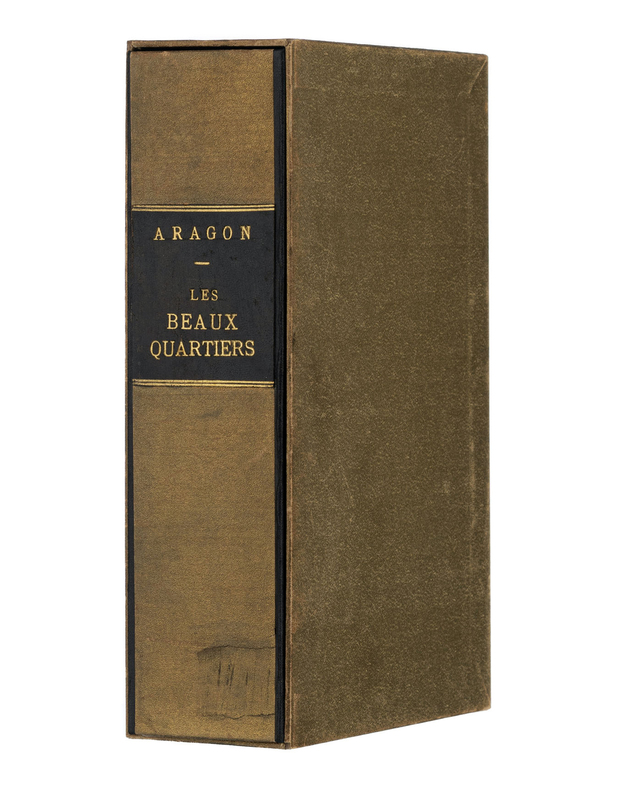
19361367Paris, Denoël et Steele, 1936. Fort vol. in-8° (25 x 15 cm) broché, 57 pages, couverture imprimée en noir et rouge,sous chemise et emboîtage doré. Édition originale tirée à 143 ex. numérotés. L'un des 25 ex. sur pur fil Lafuma, celui-ci le n°10 (tirage de tête avec 7 Chine). "Les Beaux Quartiers" est le deuxième roman du cycle "Le Monde réel" qui a débuté par "Les Cloches de Bâle". Aragon a écrit cette oeuvre à la veille de la deuxième guerre mondiale et y a dépeint des pans entiers de la société française de 1913. DESCRIPTION DE L'ŒUVRE : Le roman raconte l'histoire de deux frères, Edmond et Armand Barbentane, issus de la petite bourgeoisie provinciale du Sud de la France, qui montent à Paris dans les années qui précèdent le première guerre mondiale ; de multiples autres personnages, femmes ou hommes, gravitent autour d'eux. Avec eux, en un impressionnant tourbillon, nous découvrons la vie mondaine et demi-mondaine de la capitale, la bourgeoisie d’argent, la misère crasse des laissés pour compte, le monde des hôpitaux et de la rue, la prostitution, les maisons de jeux, le chantage, les ors, la boue, la police corrompue et celle qui ne l’est pas. Les grands débats y ont une place plus grande encore qu’en province, l’imminence de la guerre y est encore plus flagrante, plus oppressante, les mouvements de grève y sont matés avec davantage de ruse et de violence. La fresque sociale et politique n’y est pas développée au détriment des personnages qu’Aragon prend le temps de faire vivre, espérer, souffrir. L’étau qui les broie et souvent les brise ne cesse d’actionner ses mâchoires infernales : nécessités économiques, politiques, amoureuses et, pour les hommes, omniprésentes contraintes de l’amour-propre qui les taraude et les étouffe comme des vêtements trop étroits et des chaussures trop petites. Cette oeuvre, classique dans sa forme, alterne un style fort, truculent, à l’imprécision suggestive quand il le faut et une prose poétique au charme puissant, au balancement estropié et allusif cher à Aragon. Elle est le couronnement magistral du 19ème siècle réaliste par le 20ème siècle bouillonnant de créativité linguistique : il y a du ZOLA en lui lorsqu’il dépeint les Halles et du BALZAC lorsqu’il enserre ses personnages dans la noirceur des complots et du chantage. On pense à PROUST aussi dans son déploiement fantastique, mais on pense surtout à ARAGON, qu’on le découvre ou qu’on le relise.
188252508Paris France: E. Bernard & Cie. ; Marpon & Flammarion. As New. 1882. Paperback. FREE UPGRADE to Courier/Priority Shipping Upon Request IN STOCK AND IMMEDIATELY AVAILABLE FOR SHIPMENT - Text pristine clean & unmarked - Text in French. Pages not numbered. Among the artists represented: Appian Carolus Duran Guillemet Lalanne and others. -- with a bonus offer-- . E. Bernard & Cie. ; Marpon & Flammarion paperback
201298987Parkstone Press. New. 2012. Hardcover. 1906981469 . FREE UPGRADE to Courier/Priority Shipping Upon Request - IN STOCK AND IMMEDIATELY AVAILABLE FOR SHIPMENT - Flawless copy brand new pristine never opened -- 256 pp. ; 480 illustrations most in color. -- with a bonus offer-- . Parkstone Press hardcover
20344Ensemble de 9 tomes en édition originale in-16 (181 mm env.), demi-chagrin à coins havane, dos à cinq nerfs, caissons décorés d’encadrements dorés, pièce de titre rouge, double filet doré sur les plats, tête dorée, non rogné (Flammarion) ; Ex-libris “Bibliothèque de Robert Buthaud” dessiné et gravé par Raoul Serres.- Dans les Brandes. Poèmes et rondels. Paris, Librairie Sandoz et Fisbacher, 1877 ; couverture et dos conservés ; [2], 287, [1] pp. Envoi autographe signé “A Louis Cilié. Bien affectueusement, Maurice Rollinat”. Bel exemplaire.- Les Névroses. Les ames. Les luxures. Les refuges. Les spectres. Les ténèbres. Avec un portrait de l’auteur par F. Desmoulin. Paris, Charpentier, 1893 ; VIII, 399 pp., portrait en frontispice. Quelques petites rousseurs, plutôt vers la tranche extérieure. Bon exemplaire dans l’ensemble.- L’Abîme. Poésies. Paris, Charpentier, 1886 ; 292 pp. Quelques rousseurs éparses. Bon exemplaire dans l’ensemble.- Les Apparitions. Paris, Charpentier-Fasquelle, 1896 ; 310 pp., les deux derniers cahiers (25 et 26) sont sur un papier plus blanc et brillant. Bel exemplaire.- Paysages et paysans. Poésies. Paris, Eugène Fasquelle, 1899 ; 332 pp., bel exemplaire.- En errant - proses d’un solitaire. Paris, Eugène Fasquelle, 1903 ; 325 pp., [1] f. de table. Bel exemplaire.Oeuvres posthumes :- Ruminations - proses d’un solitaire. Paris, Eugène Fasquelle, 1904 ; 296 pp. ; rousseurs aux 2 premiers feuillets, le reste en bon état.- Les bêtes. Poésies. Paris, Eugène Fasquelle, 1911 ; VII, 227 pp. ; bel exemplaire.- Fin d’oeuvre. Préface de Gustave Geffroy, avec un portrait de l’auteur et trois illustrations. Paris, Eugène Fasquelle, 1919 ; 341 pp. (avec le catalogue complet de l’oeuvre musicale de Maurice Rollinat) ; 3 photographies hors-texte sur papier glacé.
Paris, Flammarion 1955. In-folio (460 x 340) ; LX-56-XI pp., en feuilles, couverture imprimée et rempliée, chemise, étui. Tirage limité à 180 exemplaires sur vélin pur fil du Marais, celui-ci enrichi d'un très beau dessin original à la plume sur la page du faux-titre avec un envoi autographe signé. Un portrait en frontispice de l'auteur et 33 burins originaux dans le texte, dont 2 à double-page et 19 dans le texte. Très bel exemplaire.
1892RW1426Paris:: Gauthier-Villars 1892. 1892. 4to. x 608 pp. 580 illustrations including photos & telescopic images 23 maps 2 color. Contemporary quarter maroon morocco gilt spine raised bands gilt & blind-stamped cloth boards Lycee Charlemagne binding. PROVENANCE: Early pencil ownership signature of Rene Hayaux du Tilly Oct. 1948 1912 - 1998. Near fine. Rare. First edition. This monumental work offers a compilation of all known observations of Mars since 1636. A rich & readable study of combined human knowledge of Mars replete with illustrations and photographs and enhanced by several maps of which two are color. A second volume was issued in 1909. Flammarion was a distinguished writer and astronomer whose special interest was Mars and in this work he seriously approaches the question of whether there is life or even civilization on Mars. A rare but key publication in the history of Mars. DSB V. "In 1892 Flammarion published La planete Mars et ses conditions d'habitabilite a compilation and synthesis of all that had been written and conjectured about the planet since 1636. A second edition appeared in 1909. Flammarion accepted the maritime view of Mars in which the dark areas were seas and the light areas continents. The orange red hue of the latter suggested a sterile sandy environment. But he argued was it possible to 'condemn a world to a fate of this kind' when all the elements of life are abundantly evident Accordingly he attributed the baleful color to vegetation." – Hockey Biographical Encyclopedia of Astronomers Vol I. pp. 372-373. Gauthier-Villars, 1892. hardcover books
awd-1110Flammarion 4, Bianchini-Ferier, 1991. Sérigraphie imprimée sur toile. Tirage annoncé à 1 000 ex. numérotés (208/147 cm).
Paris, Ernest Flammarion, 1895. In-18, (2 ff.), 319 pp., couverture illustrée. - Maroquin brun clair, triple filet doré en encadrement et masque de comédie aux angles sur les plats, dos à nerfs orné, dentelle dorée intérieure, tête dorée, non rogné, couverture conservée (Thierry Sr de Petit-Simier). Édition ORIGINALE. Willy propose ici une série de critiques musicales écrites avec sagacité et ironie sur les différents concerts et spectacles musicaux de l'époque. Chaque critique, datée du 9 mai 1894 au 14 mai 1895, offre un témoignage précieux de la vie parisienne à la fin du XIXe siècle. L'auteur y donne une description détaillée des chefs d'orchestre, des musiciens, des mises en scènes, des chanteurs et du public. Il s'agit du quatrième recueil de ce genre composé par Willy, tous portant la signature de “L'ouvreuse du Cirque d'été” ou de “L'Ex-Ouvreuse du Cirque d'été”. Belle couverture illustrée en couleurs par JOB. UN DES TRÈS RARES EXEMPLAIRES SUR PAPIER DE HOLLANDE. TRÈS bel exemplaire en pleine reliure de Thierry.
8396792Short description: In Russian. Firsov, Nikolai Nikolaevich. Readings on the history of Siberia. Volume 1-2. Moscow: Russian bibliography in the brochures of A. and I. Granat and K., 1920-1921. You are welcome to reach out to us for a detailed description of the copies currently available. Delivery of this book may take longer than usual including extended processing and pre-shipping time, no expedited shipping is available. Please advise us if you have a set date or a deadline to receive your order.SKU8396792
51-3995Paris Gauthier-Villars et Fils 1892. Large 8vo. 18.5 x 28cm. Half blue morocco with marbled boards and eps; gilt spine iwht 5 raised bands. x 608pp. Foxing on title page but not on the other pages. Very good.OCLC Number: 488952896.French astronomer born on 26 February 1842 in Montigny-le-Roi and died on June 4 1925 in Juvisy-sur-Orce. Author of several works from 1883 headed the Observatory of Juvisy founded by himself since he/she carried out numerous research on astronomy meteorology and climatology. He/She founded the monthly magazine L´Astronomie in 1882 and the Astronomical Society of France of which he/she was President until his death. Recognition of Flammarion is because it was the first serious popularizer of astronomy and one of the most translated authors science that put within the reach of amateurs.Intended for an ecclesiastical career Flammarion studied theology at the seminary in the city of Langres activity that had to leave for some time due to various economic setbacks of his family after which came as an apprentice in a print shop. After resuming his studies Flammarion left them completely to devote himself to his passion astronomy studying as an amateur since he/she was a child.Planète Mars et ses conditions d'habitabilité. 1892. Paris Gauthier-Villars et Fils Imprimeurs-Libraires. Reliure personnalisée bleue 1/2 basane. Cartonnage polychrome rouge. TBE sauf quelques taches. Paris, Gauthier-Villars et Fils, 1892. hardcover
191348026Paris, Gauthier-Villars, 1913, in-folio, 20pp, 31pl, demi-toile verte (Rel. post.), Nouvelle édition , considérablement augmentée par Camille Flammarion qui a révisé l'atlas que le cartographe Charles Dien avait publié en 1865. Cet atlas céleste est considéré comme l'un des plus importants de cette période; il a été souvent réimprimé. Au total 31 planches h.t. réparties comme suit : 5 planches doubles des constellations (hémisphères boréal et austral), 25 planches simples de localisation des étoiles et 1 belle planche gravée sur fond bleu représentant les plus belles nébuleuses du ciel. Bon exemplaire Couverture rigide
Paris, J. Hetzel, s.d. Grand in-4, (28,5 x 39 cm) XXV-132 pp. Plein chagrin lie-de-vin, triple filet d'encadrement à froid sur les plats, dos à 5 nerfs, tranches dorées, double filet doré sur les coupes, contreplats bordés et ornés d'une large dentelle dorée, gardes de papier marbré rouge carmin (reliure signée FLAMMARION VAILLANT). 40 planches hors-texte. Un des plus beaux livres illustrés par Gustave Doré chez Hetzel en 1862. Jean Henri Maurice Vaillant (Paris, 1885-?) est un libraire et relieur français actif de 1900 à 1956. BEL EXEMPLAIRE EXEMPT DE ROUSSEURS.
1989014530Paris Flammarion 1989 In-8 Broché Dédicacé par l'auteur
13374Le Figaro. Boussod, Valadon & Cie, éditeurs, 1891. In-folio, reliure de l’éditeur.
1920002239Paris Flammarion 1920
FOS-1356Kra éditeur Paris 1925. Première édition illustrée par Guy de MONTABEL. Un des 83 exemplaire sur papier Japon Impérial. Bien complet de la suite des illustrations sur Chine. Reliure doublée plein maroquin marron chocolat, contre plats de maroquin caramel, une charnière légèrement marquée, tête dorée, dos à 4 nerfs, couvertures conservées, étui (reliure signée Flammarion).
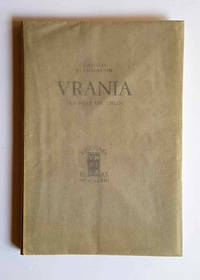
194874<p>Ejemplar de bibliófilo en rama muy buen estado edición de 24 ejemplares numerados ilustrada con 16 grabados al barniz blando realizados por Raúl Veroni. Este ejemplar sin señalar pertenece a su hijo Ral Veroni.</p> Urania paperback
187753093Paris: Libraire Académique Didier et Cie 1877. Second edition. 8vo. v 600 pp. engraved frontispiece 97 engravings in text 6 blue toned lithographic plates and 2 mounted woodburytype photographic plates with tissue guards. Scattered foxing. Contemporary half morroco and marbled paper over boards spine titled and decorated in gilt; lightly rubbed. SIGNED dated 1878 and presented by the author. A very good copy. Camille Flammarion 1842 - 1925 was a French astronomer and prolific author whose works were widely read. His interests in spiritualism reincarnation and alien life throughout the universe were explored in both his scientific and science fiction publications. <br/><br/>Two photographic plates illustrate this title: a three-quarter view of the moon by L. M. Rutherfurd and a constructed view of the moon's surface by James Nasmyth from his classic THE MOON: CONSIDERED AS A PLANET A WORLD AND A SATELLITE. <br/><br/> Libraire Académique Didier et Cie hardcover books
187389835Boston: Roberts Brothers 1873. 12mo pp. i-ii iii-iv 5-287 288: blank flyleaves at front and rear original green cloth front and spine panels stamped in gold and blind brown coated endpapers. First edition in English. LUMEN first appeared in French as RECITS DE L'INFINI in 1873; an enlarged edition followed in 1887 as LUMEN. The revised text of LUMEN was translated into English and published in New York in 1892 by Cassell apparently an unauthorized edition and in London in 1897 by Heinemann apparently an authorized edition with further revisions by Flammarion. The earlier Roberts Brothers text follows Flammarion's original 1873 text. LUMEN is a story in a series of dialogues "of a being who has undergone a number of incarnations on other worlds including planets round Capella Gamma Virgo Sirius and in the constellation Orion." - Locke A Spectrum of Fantasy p. 84. LUMEN is "perhaps the single most innovative work in the entire literature of the scientific imagination. It is the first work to offer any real idea of the scale of the universe; the first to investigate the implications of the finite speed of light and thus to toy with the notion of the relativity of space and time; and the first to examine the implications of evolutionary theory in the modeling of alien life-systems. In all these endeavors it was ahead of its time . It is in Flammarion's work that we find the fountainhead of the mythology of alien beings . Flammarion originated the mode of thought which is effective in modern science fiction's dealings with the category alien. LUMEN's affinity with modern science fiction goes further than this because it is a work expressly directed to the cultivation of the sense of wonder in whose cultivation according to many readers the prime virtue of modern science fiction lies." - Survey of Science Fiction Literature III pp. 1294-98. The two other stories "History of a Comet" and "In Infinity" the first a panoramic history of the solar system narrated by a passing comet the second a spirit description of the universe do not appear to have been reprinted in English after their initial appearance here. Anatomy of Wonder 2004 II-406. Bleiler The Guide to Supernatural Fiction 638. Bleiler Science-Fiction: The Early Years 638. Locke Voyages in Space 73. Suvin Victorian Science Fiction in the UK p. 67. Reginald 05460. Small private owner's book label affixed to front paste-down and his name address and date 25 February 1878 on verso of front flyleaf. Underlining and interesting marginalia by the owner a student or professor at Urbana University penciled throughout the text. Slight spine lean corner tips rubbed a bright tight very good copy. An interesting copy of an uncommon book. #89835 Roberts Brothers unknown books
1882016221Bruxelles Henry Kistemaeckers 1882 Demi-reliure à coins
2077Paris, Léon Vanier, libraire-éditeur, 1897. Anthologie contemporaine, no 1. In-18 (18 cm) 12 pages. Couverture gris bleu imprimée. [ Édition originale ]. Van Bever & Monda 61. [Relié avec] Les Uns et les autres. Comédie en un acte et en vers, représentée pour la première fois au Théâtre du Vaudeville par les soins du Théâtre d'Art, le 21 mai 1891. Paris, Léon Vanier, libraire-éditeur, 1891. In-18 (18 cm) 36 pages. Couverture gris bleu imprimée. Reliure demi-chagrin bleu nuit à larges coins soulignés de filets dorés, dos lisse titré en long « Paul Verlaine », tête dorée, plats et gardes marbrés. (Reliure signée Flammarion Vaillant). Très bel état. [ Première édition séparée, l'original a paru dans «Jadis et Naguère », 1884 ]. Carteret II, 429. Vicaire VII, 997. Van Bever & Monda 47.
189489834New York: The Cosmopolitan Publishing Company 1894. Octavo pp. 1-6 7-287 288: blank note: first leaf is a blank numerous illustrations by Jean Paul Laurens Saunier Meaulle Vogel and others original two-part blue cloth front and spine panels stamped in gold. First edition in English. A translation of LA FIN DU MONDE Flammarion's best and most imaginative novel a panoramic view of humanity from the twenty-fifth century to the far future Stapledonian in scope. "A work of remarkable scope and vision one of the earliest and most ambitious cosmic histories certainly worth reading if only as a historical document. Of considerable historical importance since it was probably read and absorbed by authors as diverse as W. H. Hodgson and Olaf Stapledon." - Bleiler Science-Fiction: The Early Years 778. LA FIN DU MONDE is Flammarion's "boldest scientific romance . an epic of the future. Although it is as much essay as story this is a notable work akin to H. G. Wells's THE TIME MACHINE 1895 and William Hope Hodgson's THE HOUSE ON THE BORDERLAND 1908 in presenting a striking vision of the end of the world." - Clute and Nicholls eds The Encyclopedia of Science Fiction 1993 p. 432. Anatomy of Wonder 1981 1-73 and 2004 II-407. Bleiler The Guide to Supernatural Fiction 639. Clareson Science Fiction in America 1870s-1930s 299. Locke A Spectrum of Fantasy p. 84. Locke Voyages in Space 74. Survey of Science Fiction Literature IV pp. 1592-95. Bleiler 1978 p. 74. Reginald 05459. Early Christmas gift inscription dated 1894 on front free endpaper. Cloth worn at spine ends and corner tips a sound very good copy. An uncommon book rarely found in nice condition. #89834 The Cosmopolitan Publishing Company unknown books