SCHOOL OF MILITARY ENGINEERING, CHATHAMBiblio.com

6 016 résultats
191114938Chatham: School of Military Engineering May 1911. 765 by 1075mm. 30 by 42.25 inches. Colour lithographed map 40-section canvas-backed folding map at a scale of one inch to one mile This map of Hong Kong and the New Territories is one of the earliest maps to show the topography of Lantau Island and adjacent islands in detail. Hills are shown with contours and hachure shading with heights given in feet and villages are named. Cheung Chau called "Chung Island" is detailed but Lamma appears to have been only partially surveyed. The "Mouth of the Canton or Pearl River" runs along the left margin. Mountains of interest include Lin tau Lantau Peak at 3064 feet Victoria Peak at 1774 feet Ma On Shan at 2261 feet and Tai Mo Shan at 3130 feet. Part of the new single-track Kowloon Canton Railway which opened in 1910 is depicted between Tsim Sha Tsui and Sham Chun Sum Chun. This map is an early example of the topographical maps of areas of British political and commercial interest compiled by the Geographical Section General Staff of the War Office throughout the twentieth century. School of Military Engineering, unknown
1928ABC_50475Iran 1928. Oblong album 24.5 x 29.6 cm. Mid-19th-century bright blue faux-leather the front board features a pictorial on-lay within a rectangular frame the illustration depicts a young woman in traditional costume holding a large ceramic vessel. The joints are laced through onto 2 supports. With 19 black and white photographs ca. 23.1 x 17.1 cm on thick dark blue/black paper. 9 ll. Collection of 19 engineering photographs taken in Iran dating from ca. 1928 to 1930 CE. The majority of the images are annotated with the year 1308 AH 1929-1930 CE while only photograph 7 is dated 1307 AH 1928-1929 CE.The album documents large-scale engineering works and urban modernisation in Iran during the early years of the Pahlavi dynasty 1925-1941 under Reza Shah Pahlavi 1878-1944. In this period cities such as Tabriz underwent significant restructuring and infrastructural development as part of broader state-led reforms.The photographs depict surveying activities including measuring instruments mounted on tripods uniformed officials and extensive reconstruction works. Several photographs are identifiable as views of Tabriz including the development of the Gaji Gate Darb-e Gajil in December 1929 Ahrap Ahrab Street and Munjam Street under construction. Other views show street levelling and widening works illustrating the transformation of older urban quarters into broader modern thoroughfares.Further noteworthy subjects include railway works and one photograph taken in Jafarabad shows several men wearing a combination of traditional clothing including papakha-style headgear and Western clothing reflecting the broader cultural transition of the period. The present work therefore stands as an informative visual record of early 20th-century Iranian engineering urban renewal and state modernisation.With some glue staining to the dark blue paper on several pages. A few photographs show minor marginal wear not affecting the images themselves. The final photograph is not mounted on the album paper but on a separate piece of card and is loosely inserted. Otherwise in good condition.l Cf. Tofigh Kouzehkanani & Zelef "Towards extroverted urbanism: Haussmannization and building a new urban identity in Tabriz 1925-1942" ITU AZ 22 3 2025 pp. 559-577 hardcover
19952091202133204358Omatsu-do 1995. Soft Cover. Fine. Number of books: 38 books in total Omatsu-do paperback
190360341Flint & Detroit MI: General Motors 1903-1938. Twelve vols. Oblong folio. 19 x 12.5 x approx. 2-3 in. per vol. 30 linear inches. 251; 278; 228; 84; 233; 312; 264; 140; 158; 160; 208; 212 leaves 11 of 12 vols. unnumbered. all silver gelatin Photostatic photo print positives on inconsistent quality papers either due to processing or washing process after being shot with the Rectigraph camera reproducing through a prism an image some w/ borders all featuring nine 4 x 6 in. data cards on recto of each leaf all identified w/in the original images some from photographs containing well over 20000 illustrations diagrams photographs and technical details roughness to some of the fore-edges photo textblock not cut or trimmed to size so rough cut at fore-edges occasional lifting from old wicking at fore-edges faint tidemark to lower fore-edges of a couple volumes. Uniformly bound in three-quarter maroon-coloured calf over black pebbled cloth on beveled boards Broun-Green Co. Safety Minute Book McMillan Patented post-binders with three metal posts and ring locking mechanism all leaves perforated at gutter margin for loading into the binders decorated endpapers thumb tabs at fore-edges demarcating the front of the binder gilt lettered title stamped on front covers of all some scuffing edgewear couple hinges starting or weakened occasional scuffing to back covers or to spines former owner’s labels attached to spines of a couple vols. still a VG set originally acquired by a collector when most of Harrah’s automobiles and other material were auctioned off in three separate sales in the mid-1980’s after efforts to preserve the collection failed following the acquisition of Harrah’s casino and hotel empire by Holiday Inns with their ownership stamps on flyleaves. Since Harrah mechanics had to maintain a fleet of over 1425 automobiles many of them exceedingly rare early Brass Era and foreign models these volumes provided invaluable mechanical details. This immense and unique reference set reproduces over 22000 well-illustrated index research cards on 2525 leaves prepared by General Motors for their engineering and technical staff tracking and recording the myriad of manufacturers and suppliers for automobiles trucks aircraft and marine craft from the Brass Era through the Great Depression. These prepared by the GM in-house technical periodical “Motor Vehicle Digest†provide essential visual and technical historical data for the development patent history engineering inventions of most of the major and minor national and international automobile manufacturers and parts suppliers for over three decades prior to World War II. Basically serving as the automotive industry’s equivalent of the National Union Catalogue or Acta Sanctorum these gigantic volumes trace the origins mechanical development devices and equipment on 1000’s of different manufacturers most having been lost now to the passage of time and the many shake-ups during the 20th Century. Not only do they serve as original reference from contemporary technical journals in German French Italian Norwegian Dutch and Danish all neatly translated into English but also offer a means to visually trace the development of the automobile. The four “Engine Parts†volumes include extensive sections on magnetos gasoline pumps accessory drive chains camshaft gears water pumps pistons crank shafts water pumps fuel systems fuel gauges carburetors throttle controls air filters fuel injection and even the 1937 introduction of the Down Draft Carburetor. Of notable interest is the extensive section on radiator badges or mascots and Motometer ornaments for the radiators including winged Gods & Goddesses animals and grille ornaments. The myriad of manufacturers represented is dizzying ranging from Mercedes to Packard Bugatti to Lejeuene Wolsely to Zenith with Napier Thornycroft Solex Rateau Mercedes Rickenbacker Stromberg & Locomobile thrown in. Electrical systems transmissions gears steering systems suspension shocks and more are all minutely detailed. The “Roadwheels†volume encompasses a wide range of companies and developments attempting to deal with the rough roads prior to the Good Roads Movement including spring types with internal springs against the axle tension types compression types and those specifically developed for electric vehicles and companies building electric motors for each wheel hub. The two “Internal Combustion Engines†volumes encompass not only 4-cylinder and 6-cylinder engines for automobiles but also diesel or modified engines stationery engines submarine diesel engines ocean liner and locomotive engines rotary engines for aircraft and marine applications two-cycle or two-stroke engines developed for early motorcycles and motorcycle cars and even the innovative sleeve valve motors from Willys-Knight. Engine manufacturers range from Delahaye to Bentley Buda to Humboldt-Deutz along with Mianus Alpha Northill out of Los Angeles California Coventry-Victor Tuxham Plenty & Son and Brooke. The “Final Drives or Transmissions†volume examines drive axles front brakes and other systems for Tatra Bugatti Benze & Lorelei while “Electrical Systems & Parts†details nearly 35 years of spark plug priming plug and ignition apparatus from early Brass Era and efforts of Champion Milla Strumpell Helwig Mosler and others. Interestingly the volumes focus primarily on GM competitors inventions technology & development and much of the data drawn from often obscure contemporary automakers’ journals would have proven invaluable especially as before the internet global searches and other digital reference guides there would have been nearly no comparable cross-reference to foreign technology. Lord 1858-1929 was a Princeton alumni having graduated 1879 worked in cattle ranches and gold mining in Arizona spent several years as an insurance broker in New York and Spain worked for the US Secret Service and served during the Spanish-American War in the Army Commissary Dept. in Cuba. After working in advertising and newspapers in Seattle and assistant to the Univ. of Washington he was contracted by General Motors to oversee and compile their in-house “Motor Vehicle Digest†until his death. The GM MVD should not be confused with the many different “Motor Vehicle Digest†laws and subject volumes issued by various states in the first half of the 20th Century and the only extant set of the original in-house printed journal NOT these unique volumes is recorded at the General Motors Institute Collection in Flint MI. The Rectigraph Co. was bought out by Haloid in 1937 and later became Haloid-Xerox in 1958 and their process was also used by Photoclerk and Dexigraph of Remington Rand. These still offer essential technical reference as frequently many of the magazines in the collection have never been digitized for use or are largely unavailable other than through in-person visit to special collections libraries or museum references. No copies located in Worldcat the GM Institute or Henry Ford; See: George P. Hanley The Collection of Industrial History The Society of Automotive Historians Newsletter Issue No. 63 June 1979 pp. 3-5; Frank Howard Lord Obituary The Princeton Alumni Weekly Vol. XXX No. 1 1929 pp. 40-43. General Motors, hardcover
19360008066WASHINGTON DC. Very Good. 1936. On offer is the original design study for a major dam project in the United States. The study is comprised of 2 documents. The main document is 10 inches by 8 inches contains 123 pages and is in excellent condition. The second document is a technical specifications document that contains 37 pages. It too is in excellent condition. The Savage River Reservoir is a 360 acre storage reservoir in northwest Maryland. It was completed in 1952 by the U.S. Army Corps of Engineers which also currently maintains it. The reservoir was formed by the Savage Dam which impounds the Savage River. The reservoir is used for flood control and municipal drinking. The Savage River Dam is a rock-fill earthen dam 184 feet high 1050 feet long and drains an area of 105 square miles. The dam was modified in 1980 and is owned by the Upper Potomac River Commission. The Savage River is a major wilderness recreation area and the river has been the site of U.S. Olympic trials for canoeing and international canoeing slalom championships. It is reputed to be one of the best wild trout streams in the mid-Atlantic United States. The reservoir is a major supplier of fresh water to Washington DC. Although completed in 1952 planning had begun in the 1930's. Construction began in 1939 but was suspended in 1942 due to U.S. entry into WWII. Construction resumed in 1946. The Savage River Dam Analysis of Design document is dated 1937. This 123 page document is the end result of several years of study and then the application process for funding. The project was initiated by the Upper Potomac River Commission and undertaken by the U.S. Army Corps of Engineering. It was funded by a grant from the Works Progress Administration WPA. The WPA was Franklin Roosevelt's grand scheme to help deal with the massive unemployment stemming from the Great Depression. It was the largest and most ambitious American New Deal agency employing millions of people to carry out public works projects including the construction of public buildings and roads. The Savage River Dam Analysis of Design contains general descriptions design criteria and illustrations technical specifications drawing maps and charts. There are numerous detailed fold-out engineering drawings bearing the U.S. Engineer Office stamp and signatures of the 3 signing engineers - Tippietts Schmitt and Luplow. Since its construction there has been subsequent work over the decades. Although there may be some copies of the model studies for this major dam project this appears to be the original design document. The second document is a technical memorandum entitled Spillway For Savage River Dam - Hydraulic Model Investigation. It is dated 1954. The purpose of this memorandum was to verify the data regarding flow rates and impacts as a result of additional flood control alterations having been made. The document contains 37 pages of charts diagrams and analysis. A researcher looking at the underlying studies that led to the decision to build this important dam would find this study to be a goldmine of information. Environmentalists could see the state of conservation thinking at the time. The area is under active threat today 2018 from creeping urban spread and natural gas drilling. This document shows the original thinking and work that went into the creation of the reservoir and the Savage River system.; Manuscript; 4to - over 9¾" - 12" tall; KEYWORDS: HISTORY OF 20TH CENTURY; 1930S; GREAT DEPRESSION; NEW DEAL; FRANKLIN DELANO ROOSEVELT; UNITED STATES MARYLAND SAVAGE RIVER; SAVAGE RIVER DAM; SAVAGE RIVER RESERVOIR; SAVAGE RIVER STATE FOREST; WORKS PROGRESS ADMINISTRATION; WPA; UPPER POTOMAC RIVER COMMISSION; US ENGINEERING OFFICE; U.S. ARMY CORPS OF ENGINEERING; SCIENCE AND TECHNOLOGY; DAM CONSTRUCTION FLOOD CONTROL DAM DESIGN; HYDROLOGY; DRAWINGS; MAPS; CHARTS; W. D. LUPLOW; ERNEST F. TIPPETS SCHMITT; AMERICANA HANDWRITTEN MANUSCRIPT DOCUMENT LETTER AUTOGRAPH WRITER HAND WRITTEN DOCUMENTS SIGNED LETTERS MANUSCRIPTS DIARY DIARIES JOURNALS PERSONAL HISTORY SOCIAL HISTORY HISTORICAL HOLOGRAPH WRITERS AUTOGRAPHS PERSONAL MEMOIR MEMORIAL ANTIQUITÉ CONTRAT VÉLIN DOCUMENT MANUSCRIT PAPIER ANTIKE BRIEF PERGAMENT DOKUMENT MANUSKRIPT PAPIER OGGETTO D'ANTIQUARIATO ATTO VELINA DOCUMENTO MANOSCRITTO CARTA ANTIGÜEDAD HECHO VITELA DOCUMENTO MANUSCRITO PAPEL . unknown
19972080502106907340Not Available 1997. Soft Cover. Fine. The book is in fine condition. Not Available paperback
1929025041Pasadena 1929. Original Drawing . No Binding. Near Fine. 13 3/4" x 12 1/4. Original Pencil Engineering Drawing Of Three Views Of A "Latitude Finder At Any Hour Angle With Three Reflections" Dated 1929 Signed Rwp. The Drawing Is 9 5/8" X 11 1/8" With Ample Margins. Porter Is Famous For His Prescient Pre-Construction Drawings Of The Palomar Observatory And Its Telescopes Machinery And Buildings So Well Visualized That They Were Used As Guides During Construction. <br/> <br/> unknown
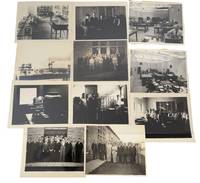
1930232561930. Stanford University Military Engineering Archive Documenting the First Army Ordnance Reserve Gauging Program ca. 1930. Stanford University photo archive documenting the emergence of interwar military-industrial technical education ordnance gauging instruction and precision engineering research on campus during the early development of Stanford's engineering and applied science programs. Rather than depicting science classrooms in a general sense these photographs specifically document the technical culture surrounding Army ordnance training instrumentation systems machine calibration and laboratory-based engineering instruction that linked universities to the expanding infrastructure of American military preparedness between World War I and World War II. Taken together the archive captures Stanford at the moment when higher education increasingly merged scientific research industrial precision manufacturing and military technical training into a unified research model that later shaped the wartime and Cold War defense university system.<br /> <br /> Photo archive of 11 large silver gelatin photographs each approximately 8" x 10" Stanford University California dating from 1930 into the 1950s; two later views mounted to decorative yellow board. Several photographs depict laboratory interiors filled with precision instrumentation gauging apparatus optical and mechanical measuring devices machine-tool equipment calibration benches microscopes drafting stations and technical worktables arranged for instruction and inspection work. One especially important close-up photograph shows a large precision gauging or rotational calibration apparatus associated with ordnance measurement and machine tolerance testing. Surrounding the device are machined cylindrical components threaded fittings gauge rings and polished metal parts likely used in dimensional inspection bore alignment concentricity testing or interchangeable manufacturing instruction. Another darkened workshop view depicts what appears to be a heavy precision lathe or gauging bench fitted with a mounted cylindrical test component equipment consistent with ordnance inspection and military engineering instruction during the interwar period. Additional photographs show groups of students and instructors posed around technical apparatus inside instrumentation laboratories while later mounted photographs document more formalized postwar engineering office and drafting environments associated with large-scale technical administration and research organization.<br /> <br /> Most important is a detailed handwritten verso inscription reading: "Equipment used Feb 1930 Ordnance School at Stanford University. This was first time a course in gauging was given in any Army Ordnance Reserve Unit permanent facilities excepted. Instructor; Lieut Merrill S. Hingo. Photo; Lieut Howard Story Taylor." The inscription firmly identifies the archive as documentation of early Army ordnance reserve technical instruction conducted at Stanford and specifically ties the machinery to military gauging education. In the 1920s-30s "gauging" referred not merely to ordinary measurement but to the specialized science of precision dimensional inspection used in artillery manufacture weapons-part standardization shell tolerances bore measurement interchangeable machining systems and industrial calibration. Such instruction formed a critical component of modern military-industrial production where even minor deviations in machining tolerances could affect artillery accuracy chamber pressure shell seating or mechanical reliability.<br /> <br /> Several outdoor group portraits further reinforce the military context. One large group stands beneath a doorway marked "Military Science and Tactics" while another includes Colonel Donald C. Cubbison a career U.S. Army officer and West Point graduate who served as professor of military science and tactics at Stanford from 1930 to 1935 before later attaining the rank of major general during World War II. His appearance situates the archive directly within Stanford's interwar military training system and links the photographs to broader national efforts to train technically educated reserve officers in engineering ordnance artillery science and industrial preparedness.<br /> <br /> The archive also reflects Stanford's broader transformation into a modern research university centered on applied science and engineering. During the interwar years Stanford's scientific departments expanded laboratory instruction instrumentation programs and research-based technical education under faculty including Robert E. Swain John P. Mitchell William H. Sloan and George S. Parks. Parks in particular became associated with analytical chemistry and geochemical laboratory science disciplines heavily dependent upon precision instrumentation and calibrated measurement systems. The engineering and laboratory culture documented here overlaps with contemporary developments in industrial metrology applied physics materials testing optical measurement and machine-tool inspection that increasingly tied university research to industrial production and military logistics.<br /> <br /> What makes the archive especially significant is the way it documents the transitional infrastructure between traditional university instruction and the emerging defense-oriented research university model. These photographs preserve not simply classrooms but the physical systems of technical education itself: calibration benches inspection machinery gauging apparatus optical instruments drafting rooms and laboratory spaces where students and reserve officers were trained in the precision engineering practices underlying twentieth-century industrial warfare and mass manufacturing. In doing so the archive visually traces the early foundations of the university-based defense engineering culture that would later expand dramatically during World War II and the Cold War throughout California research institutions and the broader military-industrial complex.<br /> <br /> Photographs are sharp and highly detailed with clear views of equipment and interiors; handwritten identifications remain legible. The two mounted 1950s photographs have several large tears without image loss with lighter handling wear elsewhere. Overall good condition. unknown
190953577Evansville IN: A.L. Swanson Electrical & Manufacturing Co. ca. 1909-1925. Oblong 4to. 62 original silver gelatin photos nearly all backed in linen some w/ embossed photographer’s stamp in lower right corner or photographer’s logo in negative several marked in pencil or ink on versos occasional fraying and dustsoiling to fore-edges of linen. Recent black post-binder original brass split pin posts at gutter margin gilt lettering stamped on front cover VG exemplar. This factory sales photo album for the Swanson Electrical & Manufacturing Co. offers an important visual record of the growth of a Midwestern American manufacturing firm after World War I through the Jazz Age. Founded originally in 1900 by Albert Swanson 1876-1949 in Evansville IN this firm became one of the largest Midwestern companies engaged in electrical engineering construction repair maintenance and retail sales. These photos show how the company built and sold washing machines electric motors radios lighting systems industrial fans installed lighting displays for department stores repaired electric motors rewound generators and installed massive electric generating steam plants for factories. These include photos of the new mill built after 1909 for Swans Down Flour showing the exterior stack for steam the control panels and more; followed by images of the electrical conduits and sea of electric motors for the spinning mill machinery of the Cannelton Cotton Mill in Indiana for the Rumble & Wensel Company; a Heinz plant near Indianapolis IN; and of special interest are the photos of the generating plant installed for the Mead Johnson Co. infant formula plant built in Evansville IN in the wake of World War I. These photos also show the repair shops the massive electrical machines the winding of coils the oil and grease-soaked workers amidst a sea of electrical machine parts work benches metal lathes and more. In addition there are a number of photos of the interior of the new Monitor Furniture Co. Plant on East Virginia St. in Evansville IN finished at the end of 1920. Swanson began repairing and installing electrical equipment in a small downtown shop before the end of the 19th century and by 1915 was refurbishing and selling giant Westinghouse and General Electric motors and generators. In 1919 the Company was incorporated and began quickly expanding finally changing its name to the Swanson-Nunn Co. which continued to install and sell equipment out of their building on 8th street much of the 20th Century. Mason 1886-1944 was a commercial photographer who specialized in architectural and advertising photography in Evansville IN throughout his career. See: Evansville Electrical Concern Re-organzied In: Electrical Review August 2 1919 pp. 209-210. A.L. Swanson Electrical & Manufacturing Co., unknown
1985ZB3932341985-1998. Volumes 6 7 9-11 13 15-19; mostly in original paper wrappers price is for the lot. - If you are reading this this item is actually physically in our stock and ready for shipment once ordered. We are not bookjackers. Buyer is responsible for any additional duties taxes or fees required by recipient's country. Photos available upon request. unknown
1965ZB393883Engineering Economy Committee of the American Society for Engineering Edu 1965. volumes 11; 13-36; 40-43. 1965-1997. partly bound library markings textually clean & tight PRICE IS FOR THE LOT. - If you are reading this this item is actually physically in our stock and ready for shipment once ordered. We are not bookjackers. Buyer is responsible for any additional duties taxes or fees required by recipient's country. Photos available upon request. Engineering Economy Committee of the American Society for Engineering Edu unknown
19732110502150903437Society of Civil Engineers 1973. Soft Cover. Fine. Number of books: 3 Society of Civil Engineers paperback
1985EG-210Boston MA.: A.A.Balkema 1985. Comprehensive Five-Volume reference set contains over 440 technical papers presented by internationally respected field experts from 47 countries. Contents include: Vol.I- Theme Lectures; Volumes II-IV- Technical Papers including Geotechnical aspects of Environmental Control Piles and Other Deep Foundations Evaluating Seismic Risk in Engineering Practice Soil Mechanics etc. Vol.V- Post Conference Proceedings including general reports and late papers. 3061 pp. collectively in five volumes. Text in English with a few contributed papers in French. Illustrated. Very minimal shelfwear. Gilt spines. Prior owner's name on the front endpaper in Vol.I only. Heavy Item. First Edition. Hard Cover. Fine/ . 4to - over 9¾" - 12" tall. A.A.Balkema Hardcover
19698249849Iliffe Books 1969. This is an ex-library book and may have the usual library/used-book markings inside.This book has hardback covers. In good all round condition. No dust jacket. Please note the Image in this listing is a stock photo and may not match the covers of the actual item450grams ISBN:059202525X Iliffe Books hardcover
1959ZB2634131959-2001. volumes 6-48 partly bound ex library PRICE IS FOR THE LOT. - If you are reading this this item is actually physically in our stock and ready for shipment once ordered. We are not bookjackers. Buyer is responsible for any additional duties taxes or fees required by recipient's country. Photos available upon request. unknown
195051105New York, McGraw-Hill, 1950. 8vo. In the original full cloth with the original dust-jacket. Dust-jacket with light miscolouring to spine and and a tear to capitals. Small tear to upper part of the back to dust-jacket. A very fine and clean copy. XIII, (1), 451 pp.
195051105New York McGraw-Hill 1950. 8vo. In the original full cloth with the original dust-jacket. Dust-jacket with light miscolouring to spine and and a tear to capitals. Small tear to upper part of the back to dust-jacket. A very fine and clean copy. XIII 1 451 pp. <br/><br/><em>First edition in the rare original dust-jacket of the first textbook on digital computers. It constitutes "the first genuine textbook on computing techniques and computer hardware was a pioneering book that influenced both American and foreign computer developments." Tomash-Erwin E14. "The first treatise on how to build an electronic digital computer" OOC"High-Speed Computing Devices was written to satisfy a perceived need following the end of World War II for a compendium of technologies applicable to the emerging field of the electronic digital computer. Because published technical information was scarce in the US there can be little question that the book was an important contribution to the computer literature of the 1950s. For today's student of computer history whether a professional historian or a history buff the book with its state-of-the-art picture of the period 1947 through 1949 establishes a well-documented baseline for tracking and evaluating subsequent technological progress" A.A. Cohen "Introduction" Charles Babbage Institute Reprint Series Edition of the ERA Report 1983."It provides the best picture of the state of the industry in its infancy. Ostensibly written as a report to the Office of Naval Research the work was really undertaken on behalf of the Naval cryptographic establishment. Engineering Research Associates ERA was a group formed primarily from demobilized World War II naval cryptographers. It presents a discussion of the mechanical and electrical both analog and digital devices that could be usefully incorporated into computing machines. Although it does not survey the computer projects then underway it does occasionally discuss individual machines in the context of integrating devices into complete systems. Engineering Research Associates ERA later became a division of Remington Rand and then of Sperry Rand." Tomash-Erwin E14Tomash-Erwin E14.Origins of Cyberspace 584. </em> hardcover
1974EG-134New York: Academic Press 1974. Classic comprehensive two-volume treatise presents Vol. I: Finite Motions contains coverage of the theory of singular surfaces; shock waves; finite amplitude oscillations; propagations of waves in deformed and stressed elastic solids; quasilinear system of hyperbolic equations with two independent variables; etc. Vol. II: Linear Theory is devoted to an exposition of the dynamical theory of linear isotropic elasticity including detailed coverage of the mathematical problems relevant to linear theory; fundamental theorems; numerous exact solutions of significant problems in one two and three space dimensions; diffraction theory of elastic waves; etc. 1003 pgs. collectively. Illustrated. Prior owner's small stamps on front endpaper lower title pg. and outer edges; small black label to lower spine; minor label removal mark on rear endpaper. Tight binding; contents clean and unmarked. Minimal shelfwear. Vol. I ISBN- 012240601x Scarce. First Edition. Hard Cover. Very Good/ . 8vo - over 7¾" - 9¾" tall. Ex-Professional Library. Academic Press Hardcover
19932080202103700237Shinseishuppan 1993. Soft Cover. Fine. Size: 22cm A5 Shinseishuppan paperback
1975ZB2633751975-2000. volumes 3-28 partly bound ex library PRICE IS FOR THE LOT. - If you are reading this this item is actually physically in our stock and ready for shipment once ordered. We are not bookjackers. Buyer is responsible for any additional duties taxes or fees required by recipient's country. Photos available upon request. unknown
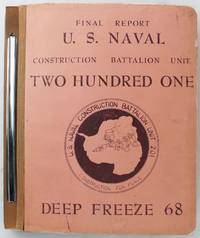
19685022Antarctica 1968. Very good. 65pp. report typed on rectos only plus 28 leaves illustrated with eighty-six black-and-white mounted photographs each approximately 5 x 7 inches most accompanied by typed paper caption strips plus three loose photographs. Quarto. Original pressboard wrappers with metal spine fastener with printed title leaf pasted to front board. Minor wear to binding photos in generally nice condition. A typed report accompanied by detailed photographs documenting the 1967-1968 projects carried out by U.S. Naval Construction Battalion Unit 201 in Antarctica dubbed "Deep Freeze '68." The projects involved the upgrading and expansion of facilities at McMurdo Station and Palmer Station including water sewer and energy infrastructure improvements and laboratory and living-quarters construction. The original photographs here provide more than eighty-five detailed and well-captioned views of Antarctic construction architecture and engineering involved in the execution of “Deep Freeze ‘68†with sixty-five pages of typed reports providing a dense written summary in support of the project.<br /> <br /> Battalion Unit 201 had been newly established in 1967 as a Seabee unit specializing solely in Antarctic construction to continue supporting the series of "Operation Deep Freeze" missions first headed by Admiral Richard E. Byrd in the 1950s to establish a permanent research infrastructure on the then-largely unexplored Antarctic continent. Plagued by material shortages and the savage regional climate Unit 201 was disbanded at the end of “Deep Freeze ‘71†as the brief building season made the continuation of a dedicated Antarctic construction unit unfeasible. unknown
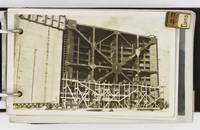
19192655Various locations including Wyoming Nebraska and Iowa 1919. Very good plus. Forty-two original black-and-white photographs and real photo postcards most with manuscript annotations bound into a two-ring leather binder. Two additional postcards laid in. Minor occasional dust soiling but overall in excellent shape. An intriguing pocket-sized binder containing a collection of photographs and real photo postcards documenting large-scale construction projects in the American West mostly involving concrete projects such as dams drainage reservoir infrastructure railroads and more between about 1913 to 1920. All of the projects occur on or west of the Mississippi River in locations such as Keokuk Iowa; Ardmore South Dakota; Grand Island Nebraska; and Arminto Wyoming. The projects cover a wide range of subject matter from a simple base for a railroad mail sack crane to entire dam wall construction and seem to feature several involving sprayable concrete commonly known as gunite. This material was rather new in the 1910s but is still widely in use to the present day.<br /> <br /> The majority of the images are captioned in manuscript identifying the project or location or often both. These include a power-generating dam in Keokuk; reinforcement of a reservoir dam near Lysite Wyoming; widening of a cut for the Chicago Burlington and Quincy Railroad through Arminto; memorializing a concrete crib wall for the same railroad at the Bancroft St. Vincent Omaha; the installation of an eighteen-inch wall casting and sinking the Kelly well in Grand Island; documenting frost action on a brick chimney and water tank and also picturing a "concrete gun" in Worland Wyoming; and others. The images are organized into two sections with small tabs one reading "Dams" and the other "Miscellan."<br /> <br /> The compiler of the pictures is not identified but he or she was most likely involved in the operational aspects of the construction projects. One of the captions is initialed at the bottom "JRH" which may help scholars identify the compiler with further research. The binder itself was produced in Kansas City which may be an additional clue to the compiler's identity. A small but focused collection featuring major western construction projects from the early-20th century. unknown
1968EG-346Arcadia California: A.A. Mathews Inc. 1968. Classic comprehesive text originally published in 1906 presents a detailed preeminent treatise on shield-work and compressed air working including its early history 1818-1880 with notes on caisson sickness. Topics covered include: cast iron lining for tunnels; the Greathead shield in London clay- the assisted shield Great Northern and Strand shields Kingsway subway shield Glasgow District subway Thomson's excavator; the shield in water-bearing strata- the Hudson River Tunnel the Vyrnwy Aqueduct Tunnel Glasgow Harbour Tunnel the Blackwall Tunnel the East River Gas Tunnel in New York the Greenwich subway the Lea Tunnel the Baker Street and Waterloo Railway; the shield in masonry tunnels- the Chagnaud shield the Tremont Street Tunnel in Boston the Boston Harbor Tunnel the Champigneul shield the Lamarre shields the Dieudonnat and Weber shields; tunnelling work carried out with a shield or compressed air- tube railways in London the Rotherhithe Tunnel Paris Metropolitan Railway the River Dee Tunnel the Brackenagh Tunnel the Hilsea Tunnel; etc. Includes a chronological list of events connected with tunnelling by means of a shield or of compressed air and some English patents relating to tunneliing with shield and compressed air 1818 to 1904. 389 pgs. Illustrated with 260 figures drawings and diagrams including a fold-out chart. Gilt spine. Minor rubbing to corners; very minimal shelfwear. Scarce. Limited Edition Reprint. Hard Cover. Fine. 4to - over 9¾" - 12" tall. A.A. Mathews Inc. Hardcover
19332092902141207453China Engineering Institute 1933. Soft Cover. Fine. Volume: 1 China Engineering Institute paperback
1955ZB2634141955-1958. Old Series volumes 3-12 partly bound ex library PRICE IS FOR THE LOT. - If you are reading this this item is actually physically in our stock and ready for shipment once ordered. We are not bookjackers. Buyer is responsible for any additional duties taxes or fees required by recipient's country. Photos available upon request. unknown