13 972 résultats
Folio (340 x 520 mm). (14), 125, (1 blank), 218, (2) pp. With hand-coloured engraved title-page and 30 double-page hand-coloured engraved plates, each celestial charts or model Universes. Also with 4 engraved and 2 woodcut in-text diagrams, illustrated woodcut initials, headpieces, and tailpieces. Contemporary full vellum ruled in floriated gilt, decorated with gilt arabesques, stamped in gilt on spine, all edges gilt. First edition, second issue of the only celestial atlas published in the Golden Age of Dutch cartography, and perhaps the most important 17th century celestial atlas to be produced. - Unlike later celestial atlases, the Cellarius charts demonstrated various ancient and contemporary cosmological ideas, rather than merely the names and positions of the stars. The purpose of the book was to assess contemporary attempts to discover the underlying harmony of the universe. As such, the charts represent the highest levels of 17th century astronomical thought, with lavishly engraved and hand-coloured plates showing the three great theories on the nature of the universe: the Ptolemaic, the Copernican, and the Brahean. This was an era when the debate between these models was at the forefront of cosmological science, on par with the debate between Einsteinian Relativism and Quantum Theory today. - Featured in four plates, the Ptolemaic model was the oldest, formulated by the Alexandrian astronomer and mathematician Ptolemy about 150 CE. Ptolemy's approach placed the Earth at the centre of the cosmos, but unlike other ancient models (for instance, Aristotle's) could explain the odd movement of the planets as observed from Earth: unlike the moon and Sun, most planets occasionally appear to travel in spirals in the night sky rather than tracking sedately East to West. This movement in rooted in the word planet itself, from the Greek "planetes" meaning "wandering one". Ptolemy was able finally to mathematically explain the wandering of the planets, though by way of a complex geometry of epicycles. - By the 16th century, this model was beginning to wear thin. In 1543 Nicholas Copernicus (1473-1543) made detailed observations which led him to publish "De Revolutionibus Orbium Coelestium" ("On the Revolutions of the Celestial Orbs"), which solved the worst geometrical complications of Ptolemy by placing the Sun at the centre of the universe and making orbits by and large circular. However, until Galileo, the Copernician theory lacked an underlying system of physics to explain this new movement. Tycho Brahe (1546-1601) attempted to forge a middle path between the classic Ptolemaic model and the neater mathematics of the Copernican, allowing that most planets would orbit the sun, but that the Sun orbited the Earth, which remained at the centre of the cosmos. As early as the 12th century it was not uncommon to posit that one or two planets might orbit the Sun, which in turn orbited the Earth. However, in the mediaeval period, debate was held off due largely to the lack of technological ability to observe the sky with precision. It was simply impossible to prove whether the Sun or the Earth stood at the centre, and thus similar (though always geocentric) models existed side by side without too much controversy. When Cellarius placed these three models together it was in a world where this had changed: one of these models would emerge to portray what was, to contemporaries, an inimitable truth both scientific and deeply religious. The only question was who would win the day. - In this volume, Cellarius has delved into this debate in striking baroque style, bringing to bear all the power of the Dutch Golden Age of cartography on the heavens rather than the Earth. The four engravings of the Ptolemaic system depict the central Earth encased, as was traditional, in the four elements, including a large ring of fire. Above this are the orbits of the seven planets: the Moon, Mercury, Venus, the Sun, Mars, Jupiter, and Saturn, bordered by the ecliptic, in which the fixed stars spin around the unmoving Earth once a day. Another Ptolemaic plate includes two smaller models as part of the marginal decoration, one of the Ptolemaic hypothesis, "in qua Terra totius Universi centrum", and one of the Brahean hypothesis, "in qua centrum Lunae et Firmamenti est Terra. reliquorum quinq. Planetarum Sol". In this way, Cellarius placed each model in direct dialogue with each other, not only in text but in image. Following the section on Ptolemy, Copernicus bursts onto the scene with a model dominated by a central sun, its rays stretching out to every corner of the universe. Around it are Mercury, Venus, and then Earth itself, around which orbits the Moon; next comes Mars and then Jupiter, now with four moons to itself, and finally Saturn. The four moons of Jupiter had only been discovered fifty years previously, near-simultaneously by Galileo and by Simon Marius; their presence remained innovative in Cellarius's time. The second illustrates in more detail the orbit of the Earth around the Sun and the rotation of Earth which must create night and day in the Copernican system. Finally, Brahe's compromise is introduced, mapped so beautifully that its inelegant fusion of theories appears somehow elegant in its own right. The Earth at the centre is orbited by the Moon, then by the Sun. Around the Sun, however, are Mercury and Venus in tight orbit, and then, more distantly, are Mars, Jupiter - again with its modern four moons - and Saturn. - Thus, in one volume, Cellarius has encapsulated the increasingly accurate celestial cartography, the increasingly uncertain laws of physics, and the endlessly fascinating 17th century multiverse in a moment on the cusp of the most momentous decision in the history of science. Strangely, Cellarius himself remains a somewhat mysterious figure, with little known other than that he was the rector of the Latin school of Hoorn and a gifted mathematician. In fact, it appears that "[t]he most elaborate and famous celestial atlas of the 17th century was issued by an author unknown to the history of astronomy" (Whitfield). This 1661 edition is a variant of the first edition of 1660, identical except for the change of date on the title. - Touch of exterior wear, a few plates with tape reinforcement where they have begun to separate from guards. Stunningly ornate, detailed, and well preserved. Koeman IV, Cel 2. Snyder, Oude Hemelkaarten p. 115f. Whitfield p. 101.
4to. 4 vols. (10), 20 pp. (10), 40 pp. (14), 33 pp. (12), 19 pp. With 2 watercoloured and 4 coloured engraved coats of arms, 1 coloured engraved dedication plate, 183 (instead of 186) plates of birds, 15 of which in watercolour and 168 on splendidly illuminated engraved plates, partly heightened in gold, silver and copper, with lavish watercolour borders. Contemporary glazed red morocco binding with double gilt engraved spine labels, splendid floral spine and cover gilding. Vols. 4-6 with coloured armorial supralibros to upper covers. Calico endpapers, all edges gilt. Unique copy of one of the rarest works of zoological book illustration, from the library of the banker, art collector, and patron Moritz von Fries (1777-1826), for whom the set was in all likelihood specially produced. Around 1800, Fries was considered without doubt the richest man in the Habsburg monarchy. The splendid engraved plates were elaborately illuminated, each with rich botanical and architectural decoration extending even beyond the engraved matter. In addition, the copy at hand was enhanced by 15 original watercolours (all in vols. 5 and 6), whereas the regular copies include merely prints. The only verifiable complete copies, in the Austrian National Library (ÖNB) and the Bavarian State Library (BSB), show less splendid decoration, with only three watercolours each in the respective volumes and no watercolour borders whatsoever. The Fideicommissum collection in the ÖNB holds 5 illuminated volumes of Spalowsky's work, with volume 5 containing the highest traceable number of watercolours among all copies available for comparison. As the final volume is lacking in the Fideicommissum collection, the eight watercolours and splendid framings of vol. 6 of Fries's copy are probably unique. - Since 1932, the only copies traceable at auction were those at Ketterer, 2017 (vols. 1-4) and Christie's, 2012 (vols. 1-3). The volumes sold in 2017, along with the ones at the ÖNB and BSB, belong to the normal edition without the watercolour embellishment and the artist's colouring, while the copy sold at Christie's would seem to have been at least comparable to Fries's in respect to its décor. However, neither the Christie's copy nor any of the others discussed above include any original watercolours, which are to be found in that of Fries's alone. - The splendid avian illustrations surrounded by landscape motifs and architectural decoration are labelled in red ink, identifying the animals' German and scientific names. The labelling is sometimes overpainted, suggesting that the decision to extend the watercolour décor was made at a later stage. The engravings were produced by five artists, among which were Benedikt Piringer and Sámuel Czetter. In vol. 5 of the Fideicommissum copy, Piringer signed one of the watercolours, proving that he provided templates for the engravers and contributed to the colouring. - Spalowsky's "Naturgeschichte der Vögel" was planned as part of a large natural history publication. In a subscription announcement from 1791 the surgeon and army physician advertised the plates showing species "previously not illustrated by any author" and promises the vivid, realistic colour "of the originals". A large proportion of the species depicted, including four falcons, originate from Asia, mostly from India and China, and are not to be found in Brisson's or Buffon's works. The present copy constitutes a special edition of the most expensive version of decoration, priced at 36 guilders - 15 times the cost of the plainest version. The eventual failure of this ambitious project was undoubtedly due not alone to the author's untimely death in 1797, although Spalowsky did succeed in wooing several prominent dedicatees for his elaborate publication. The "Naturgeschichte der Vögel" is dedicated to Alois I Joseph von Liechtenstein and Caroline von Manderscheid-Blankenheim (vol. 1), Beethoven's patron Franz Joseph Maximilian von Lobkowitz and Caroline Theresa von Schwarzenberg (vol. 4), Wenzel count Paar and Maria Antonia Princess Liechtenstein (vol. 5), as well as Anton Theodor von Colloredo-Waldsee-Mels, archbishop of Olmütz (vol. 6). - Provenance: 1) Maurice count Fries, with his library stamps, "EX BIBL(iotheca) MAVR(icii) COM(es) FRIES" to title-page (verso), now obscured by monogrammed red seals ("MF"); 2) Dorotheum sale, 12 Feb. 1932, lot 44, 75 ATS (description mounted to lower flyleaf of vol. 6); 3) Austrian private collection; 4) Dorotheum sale, 18 Dec. 2019, lot 222, not mentioning the Fries provenance or the 15 watercolours. - Marginal flaw to armorial supralibros of vol. 5. Lacks 3 plates (plate 2 in vol. 1, plates 6 and 39 in vol. 5). Index and plate 42 in vol. 4 have small flaws. Plate 31 in vol. 1, plate 43 in vol. 4, and plate 44, as well as one armorial engraving in vol. 5 slightly smudged. Nissen, IVB 888. Schlenker 345.1. Wurzbach XXXVI.56. Sitwell/Buchanan p. 143. Not in Nissen, ZBI. Not in Anker.
8vo. IX, (1), 502, 32 pp. With half title, folding lithographed diagram and publisher's adverts at end dated June 1859. Original green cloth covers bound in as pastedowns, cloth spine mounted on first free endpaper at the end. Modern blue morocco, gilt, marbled flyleaves. Stored in custom-made slipcase. First edition, first issue, of "the most important single work in science" (Dibner), and "a turning point, not only in the history of science, but in the history of ideas in general" (DSB). "No work of science has ever been so fully vindicated by subsequent investigation, or has so profoundly altered humanity's view of itself and how the living world works" (Wilson). - This first impression of the first edition can be distinguished from later impressions of the work through the presence of the misprint "speceies" on p. 20, which was corrected in the second impression. This copy handsomely rebound but still retaining the cloth binding of Freeman's variant b. Of the first edition of 1250 copies, fifty-eight were distributed for review and presentation, this being one of them: the slip of paper "with Mr Darwin's compliments", uncommonly in Darwin's own hand, tipped in at beginning. Small closed tear in the folded table, very light soiling and foxing at the beginning, but a good, clean and uncut copy. - Provenance: small ink stamp of Francis Darwin Swift (1864-1944), grandson of Charles Darwin's uncle Francis Sacheverel Darwin, showing a leaf-bearing stag and the name "F. Swift" in blackletter. PMM 344. Dibner Heralds (1980) 199. Eimas Heirs 1724. Freeman 373. Garrison/Morton (1991) 220. Grolier, Science 23b. Norman 593. Sparrow, Milestones 49. Waller 10786.
8vo. IX, (1), 502, 32 pp. With half title, folding lithographed diagram and publisher's adverts at end dated June 1859. 20th century blue half morocco binding with cloth covers, gilt rules, marbled flyleaves. Top edge gilt. Almost unobtainly rare revised issue of the first edition, or rather the intermediary stage to the first issue of the second edition, called by Darwin himself "only a reprint [with] a few important corrections". Published in January 1860, this is the only known copy to retain the year "1859" on the title-page, the original two quotations opposite (while the second edition is usually marked by having three), and the 32 pages of ads at the end, dated "June 1859" (usually lacking in the second edition). Alterations between the first and second editions are minor, though it is notable that Darwin corrected the misprint "speceies" on page 20 and shortened the "whale-bear" story on page 184. - Immediately recognized as revolutionary and controversial, the "Origin's" small first edition of only 1250 copies sold out on the first day, and by the late autumn of 1859 the publisher Murray was asking Darwin to begin revising at once for a new edition. This was to become the second edition (never so called on the title-page), of which a few copies were printed that retain the date "1859". Freeman knows of only two, at Yale and the University of Southern California, LA, both of which, however, already have three instead of two quotations opposite the title: "The existence of such copies has long been known to the trade, although, from their extreme rarity, few booksellers can ever have seen one" (p. 77). Freeman clarifies that while there is "only one issue of the first edition" of the "Origin of Species", "the text being identical in all copies" (p. 75), it was "customary, for many years, for anyone offering a copy of the first edition to describe it as 'first edition, first issue'", and he admits that "the book-sellers were, in a purist sense, right; the new printing was from standing type of the first edition, although with a considerable number of resettings" (p. 77). By this standard, the present specimen is clearly one of the second edition. Yet Freeman, from his evidence, considered "the presence of two quotations only, from Whewell and Bacon, on the verso of the half-title leaf", to be "diagnostic" of the first edition. Unknown to Darwin's bibliographer, the present revised version sits between the first edition and the first issue of the second, exhibiting characteristic features of both. Only a tiny number of copies of this proto-first issue of the second edition can have been produced: it appears a unique variant of what has always been considered the "rara avis" of Darwin bibliography. - Lower and right edges untrimmed, a very short tear in the diagram's first fold; an old repaired tear to the gutter of the following leaf and some very light foxing to the margin of the preceding one. Otherwise an impeccable copy, bound in the mid-20th century for the American petroleum geologist Dr. Edgar Wesley Owen (1896-1981) with a posthumous exlibris ticket loosely inserted. PMM 344. Dibner Heralds (1980) 199. Eimas Heirs 1724. Garrison/Morton (1991) 220. Grolier/Horblit, Science, 23b. Grolier, Medicine, 70B. Norman 593. Sparrow, Milestones 49. Waller 10786. Freeman p. 77 and cf. nos. 373 & 375.
Folio (208 x 310 mm). Latin ms. and illustrations on paper. 184 ff. with gilt-raised title-page and a total of 292 watercolour and gouache plant illustrations (1 double-page), captioned and numbered 1-290 by a contemporary hand (nos. 45 and 149 assigned twice). 19th century green half cloth over marbled boards. Stored in custom-made half morocco case. Unique, museum-quality manuscript herbal, previously unknown to research, compiled for the Memmingen pharmacist Wolfgang Schötz by an unidentified but obviously professionally trained artist. The nearly 300 watercolours and gouaches, all impressively accomplished, show the principal Central European medicinal, poisonous, spice and ornamental plants as they were to be found in the gardens, meadows and forests of the free imperial city of Memmingen: hollyhock, tarragon, snow pea, prunella, dandelion, spiked rampion (phyteuma spicatum), swallow-wort (asclepias vincetoxicum), echium, caper spurge (euphorbia lathyris), white bryony (wild hop, Bryonia alba), staghorn sumac (Rhus typhina), poppy (papaver rhoeas), banewort (atropa belladonna), foxglove (digitalis), hemlock (Conium maculatum), as well as splendid tulips, irises and martagon lilies, Jacob's ladder (polemonium), rose, chrysanthemum, gentian, daffodil, barberry, etc. The shapes of the leaves and blossoms, often also of the roots and bulbs are rendered with extreme precision; occasionally, the illustration is enlivened with beetles, caterpillars and other insects, drawn with similarly meticulous realism. The Latin and German captions are apparently by two different writers; some of the Latin annotations may be in Schötz's own hand. The quality of the draughtsmanship and colouring approaches that of the roughly contemporaneous studies by Nicolas Robert, whose documentation of the plants in the French royal gardens, commissioned by the court of Versailles, were famous even then and remain so to this day. - The pharmacist Wolfgang Schötz (Schütz) also served as judge in the municipal court of his native Memmingen. Correspondence in his hand with the German physician and alchemist Johann Joachim Becker (1635-82) has survived in the latter scholar's posthumous papers in Rostock. Schötz was considered "the largest and strongest man" in town; when he died in 1695, ten men were needed to bear his mortal remains to the graveyard (cf. J. F. Unold, Geschichte der Stadt Memmingen [1826], p. 292). - Title-page somewhat duststained and rubbed. Leaves numbered 1-183 in pencil in the later 19th century, probably during rebinding; a few leaves transposed. A few edge flaws (some with early repairs); edges somewhat fingerstained and dampstained throughout with a larger dampstain near the end, but illustrations preserved in brilliant original colour. A masterpiece of botanical illustration.
76 volumes, mostly offprints or articles removed from journals, bound in private wrappers or in the original printed wrappers. Mostly 8vo but including a few specimens in small folio. An ensemble of 82 works from the library of Sigmund Freud, comprising roughly half of the known corpus now in private hands. In his census, the medical historian Gerhard Fichtner established the number of works from Freud's former library now in private ownership at only 166 works, or some 4 percent of his former collection of 3725 titles, the vast majority of which (more than 3,400 books) are today preserved by the Freud Museum in London and the Health Sciences Library in New York. Regarding the privately owned works, "it is noteworthy that Freud (during both the Viennese and London time) bestowed upon Eva Rosenfeld, a friend of Anna Freud, 25 important early items from his library. Amongst the privately owned volumes are also some that surfaced in recent years in the second-hand market. They are predominantly offprints, whose dedications show they once belonged to Freud's library and, as a rule, carry the partially erased stamp of the Psychoanalytic Ambulatorium Vienna. They must have arrived long before Freud's emigration in this library, which was seized and destroyed by the Nazis. Did the erasure of the stamp help to save these items, or did it disguise unauthorized possession? They come from the estate of a German analyst" (Davies/Fichtner, pp. 17f.). Indeed, the nature of some of these erasures - rather constituting overpastings with near-contemporary typed transcriptions of those parts of the text obscured by the stamp (as in David Baumgart's article on Spinoza's image in German and Jewish thought) - would strongly suggest the former reason: such an overpasting would arguably have sufficed to conceal the items' provenance from a cursory examination in 1938, but would not at all be helpful to a collector wishing to obscure a third party's title. - The present ensemble includes articles by 40 different authors from a range of disciplines, including Hugo Bergmann, Eugen Bleuler, Carl Clemen, Josef Friedjung, Heinrich Gomperz, Gustav Hans Graber, Jakob Kläsi, Otto Pötzl, and Isidor Sadger. Two specimens preserve the author's inscription to Freud (by Pötzl); others contain autograph corrections by the author (Sadger). Eighteen items show traces of a removed stamp or inscription. Paper often brittle; some wrappers a little rubbed or chipped, but on the whole very well preserved. Acquired from a Belgian private collection. Detailed list available on request. Cf. Davies/Fichtner (eds.), Freud's Library. A Comprehensive Catalogue (Tübingen/London, 2006).
Folio (46 x 30 cm). 2 vols. in 1. (18), 245, (2), 247-482, (10) pp. With 2 richly engraved allegorical frontispieces, an engraved plate with a full-page portrait of Emperor Leopold I, an engraved plate showing all knowledge of the universe organised as a tree, 2 engraved volvelles (with 4 rotating dials), 20 further engravings on integral leaves and a couple dozen woodcut figures in the text. Contemporary richly gold-tooled red goatskin morocco decorated a petit fers, gold-tooled turn-ins, board edges and raised bands, giving a total of more than 1500 impressions of about 14 stamps and 3 rolls, edges gilt over red and blue squiggles. Janssonius van Waesberge, who published Kircher's books in Amsterdam from 1664/65 to 1682, arranged to have copies of several luxuriously bound for Kircher to present to leading figures, and this is almost certainly one of them, presented to Giovanni Paolo Oliva, Superior General of the Jesuit Society. First and only edition of this work important for the theory of science. Its fundamental idea of connecting all branches of science in a common system is based upon the thoughts of Ramon Llull. "Represents the 17th century research for a universal language" (Merill) and is considered a "fascinating anticipation and precursor of computer science" for its treatment of the art of combinatorics. At the same time, it forms a manual of mnemotechnics and of a method of learning. - On 29 July 1661 Kircher contracted to have the Amsterdam bookseller Johannes Janssonius van Waesberge (1616-81) publish his books, including new editions of some previously published works as well as works not yet written. Kircher also had Van Waesberghe arrange for some copies of the books to be luxuriously bound for presentation to various luminaries. - No expense was spared to produce the present binding, and it bears the owner's inscription of Giovanni Paolo Oliva (1600-81), Superior General of the Jesuit Society, who granted the privileges for both volumes - an obvious candidate for a presentation copy. Moreover, the binding is nearly identical to that of the Morgan Library's copy of the same edition, using the same tools in a nearly identical arrangement: thus, a single binder made at least two virtually identical and extremely luxurious bindings for the same edition, a fact which strongly supports the notion that they were made as Kircher's presentation copies. - In a 1948 Sotheby’s catalogue, Anthony Hobson attributes the binding of the copy now at the Morgan to the most famous Dutch binder of all time, Albert(us) Magnus (1642-89). Miner merely notes this attribution and the Morgan still attributes it to Magnus, but Nixon, discussing other Kircher books bound by Magnus, writes "I am less certain that ... the Ars magna sciendi in the Landau-Finaly sale ... does come from the same workshop". Similarly, De la Fontaine Verwey calls the attribution to Magnus "doubtful", and Foot writes that the binding "is decorated ... with closely massed tools, which I have not found on any other Dutch binding of the period". High-quality Dutch bindings in richly gold-tooled morocco from the 1660s to the 1690s were once almost invariably attributed to Magnus, but Foot distinguishes about a dozen different Dutch workshops that finished bindings in this style, noting that some "show the same high level of craftsmanship and are decorated with tools very closely similar to those used by" Magnus. The fact that few of these groups of bindings have so far been linked to named bookbinders takes nothing away from the quality of the work. The present binding represents a workshop of the highest order that has so far been barely studied, and its large number of tools, with more than 1500 impressions of about 14 stamps and 3 rolls, gives a good overview of the workshop’s equipment. The paper is of royal format, probably indicating a large-paper copy, since many copies seem to be 37 to 40 cm tall. - With the contemporary owner’s inscription of Giovanni Paolo Oliva at the foot of the title-page and the armorial bookplate of the Bibliotheca Philosophica Hermetica in Amsterdam. Browned and foxed as common, a few leaves more severely, with the ink of both the letterpress text and the engravings sometimes leaving a browned offset or showing through on the reverse, but otherwise in good condition. The foot of the spine has a crack in the front hinge and a few wormholes and repaired tears in the backstrip (all within the lowest 4 cm); the head of the spine also shows a few wormholes but only minor damage. The turn-ins have browned the outer edges of the marbled pastedowns, and the free endleaves are more severely browned than the leaves of the book itself. The binding is otherwise in very good condition, with only minor scuff marks around the extremities and with nearly all of the tooling clear and well-preserved. De Backer/S. IV, 1066-1067 (no. 28). Breslauer cat. 107 [1984?], p. 188 (this copy). Caillet 5771. Dünnhaupt (Bibliogr. Handbuch), Kircher 23. Ferguson I, 467. Findlen, Athanasius Kircher, pp. 7, 35, 83-85 & passim. Fletcher, Athanasius Kircher (2011), pp. 415-417, 495, 557f. & 567 (no. 24). Honeyman 1827 (incompl.). Merrill, Athanasius Kircher 22 (2 copies, 1 lacking 1st frontispiece & 1 lacking portrait). Thorndike VII, 567. For the Morgan Library copy in a nearly identical binding: H. de la Fontaine Verwey, "The binder Albert Magnus ...", in: Quaerendo 1 (1971), pp. 158-178, at p. 163, note 3. Mirjam Foot, Henry Davis gift I (1978), p. 246. Dorothy Miner/Walters Art Gallery, History of bookbinding (1957) 434 (ill.). Howard Nixon, Broxbourne Library (1956), p. 154. Sotheby’s London, 13 July 1948 (Baron Horace de Landau coll.), lot 69. Sotheby’s London, 13 March 1956 (J. W. Hely-Hutchinson coll.), lot 391 (ill.). For Van Waesberge: Van Eeghen, De Amsterdamse boekhandel IV, pp. 257-163.
000150<p><strong>126 × 59 cm.</strong> Paper mounted on <strong>thick cloth</strong>. Text in <strong>Ottoman Turkish</strong> printed in a <strong>European-style typeface</strong>.</p><p>Depicting the <strong>northern Ottoman territories</strong> extending from the <strong>Caspian Sea</strong> to the <strong>eastern regions of Austria</strong>.</p><p>An <strong>early wall map</strong> printed under <strong>Ottoman authority</strong> in <strong>Üsküdar Scutari</strong>.</p> the Imperial engineering ground forces, Muhendishane
Folio (265 x 420 mm). (4), 3, (1) pp. With 59 etched plates (8 are double-page) by Daniel Mackenzie. Slightly later half calf, marbled sides, gold-tooled monogram AL on spine. First and only edition of one of the rarest books on Japanese flora. Kaempfer (1651-1716) was a professor from Lemgo, Germany, who joined the Dutch East India Company (VOC) as a physician in 1685. After periods in what are now India and Indonesia he travelled in 1690 to Japan to work as a doctor on Dejima (Deshima), the Dutch trading post or factory in Nagasaki. This was one of the rare places where Western and Japanese people were allowed to interact. During his three-year term of duty, Kaempfer was twice allowed to journey to Edo (now Tokyo) in the company of the head of the factory. Upon his return he went into medical practice in his native town, Lemgo. After his return to Europe he wrote a number of works in manuscript, but did publish them, leaving them in manuscript at his death. Sir Hans Sloane acquired these manuscripts, alsong with his drawings and herbarium, and arranged for their translation and publication, the first to appear in translation was The history of Japan in 1727. This English translation established Kaempfer's reputation as the 18th-century authority on Japan and deeply influenced Japan's image in Europe. - Kaempfer's botanical drawings used for the present publication were among the more than 4000 groups of manuscripts from Sloane's collection that formed the core of the Library of the British Museum when it was established in 1753 (Sloane MS 2914). The renowned botanist and companion of the 1768 Cook expedition Sir Joseph Banks (1743-1820) was responsible for the editing and publication of this work and dedicated it to the curators of the Library. In most cases no plates had previously been made from these drawings, so they remained unpublished. In the last years of his life Kaempfer himself had published only a small number of his drawings in his Amoenitatum exoticarum, printed in Lemgo in 1712. Thus the present publication introduces many Japanese plants for the first time to a large audience in the West. Kaempfer's herbarium is now in the Natural History Museum, South Kensington. - Royal Library duplicate stamp in the foot of title page. With some minor foxing, the last few plates stained only in the lower margin, not affecting the illustrations. Otherwise in very good condition. Great Flower Books, p. 62. Henrey 886. Nissen (BBI) 1019. Stafleu/Cowan 3484.
4to. (3), 78 pp. With an engraved plate bound as a frontispiece. Contemporary marbled boards. Second edition of Leibniz's groundbreaking work on combinatorics. It was first published in 1666 as "Dissertatio de arte combinatoria", expanded from the author's thesis "Disputatio arithmetica de complexionibus", with which he earned the venia legendi. This unauthorized re-release, produced 24 years later, caused Leibniz to respond with corrections in the Acta Eruditorum of 1691. Both editions are extremely rare; NUC lists no more than two copies of the present one. - This is Leibniz's earliest work in combinatorics, the branch of mathematics concerned with the study of finite or countable discrete structures. It thus constitutes an early and important contribution to the scientific foundations of modern computer engineering. "In this treatise, Leibniz undertook that part of his grand plan that aimed at achieving a complete set of possible connections of terms, and the mathematical conception of this problem he named 'ars combinatoria' - a name that would stick" (cf. Cantor). This early work of Leibniz is all the more remarkable for the "very modest specialized knowledge that he then possessed [and which] is reflected in the 'Dissertatio de arte combinatoria'" (DSB). - Somewhat browned throughout as common due to paper. Trimmed rather closely, with some professional remarginings at the top edge near the end of the book and repairs to the gutter of the title page (loss of a few letters at the very left, some unobtrusively supplied). A single copy in auction records (1998: Reiss 65, lot 583: 65,000 DM). Apart from the frontispiece, VD 17 cites 33 numbered plates - in apparent error, for no known copy contains more than this single plate. VD 17, 12:194409W. Poggendorff I, 1413. DSB VIII, 153 & 160. Cantor III, 43-45. NDB XIV, 122. Cf. Ravier 6.
8vo. 134 pp., final blank leaf. Original printed wrappers with printed title enclosed in decorative border. First separate printing: exceptionally rare offprint of this important essay on the foundations of calculus and real analysis by the first inventor of non-Euclidean geometry. "As early as 1835, Lobachevsky showed in [this] memoir the necessity of distinguishing between continuity and differentiability" (Cajori). - Lobachevsky's works in other areas of mathematics were either directly relevant to his geometry (as his calculations on definite integrals and probable errors of observation) or results of his studies of foundations of mathematics (as his works on the theory of finites and the theory of trigonometric series). "The mathematicians of the 18th century did not touch the question of the relation between continuity and differentiability, presuming silently that every continuous function is eo ipso a function having a derivative. Ampère tried to prove this position, but his proof lacked cogency. The question about the relation between continuity and differentiability awoke general attention between 1870 and 1880, when Weierstrass gave an example of a function continuous within a certain interval and at the same time having no definite derivative within this interval (non-differentiable). Meanwhile, Lobachevski already in the thirties showed the necessity of distinguishing the 'changing gradually' (in our terminology: continuity) of a function and its 'unbrokenness' (now: differentiability). With especial precision did he formulate this difference in his Russian Memoir of 1835: 'A method for ascertaining the convergence, etc.'. A function changes gradually when its increment diminishes to zero together with the increment of the independent variable. A function is unbroken if the ratio of these two increments, as they diminish, goes over insensibly into a new function, which consequently will be a differential-coefficient. Integrals must always be so divided into intervals that the elements under each integral sign always change gradually and remain unbroken" (Halsted, p. 242). This work includes an extensive discussion of infinite series, including a new convergence criterion, now known as "Lobachevsky's test". Much space is also devoted in this memoir to definite integrals, prompted by the computation of areas and volumes in Lobachevskian geometry. One year later, Lobachevsky devoted a whole memoir to this subject. - Wrappers wrinkled; some damage to border on lower cover; spine and corners professionally restored with like paper. Chipped corners of title-page remargined; interior shows creasing with occasional light waterstains to margins. Exceptionally rare, as are all of Lobachevsky 's Kazan publications, even in Russian collections: OCLC lists the Harvard copy only. Cajori, History of Mathematics, S. 421. Halsted, "Biology and Mathematics", 12th Annual Report of the Ohio State Academy of Science (1903), S. 239-247. OCLC 84296869.
4to (200 x 264 mm). IX, (3), 187, (1) pp. With 13 folding engraved plans and maps, 3 folding tables. Publisher's original cloth with giltstamped spine title, bound by Edmonds & Remnants with their label to lower pastedown. Author's presentation copy of the third edition, inscribed on the day of publication to the influential London architect and journalist George Godwin (1813-88) on the title-page: "Geo. Godwin Esq. / in gratitude for the services he has / rendered to the cause of good / sanitary construction / Florence Nightingale / London, Dec. 14 1863". - When 'Notes on Hospitals' first appeared in 1859, in much briefer form than here, it was "immediately greeted by George Godwin as essential reading for architects, who were advised to 'obtain the volume and master it'" (Mark Bostridge, Florence Nightingale, p. 337f.). As editor of 'The Builder', Godwin expanded its scope to include sanitation, social issues, and other subjects. He wrote on slums and promoted the use of public baths, wash-houses, charitable housing trusts, and pavilion-styled hospitals. His architectural works, centred around Kensington and Chelsea, include The Boltons, Elm Park Gardens, and St. Luke's Kensington. The 1863 edition of "Notes on Hospitals" was "massively augmented and rewritten that it is effectively a new book" (McDonald). - Spine and joints professionally restored. Old paper label on spine. - Provenance: 1) George Godwin (presentation inscription); 2) front pastedown has bookplate of James O'Byrne (1835-97), the Liverpool-based architect whose library was dispersed at Christie's in 1987. Lynn McDonald, Florence Nightingale and Hospital Reform (2012), p. 79. Cf. Garrison/Morton 1611 (citing the 1859 first edition).
231 x 171 mm on backing cardboard (376 x 280 mm). The well-known portrait of Freud taken by the Austro-Hungarian photographer László Willinger: a very attractive print in excellent condition. Willinger, who has been barred from any professional activity in Germany in 1933, worked for some time in the Vienna atelier of his father Wilhelm before emigrating in 1939. The present portrait was created in 1935. - Provenance: collection of the granddaughter of the Austro-American psychoanalyst René Spitz; acquired from a Belgian private collection. - Backing cardboard a little stained in two places and traces of old mounting on verso, otherwise clean and crisp.
8vo. 136 pp. Yellow original cloth in modern half calf slipcase with giltstamped spine title. First edition of Freud's famous study known in English as "Civilization and Its Discontents", inscribed and signed by the author to his son Ernst, an architect, and Ernst's wife, the classical scholar Lucie (Lux), née Brasch (the parents of Lucian Freud): "Seinen lieben Kindern Ernst u Lux / vom Verf.". - Provenance: from the collection of the Austro-British photographer and cinematographer Wolfgang Suschitzky, whose family had known the Freuds in Vienna and who later, after his emigration to London, lived near the Freud Museum in Maresfield Gardens. Passed by descent to his son, the cinematographer Peter Suschitzky, whose works include the David Cronenberg film "A Dangerous Method" about the affair between C. G. Jung and Sabina Spielrein. Latterly in a Belgian private collection. - Occasional light duststaining the original cloth binding, interior in excellent condition. The elegant blue and black half calf slipcase is signed by the Franco-American bookbinder Paul Bélard. - Copies of Freud's works inscribed to his children are of the utmost rarity: the Freud Museum London owns just a single specimen, inscribed to his daughter Anna. Meyer-Palmedo/Fichtner 1930 a. Grinstein 10619.
8vo and 4to. 2 vols. and volume of plates. XLVIII, 654 pp. XXVIII, 757 pp. With 17 plates (12 in colour; with the extra plate after no. II). Contemporary half calf with giltstamped Saxon arms on covers. Edges marbled. First edition of Goethe's principal scientific work, the "Farbenlehre", including the quarto-sized "Erklärung der zur Goethe’s Farbenlehre gehörigen Tafeln". "Goethe's first publication on optics culminated in his 'Zur Farbenlehre', his longest and, in his own view, best work, today known principally as a fierce and unsuccessful attack on Newton's demonstration that white light is composite" (DSB V, 445). The plates are of various sizes, showing this to be the earliest impression of the 17-plate set, but do not have the manuscript corrections present in some copies (cf. Hagen, p. 170). - Bindings somewhat rubbed; occasional brownstaining due to paper. A fine, complete copy in its first binding, originally in the library of the Dukes of Saxe-Weimar-Eisenach: gilt Saxon arms on the marbled covers; armorial stamps to all titles. Most famously, Duke Karl August was Goethe's friend, lord, and benefactor. Hagen 347, 347 d. Goedeke IV 3, 583 (46). Kippenberg I, 386, 389. Hirzel A 288. Speck 2289/90. Schmid 55-58. Brieger 733. WG² 79.
Oblong folio (555 x 385 mm). Tinted lithographed title-page and 30 tinted lithographed plates (555 x 385 mm, one slightly smaller: 350 x 505 mm), all in fine contemporary hand colour. Loose in modern clamshell box. Extremely rare first edition of an impressive series of lithographed views showing the zinc mines, foundries and factories in Belgium and Germany owned by the "Société Anonyme de Mines et Fonderies de Zinc de la Vieille Montagne". The series includes views of Moresnet, Welkenraedt, Rabotraedt, Angleur, Saint Léonard (Liège), Valentin-Cocq and Bray, all beautifully rendered by the French landscape painter Adolphe Maugendre (1809-1895). The Vieille Montagne society was founded in 1837. Its history goes back to 1806, when Jean-Jacques Daniel Dony (1759-1819) was granted the sole mining rights to the calamine deposits of Vieille Montagne (or Altenberg), between Liège and Aachen. Dony had invented a new method for extracting zinc and casting it in ingots. In 1809 he established a rolling mill at Saint-Léonard, apparently the first plant for the industrial production of zinc. The series shows the complete process of producing zinc, from the zinc ore extraction to the stoking, pouring and refilling of the crucible, and finally the production of sheets of zinc in a rolling mill. It includes four detailed views of the Saint-Léonard plant (one, surprisingly, featuring a woman and two children). In the 20th century the Vieille Montagne society, together with a number of other mining and smelting companies, evolved into "Umicore", a global materials technology and recycling group still active today. A second edition was published in 1855 as Album des usines et etablissements de la société and is much less rare than the present first edition. - Some light marginal spotting, the title-page more severely, title-page with a tiny tear, otherwise in very good condition. An important visual record of the history of the zinc industry. WorldCat (only a catalogue entry, not listing any copies); no further copies in KVK. For Dony: Biographical Dictionary of the History of Technology, pp. 376-377; for Maugendre: Benezit VII, p. 273.
Folio (228 x 330 mm). (36), 415, (1) pp. Title-page printed in red and black. With hundreds of geometric figures in the text. - (Bound after) II: Coenders van Helpen, Barent. Thresor de la philosophie des anciens où l'on conduit le lecteur par degrez à la connaissance de tous les metaux & mineraux [...]. "Cologne" (i.e., Groningen), Claude le Jeune, 1693. (6), 240 pp. Title-page printed in red and black. With allegorical frontispiece ("Escalier des Sages"), woodcut ornaments, 12 allegorical plates, and 5 copper engraved plates with alchemical motifs. Contemporary smooth, deep auburn full calf with gilt ornamentation and traces of a label to spine. Editio princeps of books V, VI and VII of the "Conica", the most original part of Apollonius's fundamental work on conic sections. The text survives only in the Arabic manuscript of Abu 'l Fath of Ispahan, purchased by the Medici family in the first half of the 17th century and here translated and edited by Alfonso Borelli. "This was a valuable addition to the mathematical knowledge of the time, for whereas Books I-IV of the Conics dealt with information already known to Apollonius's predecessors, Books V-VII were largely original. Book V discusses normals to conics and contains Apollonius's proof for the construction of the evolute curve; Book VI treats congruent and similar conics and segments of conics; Book VII is concerned with propositions about inequalities between various functions of conjugate diameters" (Norman). "The fifth book is especially important treating of normals as minimum and maximum straight lines drawn from given points to the curve" (Honeyman). "The sixth book is on the similarity of conics. The seventh book is on conjugate diameters" (Cajori). - A fine, wide-margined copy. - Bound first is the final edition of the "Thresor de la philosophie des anciens", a reference treatise for the theory and practice of alchemy, esotericism and hermetic philosophy that draws on Hermes Trismegistus, Paracelsus, and Sendivogius. Couched in the form of a dialogue, the book discusses the ten-step ascent to the single matter via two qualities, three principles, and four elements. The 17 remarkable allegorical plates depict alchemy, chaos, heat, love, the elements, sulphur, mercury, and salt. The Groningen politician Coenders (1601-78) first published this rare work in 1686. - Occasional light browning; title-page trimmed along top edge. Binding a little rubbed at extremeties, spine-end professionally repaired, but an appealing volume. I: Norman 58. Honeyman 119. De Vitry 29. Sarton I, 173-175. DSB I, 179-193 (Apollonius) & II, 308f. (Borelli). Cajori, A History of Mathematics, pp. 40f. DBI XII, 546. Riccardi I, 158 ("bella edizione, ed assai ricercata"). - II: VD 17, 7:651937N. Caillet 2419. Duveen 287. Verginelli 74. Brüning II, 2718. Brunet II, 1052.
Oblong folio (245 x 375 mm). 2 engr. title pages and 22 + 20 engr. plates by Pfeffel after Danreiter. - (Bound with) II: Steingruber, Johann David. Architecture civile. Erster Theil [= all published]. Architecturally engr. title-page, engr. preface (misbound before title-page), and 25 numbered engr. plates by J. D. Ringlin after Steingruber; explanatory text engraved within the plate in German and French. - (Bound with) III: Charmeton, Georges. Plans de divers edifices et corniches choisies. Abriße unterschiedener Gebälcke und Kronwercke. 12 engr. plates, including the title-page. Contemporary German half vellum over paste boards and beige paper covers (a little foxed); slightly faded red stained gilt lettered label tooled directly onto spine. Red speckled edges. A remarkable sammelband of three rare architectural and garden ornament works (the first in two parts), all of which were published by the important Augsburg print publisher Johann Andreas Pfeffel. I: First and only edition of a very scarce ornamental garden pattern book by the newly appointed court gardener and inspector of the Salzburg gardens, Franz Anton Danreiter (1695-1760). In 1728 Danreiter was appointed court gardener and inspector to related buildings by the ducal bishop of Salzburg. He translated Dezallier's "La Theorie et la Pratique du Jardinage" into German and became one of the more important mediators of French garden design to the German-speaking countries. His own designs issued in the present work, in two parts, with the second part particularly rare, show more than 100 ornamental and fanciful planting patterns on 42 plates. This was his first and rarest model book with garden plans for parterres. They show that far from endlessly repeating the strict symmetrical canon of French Baroque garden design, Danreiter developed a never-ending variety in ornamental designs which herald the German rococo. Danreiter served five successive bishops in Salzburg. Between 1727 and 1735 he also engraved a number of large-scale views of the city which represent a unique documentation of Salzburg in its 18th century baroque glory. - II: First edition of Steingruber's first published architectural book, showing designs for town houses and palaces. In total Steingruber shows seven scaled designs from a garden pavilion in an aristocratic park (2), several ever more lavish town houses for the haute bourgeois (4), and finally a ducal residence (1). Each design is shown in as much detail as possible with elevations and plans, but also several sections. The grander houses are shown with views of street and garden elevations; some designs have differently laid out plans. The architect J. D. Steingruber (1702-87) was appointed court architect by the Margrave of Brandenburg-Ansbach in 1734. In the course of his near sixty-year tenure of this position he was able to transform the townscape of Ansbach after his own designs. He is best remembered for his playful "Architektonisches Alphabet" (1773), a remarkable series of designs in which each building has a ground plan based on a different letter in the alphabet. - III: Scarce 18th century copy of Charmeton's rare "Diverses corniches choisies sur l'anticque", originally issued in 30 plates in c. 1670 (cf. Guilmard, 68). Pfeffel decided to issue only a selection of the designs. - Very rare: the only three complete copies of Danhauser's work located in libraries worldwide are at Augsburg (cf. KVK), Dumbarton Oaks (cf. OCLC), and the National Gallery, Washington (cf. Millard, Northern, no. 18). The Bavarian State Library and the British Library have only the first part; Olschki, Choix, 645 offered a copy with the second part, but lacked 2 plates in that part. - First leaf with near-contemporary aristocratic illegible ownership stamp. A fine architectural sammelband in excellent fresh condition with the plates in strong impressions, all printed an thick paper. I: Kat. der Ornamentstichslg. Berlin 3332 (wrong collation). II: Kat. der Ornamentstichslg. Berlin 2006. Cicognara 676. OCLC records copies at Avery and Getty; as well as 4 copies in Germany (including Berlin). III: Kat. der Ornamentstichslg. Berlin 3929.
8vo (154 x 223 mm). (4), 371, (5) pp. Modern full morocco binding with gilt cover rules, spine gilt, leading edges gilt, all edges gilt. First edition of Freud's 'Interpretation of Dreams'. "Unquestionably Freud's greatest single work" (PMM). Here, Freud introduces the idea of the unconscious, and leaves an indelible mark on culture, advancing the idea that dreams have symbolic meaning to the dreamer beyond their literal content. - In perfect condition, preserved in a tasteful modern binding. Garrison/Morton 4980. PMM 389. Grinstein 277. Grolier/Horblitt 32. Grolier (Medicine) 87. Norman F33.
Large folio. (4), 20 pp. With 35 engraved botanical plates (8 folding), 20 drawn by Pierre-Joseph Redouté, 1 each by J. P. and L. J. Redouté, 10 by James Sowerby, 2 by J. G. Bruyière, and 1 by B. Pernotin. Engraved by Fr. Hubert, Maleuvre, Juillet, J. B. Guyard, Stephane Voysard and Milsan. Contemporary half red roan (sheepskin), blue paper sides, green parchment corners. Preserved in custom-made box. Second edition, usually called the second issue, of a flower art book by the French botanist Charles Louis L'Héritier de Brutelle (1746-1800). In this book, L'Héritier describes 35 genera and 124 species of rare plants in Kew Gardens and the herbarium of his fellow botanist Joseph Banks, which he studied in 1786 together with Pierre Joseph Redouté. His text also refers to the 35 plates, which depict some of the flowers. L'Héritier mostly describes horticultural plants, including many exotic plants from South Africa. Most of the plates were provided by the two most gifted botanical artists of the age: the Frenchman Pierre Joseph Redouté and the Englishman James Sowerby. - The "Sertum Anglicum" was published as a token of the author's gratitude for the hospitality shown by Banks and other fellow botanists on his visit to England. Remarkably, 13 genera and 65 species of exotic plants are here described for the first time. Furthermore, no fewer than 31 of the plates are the first published illustrations of the species, and seven remain the only illustration of the species ever published. The book therefore remains an irreplaceable botanical reference work today, beyond its value as a work of botanical art of the highest quality, containing beautiful flower illustrations by two of the greatest masters of all time. - Although the imprint gives 1788 as the year of publication, Stafleu & Cowan call the present version of the "Sertum Anglicum" both a "reprint" and a "reissue", probably published as a whole after L'Héritier's death in 1800. It differs from the earlier version in the number of pages for the main text. The first version was published in five parts with the entire letterpress text in part 1. Its main text occupies 35 pages, while the main text of the present second version occupies 20 pages. But the title-page and the other preliminary leaf are apparently true reissues of the first printing, for both are dated 1788 and have the same imprint (giving the printer as Pierre-François Didot, although he died in 1795, and the same booksellers). While the imprint of the first issue suggests that it was printed and published as a whole in 1788, it was actually published in five parts between 1789 and 1792: in early January 1789 (the complete text and plates 1-2), May 1790 (plates 3-12), April 1792 (plates 13-24 & 15 bis) and late in 1792 (plates 25-34), respectively. Some types on the "1788" title-page were also out of date by 1800. - With a hand-written inscription on the first endleaf. Binding, especially the edges, slightly rubbed; the paper sides are slightly discoloured. With only a few stains and the edges of the paper slightly frayed. Spine professionally reinforced. A large paper copy of a rare work in good condition. Dunthorne 248. Great Flower Books 65. Hunt 692. Nissen (BBI) 1189. Pritzel 5270. Stafleu/Cowan 4492.
4to. (4), 35, (1), 306 pp. With 2 folding tables and 1 folding plate. Contemporary full vellum with 19th century giltstamped red title label pasted to spine. All edges red. First edition of "Bernoulli's most original work [... and his] most famous single writing" (DSB). the "establishment of the fundamental principles of the calculus of probabilities" (Grolier/Horblit). "Jakob Bernoulli's posthumous treatise, edited by his nephew [Nicholas I Bernoulli], (the title literally means "the art of [dice] throwing") was the first significant book on probability theory: it set forth the fundamental principles of the calculus of probabilities and contained the first suggestion that the theory could extend beyond the boundaries of mathematics to apply to civic, moral and economic affairs. The work is divided into four parts, the first a commentary on Huygens's 'De ratiociniis in ludo aleae' (1657), the second a treatise on permutations (a term Bernoulli invented) and combinations, containing the Bernoulli numbers, and the third an application of the theory of combinations to various games of chance. The fourth and most important part contains Bernoulli's philosophical thoughts on probability: probability as a measurable degree of certainty, necessity and chance, moral versus mathematical expectation, a priori and a posteriori probability, etc. It also contains his attempt to prove what is still called Bernoulli's Theorem: that if the number of trials is made large enough, then the probability that the result will lie between certain limits will be as great as desired" (Norman). This was the first statement of the law of large numbers. - Insignificant browning, more noticeable in title-page (with an old edge repair on verso); final leaf a little duststained in the margins. An excellent copy from the library of the Swedish astronomer and statistician Carl Vilhelm Ludwig Charlier (1862-1934) with his bookplate to front pastedown (overpasting an earlier Parisian printed bookseller's label). Charlier played a crucial role in the development of statistics in Swedish academia, and several of his pupils became statisticians. He also translated Newton's "Principia" into Swedish. PMM 179. DSB II, 50. Dibner 110. Evans 8. Grolier/Horblit 12. Sparrow 21. Norman 216. OCLC 10851120. Goldsmiths'-Kress 05090.0.
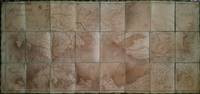
191114938Chatham: School of Military Engineering May 1911. 765 by 1075mm. 30 by 42.25 inches. Colour lithographed map 40-section canvas-backed folding map at a scale of one inch to one mile This map of Hong Kong and the New Territories is one of the earliest maps to show the topography of Lantau Island and adjacent islands in detail. Hills are shown with contours and hachure shading with heights given in feet and villages are named. Cheung Chau called "Chung Island" is detailed but Lamma appears to have been only partially surveyed. The "Mouth of the Canton or Pearl River" runs along the left margin. Mountains of interest include Lin tau Lantau Peak at 3064 feet Victoria Peak at 1774 feet Ma On Shan at 2261 feet and Tai Mo Shan at 3130 feet. Part of the new single-track Kowloon Canton Railway which opened in 1910 is depicted between Tsim Sha Tsui and Sham Chun Sum Chun. This map is an early example of the topographical maps of areas of British political and commercial interest compiled by the Geographical Section General Staff of the War Office throughout the twentieth century. School of Military Engineering, unknown
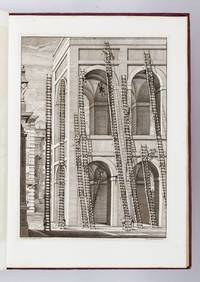
1824ST19673Rome: Crispino Puccinelli 1824. Second Edition with the Addition of Later Machines and Premises. 520 x 370 mm. 20 1/2 x 14 1/2". 4 p.l. XXIX 1 46; 4 48 pp. Two volumes bound in one. Edited and with notes on the life and work of Zabaglia by Filippo Maria Renazzi. <br/> SPLENDID CONTEMPORARY RED MOROCCO VERY ATTRACTIVELY GILT covers with frames formed by thick and thin gilt rules filled with alternating fleuron tools above an undulating ribbon roll central panel framed by multiple gilt rules connecting ornate floral corner- and sidepieces flat spine divided into panels by multiple plain and decorative rules these panels with rectangular centerpiece composed of volutes arabesques and floral tools marbled endpapers. Engraved portrait of Zabaglia by Girolamo Rossi after a drawing by Pietro Leone Ghezzi engraved vignettes on both title-pages and 62 FINE ENGRAVED PLATES 10 OF THEM FOLDING after designs by Francesco Rostagni. Berlin Katalog 2755; Brunet V 1515 ; Graesse VII 501; Cicognara 968 all citing the first edition. Trivial signs of use to the binding and contents with insignificant imperfections only: AN EXCEPTIONALLY FINE COPY the attractive binding lustrous and virtually unworn and THE PLATES REMARKABLY CLEAN FRESH AND BRIGHT with especially ample margins.<br/> <br/> This is a remarkably beautiful copy inside and out of the second enlarged edition of a fundamental work for the history of engineering and the construction of buildings expanding the original 1743 edition for educational use with text in academically appropriate Latin in addition to the original Italian. Niccola or Nicolò Zabaglia 1667-1750 began working as a day laborer on the construction of St. Peter's Basilica in 1686 and was employed full time on the project by 1691. According to Dizionario Biografico degli Italiani "by 1696 he was able to demonstrate his ability as a mechanic moving the large porphyry cup and the bronze statues placed in the Vatican baptistery." Although illiterate he was an ingenious practical engineer. DBI notes that "the preparation of scaffolding and exceptional castles and the transport of extraordinary weights" were his strongest skills. For the Vatican he organized the removal transportation and installation of several obelisks at St. Peter's and other churches figured out a way to move a large marble altar and prepared the scaffolding needed to construct maintain or restore areas of St. Peter's. He was involved in strengthening its famed dome after the earthquakes of 1703 and 1730 inventing the necessary machines to do the work and training the construction crew. This volume's splendid oversized engravings illustrate the machinery and instruments used for the restoration of the dome—elaborate hoisting devices construction tools pulleys scaffolding ornamental tiles etc.—as well as the craftsmen at work. The transportation of the Vatican obelisk by Domenico Fontana in 1590 is represented by a fine selection of plates from Carlo Fontana's work on St. Peter's "Templum Vaticanum" published in 1694 and derived from Domenico's original "Delle transportazione dell'obelisco Vaticano". This undertaking may be compared with the plates depicting Zabaglia's methods for transporting and erecting obelisks. The greatest honor conferred on the unofficial "Engineer of the Vatican" in his lifetime was the first edition of this work published at Rome by Niccolò & Marco Pagliarini in 1743 with a total of 55 plates. The present second edition is enlarged with a biography of Zabaglia written by jurist Filippo Maria Renazzi 1742-1808 and with eight more plates which are among the very best and largest in the book; it is less commonly encountered than the first edition. This may be due to the fact that if put to the intended use in educational settings copies of the 1824 edition would have seen far more wear and tear than the earlier printing. Crispino Puccinelli unknown
4to. (7), "335" [= 332], (6) ff. With a helmed, crested and mantled dedication woodcut of the Contreras coat of arms on the title-page (dexter argent paly of 3 azure, sinister an inverted tower, the whole with a bordure containing 12 X's) repeated at the end of liber I, woodcut device at the end of the text (stork standing on its left foot on a scull and holding a rock in its right foot, holding a banderole in its beak with the word "vigilate"), and a woodcut annunciation (including a banderole with "ave Maria gracia plena") above the colophon, a woodcut tailpiece (plus 5 repeats), and headpieces, tailpieces and factotums built up from arabesque and other typographic ornaments.Tree-pattern tanned sheepskin (ca. 1830), sewn on 3 recessed cords but with 4 false bands on the gold-tooled spine, with the title and author's name on a brown and a black morocco label in the 2nd and 4th of 5 compartments and the owner's initials J.S. (for José Saranderes) in the 5th, marbled endpapers (large blue shell on small brown shell, the form similar to Wolfe 125), headbands in blue and white. Rare first and only early edition, with the text in Spanish but the lists of ingredients in Latin, of by far the most extensive and most detailed early medicinal recipe book in Spanish, with recipes for about 300 medicines arranged in 9 sections for internal medicines followed by 3 sections for external medicines. Each recipe begins with a list of ingredients followed by instructions for the preparation of the medicine and information about its uses and dosage under various circumstances. Liber 1, section V is devoted to opium. The book closes with an appendix on weights and measures and an extensive index. Its only real predecessor, Luis de Oviedo's 1581 Methodo de la coleccion, y reposicion de las medicinas, offers only 49 recipes and gives no clear lists of ingredients. - Almost all we know about Castillo comes from the book itself, where he gives some biographical information. He was born to Spanish parents in Bordeaux, where he studied pharmacology, then worked in the apothecary shop at the Escorial in Madrid where he learned a great deal about chemistry (a remarkably early example of experimental chemistry in pharmacology: López-Pérez, Chymia, 2010, p. 344) and moved about 1610 to Cádiz where he set up his own apothecary shop. He noticed the dangerous lack of good Latin among young people working for apothecaries and provided the present work to remedy the situation. He was still fairly young when he wrote it. On the title-page he calls himself a professor of medicine at Cadíz, but he probably taught on his own account, for there was no faculty of medicine in Cadíz until 1748. The colophon's "en cassa de l autor" suggests the publication was his own venture, without institutional support, and he dedicates it to Juan Ruiz de Contreras y Téllez (ca. 1570-1625), an important councillor to King Phillip III, though he lost some of his influence when the king died in 1621. Although Castillo titles his book Pharmacopoea, and it was widely used and influential in Spain, it appears never to have been officially adopted as a standard, so that it does not fit the strict modern definition of a pharmacopoeia. The content of the book is: liber 1 (internal): I De conditis aut conservis. II De sapis. III De eclegmatis seu loch. IV De pulveribus aromaticis electuariorum. V De opiatis. VI De electuaris. VII De hieris. VIII De pilulis. IX De trochiscis. liber 2 (external): prefacio. I De oleis. II De unguentis. III De emplastris. [Appendix:] Tractado de los pessos, y medidas vivales. - With an owner's inscription of the Madrid pharmacologist José Saranderes, author of a 1837 manuscript on the preparation of opium, on the back of the title-page and his initials J.S. gold-tooled at the foot of the spine. Slightly browned with some foxing, spots and stains, a hole affecting a couple words in Y2 and restored corners in 7 other leaves without loss of text, but still generally in good condition. Binding slightly rubbed but otherwise good. The earliest extensive book of medicinal recipes in Spanish: a pioneering pharmacological work. Bibliographia medica Hispanica II, 140 (p. 63). R.R, Guerrero, Diccinario ... autores farmacéuticos I (1958), pp. 632f. A. Hernández Morejón, Historia bibliográfica de la medicina Española V (1846), 50. Krivatsy 2260 (lacking title-page & 1 text leaf). Palau 47896 & 48131. USTC 5021897. Wellcome I, 1355.
8vo. 453-460 pp. Original wrappers. Stored in custom-made black half morocco case. First printing, offprint from the "Archiv für Anatomie und Physiologie" (1884, 5-6). Inscribed and signed to his schoolfriend, the chemist Josef Herzig, on the upper wrapper cover: "Seinem lieben Freunde Dr. Jozef Herzig | dVerf.". "Freud's full account of his method of staining nerve tissue with gold chloride [...] An English version [...] was published in Brain 7 (1884) [...] under the title 'A new histological method for the study of nerve-tracts in the brain and spinal cord'" (Norman). - Very rare and in quite good condition with insignificant edge wear and traces of handling. Provenance: from the collection of the psychoanalyst and bibliophile Haskell Field Norman (1915-96) with his bookplate on inside front cover; acquired from a Belgian private collection. Grinstein 30. Stanford 6. Norman F 6 (this copy).