13 972 résultats
2003nrg1342Dusseldorf : VDI-GVC 2003 Dusseldorf : VDI-GVC 2003.pictorial hardback First edition 666 pages text in English Absolute minor shelfwear but this is A BRAND NEW BOOK UNUSED. Full refund if not satisfied. 24 hour despatch via Insured. If not pictured in this listing a scan of the actual book is available on request. 1st Edition. Hardcover. As New/No Jacket. Du?sseldorf : VDI-GVC, hardcover
194998191Düsseldorf. 1949. 76 Seiten. Mit teils faks. Abbildungen u. zahlreichen Werbeanzeigen. Ill. Originalbroschur. (Geringere Gebrauchsspuren). 21x15 cm
5C208IEEE Transactions New York 1965-1971. Approx. 2000 pages with many illustrations cloth with embossed back title quart stamp on frontpage. - Text english/ Including: Volume BME-12 1965/ Volume BME-14 1967/ Volume BME-15 1968/ Volume BME-16 1969/ Volume BME-17 1970/ Volume BME-18 1971 - hardcover
19548239Frankfurt. (1954). 24 n.n. Seiten. Mit mehreren mont. Porträt-Abb. u. Textillustrationen von P. Wywiorski. Druck auf Werkbüttenpapier. Vergoldete Originalbroschur mit Kordelbindung. (Bibl.-Exemplar mit Gebrauchsspuren) 24x17 cm
1973145368Stuttgart. 1973. 12 n. n. Seiten. Mit 3 ganzseitigen Zeichnungen in rot. Originalbroschur. 21x15 cm
19582091502135410737Not Available 1958. Soft Cover. Fine. Number of books: 1 Not Available paperback
19981310721PN. New. 1998. Soft Cover. Date is original print. This is a reprint edition . PN paperback
Fine Turkish, Ottoman (1500-1928) Original wrappers. 4to. (28 x 20 cm). In Ottoman script (Old Turkish with Arabic letters). 727 p., richly illustrated. Lithography from the chapograph text. Rare complete translation of this early Turkish edition by French mathematician and rector of the University of Paris Paul Emile Appell. In mathematics, an Appell sequence (or equations, or polynomials), is named after him, as is rue Paul Appell in the 14th arrondissement of Paris and the minor planet 988 Appella. "In mechanics, he proposed an alternative formulation of analytical mechanics known as Appell's equation of motion. He discovered a physical interpretation of the imaginary period of the doubly periodic function whose restriction to real arguments describes the motion of an ideal pendulum" (Wikipedia). The translator Mustafa Salim (1873-?) gave lectures on differential and integral calculations, high algebra, technical mechanics, and mathematical mechanics at Hendese-i Mülkiye-i Sâhâne, Darülfünûn [i.e. House of Sciences] and Darüssafaka, which were outstanding schools of the time. (Kökcü). Özege 13550.; TBTK 749, 4573.; This edition is not located in OCLC.
Very Good Turkish, Ottoman (1500-1928) Original full dark brown leather bdg. Decorated borders on boards, five compartments on the spine, second lettered gilt in the title. Cr. 8vo. (19 x 14 cm). In Ottoman script (Old Turkish with Arabic letters). 294 p., 17 folded engraved plates, and richly engraved illustrations. Early edition of this extremely rare encyclopedic book of the first comprehensive Ottoman engineering including the firsts in Ottoman literature of science, especially on various subjects of modern physics and mechanics, cartography, map making, surveying, arrangement of army camps, construction of pulleys, cannon shooting, etc. This book was written by Hüseyin Rifki, who was the chief professor of the Mühendishâne [i.e. Ottoman Engineering School] and was assigned to Medina, Arabia in 1816 to repair the holy buildings in Medina, Arabia. Another important aspect of the book is that it contains the ratios between the measurements used in various European countries before the meter system and the Ottoman measurements, as well as French measures and scales. Early typographic imprint on European paper with a watermark. Hüseyin Rifki translated the ancient mathematician Euclid's book Elements, in which he laid the foundations of geometry, from the English original of the English mathematician John Bonnycastle (1760-1821) in 1789, into Turkish with the name of "Usul-i Hendese", together with Selim Efendi, a converted English engineer. He was appointed as "Engineering-i Berri-i Hümâyûn Serhocasi" [i.e. The Chief Professor of the Engineering School] after the Code of Engineers was put into effect in 1806. He served as the chief teacher between 1806 and 1816. He was sent to the Balkans in 1816 and then was assigned to repair the holy buildings in Medina, Arabia. He died in 1817, just after returning from Mecca to Medina. Özege 12620.; TBTK 14349.; This edition is not located in OCLC.
Fine Turkish, Ottoman (1500-1928) Paperback. 4to. (30 x 21 cm). In Ottoman script. 9 p. Süleyman Sirri Aral, (1874-1925), was the pioneer of water engineering in Turkey. He was born in Thessaloniki (Salonica), his father was Müderris Yusuf Efendi. Her mother Zühre Hanim and Atatürk's mother Zübeyde Hanim were sibling grandchildren. He was a graduate of the Turkish School of Engineers. He worked as Deputy Chief Engineer of Syrian Public Works, Yanya [i.e. Ioannina] Central Engineering and "Idâdî" Teacher, Baghdad Geometry and Flood Barrier Engineering for the Hindiyye Flood Barrier between 1906-1908, Jerusalem and Bursa Public Works Chief Engineer. He played an important role in the Konya Irrigation Project, (1907-1913). This report is the first one on the Menderes [= Meander] river improvement in 1924. The Büyük Menderes River (historically the Maeander or Meander), is a river in southwestern Turkey. It rises in west-central Turkey near Dinar before flowing west through the Büyük Menderes graben until reaching the Aegean Sea in the proximity of the ancient Ionian city Miletus. The word "meander" is used to describe a winding pattern, after the river. The river rises in a spring near Dinar and flows to Lake Isikli. After passing the Adigüzel Dam and the Cindere Dam, the river flows past Nazilli, Aydin, and Söke before it drains into the Aegean Sea. The Maeander was a celebrated river of Caria in Asia Minor. It appears earliest in the Catalog of Trojans of Homer's Iliad along with Miletus and Mycale. In this report, there's usual information on the Meander River with its geography and history. The second chapter includes the reasons for the improvement of the river and accounts about it with a detailed table. This is an early water engineering book printed in the Ottoman Empire. Extremely rare. First and Only Edition. Not in Özege.; Not in OCLC.; Four copies in the National Library of Turkey.
716 SS. Mit 5 (statt 6) gest. Tafeln. - (Beigebunden): Nova acta eruditorum, anno MDCCXLIX (1749) publicata. (4), 720, (28) SS. Mit 4 (von 6) gest. Tafeln. Halbpergamentband der Zeit mit goldgepr. Rückentitel. Dreiseitiger Farbschnitt. 4to. Sammelband zweier Jahrgänge des bekannten, von Friedrich Otto Mencke herausgegebenen und 1732-76 erschienenen gelehrten Periodikums, das die seit 1682 erscheinenden "Acta eruditorum" ablöste. Beiträge aus Mathematik, Philologie, Jurisprudenz, Bibliothekskunde, Theologie etc. - Vereinzelt unbedeutend braunfleckig. Es fehlt der Titel des Jahrgangs 1748. Diesch 1. Kirchner 91. ZDB-ID 504753-5.
46, (1) SS. 127, (1) SS. 130 SS. Mit 2 gefalt. Kupfertafeln. Ital. Interimspappband der Zeit mit marmoriertem Rückenbezug und hs. Rückentitel. 8vo. Fragment von Bd. 1 der ersten italienischen Ausgabe, enthaltend drei wichtige Aufsätze, darunter der bahnbrechende Text "De analysi aquarum" (1778), "the first comprehensive account of the analysis of mineral waters" (DSB II, 5) - im einzelnen: "Della ricerca della verità"; "Dell' acido aereo" und "Dell' analisi dell' acque". Es fehlen der Titel sowie die auf das Vorliegende folgenden Aufsätze (32; 20; 30; 76; 64 SS.; 2 weitere Tabellen); außerdem der 1788 erschienene 2. Band (120; 50; 48; 84; 46; 30; 62; 110; 64 SS; 2 Tabellen). "The odd pagination is due to each of the individual dissertations having its own pagination within the vols. - Very scarce. A selection of essays translated from the Latin of Opuscula Physica et Chemica, most based on the French edition of 1780-1785, with notes by Guyton de Morveau. They are all separately paged and signed, with some having errata at end. Most have Tofani's signed dedication and notes signed by him [...] There are [...] two folding etched plates of chemical apparatus" (Curtis Schuh's Biobibliography of Mineralogy). - Hier offenbar als Teil einer anderen Zusammenstellung gebunden: Der Rückentitel lautet "Raccolta di Opuscoli Tom. III". Monström 280. Cole 105.
Very Good Turkish Paperback. Some rubbed on cover. 4to. (28 x 20 cm). In Turkish. 16, [6] p., 6 unnumbered b/w plates. Cümhuriyet Türkiyesi, elektrikli Türkiye. Book includes first works from on the electricity supplied and opening of the last electric factory in Turkey, first ten years of early Republican period, 1923-1933, with fine plates and statistical tables. Hasan Halet Isikpinar, was a Turkish engineer and professor. He initially graduated from Robert College as an electrical engineer in 1916, being the first Turkish graduate of the engineering department. He advanced his studies to receive a degree of mechanical engineering from the same institution in 1922. After his assistantship in Robert College from 1923 to 1925, he attended Massachusetts Institute of Technology until 1928 and graduated as the first Turkish student of the university. He kept his tenure as a professor in Robert College in the department of engineering until 1934, where he contributed to the advancement of the department of electrical engineering to a significant extent. He led over 800 engineering projects in Turkey, majority of which being the first examples within the newly founded Turkish Republic. He was fluent in multiple languages including English, French, German and Italian, with his most notable works including widely sourced engineering books in these languages, including "L'Industrie Electrique et les Ressources Motrices de la Turquie", in which he stressed the importance of Turkey as a petroleum resource. He later presented his findings on the topic to Mustafa Kemal Atatürk. He is the son of Mehmet Halit Taspinar, a government officer with civilian Pasha rank equals to Ferik in the government of Abdul Hamid II, best known for passing critical government correspondence to Mustafa Kemal Atatürk during the Turkish War of Independence to support 'Kuva-yi Milliye' (National Forces). First and Only Edition. Extremely rare. Only 2 copies in OCLC 254443059.
Fine Fine Turkmen Original bdg. Dust wrapper. Roy. 8vo. (24 x 17 cm). Introduction in Turkmen, facsimile in Arabic. [2], 28, 256 p., color facsimiles of the earliest of all copies, dating 1206 (preserved in the Library of Topkapi Serai, Istanbul, No. 3472), color ills. [The book of knowledge of ingenious mechanical devices] Adatdan dasari mehanik gurallayn maglumaty hakda kitap. Al-Jazari was a Muslim polymath: a scholar, inventor, mechanical engineer, artisan, artist and mathematician. He is best known for writing 'The Book of Knowledge of Ingenious Mechanical Devices'. Kitab fi ma'rifat al-hiyal al-handasiya, (lit. 'Book in knowledge of engineering tricks') in 1206, where he described 100 mechanical devices, some 80 of which are trick vessels of various kinds, along with instructions on how to construct them. The only biographical information known about him is contained in his famed Book of Knowledge of Ingenious Mechanical Devices. Like his father before him, he served as chief engineer at the Artuklu Palace, the residence of the Mardin branch of the Artuqids which ruled across eastern Anatolia as vassals of the Zengid dynasty of Mosul and later of Ayyubid general Saladin. Al-Jazari was part of a tradition of artisans and was thus more a practical engineer than an inventor who appears to have been "more interested in the craftsmanship necessary to construct the devices than in the technology which lay behind them" and his machines were usually "assembled by trial and error rather than by theoretical calculation." His Book of Knowledge of Ingenious Mechanical Devices appears to have been quite popular as it appears in a large number of manuscript copies, and as he explains repeatedly, he only describes devices he has built himself. According to Mayr, the book's style resembles that of a modern "do-it-yourself" book. Some of his devices were inspired by earlier devices, such as one of his monumental water clocks, which was based on that of a Pseudo-Archimedes. He also cites the influence of the Banu Musa brothers for his fountains, al-Saghani for the design of a candle clock, and Hibatullah ibn al-Husayn (d. 1139) for musical automata. Al-Jazari goes on to describe the improvements he made to the work of his predecessors, and describes a number of devices, techniques and components that are original innovations which do not appear in the works by his precessors. The most significant aspect of al-Jazari's machines are the mechanisms, components, ideas, methods, and design features which they employ. (Source: Wikipedia). There are 50 devices that Al Jazari designed and explained how they function in his book and created technical drawings of them in such detail that allow to reconstruct in its original size, make, model and full functionally. This nice facsimile edition, fully executed in color, is based on a manuscript present in the Library of Topkapi Palace, (ms. no. 3472). It is dated 1206, andaccording to the foreword, is the earliest extant copy of al-Jazarî's work.
4to. (6), 161, (21) pp. With 58 figures on 10 (counting 1 as frontispiece) engraved plates, mostly folding. Contemporary half calf with label to gilt spine. Second edition of the work first published in Frankfurt in 1719 under a slightly different title and the pseudonym of "Gregorius Anglus Sallwigt". Important for the history of Rosicrucianism, "the mystical content of which is very much unclear" (Kopp). An enlarged version, entitled "Opus Mago-Cabbalisticum et Theosophicum [...]", was published in 1735 under the name of the author (who had died in 1727) and was reprinted in 1760 and 1784. Compared with later copies, the present one is not only more beautifully printed, but also has larger plates and is generally executed with greater accuracy. "The ten folding plates are of absorbing interest to the Rosecrucian turn of mind. Goethe studied this book intensively" (Hoover). Details about Welling (1652-1727), according to Hoover "a man of great learning but very superstitious", the various editions of his works and their content are provided by Frick, Die Erleuchteten, pp. 54, 491ff. and 426ff.: "At the beginning of the eighties of the 18th century, Welling's Opus Mago-Cabbalisticum became the most important text and instruction book of the Order of the Gold- and Rosicrucians [...] The fourth chapter of the first part, 'De mundo archetypo', was transferred almost verbatim into the instruction documents of the first Degree of the Order". - The fine engravings depict geometrical figures and cabbalistic symbols, among them the "Systema Magicum Universi". Slightly browned and insignificant spotting; occasional underlinings and pencil marginalia, otherwise a good copy. Ferguson II, 317. Duveen 526. Neu 4323. Ferchl 466. Mellon 150 (note). Kopp II, 240. Cf. Hoover 872.
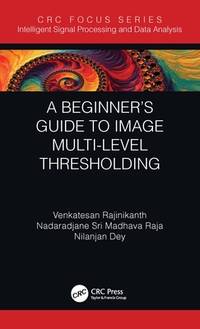
2020BN129060Taylor & Francis Ltd 2020. 2020. Hardcover. A Beginner's Guide to Multilevel Image Thresholding <br/><br/>A Beginner's Guide to Multilevel Image Thresholding Venkatesan St. Joseph's College of Engineering OMR Chennai TN India Rajinikanth Nadaradjane Sri St. Joseph's College of Engineering OMR Chennai TN India Madhava Raja Nilanjan Dey Taylor & Francis Ltd hardcover
Ex - Lib stickers to spine and inside cover. Stamps to FEP and title page. Text is clean, bright and tight Ex - Library
1951HS-44Northeast Harbor Maine: Ellen Fink Milton 1951. Classic text presents a detailed biographical monograph written by Albert Fink's daughter- author. Text describes the life and outstanding achievements of Albert Fink world renown German civil engineer who immigrated to the U.S. in 1849 and was hired by the Baltimore & Ohio railroad as a draughtsman. He became chief office assistant to Benjamin H. Latrobe which gave him superintendence of the design construction and supervision of the building of the first important iron bridges in the U.S. He was also consulting engineer of the Norfolk and Petersburg railway and rhe Louisville and Nashville road. 102 pgs. Illustrated. Frontispiece of Albert FInk. Presentation nameplate from A.P. Milton pastedown on front endpaper along with another small label; small stamp to title pg. and outer edge. Label removal mark on lower front cover. Minimal shelfwear. First Edition. Hard Cover. Very Good. 8vo - over 7¾" - 9¾" tall. Ex-Professional Library. Ellen Fink Milton Hardcover
1983768018PN. New. 1983. Soft Cover. Date is original print. This is a reprint edition. . PN paperback
114 pages, illustrated. eng
1968735766PN. New. 1968. Soft Cover. Date is original print. This is a reprint edition. . PN paperback
1988EG-231Indiana: Purdue Research Foundation 1988. Classic text traces the historic background and areas of electrical engineering electric railway engineering birth of radiotelephony and the various engineering departments and research centers at Purdue and its founding fathers. 307 pgs. Illustrated. Photo frontispiece of one of Purdue's engineering buildings. First Edition. Hard Cover. Excellent. 8vo - over 7¾" - 9¾" tall. Purdue Research Foundation Hardcover
1985624h5439Canada: Barry G. Levine 1985. Book. Very Good. Hardcover. First Edition. 8vo - over 7¾" - 9¾" tall. "A celebration of the ideas activities and traditions that one hundred years of enthusiastic Skulemen have brought to life Skillfully and Vigorously. Traces the growth of the University of Toronto's Engineering Society from the early days of campus scraps to the existing traditions of Skule Nite Chariot races and the Lady Godiva Memorial Band. Yet throughout the revelry the desire to maintain a certain degree of professionalsim can be seen to exist." - dust jacket. Author graduated from the U. of T. Engineering program in 1984. pp. 4 73 1. Oblong 11" x 9". Includes numerous black and white reproductions of archival photos and illustrations. Book clean and unmarked with light wear. Moderate wear to dust jacket now preserved in archival-grade Brodart. A quality copy of this fun and informative history. Bonus: Laid-in is a programme for the Society's Spring Reunion Dinner-Dance held at the Royal York Hotel on June 6 1986. Barry G. Levine Hardcover
0309460042.Gpaperback. Good. Access codes and supplements are not guaranteed with used items. May be an ex-library book. paperback
"A celebration of the ideas, activities and traditions that one hundred years of enthusiastic Skulemen have brought to life, Skillfully and Vigorously. Traces the growth of the University of Toronto's Engineering Society from the early days of campus scraps to the existing traditions of Skule Nite, Chariot races and the Lady Godiva Memorial Band. Yet throughout the revelry, the desire to maintain a certain degree of professionalsim can be seen to exist." - dust jacket. Author graduated from the U. of T. Engineering program in 1984. pp. [4], 73, [1]. Oblong 11" x 9". Includes numerous black and white reproductions of archival photos and illustrations. Book clean and unmarked with light wear. Moderate wear to dust jacket now preserved in archival-grade Brodart. A quality copy of this fun and informative history. Bonus: Laid-in is a programme for the Society's Spring Reunion Dinner-Dance held at the Royal York Hotel on June 6, 1986. Book