292 résultats
19582082402113503031Bungakudo 1958. Soft Cover. Fine. Volume: 1 Bungakudo paperback
Takahiro, Kaneshima, SnejIn Pristine Condition. unknown
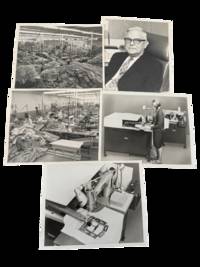
1950233261950. Garment factory photographs documenting women's industrial sewing labor machine based apparel production and managerial oversight in the postwar United States circa 1950s with direct evidence of how mass clothing manufacture depended on large sewing rooms specialized equipment and gendered factory work. Archive documents the production floor as a working system rather than a single portrait scene placing rows of women at Pfaff machines beside piles of cut or partly finished garments while a separate executive portrait and staged equipment views link shop floor labor to administration and industrial sales culture. The group matters because postwar clothing production relied heavily on women's wage labor in factories where speed repetition and machine specialization turned fabric into standardized output for a growing consumer economy.<br /> <br /> Photo archive of 5 Large silver gelatin photographs each 8" x 10" circa 1950s. Two photographs show the main sewing room from wider angles with long rows of women seated at machine stations beneath suspended electric lines and task lighting while large heaps of striped fabric or finished garments spill across tables and benches in the foreground. The workers are positioned close together in a dense production space organized around straight runs of tables and sewing heads with little separation between labor stations and material flow. One photograph isolates a woman operating a large Pfaff industrial unit in a cleaner demonstration setting while another gives a close technical view of a Pfaff machine head and work plate. A fifth photograph shows an older male executive or manager seated in an office.<br /> Postwar apparel production expanded through factories that combined assembly line logic with skilled but repetitive needlework and women formed a large share of that labor force in garment plants across the United States. The Pfaff machines represent the technological side of production while the sewing room views show the human structure that made the machines profitable with women handling fabric continuously at closely arranged stations under managerial control. Light handling wear and minor curling to edges. Overall very good condition. The archive preserves the relationship between labor machinery and output at a moment when industrial clothing manufacture still depended on concentrated factory work before later shifts toward overseas production transformed the industry. unknown
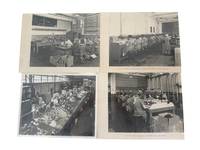
1940235071940. Women's wartime factory labor photo archive depicting rubber molding inspection precision trimming packing and bench production in the United States during the World War II era. More than six million women took wartime jobs in American factories and wartime labor needs moved women into industrial work involving machinery inspection aircraft parts laboratory work and other production roles previously coded as male labor. The captioned Parker views place women inside a rubber parts operation where quality control hand finishing and distribution preparation were treated as essential production work. The archive records the practical shop-floor labor behind the larger wartime shift: long tables stools bins boxed parts inspection lamps trimming tools and women working in sequence across a factory interior.<br /> <br /> Photo archive of 4 large silver gelatin photographs each measuring 8" x 10.75" United States circa 1940s. One caption reads "View of inspection of Parker-molded rubber parts" with women seated along a long worktable examining parts before distribution. Another caption reads "Operators with equipment for precision-trimming of mold rubber parts" showing women working at a row of bench stations with overhead cords boxes and factory equipment. Additional scenes show women packing sorting and assembling small molded components at long tables surrounded by stacked cartons metal containers industrial windows and production shelving.<br /> <br /> During and after World War II women's factory labor did not simply fill temporary vacancies; it proved women could perform skilled industrial tasks in defense-related production even as many employers pushed women out of those jobs when men returned from military service. Light handling wear corner wear minor creasing and curling; photos generally clean and clear and captions remain legible on two mounts. Overall in very good condition. This archive shows the wartime demand for women's labor in order to keep American production moving during the war. unknown
1871165651871. Women Employment Labor To the Right Honorable Richard Assheton Cross M.P. Secretary of Sate for the Home Department. 1871. 4 pages. 8 x 5 in. In this document women workers express fears regarding proposed labor regulations that would limit their ability to earn and would "restrict the paid labour of all women.or even make all married women half-timers." They claim it is unjust treatment that would harm women workers and pit their marriages at odds with their ability to work: "Your Memorialists assert that it is unjust to place restriction son the labour of unmarried women for the presumed protection of married women or mothers and further that any special restrictions upon the labour of married women is practically a penalty imposed on marriage as regards to the woman." Document that reveals the competing priorities for women factory workers between workplace safety and their earning power. Chipping with small losses along top and right edge. Repairs to two tears on page 2. Top left corner missing. Good only. unknown
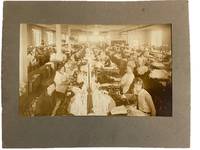
1920173461920. 1920s vintage sepia photograph of around 50 women at work in a textile factory. The photographer's board is 10" x 8" inches and image is 8.25" x 5" inches. The women are seated in long rows and armed with sewing machines and seem to be turning bundles of cloth into garments. Spools of thread hang down from a center rail in the middle of the table to be fed into the sewing machines. Some of the cloth appears to be polka-dotted similar to the dresses that several women pictured appear to be wearing. The factory is consisted almost entirely of women - there is one man in a waistcoat walking around accompanied by an older woman. The working women seem to be of varying ages from their early 20s into their 50s. Textile manufacturing was unique at the time for its overwhelmingly female labor force. Sepia toned very good condition with great detail. unknown
1675310157.Gpaperback. Good. Access codes and supplements are not guaranteed with used items. May be an ex-library book. paperback
19792080202105600416Not Available 1979. Soft Cover. Fine. The book is in fine condition. Not Available paperback
0-13306Cartella con poco meno di 50 fogli dattiloscritti anni '50 su carta forte e l'intestazione "Confidentiel". unknown
8408221930.Ghardcover. Good. Access codes and supplements are not guaranteed with used items. May be an ex-library book. hardcover
19282090502113701974Not Available 1928. Soft Cover. Fine. The book is in fine condition. Not Available paperback
19642083002116203140Dokdo Island 1964. Soft Cover. Fine. The book is in fine condition. Dokdo Island paperback
1599570351.GGood. Access codes and supplements are not guaranteed with used items. May be an ex-library book. unknown
2005572110112037The Time Factory 2005-08-01. Calendar. Good. Book has writing inside. The Time Factory unknown
24375627like new. unknown
S17B-05004International Paper. Used - Acceptable. Acceptable condition. No Dust Jacket Dampstained. paper paper industry manufacturing NOT AVAILABLE FOR SHIPMENT OUTSIDE OF THE UNITED STATES. International Paper unknown
1906821410.Gpaperback. Good. Access codes and supplements are not guaranteed with used items. May be an ex-library book. paperback
49014549-6Used - Good. Pages intact with minimal writing/highlighting. The binding may be loose and creased. Dust jackets/supplements are not included. Stock photo provided. Product includes identifying sticker. Better World Books: Buy Books. Do Good. unknown
37485265-6Used - Very Good. Pages intact with possible writing/highlighting. Binding strong with minor wear. Dust jackets/supplements may not be included. Stock photo provided. Product includes identifying sticker. Better World Books: Buy Books. Do Good. unknown
2001GB000JKY6EWI3N00Cuddly Duck Productions 2001. Unknown. Good. Pages can have notes/highlighting. Spine may show signs of wear. ~ ThriftBooks: Read More Spend Less.Dust jacket quality is not guaranteed. Cuddly Duck Productions unknown
1934160424003The Clever Factory. Unknown Binding. Very Good. Nice looking book has minor edge wear. The Clever Factory unknown
100-17130The Clever Factory Inc. Paperback. New. The Clever Factory, Inc paperback
100-20928The Clever Factory Inc. Hardcover. New. The Clever Factory, Inc hardcover
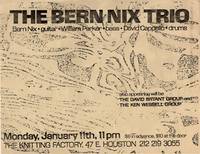
1989168377N.p.: N.p. 1989. Two original flyers announcing a performance by The Bern Nix Trio at the original New York Knitting Factory location on Houston Street circa 1990.<br /> <br /> The Bern Nix Trio consisting of Nix on guitar William Parker on bass and David Cappello on drums formed in 1985 and played together until the early 1990s. In 1994 Nix released the album "Alarms and Excursions" as The Bern Nix Trio with Fred Hopkins on Bass and Newman Baker on drums.<br /> <br /> 8.5 x 11 inches. Xerographically reproduced one printed on pale yellow and one printed on salmon. Near Fine. N.p. unknown
ria9781068333804_inpPaperback. New. New Book; Fast Shipping from UK; Not signed; Not First Edition; In this practical second edition of the OneStream Foundation Handbook - comprising more than 15% new and revised content - The Architect Factory team at OneStream Software explains each part of an implementation and the design of solut paperback