Books Factory StudioBiblio.com
Factory, The MomaBiblio.com
Yo Mamma! Yo Mamma!
1329348486.Ghardcover. Good. Access codes and supplements are not guaranteed with used items. May be an ex-library book. hardcover

Bonita · États-Unis64,84 $US≈ 54,86 €
292 résultats
2004Q-8495692295Atrium Arto Editorial 2004-10-30. Paperback. New. New. In shrink wrap. Looks like an interesting title! Atrium Arto Editorial paperback
19682092902137700264Japan National Railway Takatori Factory 1968. Soft Cover. Fine. The book is in fine condition. Japan National Railway Takatori Factory paperback
19682091202133101654Japanese national railway 1968. Soft Cover. Fine. Volume: 1 Japanese national railway paperback
1329348486.Ghardcover. Good. Access codes and supplements are not guaranteed with used items. May be an ex-library book. hardcover
24375627like new. unknown
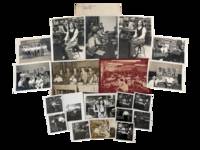
1940233241940. Dictaphone Corporation factory photographs documenting women and men manufacturing dictating machines in Bridgeport Connecticut circa 1940s showcasing the postwar expansion of women's employment inside a growing communications technology industry. The group centers on Dictaphone's Bridgeport plant at 335 Howard Avenue where workers appear at long rows of benches with recording and transcription equipment tool drawers lamps wiring and partly assembled machines placing this archive within the larger World War II and postwar reorganization of American factory labor. Several photographs give women a central place within that system not as incidental figures but as seated operators bench workers and posed employees inside the production rooms themselves grounding the archive in the history of women's industrial employment as office technology manufacturing expanded beyond clerical use into large scale commercial production.<br /> <br /> Archive of 21 pieces including 20 black and white and one red photographs ranging from 2" x 2" to 5" x 7" and original envelope. Bridgeport Connecticut circa 1940s. One original company envelope is printed "DICTAPHONE CORPORATION / 335 HOWARD AVENUE / BRIDGEPORT CONN." fixing the factory location. Interior views show crowded production rooms under fluorescent strip lighting with dozens of workers seated at benches operating or assembling dictating machines and related components; in the largest image male workers fill a deep factory floor while several men in the foreground lean into handsets or testing devices at stations packed with equipment. One view shows a male worker alone at a bench in a long machine lined room with belts tools and suspended mechanisms overhead; several smaller prints show women seated at desks or worktables women and men posed together on the shop floor and mixed groups of workers assembled outdoors or around demonstration tables with supervisors and visiting men in suits. The images repeatedly emphasize rows of benches machine bodies cords lamps and standardized work positions while the envelope and repeated factory interiors tie the lot to Dictaphone's manufacturing operation rather than to sales or office promotion alone.<br /> <br /> During World War II and the immediate postwar years firms producing office equipment occupied an important place in the broader American communications and business machine economy supplying devices that organized dictation transcription record keeping and administrative workflow for corporations law offices and government users. This archive makes that industrial system visible at the level of labor showing how the growth of business technology relied on factory discipline gendered employment patterns and the integration of women into production space during a period when wartime labor demand altered who worked at the bench and who appeared in the industrial workforce. Light edge wear envelope toned. Overall very good condition. A concentrated visual record of 1940s office machine manufacturing placing women's industrial labor inside the production history of one of the leading American dictation companies. unknown
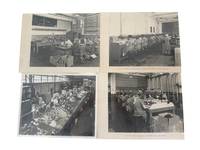
1940235071940. Women's wartime factory labor photo archive depicting rubber molding inspection precision trimming packing and bench production in the United States during the World War II era. More than six million women took wartime jobs in American factories and wartime labor needs moved women into industrial work involving machinery inspection aircraft parts laboratory work and other production roles previously coded as male labor. The captioned Parker views place women inside a rubber parts operation where quality control hand finishing and distribution preparation were treated as essential production work. The archive records the practical shop-floor labor behind the larger wartime shift: long tables stools bins boxed parts inspection lamps trimming tools and women working in sequence across a factory interior.<br /> <br /> Photo archive of 4 large silver gelatin photographs each measuring 8" x 10.75" United States circa 1940s. One caption reads "View of inspection of Parker-molded rubber parts" with women seated along a long worktable examining parts before distribution. Another caption reads "Operators with equipment for precision-trimming of mold rubber parts" showing women working at a row of bench stations with overhead cords boxes and factory equipment. Additional scenes show women packing sorting and assembling small molded components at long tables surrounded by stacked cartons metal containers industrial windows and production shelving.<br /> <br /> During and after World War II women's factory labor did not simply fill temporary vacancies; it proved women could perform skilled industrial tasks in defense-related production even as many employers pushed women out of those jobs when men returned from military service. Light handling wear corner wear minor creasing and curling; photos generally clean and clear and captions remain legible on two mounts. Overall in very good condition. This archive shows the wartime demand for women's labor in order to keep American production moving during the war. unknown
1871165651871. Women Employment Labor To the Right Honorable Richard Assheton Cross M.P. Secretary of Sate for the Home Department. 1871. 4 pages. 8 x 5 in. In this document women workers express fears regarding proposed labor regulations that would limit their ability to earn and would "restrict the paid labour of all women.or even make all married women half-timers." They claim it is unjust treatment that would harm women workers and pit their marriages at odds with their ability to work: "Your Memorialists assert that it is unjust to place restriction son the labour of unmarried women for the presumed protection of married women or mothers and further that any special restrictions upon the labour of married women is practically a penalty imposed on marriage as regards to the woman." Document that reveals the competing priorities for women factory workers between workplace safety and their earning power. Chipping with small losses along top and right edge. Repairs to two tears on page 2. Top left corner missing. Good only. unknown
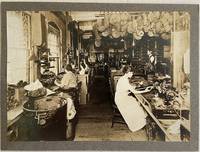
1900178581900. Women at Work Albumen photo of women at work in a small factory. Photograph measures 7.75" x 5.5" inches and is on gray photographer's board measuring 8.5" x 6.5" inches. Circa 1900s. Albumen print. Women sitting at long wooden tables in small manufacturing shop. Palm-sized rings hang in loops from the ceiling and can be seen scattered throughout the photo. One woman in a long white dress holds length of material looking it over while another sitting behind her and across and wooden aisle looks away from the camera toward her desktop. Two other women can be seen seated behind her further back into the shop. A man in shirt and vest appears to be observing the women at work while another man at the back of the shop appears to be using some sort of pressing device. It's unclear what's being manufactured but the details of materials and workplace layout give rich details to take in. The women would have been part of a growing female workforce utilized to support production in the midst of industrialization. Overall very good condition. unknown
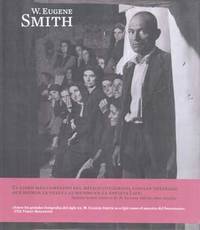
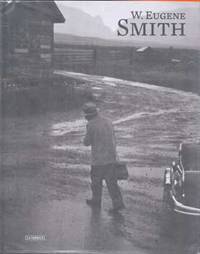
75-8168Madrid: La Fabrica Editorial 2008. Fo. Cloth Hard Cover ca. 240 pp. First Edition. B&W Plates. Version with Cover Image from Page 47. Very Good. Dust Jacket also Very Good with Creasing. Includes Belly Band of Terra Cotta Paper. Oversize Book May require extra Shipping ChargesWilliam Eugene Smith was born in 1918 in Wichita Kansas. He took his first photographs at the age of 15 for two local newspapers. In 1936 Smith entered Notre Dame University in Wichita where a special photographic scholarship was created for him. A year later he left the university and went to New York City. After studying with Helene Sanders at the New York Institute of Photography in 1937 he began working for News-Week later Newsweek. He was fired for refusing to use medium-format cameras and joined the Black Star agency as a freelancer……Smith worked as a war correspondent for Flying magazine 1943–44 and a year later for Life. He followed the island-hopping American offensive against Japan and suffered severe injuries while simulating battle conditions for Parade which required him to undergo surgery for the next two years……Once recuperated Smith worked for Life again between 1947 and 1955 before resigning in order to join Magnum Photos as an associate. In 1957 he became a full member of Magnum. Smith was fanatically dedicated to his mission as a photographer. Because of this dedication he was often regarded by editors as “troublesome.â€â€¦.A year after moving to Tucson to teach at the University of Arizona Smith died of a stroke. His archives are held by the Center for Creative Photography in Tucson Arizona. Today Smith’s legacy lives on through the W. Eugene Smith Fund to promote “humanistic photography†founded in 1980 which awards photographers for exceptional accomplishments in the field. Madrid: La Fabrica Editorial, 2008 hardcover
75-8167Madrid: La Fabrica Editorial 2008. Fo. Cloth Hard Cover ca. 240 pp. First Edition. B&W Plates. Version with Cover Image from Page 109. Very Good. Dust Jacket also Very Good with Creasing Abrasions now in Protective Mylar Cover. Oversize Book May require extra Shipping ChargesWilliam Eugene Smith was born in 1918 in Wichita Kansas. He took his first photographs at the age of 15 for two local newspapers. In 1936 Smith entered Notre Dame University in Wichita where a special photographic scholarship was created for him. A year later he left the university and went to New York City. After studying with Helene Sanders at the New York Institute of Photography in 1937 he began working for News-Week later Newsweek. He was fired for refusing to use medium-format cameras and joined the Black Star agency as a freelancer……Smith worked as a war correspondent for Flying magazine 1943–44 and a year later for Life. He followed the island-hopping American offensive against Japan and suffered severe injuries while simulating battle conditions for Parade which required him to undergo surgery for the next two years……Once recuperated Smith worked for Life again between 1947 and 1955 before resigning in order to join Magnum Photos as an associate. In 1957 he became a full member of Magnum. Smith was fanatically dedicated to his mission as a photographer. Because of this dedication he was often regarded by editors as “troublesome.â€â€¦.A year after moving to Tucson to teach at the University of Arizona Smith died of a stroke. His archives are held by the Center for Creative Photography in Tucson Arizona. Today Smith’s legacy lives on through the W. Eugene Smith Fund to promote “humanistic photography†founded in 1980 which awards photographers for exceptional accomplishments in the field. Madrid: La Fabrica Editorial, 2008 hardcover
1997Q-0965596516Amherst Pr 1997-03-01. Paperback. New. In shrink wrap. Looks like an interesting title! Amherst Pr paperback
DADAX0965596516Brand: Amherst Pr 0000-00-00. First Edition. paperback. New. 7.00x0.75x10.25. Buy with confidence. Excellent Customer Service & Return policy. Brand: Amherst Pr paperback
2005572110112037The Time Factory 2005-08-01. Calendar. Good. Book has writing inside. The Time Factory unknown
1965464396Bristol : Campaigners Against Factory Farming 1965. Edition Unstated. Softcover. SIGNED. Good copy in the original stiff-card wrappers somewhat stained. Well-preserved overall. Date is suggested. Physical description; 30 pages. Subjects; Factory farming. Animal welfare. Livestock. Bristol : Campaigners Against Factory Farming paperback
1989168377N.p.: N.p. 1989. Two original flyers announcing a performance by The Bern Nix Trio at the original New York Knitting Factory location on Houston Street circa 1990.<br /> <br /> The Bern Nix Trio consisting of Nix on guitar William Parker on bass and David Cappello on drums formed in 1985 and played together until the early 1990s. In 1994 Nix released the album "Alarms and Excursions" as The Bern Nix Trio with Fred Hopkins on Bass and Newman Baker on drums.<br /> <br /> 8.5 x 11 inches. Xerographically reproduced one printed on pale yellow and one printed on salmon. Near Fine. N.p. unknown
12102Schauman catalogue: Jyväskylä Finland. 1932. Harbord catalogue: Harbor Plywood Corporation Chicago Illinois and Hoquiam Washington. 1930. Schauman catalogue: 59pp 4to consisting of 9pp. of letterpress and 50pp. of collotype illustrations. In original cream printed wraps with cover printed in red. In good condition. Written entirely in English with informative captions. Harbord catalogue: 16pp. 12mo. In original wraps printed in yellow and black. Stapled pamphlet on art paper. In good condition with staples beginning to rust. With numerous illustrations of 'the spacious new home of E. W. Daniels Vice-President of the Harbor Plywood Corporation and manager of its Door units'. The final page carries a list of 'Points About the Plywood Home' the first being that it was 'Erected at Hoquiam Washington 1930.' Schauman catalogue: Jyväskylä, Finland. 1932. Harbord catalogue: Harbor Plywood Corporation, Chicago, Illinois, and Hoquiam, W paperback
0331779293.Ghardcover. Good. Access codes and supplements are not guaranteed with used items. May be an ex-library book. hardcover
0366281232.Ghardcover. Good. Access codes and supplements are not guaranteed with used items. May be an ex-library book. hardcover
036628116X.Gpaperback. Good. Access codes and supplements are not guaranteed with used items. May be an ex-library book. paperback
0331315971.Ghardcover. Good. Access codes and supplements are not guaranteed with used items. May be an ex-library book. hardcover
0331041049.Gpaperback. Good. Access codes and supplements are not guaranteed with used items. May be an ex-library book. paperback
1333091087.Gpaperback. Good. Access codes and supplements are not guaranteed with used items. May be an ex-library book. paperback
0656652276.Ghardcover. Good. Access codes and supplements are not guaranteed with used items. May be an ex-library book. hardcover
0331679795.Gpaperback. Good. Access codes and supplements are not guaranteed with used items. May be an ex-library book. paperback