501 résultats
1868102205Paris, Michel Lévy Frères, Libraires-éditeurs 1868 4 volumes. In-4 27 x 18 cm. Reliures demi-basane bordeaux, dos lisses ornés de filets et de roulettes dorées, 326-320-329-320 pp., nombreuses gravures dans et hors-texte, sommaires. Dos insolés, reliures légèrement frottées, rousseurs marginales, intérieur assez frais.
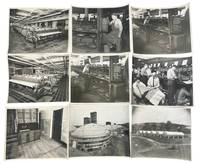
1945234071945. Reading Pennsylvania factory photo archive documenting textile machinery production and hosiery manufacturing work circa late 1940s to early 1950s at or near the Wyomissing industrial complex associated with Textile Machine Works and Berkshire Knitting Mills. Reading became one of the major American centers for full fashioned knitting machinery after Ferdinand Thun and Henry Janssen founded Textile Machine Works in 1892 and the equipment seen here belongs to the world of stocking manufacture before seamless nylon hosiery reshaped the industry in the 1950s.<br /> <br /> Photo archive of 17 large silver gelatin photographseach 8 x 10 inches Reading or Wyomissing Pennsylvania circa 1940s to early 1950s. Rows of large knitting machines fill long factory rooms under fluorescent lighting; workers stand beside circular or braiding machinery marked with chalked Greek words; an engineering office includes men studying large technical drawings; machine tools metal stock exterior factory buildings tanks and utility structures place the scenes within a large industrial plant. Several versos are stamped "Paul Bauer Photographer 608 Franklin St. Reading Pa." and "Photo by Paul Bauer." Several shop-floor views include a chalked Greek vocabulary list beside the machinery a striking detail in a Reading industrial region that had an established Greek immigrant community by the early twentieth century.<br /> <br /> The archive records the machinery workers drafting practices and plant environment behind Pennsylvania's textile machinery economy at the point when American hosiery manufacturing still depended on large specialized mechanical systems and skilled shop labor. Documenting the production floors machine details engineering rooms workers and exterior plant views. Minor edge and curling; images remain clear and well preserved. Overall in very good condition. unknown
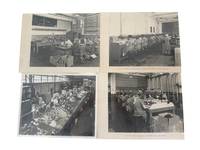
1940235071940. Women's wartime factory labor photo archive depicting rubber molding inspection precision trimming packing and bench production in the United States during the World War II era. More than six million women took wartime jobs in American factories and wartime labor needs moved women into industrial work involving machinery inspection aircraft parts laboratory work and other production roles previously coded as male labor. The captioned Parker views place women inside a rubber parts operation where quality control hand finishing and distribution preparation were treated as essential production work. The archive records the practical shop-floor labor behind the larger wartime shift: long tables stools bins boxed parts inspection lamps trimming tools and women working in sequence across a factory interior.<br /> <br /> Photo archive of 4 large silver gelatin photographs each measuring 8" x 10.75" United States circa 1940s. One caption reads "View of inspection of Parker-molded rubber parts" with women seated along a long worktable examining parts before distribution. Another caption reads "Operators with equipment for precision-trimming of mold rubber parts" showing women working at a row of bench stations with overhead cords boxes and factory equipment. Additional scenes show women packing sorting and assembling small molded components at long tables surrounded by stacked cartons metal containers industrial windows and production shelving.<br /> <br /> During and after World War II women's factory labor did not simply fill temporary vacancies; it proved women could perform skilled industrial tasks in defense-related production even as many employers pushed women out of those jobs when men returned from military service. Light handling wear corner wear minor creasing and curling; photos generally clean and clear and captions remain legible on two mounts. Overall in very good condition. This archive shows the wartime demand for women's labor in order to keep American production moving during the war. unknown
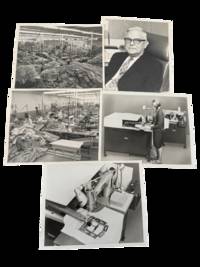
1950233261950. Garment factory photographs documenting women's industrial sewing labor machine based apparel production and managerial oversight in the postwar United States circa 1950s with direct evidence of how mass clothing manufacture depended on large sewing rooms specialized equipment and gendered factory work. Archive documents the production floor as a working system rather than a single portrait scene placing rows of women at Pfaff machines beside piles of cut or partly finished garments while a separate executive portrait and staged equipment views link shop floor labor to administration and industrial sales culture. The group matters because postwar clothing production relied heavily on women's wage labor in factories where speed repetition and machine specialization turned fabric into standardized output for a growing consumer economy.<br /> <br /> Photo archive of 5 Large silver gelatin photographs each 8" x 10" circa 1950s. Two photographs show the main sewing room from wider angles with long rows of women seated at machine stations beneath suspended electric lines and task lighting while large heaps of striped fabric or finished garments spill across tables and benches in the foreground. The workers are positioned close together in a dense production space organized around straight runs of tables and sewing heads with little separation between labor stations and material flow. One photograph isolates a woman operating a large Pfaff industrial unit in a cleaner demonstration setting while another gives a close technical view of a Pfaff machine head and work plate. A fifth photograph shows an older male executive or manager seated in an office.<br /> Postwar apparel production expanded through factories that combined assembly line logic with skilled but repetitive needlework and women formed a large share of that labor force in garment plants across the United States. The Pfaff machines represent the technological side of production while the sewing room views show the human structure that made the machines profitable with women handling fabric continuously at closely arranged stations under managerial control. Light handling wear and minor curling to edges. Overall very good condition. The archive preserves the relationship between labor machinery and output at a moment when industrial clothing manufacture still depended on concentrated factory work before later shifts toward overseas production transformed the industry. unknown
2007165430New York: Chronicle Books 2007. Hardcover. First American Edition. As New. Still in publisher's shrinkwrap.<br /> <br /> Between 1978 and 1992 Factory Records was one of the most important record labels in Britain. It launched the careers of Joy Division New Order and the Happy Mondays and others. The entity was launched jointly with the legendary Hacienda Club and Dry Bar both in Manchester; and it introduced along with its new music a new concept of high-quality cutting-edge design. <br /> <br /> A complete full-color chronological catalog of the label's output with each release accompanied by its original inventory number along with photos of album sleeves singles special editions flyers posters stationery and architectural projects. <br /> <br /> Oversize volume shipping billed at cost. Chronicle Books unknown
186020818Le Longeron 1860 2 photographies Originale sur papier Albuminé format : 20 x 25,5 cm15,5 x 10,5 cm collées sur carton beige, vitrées et encadrées dans un cadre doré à la feuille d'or de format : 37,5 x 43,5 cm, 1860 environ
193946634Shanghai: Nishimura Company 1939. Edition not stated. Quarto 26.5cm; black simulated leather stamped in red and gilt in brown paper slipcover; unpaginated photo-illustrated plates w/ rice paper overlays. Wear minor scuffs and soiling to boards; toning and foxing intermittent throughout text especially on overlays; some overlays creased or torn. Slipcover worn and chapped with abrasions and two large one repaired tears across front panel. Photo-illustrated pastedowns and endpapers. Very Good in Good slipcover. All text in Japanese with some obsolete/antiquated kana/kanji oriented right to left. This is a privately-issued commemorative yearbook-type photo album shashin-cho published on behalf of the Imperial Japanese Army medical forces during the Second Sino-Japanese War 1937-1945. Specifically it was produced for those who served under military physician captains/commanding officers Nobuo Isa and Tetsuo Fukaya who were stationed in or near Shanghai at the time.<br /> <br /> By July 1939 the Imperial Japanese Army was beginning to feel the impact of its own mounting casualties and costs; the Chinese Red Army would launch a major offensive later that November. While the Japanese occupation of Shanghai was notably brutal there is little evidence of violence in this album. However some photographs do depict the aftermath of battle with ruined buildings and soldiers being treated for injuries. Other subjects are mundane in nature: Staff and group portraits hospitals and other facilities physicians at work company events and ceremonies. Also includes photographs of Shanghai and a fold-out map of the Hangzhou Bay area. Apparently not cataloged in OCLC or available commercially as of November 2019. Nishimura Company unknown
193946634Shanghai: Nishimura Company 1939. Edition not stated. Quarto 26.5cm; black simulated leather stamped in red and gilt in brown paper slipcover; unpaginated photo-illustrated plates w/ rice paper overlays. Wear minor scuffs and soiling to boards; toning and foxing intermittent throughout text especially on overlays; some overlays creased or torn. Slipcover worn and chapped with abrasions and two large one repaired tears across front panel. Photo-illustrated pastedowns and endpapers. Very Good in Good slipcover. All text in Japanese with some obsolete/antiquated kana/kanji oriented right to left. This is a privately-issued commemorative yearbook-type photo album shashin-cho published on behalf of the Imperial Japanese Army medical forces during the Second Sino-Japanese War 1937-1945. Specifically it was produced for those who served under military physician captains/commanding officers Nobuo Isa and Tetsuo Fukaya who were stationed in or near Shanghai at the time.<br/><br/>By July 1939 the Imperial Japanese Army was beginning to feel the impact of its own mounting casualties and costs; the Chinese Red Army would launch a major offensive later that November. While the Japanese occupation of Shanghai was notably brutal there is little evidence of violence in this album. However some photographs do depict the aftermath of battle with ruined buildings and soldiers being treated for injuries. Other subjects are mundane in nature: Staff and group portraits hospitals and other facilities physicians at work company events and ceremonies. Also includes photographs of Shanghai and a fold-out map of the Hangzhou Bay area. Apparently not cataloged in OCLC or available commercially as of November 2019. Nishimura Company unknown books
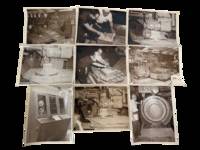
1960233821960. Industrial factory photograph archive documenting large scale machining systems automated tooling equipment and precision manufacturing processes during the height of postwar American industrial expansion circa 1960s. Several scenes feature Sundstrand branded machinery associated with the Sundstrand Corporation a major Rockford Illinois manufacturer of machine tools aerospace components and industrial automation systems during the Cold War industrial economy. By the 1960s American factories increasingly relied on massive numerically controlled machining equipment capable of producing aircraft parts turbine components and heavy industrial hardware with levels of precision unattainable in earlier manually operated machine shops. These photographs record the physical scale of that transition capturing the integration of computerized or semi automated production systems into factory environments that formed the backbone of aerospace defense transportation and heavy manufacturing industries during the period.<br /> <br /> Photo archive of 9 Large Silver Gelatin photographs each 8" x 10" circa 1960s. Interior factory scenes show enormous industrial machining centers occupying tiled production floors beneath overhead lighting and exposed structural systems. Multiple photographs depict large circular indexing tables rotary cutting assemblies suspended tooling heads and enclosed control units bearing visible "Sundstrand" identification. Engineers and machinists wearing shop coats and protective glasses appear adjusting tooling mechanisms calibrating machine components and servicing cutting assemblies surrounded by heavy cables hydraulic systems and banks of industrial controls. Several machines are shown actively engaged in metal cutting operations with curled metal shavings accumulating beneath rotating tooling heads and across surrounding platforms. One scene captures technicians removing or fitting a large machined component beneath a circular cutting apparatus while another documents reel based electronic control equipment integrated into the production system reflecting the growing use of automated process control in industrial manufacturing during the decade.<br /> <br /> The 1960s marked a decisive transformation in American manufacturing as industries shifted from conventional machining toward automated and numerically controlled production methods capable of supporting aerospace engineering military procurement automotive manufacturing and mass industrial output. Companies such as Sundstrand played a central role in supplying the specialized tooling and machine systems that allowed factories to machine increasingly complex metal components at industrial scale. Some curling scattered edge and surface wear as well as foxing to margins; images remain sharp with strong detail. Overall in good condition. The photographs preserve direct visual evidence of the machinery labor practices and production environments that defined late midcentury industrialization before many such facilities were modernized outsourced or dismantled during later waves of deindustrialization. unknown
Arvidsson, GöstaIn Pristine Condition. unknown
19205789Aden /Germany, SD (Circa 1920). 1920 18 cartes postales en tirage sépia (90 x 140 mm), dont 9 sur bristol et 9 sur papier albuminé. Chemise à rabats de papier neutre.
awd-103New York, Kathmandu, Shivastan Publishing, 2004. In-8 agrafé, couverture bleue sur papier du Népal (24 pp.). Tirage à 200 ex. illustrés et signés au crayon. Dernier peintre et poète beat, proche de Warhol (pour qui il apparaît dans Kitchen et Chelsea Girls), Rene Ricard (1946, 2014) a aussi révélé Jean-Michel Basquiat dans Artforum en 1981. Très bon état.
19782091202133101534Sanseisha 1978. Soft Cover. Fine. Volume: 1 Sanseisha paperback
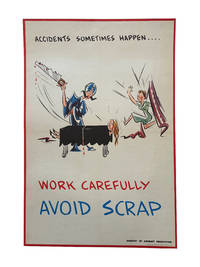
005079London: Ministry of Aircraft Production for H.M.S.O. Colour lithographic poster linen backed approximately 530mm x 780mm with backing poster being approximately 490mm x 740mm in size n.d. c. 1944. Lightly creased from old folds one tiny hole and one very small scuff to background otherwise quite bright and clean. Printed by J. Weiner for H.M.S.O. First Edition. Unbound. Good. Illus. by Harrison Nat. Double Elephant. Poster. Ministry of Aircraft Production for H.M.S.O. Paperback
2005572110112037The Time Factory 2005-08-01. Calendar. Good. Book has writing inside. The Time Factory unknown
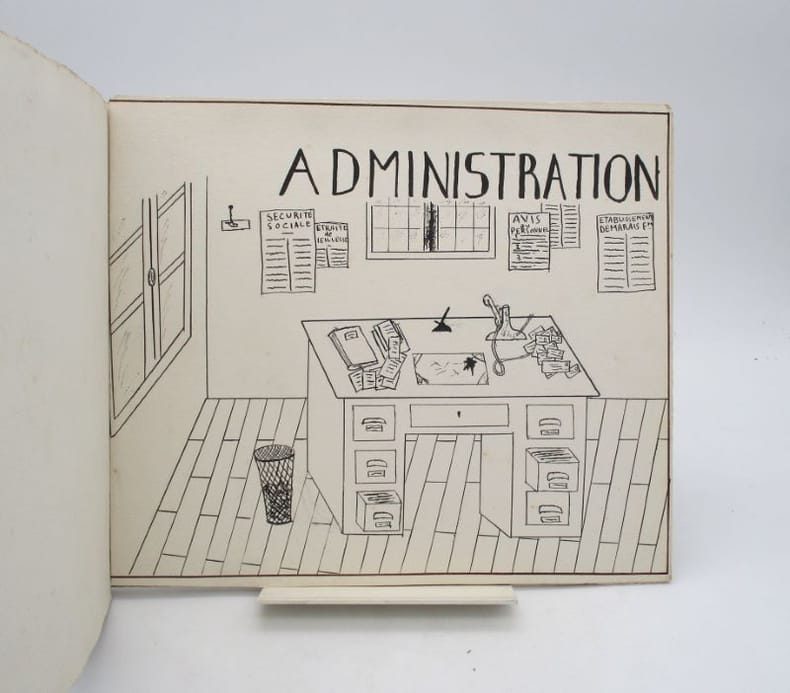
17810Bourges, distillerie Desmarais, [vers 1949]. In-8 oblong, [20] ff., en feuilles, couverture originale peinte (quelques petites rousseurs et taches).
192028350LES SABLES D'OLONNE 1920 un PLAN ORIGINAL aquarellé en lavis de couleur rouge et manuscrit à l'encre brune, sur papier crème, Format : 54,5 centimètres de haut par 69,5 centimètres de large, plan à l'échelle de 0,01 cm par mètre, bordant d'une part : LA RUE BASSE, LA RUE DES DAMES ET LA RUE DU COEF, sans date (1920) ,
56 pages. Features: Great colour ad for International Trucks inside front cover; Nice two-colour full-page Chevrolet ad; Super Sub-Hunters (fiction); Nice one-page Canada Dry ad; Canadians are donating the blood to be used for Britain's armies; Churchill and Chamberlain - a column from London; Pottsy (fiction); What Canada Means to Me; Tondar (fiction); Wakeville, Awake! (part 4 of 4); South of the Border - photos and article on the thriving city of Windsor, Ontario; Great full-page ad for Sisman's Scampers (shoes); Kindergarten of the Air - Frank Lucas and his Toronto Model Airplane Factory -article with photos; Nice full-page two-colour ad for Moffat Electric Ranges; Nice two-colour full-page ad for Caterpillar diesel engines and electric sets; Full-page Dodge Truck ad; Great colour ad for Hewetson Shoes inside back cover; Nice colour ad for Nash automobiles on back cover. Moderate wear. Unmarked. Binding tight. A nice copy. Book
191645078Chicago and New York:: Paris Garters made by A. Stein & Co. ca. 1916. Some light foxing; but extremely attractive. Consisting of a sample men's garter and men's arm band each with original printed cardboard mounting set into the original box illustrated in color with two attractive young ladies gathering roses. The garter "No metal can touch you" was patented in 1908 and 1914; the armband was patented 1916. Paris Garters, made by A. Stein & Co., unknown
Features: Title page photo of large column of British and French infantry on the march; Seven excellent photos document the Austrian offensive on the Italian Front; Photo of Italian naval regiment being reviewed on St. Mark's Piazza; G.K. Chesterton writes about the pacifist/patriot groups; One-page illustration of pilot guiding burning plane while standing on its wing; The Japanese Fleet in the War (article); The"New" Star - of 1895!; The Woman, The Boy, and the Land; Page of illustrations present "Sons of Sister Republics - Franco-American Brothers -in-Arms; The Acrobatics of Aviation (article) One page illustration with inset sketch describes the "Immelmann Turn" performed by aircraft; Two pages of photos and illustrations of personalities of the Supreme War Council meeting at Versailles; Muscles, Nerves, and Brains - article describes how to take care of our health; Photo of artillery horses wearing gas-masks; Photo of American ambulance men evacuating wounded soldiers down a ladder from a French hospital under German shell-fire; Six photos illustrate the West in the East - British methods in Mesopotamia; Glorious centrefold illustration shows French, American, and British fighting shoulder to shoulder; One-page illustration shows the salvage of scrap metal in the Midlands; One-page illustration shows copper driving-bands for shells being thrown into annealing furnace at Birmingham in the National Shell Factory; Roll of Honour - 18 photos of officers including Lieut.-Col. Arthur L. Wrenford; Photo of Japanese General being received at a French headquarters; Photo of Canadian nurses picking through a downed Gotha aircraft; Charming two-colour back cover ad for Cavanders "Army Club" cigarettes features well-dressed young lady with umbrella chatting with man in uniform; and more. 36 pages including several pages of marvelous vintage ads, most of which are illustrated. Unmarked with average wear. Binding intact. A sound copy of this excellent WWI-era issue. Magazine
Pages 65-100. Features: Charming ad for Kruschen Salts inside advertorial front cover; Front cover photo of German soldiers returning to Berlin "Undefeated"; Article by G.K. Chesterton about the hope of the Polish people; Photo of the late great actor Sir Charles Wyndham; Photo of German troops entering Berlin; Photo of Liebknecht addressing large crowd in Unter Den Linden in Berlin; Two-page photo spread of the new "Lloyd George" Coalition Government - the Premier and some of the chief members - 32 photos in all; A Great Day in Prague - several photos show President Masaryk's Triumphal Entry; Photo of Filippo Cavallini, Luigi Dini and Adolfo Re-Riccardi in prisoners dock as they face charges of treason; Several photos of the aftermath of war; Photos of British Peace Delegates departing to Paris; Three pages of photos of Theodore Roosevelt - A Friend of Britain; Aerial Records and Record Making - article by C.G. Grey - Editor of "The Aeroplane"; Superb full-page photo portrait of Poland's Ignace Paderewski; Two pages of illustrations depicting heraldic symbols for commemorating naval traditions - some new badges for British War-Ships; Nice centerfold illustration by Arthur Watts shows a coastal motor-boat engaging a German seaplane; Large aerial photos of bombs exploding at sea; Illustration of new Undersecretary of State for Air - The Rt. Hon. Major-General J.E.E. Seely, D.S.O., on his charger Warrior; Photo from Baghdad of the British Commander-in-chief reading a proclamation announcing the surrender of Turkey; Great full-page ad for Kenilworth Cigarettes shows young lady on bed lighting her smoke from that of her male companion in uniform; Aerial photo of bombed Red Cross hospital at Etaples; Photo of Herr Ebert addressing a meeting of non-commissioned officers; Interesting photo of the interior of the Sopwith Aviation company's big factory at Ham, Surrey; "Astol" ad on back cover claims to restore natural colour to hair which is grey or faded; numerous other gorgeous vintage ads. Moderate wear. Binding intact. Unmarked. A quality vintage copy. Book
19782091202133209362Not Available 1978. Soft Cover. Fine. Volume: 1 Not Available paperback
19892092902143801627Osaka Association of Architects 1989. Soft Cover. Fine. Number of books: 1 book Osaka Association of Architects paperback
19892092902143901403Osaka Association of Architects 1989. Soft Cover. Fine. Number of books: 1 book Osaka Association of Architects paperback
193524887Nantes 1935 Une Eau-Forte Originale, technique pointe sèche à l'encre verte, sur papier vélin blanc, Format de la cuvette : (40 x 54,5 cm), Format feuille entière : 66 x 50 cm , signature manuscrite du graveur : A. Brient à la mine de plomb en bas à droite + numérotation du tirage manuscrits par A. BRIENT à la mine de plomb en bas de la gravure à gauche : 79/150, sans date (1930)