Écomusée de la communauté Le Creusot/Montceau les MinesLivre Rare Book
153 résultats
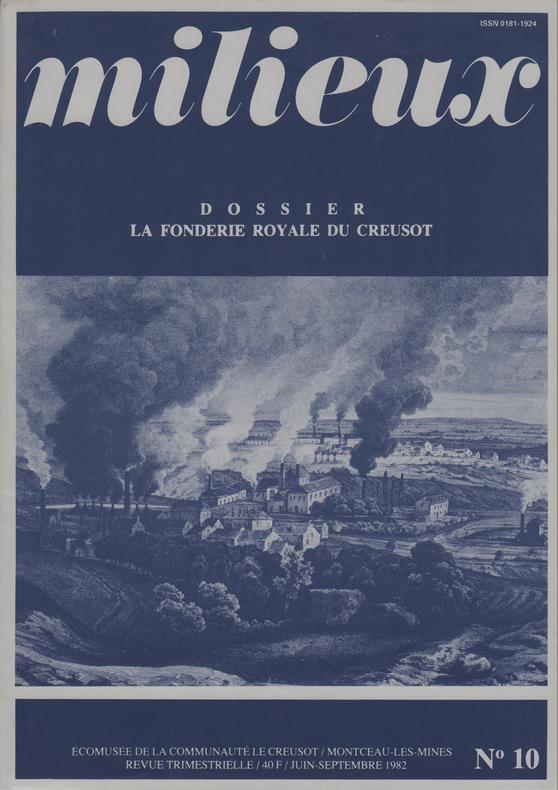
1982SPN-253Le Creusot : Écomusée, 1982. 94 pages illustrées en noir.
1986SPN-263Le Creusot : Écomusée, 1986. 77 pages illustrées en noir.
19582082402113503031Bungakudo 1958. Soft Cover. Fine. Volume: 1 Bungakudo paperback
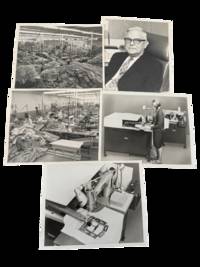
1950233261950. Garment factory photographs documenting women's industrial sewing labor machine based apparel production and managerial oversight in the postwar United States circa 1950s with direct evidence of how mass clothing manufacture depended on large sewing rooms specialized equipment and gendered factory work. Archive documents the production floor as a working system rather than a single portrait scene placing rows of women at Pfaff machines beside piles of cut or partly finished garments while a separate executive portrait and staged equipment views link shop floor labor to administration and industrial sales culture. The group matters because postwar clothing production relied heavily on women's wage labor in factories where speed repetition and machine specialization turned fabric into standardized output for a growing consumer economy.<br /> <br /> Photo archive of 5 Large silver gelatin photographs each 8" x 10" circa 1950s. Two photographs show the main sewing room from wider angles with long rows of women seated at machine stations beneath suspended electric lines and task lighting while large heaps of striped fabric or finished garments spill across tables and benches in the foreground. The workers are positioned close together in a dense production space organized around straight runs of tables and sewing heads with little separation between labor stations and material flow. One photograph isolates a woman operating a large Pfaff industrial unit in a cleaner demonstration setting while another gives a close technical view of a Pfaff machine head and work plate. A fifth photograph shows an older male executive or manager seated in an office.<br /> Postwar apparel production expanded through factories that combined assembly line logic with skilled but repetitive needlework and women formed a large share of that labor force in garment plants across the United States. The Pfaff machines represent the technological side of production while the sewing room views show the human structure that made the machines profitable with women handling fabric continuously at closely arranged stations under managerial control. Light handling wear and minor curling to edges. Overall very good condition. The archive preserves the relationship between labor machinery and output at a moment when industrial clothing manufacture still depended on concentrated factory work before later shifts toward overseas production transformed the industry. unknown
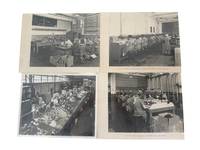
1940235071940. Women's wartime factory labor photo archive depicting rubber molding inspection precision trimming packing and bench production in the United States during the World War II era. More than six million women took wartime jobs in American factories and wartime labor needs moved women into industrial work involving machinery inspection aircraft parts laboratory work and other production roles previously coded as male labor. The captioned Parker views place women inside a rubber parts operation where quality control hand finishing and distribution preparation were treated as essential production work. The archive records the practical shop-floor labor behind the larger wartime shift: long tables stools bins boxed parts inspection lamps trimming tools and women working in sequence across a factory interior.<br /> <br /> Photo archive of 4 large silver gelatin photographs each measuring 8" x 10.75" United States circa 1940s. One caption reads "View of inspection of Parker-molded rubber parts" with women seated along a long worktable examining parts before distribution. Another caption reads "Operators with equipment for precision-trimming of mold rubber parts" showing women working at a row of bench stations with overhead cords boxes and factory equipment. Additional scenes show women packing sorting and assembling small molded components at long tables surrounded by stacked cartons metal containers industrial windows and production shelving.<br /> <br /> During and after World War II women's factory labor did not simply fill temporary vacancies; it proved women could perform skilled industrial tasks in defense-related production even as many employers pushed women out of those jobs when men returned from military service. Light handling wear corner wear minor creasing and curling; photos generally clean and clear and captions remain legible on two mounts. Overall in very good condition. This archive shows the wartime demand for women's labor in order to keep American production moving during the war. unknown
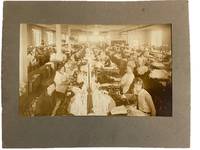
1920173461920. 1920s vintage sepia photograph of around 50 women at work in a textile factory. The photographer's board is 10" x 8" inches and image is 8.25" x 5" inches. The women are seated in long rows and armed with sewing machines and seem to be turning bundles of cloth into garments. Spools of thread hang down from a center rail in the middle of the table to be fed into the sewing machines. Some of the cloth appears to be polka-dotted similar to the dresses that several women pictured appear to be wearing. The factory is consisted almost entirely of women - there is one man in a waistcoat walking around accompanied by an older woman. The working women seem to be of varying ages from their early 20s into their 50s. Textile manufacturing was unique at the time for its overwhelmingly female labor force. Sepia toned very good condition with great detail. unknown
1971LIT60649Köln, Kiepenheuer & Witsch 1971. 473 S. Leinen mit Schutzumschlag. Umschlag etwas lichtrandig, leicht eingerissen, Laminierung teilweise gelöst. Deutsche Erstausgabe.
19711250221Verlag Kiepenheuer & Witsch; Köln, 1971. 473 Seiten; 22,5 cm; kart.
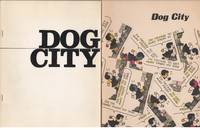
197722287Washington DC: Dog City 1977 and 1980. First Edition. Wraps. Very good -. 4to. Side-stapled no. 1 and saddle-stapled no. 2 in original wraps. Some staining to covers. Else clean and sound internally. Very good minus. Touches of wear. Though not noted both issues ex-libris contributor Doug Lang. <br/><br/>Important Washington DC based poetry magazine featuring work from P. Inman Tina Darragh Bernard Welt Steve Benson Lynne Dryer Joan Retallack Kirby Malone and others. Uncommon. Dog City paperback books
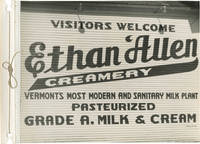
1930149350N.p.: N.p. 1930. Archive of six double weight borderless photographs of the Ethan Allen Creamery in Essex Junction VT circa 1930s. The photographs contain images of both the creamery buildings and interior of the facilities including the vats used to pasteurize milk at what the creamery's sign claims is "Vermont's most modern and sanitary milk plant."<br/><br/>Photographs roughly 9.75 x 7.75 inches. Fine. Tipped onto linen on the left edge and bound with a string. Housed in a contemporary card folder with a vintage photography studio label to the rear pastedown. N.p. unknown books
19792080202105600416Not Available 1979. Soft Cover. Fine. The book is in fine condition. Not Available paperback
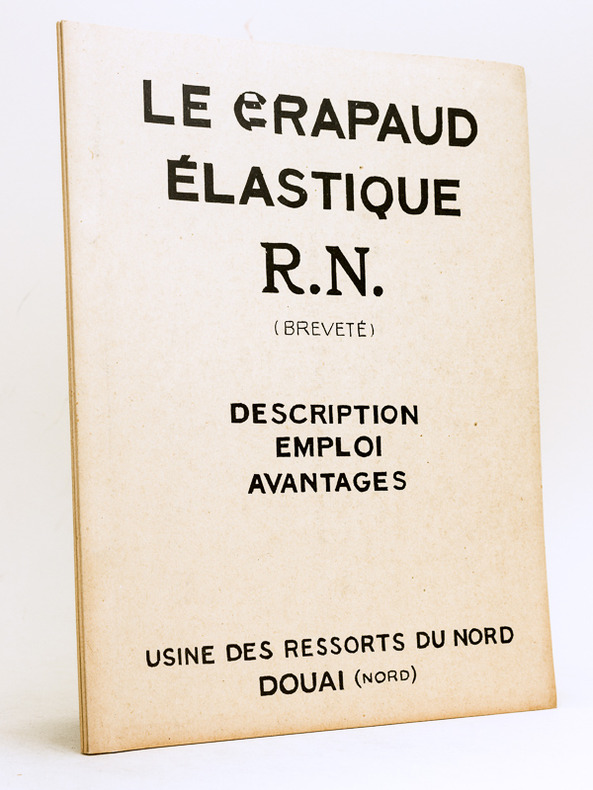
1937430001 vol. in-4 br., s.d. (circa 1937) Usine des Ressorts du Nord, Douai (Nord), 16 ff. dont un dépliant
19282090502113701974Not Available 1928. Soft Cover. Fine. The book is in fine condition. Not Available paperback
19642083002116203140Dokdo Island 1964. Soft Cover. Fine. The book is in fine condition. Dokdo Island paperback
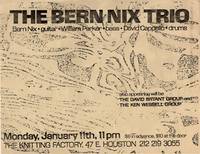
1989168377N.p.: N.p. 1989. Two original flyers announcing a performance by The Bern Nix Trio at the original New York Knitting Factory location on Houston Street circa 1990.<br /> <br /> The Bern Nix Trio consisting of Nix on guitar William Parker on bass and David Cappello on drums formed in 1985 and played together until the early 1990s. In 1994 Nix released the album "Alarms and Excursions" as The Bern Nix Trio with Fred Hopkins on Bass and Newman Baker on drums.<br /> <br /> 8.5 x 11 inches. Xerographically reproduced one printed on pale yellow and one printed on salmon. Near Fine. N.p. unknown
1945234071945. Reading Pennsylvania factory photo archive documenting textile machinery production and hosiery manufacturing work circa late 1940s to early 1950s at or near the Wyomissing industrial complex associated with Textile Machine Works and Berkshire Knitting Mills. Reading became one of the major American centers for full fashioned knitting machinery after Ferdinand Thun and Henry Janssen founded Textile Machine Works in 1892 and the equipment seen here belongs to the world of stocking manufacture before seamless nylon hosiery reshaped the industry in the 1950s.<br /> <br /> Photo archive of 17 large silver gelatin photographseach 8 x 10 inches Reading or Wyomissing Pennsylvania circa 1940s to early 1950s. Rows of large knitting machines fill long factory rooms under fluorescent lighting; workers stand beside circular or braiding machinery marked with chalked Greek words; an engineering office includes men studying large technical drawings; machine tools metal stock exterior factory buildings tanks and utility structures place the scenes within a large industrial plant. Several versos are stamped "Paul Bauer Photographer 608 Franklin St. Reading Pa." and "Photo by Paul Bauer." Several shop-floor views include a chalked Greek vocabulary list beside the machinery a striking detail in a Reading industrial region that had an established Greek immigrant community by the early twentieth century.<br /> <br /> The archive records the machinery workers drafting practices and plant environment behind Pennsylvania's textile machinery economy at the point when American hosiery manufacturing still depended on large specialized mechanical systems and skilled shop labor. Documenting the production floors machine details engineering rooms workers and exterior plant views. Minor edge and curling; images remain clear and well preserved. Overall in very good condition. unknown
198830765Rosenheimer, Rosenheim, 1988. 88 Seiten / pp., mit zahlreichen Abbildungen / with many illustrations; Kl.-8°, ca. 15 x 17 cm, Pappeinband
19762090502113717526Not Available 1976. Soft Cover. Fine. The book is in fine condition. Not Available paperback
1910345641910 6 photos au format 12 X 17 cm montées sur cartons au format in-8 du photographe Sutter Très intéressant document, une seule est une machine Japy, les autres sont des ouvriers certaines sont légèrement passées, Une photo de l'ensemble des ouvriers avec un enfant au centre
19892092902143901403Osaka Association of Architects 1989. Soft Cover. Fine. Number of books: 1 book Osaka Association of Architects paperback
19692081402109803362Koyu-sha 1969. Soft Cover. Fine. Volume: 1 Koyu-sha paperback
19828413BBLondon, Cape, 1982. gr.8°, 430 S., mit zahlreichen, teils ganzseitigen s/w-Abbildungen, illustr. original Klappenbroschur, Einband stark knickspurig, Rücken gewölbt, zahlreiche Kugelschreiber-Anstreichungen - ein zweifelsfrei intensiv gelesenes und durchgearbeitetes Exemplar (in spanischer Sprache).
1987011747Woodland CA: Printer's Ink. SIGNED by both Walter Loewen and Skip Quinlan. Lightly bumped bottom corners rear cover has small chip on side edge. Clean copy. . Very Good. Soft cover. 1987. Printer's Ink paperback
19802090202118105882Asahishinbunsha 1980. Soft Cover. Fine. The book is in fine condition. Asahishinbunsha paperback
1988x-0915299313Productivity Pr 1988. Hardcover. New. 1st edition. 304 pages. 11.75x9.00x0.75 inches. Productivity Pr hardcover