EuclidBiblio.com

31 397 résultats
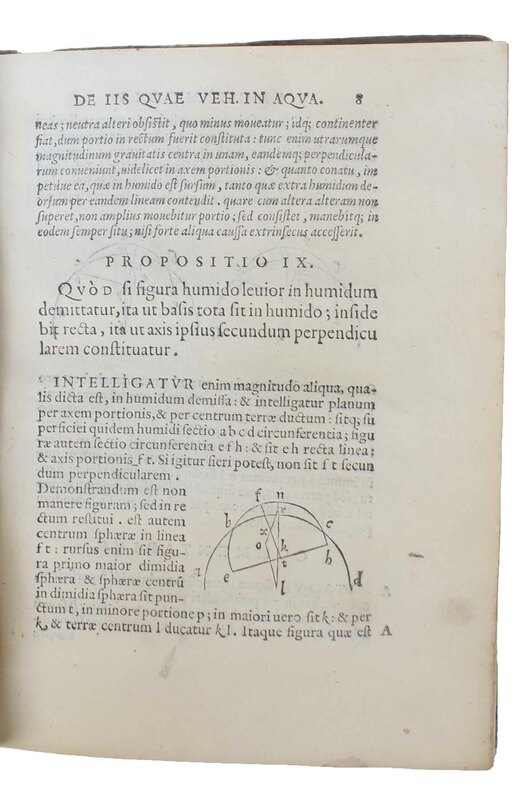
1537e8218Basel: Johannes Hervagius. G: in good condition. Cover rubbed and marked. Wear to spine. Ties at fore-edge broken. Lacking the first 3 initial leaves with Melanchthon's preface. Occasional edge-tearing. Tearing to top edge of pages 295-300 & to inner margins of pages 301-310 some loss to content. Occasional ink annotations. Sporadic foxing marking & staining. Minor worming to top corner of pages 113-128. Some mispagination. 1537. Basel Edition. Later limp vellum with yapped edges. 290mm x 210mm 11" x 8". ii 587pp. Woodcut printer's device on title page and ep woodcut initials headpieces and diagrams. Text in Latin. . Johannes Hervagius hardcover
Leipzig, 1851. 8vo. Original printed wrappers. Re-stitched and with a new paper backstrip perfectly matching the wrappers. Possibly lightly washed (?). Housed in a custom-made red cloth box with a gilt red morocco title-label to spine. XII, (2), 134 pp.
185560473Kazan, Kazan University Press, 1855-56. 4to (263 x 216 mm). In a nice later half calf binding with four raised bands and marbled paper covered boards. Extracted from ""Uchenye zapiski, Imperatorskago Kazanskago Universiteta"", 1855, vol. 1. Two library-stamps to p. 51 with offsetting to p. 50 and small stamp to last free end-paper. With very light creasing to outer margin, otherwise a fine and clean copy. 56 pp.
179959012Helmstadt, C. G. Fleckeisen, 1799. 4to. Bound uncut in a very nice recent pastiche-binding in brown half calf with elaborately gilt spine and marbled paper covered boards. With repair to title-page, not affecting text. Small restorations to upper margin of leaf A2 and A3. Brownspotted throughout. 39, (1) pp. + engraved plate.
Helmstadt, C. G. Fleckeisen, 1799. 4to. Bound uncut in a very nice recent pastiche-binding in brown half calf with elaborately gilt spine and marbled paper covered boards. With repair to title-page, not affecting text. Small restorations to upper margin of leaf A2 and A3. Brownspotted throughout. 39, (1) pp. + engraved plate.
Berlin, Papen, 1710. 4to. Very nice contemporary full calf with five raised bands to richly gilt spine. All edges of boards gilt. A bit of wear to extremities, corners bumped, and capitals professionally restored. Occasional light brownspotting, and printing weak on some leaves (including the text for the Leibnitz-paper). Overall in very nice condition. Pp. 317-19 + folded engraved plate (bound with the plates at the back of the volume - Fig. 73 - in excellent condition). [Entire volume: (22), 394 pp, 1 blank + 31 folded, engraved plates [+ Ruysch: (4), 32, (2) + 2 engraved plates + 18 pp.] ]. The frontispiece is not present.
190160101Paris, 1901. Small folio. Original printed wrappers. The fragile wrappers have been expertly restored along the edges. A stain to back wrapper, a closed horizontal tear, and spine re-enforced. A bit of soiling and discolouration. With a library-label to top of front wrapper, from the Bibliothèque des professeurs St-Stanislas, Mons, of which there is a book-plate to half-title and a stamp to title-page. Wrappers loose. Internally some brownspotting and finely restored marginal chipping, far from affecting text. 32 pp. Richly illustrated.
Paris, 1901. Small folio. Original printed wrappers. The fragile wrappers have been expertly restored along the edges. A stain to back wrapper, a closed horizontal tear, and spine re-enforced. A bit of soiling and discolouration. With a library-label to top of front wrapper, from the Bibliothèque des professeurs St-Stanislas, Mons, of which there is a book-plate to half-title and a stamp to title-page. Wrappers loose. Internally some brownspotting and finely restored marginal chipping, far from affecting text. 32 pp. Richly illustrated.
Venice, Paulus Manutius, Aldi F., 1558. Small folio. Bound in a contemporary simple full limp vellum binding. Neatly rebacked (hardly noticeable) and binding with toning, a bit of soiling, and light spotting. Verso of last leaf browned, otherwise internally unusually nice, clean, and fresh, possibly washed. With the book-plate of Mr de la place de Mont-Evray to inside of front board and old ownership-inscription (August Biturie ?) to title-page. pp. 1v and 2r with elaborate marginal annotations and calculations in 16th century hand. (4), 55, (1) ff. + (2), 63, (1) ff. Large Aldus printer's device (dolphin and anchor - Cataldi Palau, Delfino 16) to both title-pages and to final leaf of both works. Lovely woodcut illustrated initials and many woodcut text-diagrams throughout.
1936049732Association For Symbolic Logic 1938 1939 1940 1941 1942 1943 1944 1945 1946 1947 1948 1949 1950 1951 1952 1953 1954 1955 1956 1957 1958 1959 1960 1961 1962 1963 1964 1965 1966 1967 1968 1969 1970 1971 1972 1973 1974 1975 Etc. 1936. First Edition 1st Printing. Grey-blue Wrappers. Near Fine. 293 Individual Volumes In Original Wrappers Not Library Re-Binds. Foundational Material In The Development Of Modern Logic Mathematical Analysis And Ultimately The Mathematics Enabling Computers And Computer Programming And Artificial Intelligence. Some Wrappers With Minor Yellowing Primarily To Spines A Few Early Issues With Splits To Spines Very Good To Fine. Ownership Signatures Of A Noted Mathematician On Some Issues. Early Issues With Issue Numbers And Dates Inked On Spines. Lacking Vol. 21 No. 3 Vol. 46 No. 2 Vol. 62 No. 1 Vol. 64 No. 1 Vol. 70 No. 3. " . The Extant Gains Registered By The Modern Symbolic Treatment Of Logic Have Become Such An Essential Factorin Making Pronouncements Regarding The History Of Logic That We Are Constrained To Say That An Essential Knowledge Of Symbolic Logic Have Become An Indispensable Condition For Any And All Fruitful Study Of The History Of Logic" Heinrich Scholz"Concise History Of Logic". As It Is Impossible To Show That The Cause And Effect Of Any Physical Event Can Be Isolated Sufficiently To Make The Effects Of Forces Susceptible To A Complete Logical Analysis The Connection Of Physical Science And Logic Remains Tangential And Tenuous. The Impossibility Of Exactly Physically Limiting Definition Of Sources And Effects Of Forces In Social Science Make Law Economics And Politics Ridiculous And The Rest Of Social Science Merely Entertaining. The Scientific Use Of Logic Is Limited To It's Use In Occam's Razor The Endless Process Of Successive Removal Of Improper Statements Relationships And Associations In Statements About The Physical World And The Refinement Of Unscientific Arguments In The Imaginary World To Make Them More Acceptable To Contemporary Sensibilities. <br/> <br/> Association For Symbolic Logic 1938 1939 1940 1941 1942 1943 1944 1945 1946 1947 1948 1949 1950 1951 1952 1953 1954 1955 1956 19 unknown
1784864091784. MATHEMATICS Murai Chûzen. Shugyokû SANPÔ DÔJIMON CHILDREN'S QUESTIONS ABOUT MATHEMATICS 5 vols. Kyoto Tennojiya Ichirobei Temmei 4 1784. 22.9 x 15.9 cm. Uniformly bound Japanese-style fukuro-toji with original printed covers and printed paper title labels. The preface has a zodiacal date of 1781. Important and unusual classic of mathematical pedagogy in Japan heavily illustrated in bw woodcut. There appear to be but 2 copies outside Japan and both are in the Library of Congress. The KSSM volume three p.854 Union catalog from Japan identifies this as being a 6 volume work but two things militate against that: The LOC copies are both 5 volumes bound in 6 ours is 5 volumes bound in 5 and our copy has the original Tennojiya bookseller catalogue bound into the back of the book which clearly states this book is published in 5 volumes. In addition the text is continuous and ends at the end of volume 5. The covers are contemporary to the 1780's the impressions good or better the condition very good throughout. An important book. In a fitted chitsu clasped case. unknown books
184360233Marosvásárhely, Kali Simon, 1843. 8vo. In a simple contemporary half calf with gilt ornamentation to spine forming five compartments. Later paper title-label with gilt lettering pasted on to spine, partly detached in right margin. Light wear to extremities. Stamp to front free end-paper. First leaves evenly lightly browned. An overall fine and clean copy. XLIV, 386 pp. + 2 folded plates, one with 12 folding flaps with partial grey colouring.
Marosvásárhely, Kali Simon, 1843. 8vo. In a simple contemporary half calf with gilt ornamentation to spine forming five compartments. Later paper title-label with gilt lettering pasted on to spine, partly detached in right margin. Light wear to extremities. Stamp to front free end-paper. First leaves evenly lightly browned. An overall fine and clean copy. XLIV, 386 pp. + 2 folded plates, one with 12 folding flaps with partial grey colouring.
"In-8°piccolo, (4cc), 643pp, (33cc), legatura in piena pergamena coeva con unghiature, titolo manoscritto al dorso. Prima edizione, curata da Peiresc. Raguseo, un chierico che arrivò a Padova come secondo professore ordinario di filosofia,diventando amico di Galileo, fu uno dei maggiori esponenti di quella corrente contraria all'astrologia, così in voga in quel periodo. Questo volume contiene le sue lettere sulla divinazione e sull'astrologia, che condanna assieme ad altre scienze occulte quali la chiromanzia, la fisiognomica e la geomanzia. ""Inizialmente coltivò l'eloquenza, quindi la filosofia e teologia, poi si dedicò interamente alla medicina e alla matematica...E non si fermò qui, ché diventò presto seguace dell'arte di Lullo...Possedeva una famosa biblioteca, che sfortunatamente venne venduta dopo la sua morte"" (Thorndike, VI, pp 201-02) Riccardi I. 336. Cantamessa 3693. In-8 ° small, (4cc), 643pp, (33cc), contemporary full vellum binding with overlapping fore-edges, handwritten title on the spine. First edition, published by Peiresc. Raguseo, a cleric who arrived in Padua as a second professor of philosophy, becoming a friend of Galileo, was one of the leading exponents of that current contrary to astrology, so in vogue at that time. This volume contains his letters on divination and astrology, which he condemns along with other occult sciences such as palmistry, physiognomy and geomancy. ""Initially he cultivated eloquence, then philosophy and theology, then he devoted himself entirely to medicine and mathematics ... And he didn't stop there, as he soon became a follower of Llull's art ... He owned a famous library, which unfortunately was sold after his death ""(Thorndike, VI, pp 201-02) Riccardi I. 336. Cantamessa 3693. "
188814319Braunschweig: Vieweg 1888. WITH: O. Fischer Matyas Lerch E. Phragmen C. Neumann C. Meray. 1. DEDEKIND Richard <br /> <br /> Was sind und was sollen die Zahlen. Braunschweig: Vieweg and Son 1888.<br /> <br /> 8vo. xviii 58 pp. including half-title.<br /> <br /> First edition rare of Dedekind’s important work on set theory. His epochal 1872 publication Stetigkeit und irrationale zahlen gave the first rigorous definition of the system of real numbers laying the foundation for much of modern day real analysis and point-set topology. This his follow-up work elaborates on his attempts “to derive a purely logical foundation for arithmetic and devised a number of axioms that formally and exactly represented the logical concept of whole numbers†DSB. Dedekind 1831-1916 a German mathematician friend and colleague of Georg Cantor claimed all of mathematics to be a branch of logic. In this work The nature and meaning of numbers he “presents a theory of the integers using set-theoretic concepts and outlines a possible approach to placing the rationals on a logistically well-founded axiomatic basis†Parkinson p. 415.<br /> <br /> <br /> 2. FISCHER Otto<br /> <br /> Konforme abbildung sphärischer dreiecke auf einander mittelst algebraischer funktionen. Leipzig: von Metzger & Wittig 1885.<br /> <br /> 8vo. 76 pp. Complete with half-title and 2 large folding plates on heavier stock.<br /> <br /> First edition of the author’s thesis on conforming images of spherical triangles by means of algebraic functions. Fischer 1861-1916 was a German physiologist and mathematician earning a doctorate degree from the Franke Foundation in Halle an der Saale in 1885 under Felix Klein. His main interest was the mechanics of the muscles and joints of the human musculoskeletal system. He was a professor at the University of Leipzig where he taught both medicine and mathematics.<br /> <br /> <br /> <br /> <br /> <br /> 3. PHRAGMÉN Lars Edvard<br /> <br /> Über die Berechnung der einzelnen Glieder der Riemann’schen primzahlformel. Stockholm: Kongliga vetenskaps-Akademiens Förhandlingar 1891.<br /> <br /> 8vo. pp. 721-744.<br /> <br /> First edition of this famous work on the calculation of the individual members of the Riemann prime number formula.<br /> <br /> The son of mathematics teachers Phragmén 1863-1937 also taught mathematics before obtaining his degree at the University of Uppsala. He was an editor at the Acta Mathematica where he corresponded with Poincare to correct a book in which he found a number of errors. He was also president of the Swedish Society of Actuaries. He is best known however for the Phragmén-Lindelöf principle an extension of the maximum modulus principle of complex analysis to unbounded domains. <br /> <br /> 4. NEUMANN Carl<br /> <br /> Ueber den Satz der virtuellen verrückungen; Ueber das princip der virtuellen oder facultativen verrückungen. Leipzig: von Breitkopf und Härtel 1869.<br /> <br /> Two separate papers. 8vo. pp. 257-280; 53-64. In Konigl. Sachs. Gesellschaft der Wissenchaften. With annotations on the first couple of pages. At the end of the second paper a thank you by C.F. Gauss.<br /> <br /> Two works on virtual displacements. Neumann created the second-type boundary which when imposed on an ordinary or partial differential equation if specifies the value that the derivative of a solution is to take on the boundary of the domain. <br /> <br /> Neumann 1832-1925 was professor of mathematics at both the Universities of Tübingen and Leipzig. His main interests were in applied mathematics and he wrote on mathematical physics potential and electrodynamics. He was also editor of Mathematische Annalen.<br /> <br /> 5. LERCH Matyáš<br /> <br /> Contributions à la théorie des fonctions; Addition au mémorie présenté dans la séance du 15 Octobre Prag 1886.<br /> <br /> Two separate papers. 8vo. pp. 571-582; pp.423-432. With a 4 page letter containing mathematical <br /> <br /> <br /> symbols handwritten by Lerch to Karl Weierstrass 1815-1897 tipped in between the two papers. The letter is signed by Lerch and dated October 1890. A small section of page 582 is crossed out in the same hand.<br /> <br /> First printings of Lerch’s contributions to general mathematical functions. These papers are the first in a series dealing with the general theory of functions the most significant of which constitutes construction of continuous functions having no derivative. These works were written quite early. Lerch 1860-1922 showed exceptional abilities while still studying at the Czech Technical University at Prague. Before 1896 he published more than 110 scientific papers in domestic as well as prominent foreign journals. Much of his work concerned mathematical analysis including theories of infinite series of the gamma function of elliptic functions and the integral calculus.<br /> <br /> Weierstrass is generally referred to as the father of modern analysis. He made significant contributions and advancements in the field of calculus of variations. Numerous theories and functions bear his name.<br /> <br /> 6. MÉRAY Hugues Charles Robert<br /> <br /> Théorie des radicaux fondée exclusivement sur les propriétés générales des séries entières. Dijon Darantiere 1885.<br /> <br /> 8vo. 75 1 pp. Title page in manuscript signed by Méray and dated Dijon 1891. With annotations throughout probably by the author for another edition.<br /> First edition of Méray’s famous work Radical theory based exclusively on the general properties of power series. <br /> <br /> Méray 1835-1911 is remembered for having anticipated clearly and with only minor differences of style Cantor’s theory of irrational numbers one of the main steps in the arithmetization of analysis. Of interest an earlier “arithmetical†theory of irrational numbers was propounded by Weierstraass in his lectures when he introduced the real numbers as sums of sequences of rational numbers. Dedekind also seems to have developed his theory of irrationals at an earlier date.<br /> <br /> No copies of Phragmén Lerch or Méray are located by OCLC. Vieweg unknown
156552966Bologna, Alessandreo Benacci, 1565. 4to. In contemporary blank cardboards with marbled paper back-strip. Ff 8-12 with small brown dot to lower outer margin, not affecting text. A fine copy. [4], 43 ff. + 1 blank. (Erroneously paginated f. 33 as 25 and f. 44 as 43).
Bologna, Alessandreo Benacci, 1565. 4to. In contemporary blank cardboards with marbled paper back-strip. Ff 8-12 with small brown dot to lower outer margin, not affecting text. A fine copy. [4], 43 ff. + 1 blank. (Erroneously paginated f. 33 as 25 and f. 44 as 43).
Venice, Nicolo di Aristotile detto Zoppino, 1534. 4to. Later full cloth with a bit of wear. Internally with a light damp-stain affecting lower outer margin of the first leaf and last two leaves. A few occasional marginal annotationS in contemporary hand. A very fine and clean copy. 129 ff. (including the final blank). Misnumbered 7 as 8, 71 as 72 and 107 as 105.
Amsterdam, Apud Johannem Riewerts, 1663. Small 4to. Orig. blank paper boards, most of backstrip lacking and wear to extremities, but tight. Woodcut illustr. to title-page and several woodcut mathematical and physical illustrations throughout. Annotations to both free end-paper. Some minor brownspotting and even light browning to leaves. A very nice and attractive copy. (16), 140 pp. (being title-page, Preface w. Errata, Index, Ad Librum, the main text (pp. 1- 90) and the Appendix, being the Cogitata Metaphysica w. its own half-title, (pp. (91-140).
178759006459Chesterfield: J. Bradley 1787. Bound in 19th century pebbled boards stamped in gold. This is apparently a proof copy of the book that was published in 1788 of which there are only two copies on OCLC/Worldcat. There are no copies of this book noted. It is handwritten on the title page that this was a gift of the author. This copy has 12 pages unlike the 1788 edition which has 25 pp. with a diagram. Pagination: iii1 5-12 the Solution - Finis on p.12. Following blank un-numbered page are two diagrams. I believe this may be the only copy of this printing in existence. . First Edition. Hard Cover. Very Good/No Jacket. 4to - over 9¾" - 12" tall. J. Bradley Hardcover
In -8°, pp. (8), 114, brossura editoriale. Prima edizione del lavoro del matematico inglese sulla distribuzione dei numeri primi, considerato un classico nella matematica del Novecento, fu anche l’unico scritto pubblicato da Ingham in volume. La prima edizione si esaurì rapidamente, ma l’autore non volle collaborare a una ristampa considerandolo un lavoro troppo impegnativo. Lo si legge nel suo lungo necrologio sul “Times”: “Ingham could never be persuaded to prepare a second edition. The partial rewriting necessary to bring it up to date would have meant, with his exacting standards, more toil than he could face”. L’autore del necrologio aggiunge, subito dopo, che “Ingham was the embodiment of meticulous accuracy”. First edition of this work of the English scientist on prime numbers distribution, it’s considered a classic in XX century mathematics: it’s also the only one work published by Ingham in a volume. The author, as we read in his “Time” obituary, “could never be persuaded to prepare a second edition. The partial rewriting necessary to bring it up to date would have meant, with his exacting standards, more toil than he could face. Ingham was the embodiment of meticulous accuracy”.
In -4°, pp. (2), 188, (2), 1 tavola più volte ripiegata. Legatura in piena pergamena coeva, titolo manoscritto al dorso. Big table folded many times. The first and only edition of a rare work of arithmetics and calculusm, based on geometric series. Contemporary full vellum, manuscript title on spine.
172735955Leipzig: Christoph Zunkel and Bernhard Christoph Breitkopf, 1727-1739. Folio. (372x239mm). Two parts in one volume. Contemporary vellum, two cuts in spine, modern slip case. Provenance: Book plates of Arnaud de Vitry and Andras Gedeon. Stamps to half-title and title-page, from Stadtbibliothek Augsburg - sold as duplicate. First part: (14], 200, (4) pp. and 45 plates, numbered I-XLIII (plate III with volvelle). Second part: (12), 100, (94) pp. and 40 plates on 36 sheets, numbered I-XL. All plates intact. An exceptionally fine copy.
154334704(Colophon: Venice, Venturino Rossenelli, 1543). Folio. (30,5x22 cm.). Contemporary full Italian limp vellum. Remains of ties. Old handwritten title on spine. Upper part of front cover slightly creased. A few small nicks to hinges at cords. Vellum with brownspots. 242 leaves (2-241 numb. II-CCXXXIX). Misnumbering of leaves in sign. A (10 lvs.), due to the insertion of corrections on f A5. (Collation corresponds to that given by Thomas-Stanford No. 34). Large margins profusely illustrated with diagrams. Upper right corner of title gone with loss of of 3 letters ""NSE"" in MEGARENSE, f A2-A6 with upper right corners and a wormtract-hole in lower margin repaired. A wormtract in lower margin on the next 11 lvs. A1-A6 mounted skillfully on thin opaque parchment-paper. A rather faint dampstain in upper right corner throughout. Last 5 leaves with a small nick in right margin, no loss. Otherwise remarkably clean and printed on good, strong paper. On the title a large woodcut device with arms with G.T. (Gabriele Tadino, to whom the work is dedicated). Colophon with large woodcut device with the letters .P.Z.F. and this repeated on verso of last leaf.
Leipzig: Christoph Zunkel and Bernhard Christoph Breitkopf, 1727-1739. Folio. (372x239mm). Two parts in one volume. Contemporary vellum, two cuts in spine, modern slip case. Provenance: Book plates of Arnaud de Vitry and Andras Gedeon. Stamps to half-title and title-page, from Stadtbibliothek Augsburg - sold as duplicate. First part: (14], 200, (4) pp. and 45 plates, numbered I-XLIII (plate III with volvelle). Second part: (12), 100, (94) pp. and 40 plates on 36 sheets, numbered I-XL. All plates intact. An exceptionally fine copy.