CAMMAN P.Livre Rare Book
CAMMAN P. - GRIGNON A.Livre Rare Book
Trigonométrie. Sans mention de niveau.
193797628Couverture rigide. Cartonnage de l'éditeur, 218 pages.

Librairie et Cætera · Belin-Beliet, France16,20 €
251 résultats
193697666Couverture rigide. Cartonnage de l'éditeur. Couverture défraîchie. 252 pages.
193797628Couverture rigide. Cartonnage de l'éditeur, 218 pages.
74394Coll. "Que sais-je ?" n° 692, Paris, éd. Presses universitaires de France, 1956, in-12, cartonnage souple éditeur, 128 pp., très nb. dessins en noir, table des matières, Tout savoir sur l'usage des "formes mathématiques" donc de la trigonométrie. Pas courant Très bon état
in 8° m.pelle coeva tit. e fregi al dorso, tagli spruzzati pp.145 (1b)(6), tavv. f.testo inrame di Saverio Cavallari
5 voll. Folio. viii pp. (incl. frontespizio inciso) + 596 + 607–638; + 252 (ultima carta bianca); + 244 + 84 + 184 (ultima carta bianca); + viii + 340 (ultima carta bianca) + 348 + xx (ultima carta bianca); + viii + 552 + xii + 60 + 244; + xii + 624 (ultima carta bianca) + 124 (ultima carta bianca) + 60 + 20 + 24 pp. Numerosi legni e diagrammi nel testo. Legatura in pelle coeva, dorso dorato. Bruniture omogenee della carta. The evidence of the attempts to leave the Aristotelianism for the modern method and an important proof of the Galileian revolution.Clavius's work includes in addition to commentary on arithmetic and algebra one on Euclid, Teodosio and Sacrobosco; his contribution to the study of trigonometry and astronomy; his work on the calendar. Clavius has been for mathematics in Renaissence a real turning point: “Probably the man who did the most of all the German scholars of the 16th century to extend the knowledge of mathematics… was Cristopher Clavius, a Jesuit, who passed the later years of his life in Rome. He was an excellent teacher… His Algebra appeared in 1608 and was one of the best textbooks on the subject that had been written up to that time… (he was) engaged in the reform of the calendar…” (Smith). Opera Mathematica in his third volume contains the Sphaera in his last editorial, to which Clavius worked during 1610 and which was printed in 1611. Shortly thereafter, in February 1612, Clavius was dying after a period of illness. In March 1610 following his comments on the telescope, Galileo published in Sidereus Nuncius his latest astronomical discoveries. These findings, perhaps only for a lucky snap of dates, are among the topics covered in the review of Sphaera, where Clavius shows to recognize the meaning. Clavius and the Jesuits in those years had to go back to seriously consider the observations of Galileo, and had to acquire the telescope also to repeat the observations and then verify their accuracy. Clavius led directly the observations (especially on the phases of Venus and the moons of Jupiter, but also on the lunar spots) along with a group of young Jesuit mathematicians and astronomers, first of all Grienberger, thus removing, towards the end of his life and following a long friendship with Galileo, his skepticism about the Copernican theory. Galileo himself in a letter to Madame Christina of Lorraine in 1615 wrote that “altri matematici, i quali mossi da gli ultimi miei scoprimenti, hanno confessato essere necessario mutare la già concepita costituzione del mondo, non potendo in conto alcuno più sussistere”. Galilei continues that one of them was just Clavius, and the reference is certainly to the pitch of the Opera Mathematica Tomo III, p. 75, where as the result of the list of Galileo's discoveries, the Jesuit ends “Quae cum ita sint, videant Astronomi quo pacto orbes coelestes constituendi sint ut haec phaenomena possint salvari”. It 's an extraordinary moment in the history of cosmology and Church, which has marked the highlight of the heliocentric theory, which no major scientists, mathematicians and astronomers of the Society of Jesus, thought no more be able to object. As D'Elia notes (pp. 14-15): "The confirmation from him on the discoveries of the astronomer from Pisa and on the copernican interpretation he deduced, had definitive influence and perhaps even dominate, to ensure the discoveries the almost universal acceptance in the intellectual world, even if the disappearance of the old professor and that of several of his closest disciples could not prevent the ecclesiastical Authority’s precept of 1616 and the condemnation of 1633 ". Clavius had even got that Galileo was received at the Roman College, and was himself to "explain" to Cardinal Bellarmine scientific discoveries of Galilei. So while the academic and obviously ecclesiastical circles did not leave officially by the Aristotelian position, a scientist of them, for evidence and intellectual honesty, was preparing the way for the acceptance of Galileo's discoveries, and could do so given the authority of his position, achieved mainly thanks to its capital contribution asked by Gregory XIII to reform the Julian calendar, which led to the drafting of the Gregorian Calendar. Christoph Clavius (Bamberg 1538-1612) Jesuit and mathematician, astronomer, he entered the Jesuit College in Rome in '55 and then went to Coimbra, where he studied mathematics and science; back to Rome to study theology, he remained as a professor for fortyfive years. He became a pivotal figure for the general mathematical and scientific renewal that had in the Compagnia di Gesù a driving force, entering into the main controversies of the time, from the squaring of the circle to the comparison between the Ptolemaic and Copernican theories. He was the master, among other things, of Matteo Ricci, who with the help of his students, translated many works of Clavius in China, including the six books of Euclid's Elements (1574), which had several editions and updates; a work who had an enormous influence, providing a compendium of knowledge on geometry. His other important works were the Commentaries on Sphaera di Sacrobosco, a treatise on spheres’ geometry and astronomy, and work on the astrolabe. He determined the subsequent development of algebra. De Backer & Sommervogel, 2, cols. 1222–3 (with details of contents). DSB, 3, pp. 311–2. D’Elia, Pasquale, Galileo in Cina, Roma, Università Gregoriana, 1947. Jardine, Nicholas. "The Forging of Modern Realism: Clavius and Kepler against the Sceptics." Studies in History and Philosophy of Science 10 (1979): 141-73. Lattis, James M. Between Copernicus and Galileo: Christoph Clavius and the Collapse of Ptolemaic Cosmology. Chicago: University of Chicago Press, 1994 Proceedings of the Symposium on Christoph Clavius (1538–1612), July 21, 2005, University of Notre Dame, Edited by Dennis Snow. D. E. Mungello, Curious land. Jesuit accomodation and the Origins of Sinology, 1985, p. 26. Eberhard Knobloch, Christoph Clavius – Ein astronom zwischen Antike und Kopernikus”, in Cvortrage des ersten Symposions des Bamberger Arbeitskreises Antike Naturwissenschaft und ihre Rezeption, 113-40, Wiesbaden, 1990.
367p. + Four folding drawings. Numerous text charts and graphs. Damp stained. Foxed. Paper very browned but not brittle. Contemporary book review pasted on front paste down. Small 4to. Original full leather binding, very worn. Spine taped. Hardbound. Scarce and important. **PRICE JUST REDUCED! NAVAL/1
192894565Couverture souple. Broché. 116 pages.
19351102Berlin und Wien, Karl H. Bischoff 1935. EA, 319 S. 8 , Opbd, mit vielen Illustr., eine allgemeinverständliche Darstellung. Ecken bestoßen, Rücken leicht aufgeplatzt, innen gut.
1955133156Couverture rigide. Cartonnage de l'éditeur. 90 pages.
1 Vol. In-8 m. tela. Piatti stanchi . Firma d'app pag. 588 PROG 40543 CATT_ATT 54
Mm 170x245 Brossura editoriale con bandelle di pp. IX-336 con 147 illustrazioni e XII tabelle. Timbri di appartenenza e segni di nastro adesivo alle prime carte, ma per il resto in buonissime condizioni. SPEDIZIONE IN 24 ORE DALLA CONFERMA DELL'ORDINE. WORLDWIDE DELIVERY
In 8°, pp. 253. Bross. edit. ill. a col. Segni d'usura.
In 4, pp. 53 con una tav. f.t., ill. e tavv. sinottiche n.t. Dedica autogr. dell'aut. al p. ant. Br. ed. Studio dei risultati della triangolazione della regione montuosa del Veneto orientale compiuta dall'Istituto Geografico Militare mediante collegamento della livellazione trigonometrica.
Mm 105x150 Collana Manuali Hoepli, volume di pp. XXV-462+64 di catalogo dei Manuali Hoepli, con 86 incisioni e 1 tavola, legatira editoriale in tela, tagli rossi. Firma di appartenenza al piatto anteriore ed alla prima carta bianca, segni a penna al piatto posteriore. Cerniere restaurate (piccoli danni alla sguardia posteriore), leggere fioriture. Prima edizione. SPEDIZIONE IN 24 ORE DALLA CONFERMA DELL'ORDINE. WORLDWIDE DELIVERY
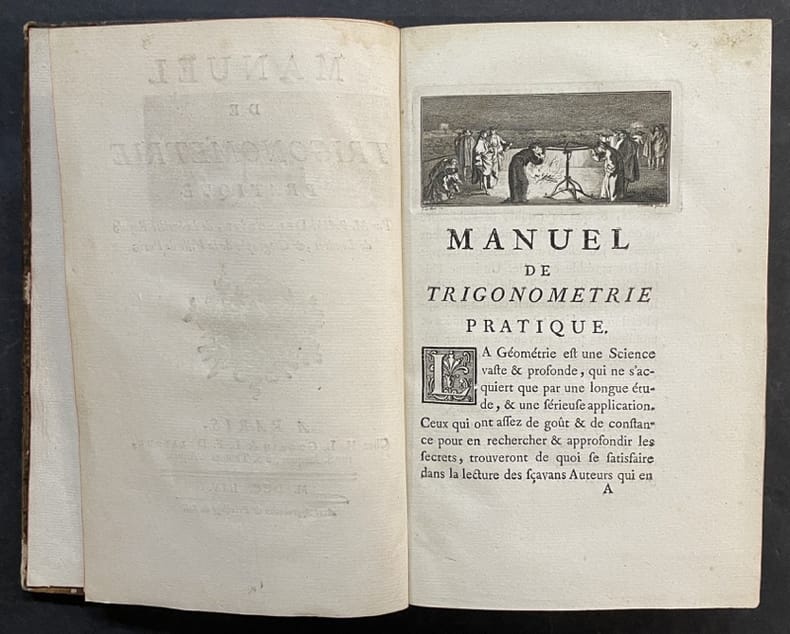
1754128848à Paris, chez H. L. Guerin & L. F. Delatour, M. DCC. LIV. 1754 In-8 20 x 12 cm. Reliure de l’époque veau havane marbré, dos à nerfs encadrés de fers dorés, pièce de titre maroquin grenat, 132-XC pp., vignette de Sébastien Leclerc gravée par Cochin, tables, 6 planches repliées contenant 89 figures in fine.
in-8°, pp. VIII-175 con 28 figure n.t. Bross. edit. con tracce del tempo sui piatti, bruniture all'interno sulle carte. Piccolo timbro di biblioteca sul verso della prima carta di guardia.
19471178801947 Editions Dunod - 1947 - Petit in-12, cartonné - 296 p. + XLVI - Quelques graphiques in texte
1903144015Couverture souple. Broché. 300 pages. Petit manque au coin supérieur des pages.
1902MATH0432Leoben, Nüssler 1902. Gr.-8°. 75 S. sowie 5 Tabellen u. 1 Tafel, HLnbd. d. Zeit, ausgeschiedenes Bibl.-Expl. mit den üblichen Kennzeichnungen.
In 8°; (12), 324 pp. e 73 c. di tav. alcune più volte ripiegate, compresa l'antiporta incisa con immagine di orologio solare, poliedri, sfera armillare, rosa dei venti, una nave sul mare ed un palazzo con torre. Antichi timbri e firma ex-libris al frontespizio che iedentifica l'esempalre come appartenuto al cavaliere Antonio Parenti. Legatura di metà novecentesca in mezza-pelle con titolo in oro e piatti foderati con carta marmorizzata. Tagli rossi. Alcuni forellini di tarlo da pagina 15 a pagina 40, da 111 a 143, da 281 a 309 presente un piccolo tunnel di tarlo, a volte restaurato, nel margine esterno bianco ma che però, a volte, sfiora alcune lettere di testo ed in una ventina di pagine lede una lettera di testo per pagina. Da 183 a 248 u n sottile tunnel di tarlo in parte restaurato si sviluppa per qualche millimetro, nel margine basso bianco del volume, sempre lontano dal testo. Per il resto in buone condizioni di conservazione. Quarta edizione rivista ed aumentata, di questo celebre trattato di gnomonica pubblicato per la prima volta nel 1641, scritto da Dom Pierre de Sainte Marie Magdeleine. Applicando i principi della trigonometria sferica, l'autore indica i metodi per costruire tutti i tipi di orologi solari e tracciarli su tutti i tipi di supporti, ma anche Quadranti lunari o metodi per conoscere l'ora di notte usando le stelle. L'opera è uno dei più celebri trattati sull'argomento del XVII° secolo. Il lavoro si conclude con elementi di stereotomia. Rif. Bibl.: Houzeau & Lancaster, 11455; Tardy, 220; Polak, 8584.
35428Paris. Gauthier-Villars. 1921. In-8. Br. 3ème édition. 361 p. BE.
187712632Paris, Gauthier-Villars, 1877. In-8 de XXXI-352 pages, demi-basane verte, dos lisse avec titre et filets dorés.
In 8, pp. XVI + 212; XXIV + 304 con 4 tavv. f. t. Mezza pelle coeva con qualche danno. La seconda parte contiene les Tables constantes.
in 16° elegante legatura edit. pp.226
In 16, leg amatoriale mz. pelle con ang. piatti marmorizzati, nervi , filetti e tit. in oro al dorso, pp. 250, avec 146 figures dans le texte;lievi abrasioni al dorso, costolo inf. leggermente distaccata al piede, minimi segni del tempo, ottimo.Luogo di pubblicazione ParisEditore DoinAnno pubblicazione 1930Collana Biblioteque D'Education Scientifique Materia/Argomento Scienze, Matematica, Geometri, Trigonometria