GERGONNE (J.D.)Livre Rare Book

110 résultats
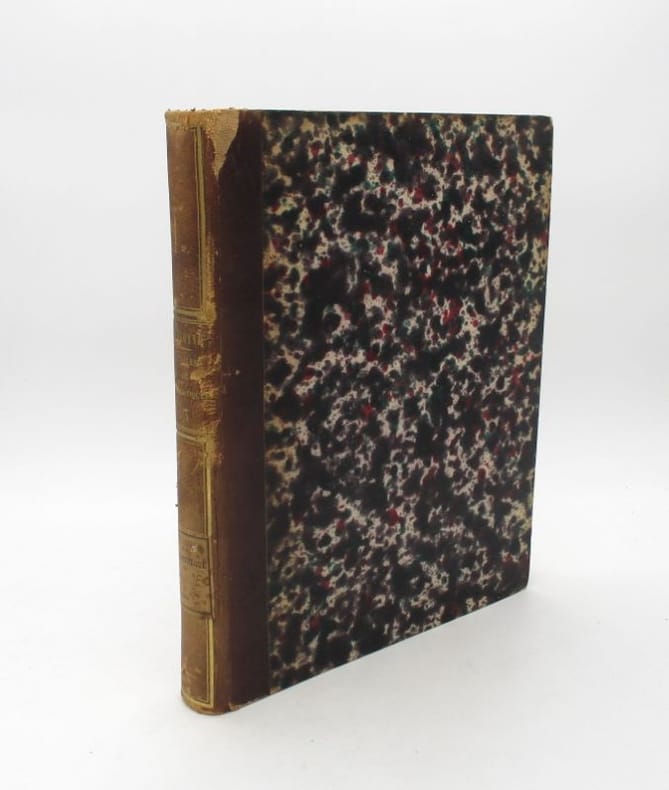
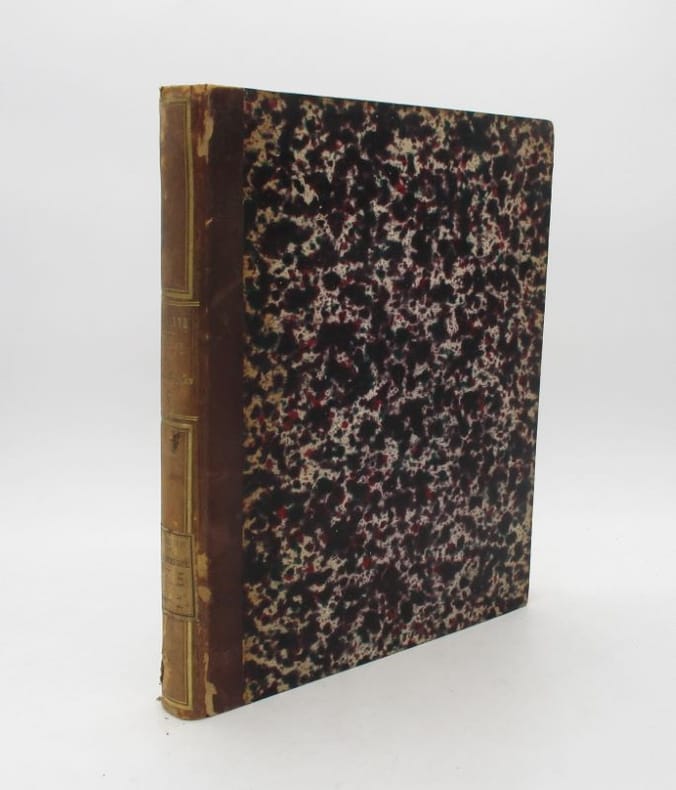
17790Nîmes, imp. P. Durand-Belle, 1813-1814. In-4, 392 pp. 6 pl., demi-basane aubergine, dos lisse orné de caissons dorés, étiquette de la bibliothèque du lycée Henri IV, tranches mouchetées (insolation, épidermures, quelques petites taches et rousseurs).
17791Nîmes, imp. P. Blachier-Belle, 1812-1813. In-4, 392 pp. 3 pl., demi-basane aubergine, dos lisse orné de caissons dorés, étiquette de la bibliothèque du lycée Henri IV, tranches mouchetées (insolation, épidermures, quelques petites taches et rousseurs).
17792Nîmes, imp. P. Blachier-Belle, 1814-1815. In-4, 390 pp. 2 pl., demi-basane aubergine, dos lisse orné de caissons dorés, étiquette de la bibliothèque du lycée Henri IV, tranches mouchetées (insolation, épidermures, quelques petites taches et rousseurs).
Book is as new with sharp corners Text is clean and unmarked. 175 pages, full of formulae. Some random phrases from the Table of Contents: Time-Potimal Problem and Maximum Principle, Pontryagin Maximum, Canonical Systems Convest Control Problem, Weak Convergence Partition of Unity, Approximation Lemma, Fixed-Point Theorem Contraction Mappings,variation Formula, Linear Matrix Differential Equations, Variation of Trajectories, Sliding Optimal Regimes,
1989285526Paris: Galerie Theoreme 1989. Limited. paperback. near fine. Picasso. Illustrated color. 54 pages square 8vo. paperback with edge-worn heavy paper slipcase. Paris: Galerie Theoreme 1989. A near fine copy in a very good- case.<br/><br/> Limited edition: no. 523 of 1000.<br/><br/> Galerie Theoreme unknown books
1931EC10-717Leipzig, Akademische Verlagsanstalt, 1931 / 1930 / 1933. original wrappers, large 8 vo, A) 2 leaves, 404 and 62 pages, [G?del p. [173]-198], B) [183]-404 and 52 pages, 2 leaves, [G?del 349-360], C) 235-470 and 41 pages, 2 leaves, [G?del 433-443], wrappers with librarystamps TU WIEN Ausgeschieden, (=Cancelled Ex-Library copies)
1931BA9-1017Leipzig, Akademische Verlagsanstalt, 1931 / 1930 / 1933. original wrappers, large 8 vo, A) 2 leaves, 404 and 62 pages, [G?del p. [173]-198], B) [183]-404 and 52 pages, 2 leaves, [G?del 349-360], C) 235-470 and 41 pages, 2 leaves, [G?del 433-443], wrappers with librarystamps TU WIEN Ausgeschieden, (=Cancelled Ex-Library copies)
1892, 1892, , , , ENVOI de l'auteur au mathématicien Charles Hermite (1822-1901), élève de polytechnique (X 1842), professeur de mathématiques au Collège de France, professeur d'algèbre supérieure à la Sorbonne et membre de l'Institut. Georges Fontené (1848-1923), professeur agrégé de mathématiques, publia de nombreux articles dans le Annales de mathématiques sur la géométrie pure et analytique, les hyperespaces, les fonctions et intégrales elliptiques, les courbes algébriques planes et gauches ou les équations linéaires. Il a contribué à la formulation du théorème de Rouché-Fontené. Tampon annulé de l'institut catholique de Paris
190051494Paris Gauthier-Villars 1900. 4to. No wrappers. In: "Comptes Rendus Hebdomadaires des Séances de L'Academie des Sciences" Tome 131 No 24. Pp. 975- 1017. Entire issue offered. Fejér's here spelled Téjer ! paper: pp. 984-987. Clean and fine. <br/><br/><em>First printing of this importent paper in which Féjer states the "Summation Theorem" that bears his name."Fejér’s main works deal with harmonic analysis. His classic theorem on C 1 summability of trigonometric Fourier series 1900 not only gave a new direction to the theory of orthogonal expansions but also through significant applications became a starting point for the modern general theory of divergent series and singular integrals. Through a Tauberian theorem of G. H. Hardy’s the convergence theory of Fourier series was considerably affected by Fejér’s theorem as well; it is closely connected with Weierstrass’ approximation theorems and with the more advanced theory of power series and harmonics potential theory and makes possible a number of analogues for related series such as Laplace series."DSB. </em> unknown
199362204New York, Springer (Graduate Texts in Mathematics / GTM 144), 1993. XIV, 223 S. (24 cm) Pappband / gebundene Ausgabe
175042900Petropoli St. Petersbourg 1750. 4to. Uncut without wrappers. Extracted from "Novi Commentarii Academiae Scientiarum Imperialis Petropolitanae" Tom. I. ad Annum 1747 et 1748. Pp. 3-19 a. 1 engraved plate. and pp. 20-48. <br/><br/><em>First printing of both papers. The second is important as it contains Euler'is second proof of the Euler-Fermat theorem which Euler presents as a consequence of the theorem that abp = apbp mod p. This paper also includes results about possible divisors of a2n b2n and Euler uses this to show again that F5 is not prime. - Enestroem No. 133 a. 134. </em> unknown
177041596Berlin Haude et Spener 1770. 4to. No wrappers as issued in "Mémoires de l'Academie Royale des Sciences et Belles-Lettres" Tome V pp. 203-221 1 plate and pp. 222-288 1 engraved plate. <br/><br/><em>Both papers first edition. The first paper is Euler's discussion of "Cramers Paradox" and it contains his inventions of 2 kinds of curves "Cusps of first kind" or keratoid cusp and "Cups of second kind" or ramphoid cusp. - Enestroem E 169.The second paper contains Euler's famous proof of "The fundamental Theorem of Algebra". - Enestroem E 170. </em> unknown
105953Paris, Berger-Levrault & Cie Editeurs, rue des Beaux-Arts, 5, sans date [1907], 1 volume in-8 de 225x145 mm environ, viii-301 pages, 1f. (table des matières), demi-reliure à coisn en veauu havane, signée Jaquet-Lyon, dos à nerfs portant titres dorés sur pièce de titre rouge, orné de petits fleurons dorés aux entrenerfs, cuir souligné d'un double filet doré sur les plats, gardes marbrées, tête dorée, couvertures conservées. Petits frottements, légères épidermures et quelques rousseurs sur le cuir, intérieur bon état.
1979100133734Springer 1979 969 pages 14 86x21 41x1 85cm. 1979. Broché. 2 volume(s). 969 pages.
35371Paris. Albert Blanchard. 1971. In-8. Br. 58 p. TBE.
199473610Berlin/New York, Springer (Universitext), 1994. VIII, 118 S. Paperback / kartonierte Ausgabe
2 volumes [6]-510 pages + [4]-428 pages, 32 planches demi chagrin havane, dos à nerfs 1876, 1876, in-8, 2 volumes [6]-510 pages + [4]-428 pages, 32 planches, demi chagrin havane, dos à nerfs, Rare édition des Oeuvres complètes du célèbre géomètre du XVIIe siècle Desargues procurée par l'historien et spécialiste de l'histoire des mathématiques, Noël Germinal Poudra (1794-1894). Relié in fine : POUDRA et HOSSARD, Question de probabilité résolue par la géométrie. Paris, J. Corréard, 1859. [4]-23 pages, une planche Exemplaire provenant de la bibliothèque de la Faculté catholique de Paris, avec cachet annulé ; et étiquette de la librairie de Henri Vieillard, dont sa veuve, Mme Vieillard, fit don à l'Institut Catholique en 1902. Légères épidermures au dos
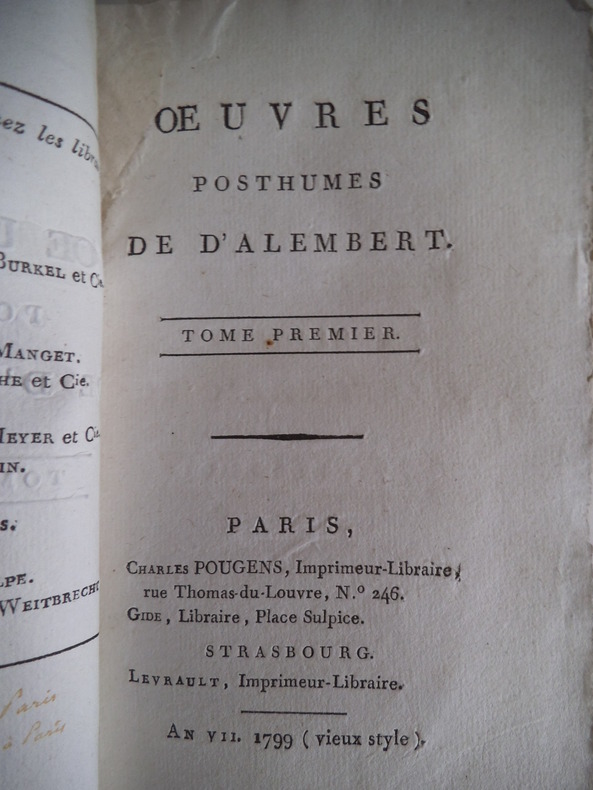
5641Deux tomes en deux volumes in 8 brochés,couverture d’attente,étiquette de titre imprimée.Tome 1:faux-titre, titre,XII,480 pages, non rogné.Tome 2:faux-titre titre 418 pages non rogné, Charles Pougen Paris Berger Levrault Strasbourg 1799 vieux style (an VII) édition originale Très bon état à très grandes marges
184846603Berlin Haude et Spener 1848-52. 4to. No wrappers as extracted from "Mémoires de l'Academie Royale des Sciences et Belles-Lettres" tome II 1846 tome IV tome VI a. tome VI. Pp. 182-224 pp. 249-291 pp. 361- 378 pp. 413-416 and 1 folded engraved plate. <br/><br/><em>First apperance of d'Alembert's 3 importent papers on the Calculus of Integration a branch of mathematical science which is greatly indepted to him. He here gives the proof of THE FUNDAMENTAL THEOREM OF ALGEBRA called d'Alembert's theorem and later corrected by Gauss 1799.The theorem is based on these three assumptions:Every polynomial with real coefficients which is of odd order has a real root. This is a corollary of the intermediate value theorem. Every second order polynomial with complex coefficients has two complex roots. For every polynomial p with real coefficients there exists a field E in which the polynomial may be factored into linear terms.Also with an importent paper by Leonhard Euler "Mémoire sur l'Effet de la Propagation successive de la Lumiere dans l'Apparition tant des Planetes que des Cometes" Memoir on the effect of the successive propogation of light in the appeareance of both comets and planets. Pp. 141-181 and 2 folded engraved plates. - The paper is founded on Euler's theory of light as waves and not as particles. It is from the same year as his fundamental work on light as waves: "Nova Theoria" - Enestroem E 104. </em> unknown
35654Paris. Librairie Vuibert. 1923. In-8. Br. Nbrs figs. mathématiques. 102 p. Très bon état intérieur. Rousseurs sur la couv. et tache d'encre.
47123Dunod.2003.2 vols.in-8,couv.souples illustrées.1: Calcul propositionnel algèbre de Boole,calcul des prédicats.385 p. 2: Fonctions récursives,théorème de Godel, théorie des ensembles,théorie des modèles.347 p. TBE.
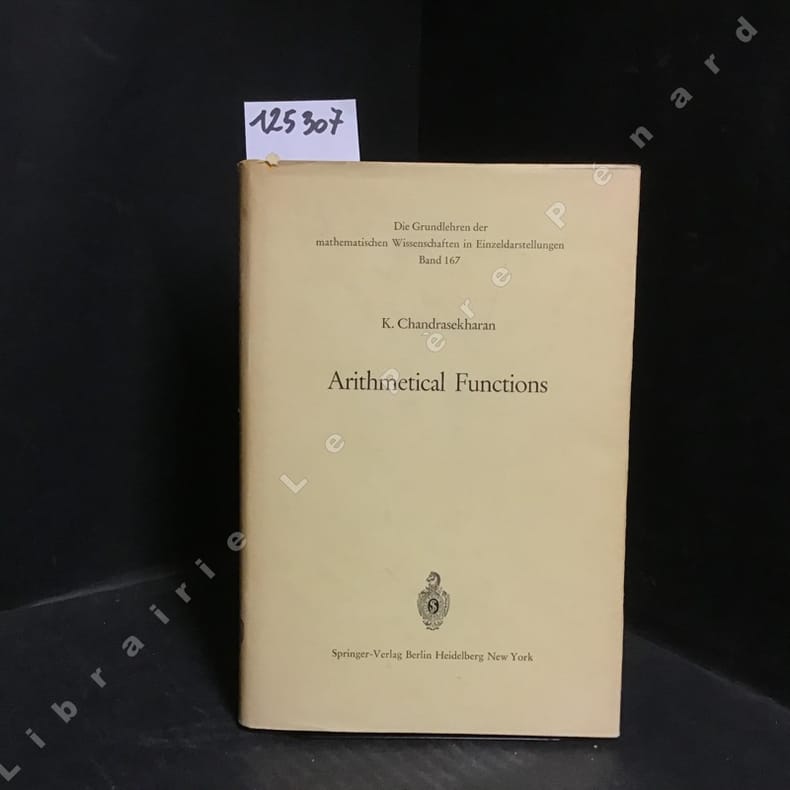
19701253071970 Springer-Verlag Berlin / Heidelberg / New York - Collection "Die Grundlehren der matematischenn Wissenschaften in Einzeldarstellungen" vol. 167 - 1970 - In-8, reliure pleine toile sous jaquette - XI-231 pages - Texte en anglais
185842295London Richard Taylor and William Francis 1858 and Taylor and Francis 1866. 4to. No wrappers as extracted from "Philosophical Transactions" Vol. 148 - Part I. Pp. 17-37 and Vol. 156 - Part I Pp. 25-35. Clean and fine. <br/><br/><em>First appearance of this outstanding contribution to mathematics announcing his invention and developments of the ALGEBRA OF MATRICES what is now called the Cayley-Hamilton theorem for square matrices of any order. "The subject originated in a memoir of 1858 the paper offered and grew directly out of simple observations on the way in which the transformations linear of the theory of algebraic invariants are combined.a distinctive feature of these rules is that multiplication is not commutative.we get different results according to the order in which we do the multiplication. it seems about as far from anything of scientific or practical use as anything could possible be. Yet sixty seven years after Cayley's invented it HEISENBERG in 1925 recognized in the algebra of matrices exactly the tool which he neede for his revolutionary work in QUANTUM MECHANICS."Bell Men of Mathematics."It was in connection with the study of invariants under linear transformation that Cayley first introduced matrices to simplify the notation involved. Here he gave some basic notions. This was followed by his first major paper on the subject "A Memoir on the Theory of Matrices." the paper offered here. Kline Mathematical Thought.p. 806. </em> unknown
187941917London Edward Stanford 1879. Without wrappers in "Proceedings of the Royal Geographical Society and monthly Record of Geography" April issue with titlepage to vol. 1 1879. Pp.2 225-288 a. 2 folded maps. Cayley's paper: pp. 259-261 <br/><br/><em>Fitrst appearance of Cayley's famous paper on the Four-Colour-Problem"The four-colour map problem to prove that on any map only four colours are needed to separate countries is celebrated in mathematics. It resisted the attempts of able mathematicians for over a century and when it was successfully proved in 1976 the ‘computer proof’ was controversial: it did not allow scrutiny in the conventional way. At the height of his influence in 1878 Arthur Cayley had drawn attention to the problem at a meeting of the London Mathematical Society and it was duly ‘announced’ in print. the paper offered. He made a short contribution himself and he encouraged the young A. B. Kempe to publish a paper on the subject. Though ultimately unsuccessful the work of Cayley and Kempe in the late 1870s brought valuable insights. Francis Galton is revealed as the ‘go-between’ in suggesting Cayley publish his observations in Proceedings of the Royal Geographical Society." Tony Crilly.The Four-Colour-Theorem was proved in 1976 by Kenneth Appel and Wolfgang Haken. It was the first major mathematical theorem to be proved using a computer. </em> unknown
184149105Paris Bachelier 1841. 4to. Without wrappers. In "Comptes rendus hebdomadaires des séances de l’Académie des sciences" Vol. XII No 6. Pp. 267- 316. Entire issue offered. Cauchy's paper: pp. 283-298. Some scattered brownspots. <br/><br/><em>First printing of an importent paper in information theory - the paper stating the earliest version of what will later be known as the "Nyquist Sampling Theorem" describing how many and what kind of samples are needed to construct a curve."The theorem will be formulated more completely in 1928 and become one of the cornerstones of information theory" Bryan Bunch 1841 M. </em> unknown