110 résultats
35560Paris. PUF. 1929. In-8. Br. 126 p. TBE.
19961259601996 Cambridge University Press - 1996 - Reprint with corrections - In-8 broché, couverture illustrée - 355 pages - Texte en anglais
Appendix by Norbert Wiener. 392 pages. Includes Index. Allen H. Schooley's owner's stamp on front free endpaper and title page. Small name label of Erwin Tomash at lower corner of front pastedown. Light wear to cover extremities. Page edges greyed.
In 4°; (10 inclusa errata), 86 pp. Legatura coeva in mezza-pelle con titolo e fregi in oro al dorso. Piatti foderati con carta marmorizzata coeva (qualche lieve segno del tempo alla legatura). All'interno esemplare in ottime condizioni di conservazione. Prima non comune edizione di questa importante opera matematica del celebre matematico francese, Ferdinand François Désiré Budan de Boislaurent (28 settembre 1761 - 6 ottobre 1840) che divenne famoso proprio grazie al trattato qui presentato. Iniziato a studiare a Juilly, proseguì poi a Parigi, dove si iscrisse a medicina, ottenendo il dottorato con una tesi su una questione di “Economia medica” dove sosteneva la necessità di informare in modo corretto un paziente sulla sua situazione medica. Raggiunse la celebrità quando nel 1807 pubblicò il suo “Nouvelle Methode” nel quale alla stregua di Fourier ma in modo diverso e prima di questi (il lavoro Budan lo aveva già compiuto e finito nel 1803, spiega “given a monic polynomial p(x), the coefficients of p(x+1) can be obtained by developing a Pascal-like triangle with first row the coefficients of p(x), rather than by expanding successive powers of x+1, as in Pascal's triangle proper, and then summing”. Questa regola è ancora nota come il Teorema di Budan ed è un teorema di delimitazione il numero di radici reali di un polinomio in un intervallo e calcolando la parità di questo numero. Il lavoro di Budan fu ripreso, tra gli altri, da Pierre Louis Marie Bourdon (1779-1854), nel suo celebre libro di algebra, ma con il tempo , venne eclissato dal Teorema di Fourier che garantiva un risultato equivalente. Il Teorema di Budan è però stato fortemente recuperato a partire dalla fine del XIX° secolo quando ci si accorse che alcuni risultati computazionali erano più facilmente deducibili da esso che dalla versione offerta da Fourier. In particolare, furono Collins e Akritas nel 1976 a recuperarlo, per la fornitura, in computer algebra, di un algoritmo efficiente per l'isolamento di radici nei computer. All'uscita dell'opera, la fama di Boudan, iniziò ad aumentare esponenzialmente anche oltre Manica, tanto da venir citato da numerosi importanti matematici e studiosi come ad esempio Peter Barlow o Horner. Barlow lo nominò alla voce “Approssimazione” nel suo Dizionario del 1814, sebbene, erroneamente lo affiancasse al metodo di Joseph-Louis Lagrange, definendolo come accurato ma più di interesse teorico che pratico. Horner descrivendo il lavoro di Budan sull'Approsimazione nel suo celebre articolo sulle Transazioni filosofiche presentato alla Royal Society di Londra nel 1819, articolo che diede origine al termine metodo di Horner, commentò in modo scettico i risultati di Budan ma in articoli seguenti, cambiò completamente opinione, riconoscendone il valore intrinseco. Il lavoro di Budan sembra anticipare anche quello di Paolo Ruffini del 1804. Si legge in D. S. B., II, 573 : :"Budan is known in the theory of equations as one of the independent discoverers of the rule of Budan and Fourier, which gives necessary conditions for a polynomial equation to have n real roots between two given real numbers. He announced his discovery of the rule and described its use (...) and published the paper with explanatory notes, as 'Nouvelle méthode pour la résolution des équations numériques', in 1807. (...) The need for such a rule as his was suggested to Budan by Lagrange's 'Traite de la resolution des equations numeriques' (1767). (. . .) Budan's goal was to solve Lagrange's problem - between which real numbers do real roots lie? - purely by means of elementary arithmetic. Accordingly, the chief concern of Budan's 'Nouvelle méthode' was to give the reader a mechanical process for calculating the coefficients of the transformed equation in (x - p). He did not appeal to the theory of finite differences or to the calculus for these coefficients, preferring to give them 'by means of simple additions and subtractions.' (...) Budan's rule remains the most convenient for computation". Proprio grazie agli sviluppi tecnologici della fine del novecento ed essendo usato in moderni algoritmi veloci per isolare le radici reali di polinomi, l'opera qui presentata è diventata, oggi, un classico della matematica ed è qui presentata in prima edizione, in legatura coeva ed in buone-ottime condizioni di conservazione. Non comune. First edition, good copy. Rif. Bibl.: D.S.B.,II,573.

191130628École Polytechnique 1911 in-4° 246 pp autographiées et 10 pages dactylographiées à la fin , une page déchirée sans manque
177946989Paris Ph.-D. Pierres 1779. 4to. Nice recent vellum titlelabel with gilt lettering on spine. 4XXVIII471 pp. Wide-margined clean and fine. <br/><br/><em>First edition of Bezout's main work - a fundamental contribution to algebraic geometry - in which he prooved the so called ´Bezout's theorem. The theorem was essentially stated by Isaac Newton in his proof of lemma 28 of volume 1 of his Principia where he claims that two curves have a number of intersection points given by the product of their degrees.Bézout's theorem is a statement in algebraic geometry concerning the number of common points or intersection points of two plane algebraic curves. The theorem claims that the number of common points of two such curves X and Y is equal to the product of their degrees. The work stimulated many investigations in the modern theory of elimination including Cauchy’s refinements of elimination procedure and Sylvester’s work on resultants and inertia forms. Bezout’s theorem is crucial to the study of the intersection of manifolds in algebraic geometry."It was not until 1779 that Bezout published his Théorie des équations algébriques his major work on elimination theory. Its best-known achievement is the statement and proof of Bezout’s theorem: "The degree of the final equation resulting from any number of complete equations in the same number of unknowns and of any degrees is equal to the product of the degrees of the equations." Bezout following Euler defined a complete polynomial as one that contains each possible combination of the unknowns whose degree is no more than the degree of the polynomial. Bezout also computed that the degree of the resultant equation is less than the product of the degrees for various systems of incomplete equations. Here we shall consider only the complete case.The proof makes one marvel at the ingenuity of Bezout who like Euler not only could manipulate formulas but also had the ability to choose those manipulations that would be fruitful. He was compelled to justify his nth-order results by a naive "induction" from the observed truth of the statements for 1 2 3 ···. Also numbered subscripts had not yet come into use and the notations available were clumsy."DSB. </em> hardcover
Mm 175x245 Ristampa anastatica su quella originale del 1929. Volume nella sua brossura originale, xi-573 pagine. Copia eccellente poco o nulla consultata. Spedizione in 24 ore dalla conferma dell'ordine.
Mm 175x245 Ristampa anastatica su quella originale del 1929. Brossura originale a stampa, xi-573 pp. Timbri di biblioteca privata dismessa in alcune pagine, tracce di nastro adesivo alla prima ed ultima carta, peraltro il libro è in buone-ottime condizioni. Spedizione in 24 ore dalla conferma dell'ordine.
200473213New York/Berlin, Springer (Grundlehren Text Editions / GLT), 2004. IX, 363 S. (24 cm) Paperback / kartonierte Ausgabe
200973245Basel, Birkhäuser (Birkhäuser Advanced Texts), 2009. XIX, 575 S. (24 cm) Pappband / gebundene Ausgabe
Mm 170x240 Volume nella sua brossura originale, ix-118 pagine. Buona copia, spedizione in 24 ore dalla conferma dell'ordine.
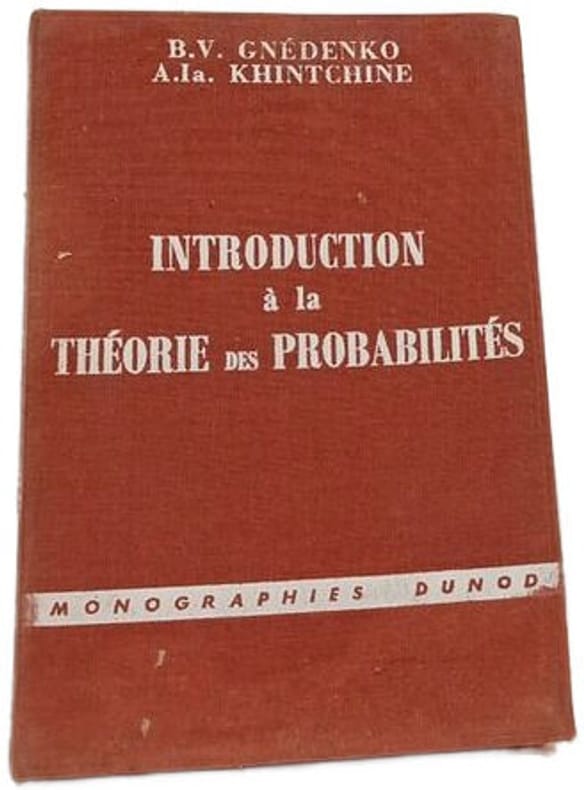
1960100145084Dunod 1960 in12. 1960. Cartonné.
In 4, pp. 23 + (1b). Intonso. Br. ed.
126157sd Publication de l'A.P.M.E.P. (Association des Professeurs de Mathématiques et de l'Enseignement Public) - N° 70 - Sans date - In-8 broché, couverture illustrée - 100 pages - Illustrations et figures en N&B dans le texte
Mm 165x255 Volume nella sua brossura originale, (12)-x-530 pagine molte delle quali ancora intonse. Piccole abrasioni alla testa e al piede del dorso, peraltro il libro è in buone-ottime condizioni nelle sue legature ben salde. Spedizione in 24 ore dalla conferma dell'ordine.
in-8, 151 pages, illustrations en noir, cartonnage illustré. Tres bel exemplaire. [AR-2]
199261066New York, Dover (Dover Books on Advanced Mathematics), 1992. X, 307 S. Broschierte Ausgabe
178044931(Paris, Moutard, Panckoucke, 1780). 4to. Extract from ""Mémoires fe Mathematique et de Physique, Présentés à l'Academie des Sciences par divers Savans"", Tome IX. Pp. 593-624 and 2 folded engraved plates. Clean and fine.
190748911(Paris, Gauthier-Villars), 1907. 4to. No wrappers. In: ""Comptes Rendus Hebdomadaires des Séances de L'Academie des Sciences"", Tome 144, No 11, No. 19 and No. 21. Pp. (593-) 664 + pp. (1009-) 1080. + pp. (1137-) 1192.(3 entire issues offered).Reesz' paper: pp. 615-619. Fischer's paper: pp. 1022-1024 a. 1148-51. Nos 19 a. 21 with some small tears to outher margins. paper fragile. Sewing loose.
186941671Kjøbenhavn (Copenhagen), Bianco Luno,1869. 4to. Uncut and unopened in orig. printed wrappers. [Off-print from: Vidensk. Selsk. Skr., 5 Række, naturvidenskabelig og matematisk Afd., 8 Bd. V.]. Pp. (203-)248. A mint copy.
193148257Easton, PA., Mack printing Compagny, 1931. Royal8vo. Contemp. full cloth. Spine gilt and with gilt lettering. In: ""Proceedings of the National Academy of Sciences of the United States of America"", Vol. 17. VII,710 pp. (Entire volume offered). The papers: pp. 315-318, 650-655 and 656-660.
183241657Berlin, G. Reimer, 1832. 4to. Without wrappers. Extracted from ""Journal für die reine und angewandte Mathematik. Hrsg. von A.L. Crelle"", 9. Bd. pp. 99-104.
180942620(London, W. Bulmer and Co., 1809). 4to. No wrappers as extracted from ""Philosophical Transactions"" 1809 - Part II. Pp. 345-372. Clean and fine.
187347891Paris: Gauthier-Villars, 1873. 4to. No wrappers. In: ""Comptes Rendus Hebdomadaires des Seances de l'Academie des Sciences"", Vol 77, Nos 1, 2, 4 a. 5 (4 entire issues offered). Hermite's paper: pp.18-24" 74-79 226-233" 285-293). With halftitle and titlepage to vol. 77.
190051494(Paris, Gauthier-Villars), 1900. 4to. No wrappers. In: ""Comptes Rendus Hebdomadaires des Séances de L'Academie des Sciences"", Tome 131, No 24. Pp. (975-) 1017. (Entire issue offered). Fejér's (here spelled Téjer !) paper: pp. 984-987. Clean and fine.