4 272 résultats
240664Paris, Jean Desaint & Charles Saillant, 1744 in-8, titre, iv pp., 83 pp., avec un tableau dépliant hors texte, broché sous couverture de papier peigne. Manques de papier au dos, mouillures supra-paginales.
3798In 12 plein cuir fauve raciné à nerfs,sans la pièce de titre,titre,132 pages,2 planches dépliantes.Suivi de abrégé du calendrier 83 pages,tableaux dont 1 dépliants,tranches mouchetées.Lottin 1743,un coin très légèrement émoussé sinon très bon état.
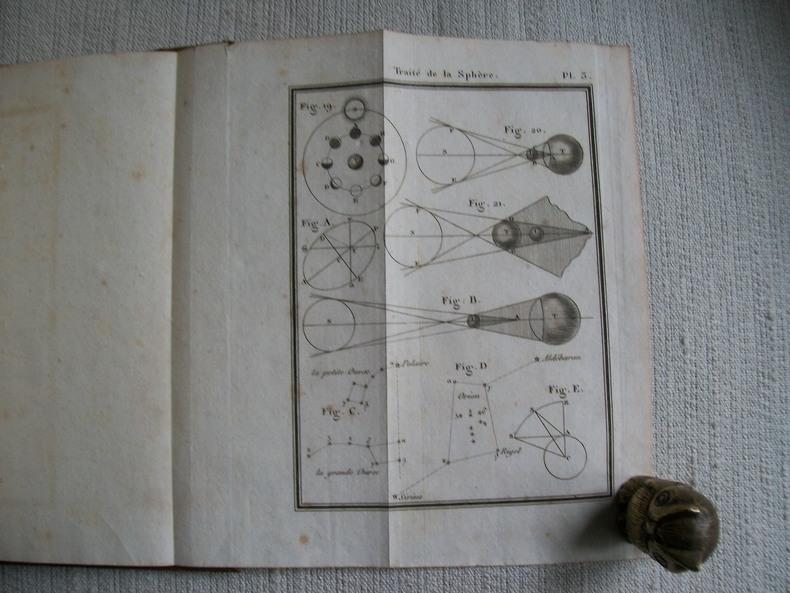
1816GITj457Paris chez Mme Ve Courcier 1816. In-8 1 feuillet non chiffré titre VI-XII 14-263pp. Basane havane marbrée, dos lisse élégamment orné de frises et fleurons dorés, reliure de l'époque. Orné de nombreux tableaux dont 1 dépliant hors texte et 3 planches dépliantes en fin d'ouvrage regroupant 21 figures numérotées et 4 figures lettrées B.C.D.E Coiffe supérieure arasée, sans la page de faux-titre, quelques pâles rousseurs par endroits. Bel exemplaire malgré les défauts signalés, reliure typique de l'époque décorative.
1757104561757 Paris, J. Desaint et Ch. Saillant 1757; 2 parties en 1 vol. in 8, reliure plein veau de l'époque, de 2 ff. n.-ch., 156 pp., 3 planches.dépliantes et 1 tableau dépliant. ; 1 ff., IV ff., 84 pp., une petite fente(1 centimetre) sans gravité) &
78763Roma, Copisteria S. Pietro senza data, ca. 1975, 340x240mm, 38pagine, in brossura, Buono stato.
44541Genève - Bâle, H. Georg 1868, 320x240mm, 43pages, broché. Poussière sur la couverture. Bon état.
19889Le Pommier - Collection "Quatre à Quatre", 2001. Broché au format 15.5 x 20 cm, 157 pages, index. Menus frottements sur la couverture. Très propre. Épuisé.
2 Vol. In-8 gr pag. 237+312 17 tavv. inc. e più vv. rip. Fioriture PROG 28002 CATT_ATT 39
In-16° pp. 341 con 6 tav. ripieg. f.t. Leg. in mezza tela coeva.
1859W82112Paris, Hachette 1859 361pp.+ 9 planches dépliantes, 2e édition, 23cm., rousseurs (texte toujours bien lisible), br.orig., bon état, W82112
1859W107939Paris, Hachette 1859 361pp. + 9 planches dépliantes, 2e édition, 23cm., rousseurs (texte toujours bien lisible), reliure cart., dos en cuir brun avec titre doré, feuilles de garde marbrées, bon état, W107939
361pp.+ 9 planches dépliantes, 2e édition, 23cm., rousseurs (texte toujours bien lisible), br.orig., bon état, W82112
361pp. + 9 planches dépliantes, 2e édition, 23cm., rousseurs (texte toujours bien lisible), reliure cart., dos en cuir brun avec titre doré, feuilles de garde marbrées, bon état, W107939
18618628Paris L. Hachette et Cie 1861 In-8 332 pp, (.) Avec la méthode à suivre pour la résolution des problèmes de géométrie et les solutions. VI planches dépliantes in-fine. 5ème édition. 1er plat débroché avec garde ; ensemble passé et frotté avec manque de papier en tête ; rousseurs éparses
Rita Capodaglio Di Cocco Geometria. Bologna, Zanichelli 1976, Copertina cartonata. Tagli sporchi di polvere, pagine ingiallite lievemente. Collana:"Lineamenti Propedeutici di Matematica 3". Buono (Good) . <br> <br> <br> 103<br>
1898W85668Paris, Gauthier-Villars 1898 59pp., br.orig., 23cm., peu de rousseurs, bon état, W85668
59pp., br.orig., 23cm., peu de rousseurs, bon état, W85668
186997402Couverture souple. Fascicule de 64 pages.
196182190Springer, Berlin 1961. XV, 520 S., Groß 8°, Original-Leinen, Bibliotheks-Exemplar (ordnungsgemäß entwidmet) mit leichten Klerückständen vom Rückenschild, Stempel auf Titel, insgesamt gutes und innen sauberes Exemplar,
1982841036Düsseldorf: Werner. 1982. 251 Seiten. 24cm. Zustand: Sehr Gut min. bis gering gebräunt (Innen); Besitzerstempel; Einband Außen hat geringe Gebrauchsspuren; Sauberes nichtöffentliches Archivex. mit Klebestreifenrest (Außen); Broschiert
Gutes Exemplar. - Unveränderter fotomechanischer Nachdruck der Ausgabe von 1867. - Georg Friedrich Bernhard Riemann (* 17. September 1826 in Breselenz bei Dannenberg (Elbe); † 20. Juli 1866 in Selasca, Gemeinde Intra [heute zu Verbania] am Lago Maggiore) war ein deutscher Mathematiker, der trotz seines relativ kurzen Lebens auf vielen Gebieten der Analysis, Differentialgeometrie, mathematischen Physik und der analytischen Zahlentheorie bahnbrechend wirkte. Er gilt als einer der bedeutendsten Mathematiker. ... (wiki) // INHALT : Plan der Untersuchung ----- I. Begriff einer nfach ausgedehnten Grösse ----- §. 1. Stetige und discrete Mannigfaltigkeiten. Bestimmte Theile einer Mannigfaltigkeit heissen Quanta. Eintheilung der Lehre von den stetigen Grössen in die Lehre ----- 1) von den blossen Gebietsverhältnissen bei welcher eine Unabhängigkeit der Grössen vom Ort nicht vorausgesetzt wird ----- 2) von den Massverhältnissen bei welcher eine solche Unabhängigkeit vorausgesetzt werden muss ----- §. 2. Erzeugung des Begriffs einer einfach zweifach... nfach ausgedehnten Mannigfaltigkeit ----- §. 3. Zurückführung der Ortsbestimmung in einer gegebenen Mannigfaltigkeit auf Quantitätsbestimmungen. Wesentliches Kennzeichen einer nfach ausgedehnten Mannigfaltigkeit. ----- II. Massverhaltnisse deren eine Mannigfaltigkeit von "Dimensionen fähig ist unter der Voraussetzung dass die Linien unabhängig von der Lage eine Länge besitzen also jede Linie durch jede messbar ist ----- §. 1. Ausdruck des Linienelements. Als eben werden solche Mannigfaltigkeiten betrachtet in denen das Linienelement durch die Wurzel aus einer Quadratsumme vollständiger Differentialien ausdrückbar ist ----- §. 2. Untersuchung der "fach ausgedehnten Mannigfaltigkeiten in welchen das Linienelement durch die Quadratwurzel aus einem Differentialausdruck zweiten Grades dargestellt werden kann. Mass ihrer Abweichung von der Ebenheit (Krümmungsmass) in einem gegebenen Punkte und einer gegebenen Flächenrichtung. Zur Bestimmung ihrer Massverhältnisse ist es (unter gewissen Beschränkungen) zulässig und hinreichend dass das Krümmungsmass in jedem Punkte in … Flächenrichtungen beliebig gegeben wird. - (u.a.m.)
19591208792Wissenschaftliche Buchgesellschaft; Darmstadt, 1959. 23 Seiten; 19 cm; fadengeh. Orig.-Halbleinenband.
187353254London and New York Macmillan and Co. 1873. 4to. Orig. full brown cloth gilt spine pictorial gilt frontcover. Near mint condition. Small embossed stamp at upper corner of title-page David Dunlop ObservatoRy Library. In: "Nature a weekly illustrated Journal of Science." Volume VIII May 1873 to October 1873. XII562 pp. Entire volume offered. Riemann's paper: pp. 14-17 a. 36-37. Internally clean and fine no traces of use. <br/><br/><em>First English translation of this milestone work on the foundations of geometry. It "is one of the key work from which derives the modern study of differential geometry and especially the study of manifolds of dimension greater than two. It was to prove central to the overthrow of Euclidean geometry as the source of geometrical ideas and to Einstein's general theory of relativity after 1915." Grattan-Guiness "Landmark Writings in Western Mathematics 1640-1940.It is a translation of Riemann's famous Habilitationsvortrag held in 1854 in secondary literature it is often misidentified as his Habilitationsschift but that was concerned with Fourier series and was delivered the year before. Riemann begins his lecture with a remark about a certain darkness that lies at the foundation of geometry. This darkness obscures the relations between that which geometry assumes i.e. the notion of space and the first principles of constructions in space. In Riemann's oponion one must take another approach towards this problem than the usual axiomatic method used ever since Euclid. The approach taken by Riemann is to a large extent guided by Gauss's work on the intrinsic geometry of surfaces; 'Disquisitiones generales circa superficies curvas' 1828. In this work Gauss showed that the curvature of a surface can be determined without reference to the ambient Euclidean space in which it lies i.e. that the curvature is an intrinsic property of the surface. Based on this Gauss showed several fundamental theorems about figures on the surface by referring only to the surface itself i.e. indicating that the surface itself is a space with its own geometry independent of the geometry of the ambient Euclidean space. Riemann argues that the true objects and properties of geometry are those which can be studied within the space itself and he defines a general n-dimensional space in a similar manner to the parametric representation of a surface. Riemann believed that we know space only locally he therefore bases his study of the geometry of such a general space or manifold as they are known today on the infinitesimal methods of calculus. This choice is a crucial departure from the classical axiomatic methods used by Euclid Lobachevsky and Bolyai. The notion of distance or metric on a manifold is a generalization of the usual Euclidean distance formula in n-dimensions. Particular choices of space and metric reveal both the hyperbolic geometries of Lobachevsky and Bolyai and elliptic or Riemannian geometry. Riemann's approach to geometry is of paramount importance this work "did more to change our ideas about geometry and physical space than any work on the subject since Euclid's Elements." Landmark Writings in Western Mathematics p.507. "The importance of this treatise is not confined to pure mathematics. Without it Einstein would not have been able to develop his general theory of relativity." Printing and the Mind of Man p.177. </em> hardcover
brossura Il volume raccoglie, oltre al testo della lezione del 1854 che dà il titolo all'opera, alcuni scritti di carattere scientifico e filosofico di Riemann. A saggi di argomento scientifico si affiancano scritti di argomento più direttamente metodologico. La concezione della scienza che ci viene offerta da questi scritti è assai significativa del personaggio e della sua epoca. Per Riemann la matematica non è un mero strumento esteriore da applicare, appunto dall'esterno, ai fenomeni. Al contrario, essa consente di spingersi con il rigore necessario oltre alla superficie dei fenomeni e di penetrare sempre più a fondo nella realtà, nell'ottica di un sistema unitario e quasi metafisico del sapere scientifico.