2 054 résultats
5 voll. Folio. viii pp. (incl. frontespizio inciso) + 596 + 607–638; + 252 (ultima carta bianca); + 244 + 84 + 184 (ultima carta bianca); + viii + 340 (ultima carta bianca) + 348 + xx (ultima carta bianca); + viii + 552 + xii + 60 + 244; + xii + 624 (ultima carta bianca) + 124 (ultima carta bianca) + 60 + 20 + 24 pp. Numerosi legni e diagrammi nel testo. Legatura in pelle coeva, dorso dorato. Bruniture omogenee della carta. The evidence of the attempts to leave the Aristotelianism for the modern method and an important proof of the Galileian revolution.Clavius's work includes in addition to commentary on arithmetic and algebra one on Euclid, Teodosio and Sacrobosco; his contribution to the study of trigonometry and astronomy; his work on the calendar. Clavius has been for mathematics in Renaissence a real turning point: “Probably the man who did the most of all the German scholars of the 16th century to extend the knowledge of mathematics… was Cristopher Clavius, a Jesuit, who passed the later years of his life in Rome. He was an excellent teacher… His Algebra appeared in 1608 and was one of the best textbooks on the subject that had been written up to that time… (he was) engaged in the reform of the calendar…” (Smith). Opera Mathematica in his third volume contains the Sphaera in his last editorial, to which Clavius worked during 1610 and which was printed in 1611. Shortly thereafter, in February 1612, Clavius was dying after a period of illness. In March 1610 following his comments on the telescope, Galileo published in Sidereus Nuncius his latest astronomical discoveries. These findings, perhaps only for a lucky snap of dates, are among the topics covered in the review of Sphaera, where Clavius shows to recognize the meaning. Clavius and the Jesuits in those years had to go back to seriously consider the observations of Galileo, and had to acquire the telescope also to repeat the observations and then verify their accuracy. Clavius led directly the observations (especially on the phases of Venus and the moons of Jupiter, but also on the lunar spots) along with a group of young Jesuit mathematicians and astronomers, first of all Grienberger, thus removing, towards the end of his life and following a long friendship with Galileo, his skepticism about the Copernican theory. Galileo himself in a letter to Madame Christina of Lorraine in 1615 wrote that “altri matematici, i quali mossi da gli ultimi miei scoprimenti, hanno confessato essere necessario mutare la già concepita costituzione del mondo, non potendo in conto alcuno più sussistere”. Galilei continues that one of them was just Clavius, and the reference is certainly to the pitch of the Opera Mathematica Tomo III, p. 75, where as the result of the list of Galileo's discoveries, the Jesuit ends “Quae cum ita sint, videant Astronomi quo pacto orbes coelestes constituendi sint ut haec phaenomena possint salvari”. It 's an extraordinary moment in the history of cosmology and Church, which has marked the highlight of the heliocentric theory, which no major scientists, mathematicians and astronomers of the Society of Jesus, thought no more be able to object. As D'Elia notes (pp. 14-15): "The confirmation from him on the discoveries of the astronomer from Pisa and on the copernican interpretation he deduced, had definitive influence and perhaps even dominate, to ensure the discoveries the almost universal acceptance in the intellectual world, even if the disappearance of the old professor and that of several of his closest disciples could not prevent the ecclesiastical Authority’s precept of 1616 and the condemnation of 1633 ". Clavius had even got that Galileo was received at the Roman College, and was himself to "explain" to Cardinal Bellarmine scientific discoveries of Galilei. So while the academic and obviously ecclesiastical circles did not leave officially by the Aristotelian position, a scientist of them, for evidence and intellectual honesty, was preparing the way for the acceptance of Galileo's discoveries, and could do so given the authority of his position, achieved mainly thanks to its capital contribution asked by Gregory XIII to reform the Julian calendar, which led to the drafting of the Gregorian Calendar. Christoph Clavius (Bamberg 1538-1612) Jesuit and mathematician, astronomer, he entered the Jesuit College in Rome in '55 and then went to Coimbra, where he studied mathematics and science; back to Rome to study theology, he remained as a professor for fortyfive years. He became a pivotal figure for the general mathematical and scientific renewal that had in the Compagnia di Gesù a driving force, entering into the main controversies of the time, from the squaring of the circle to the comparison between the Ptolemaic and Copernican theories. He was the master, among other things, of Matteo Ricci, who with the help of his students, translated many works of Clavius in China, including the six books of Euclid's Elements (1574), which had several editions and updates; a work who had an enormous influence, providing a compendium of knowledge on geometry. His other important works were the Commentaries on Sphaera di Sacrobosco, a treatise on spheres’ geometry and astronomy, and work on the astrolabe. He determined the subsequent development of algebra. De Backer & Sommervogel, 2, cols. 1222–3 (with details of contents). DSB, 3, pp. 311–2. D’Elia, Pasquale, Galileo in Cina, Roma, Università Gregoriana, 1947. Jardine, Nicholas. "The Forging of Modern Realism: Clavius and Kepler against the Sceptics." Studies in History and Philosophy of Science 10 (1979): 141-73. Lattis, James M. Between Copernicus and Galileo: Christoph Clavius and the Collapse of Ptolemaic Cosmology. Chicago: University of Chicago Press, 1994 Proceedings of the Symposium on Christoph Clavius (1538–1612), July 21, 2005, University of Notre Dame, Edited by Dennis Snow. D. E. Mungello, Curious land. Jesuit accomodation and the Origins of Sinology, 1985, p. 26. Eberhard Knobloch, Christoph Clavius – Ein astronom zwischen Antike und Kopernikus”, in Cvortrage des ersten Symposions des Bamberger Arbeitskreises Antike Naturwissenschaft und ihre Rezeption, 113-40, Wiesbaden, 1990.
pp. (12), 150 [i.e. 251], (1), bel frontespizio inciso su legno, con stemmi e il ritratto dell’autore, e numerosi legni nel testo. Tra p. 214 e 215 inserite 4 carte con una nota manoscritta e alcuni calcoli. Legatura in piena pergamena con titolo manoscritto al dorso. Seconda edizione italiana. rara opera di matematica, interessante specialmente per le parti dedicate all’aritmetica mercantile, alla riscossione dei tributi e al commercio. Vari gli argomenti che vengono trattati, sia di calcolo, che istruzioni per la costruzione di torri, pozzi, strade ecc.; ma anche metodi per misurare le superfici di terreni piani edificabili e zone montuose, calcolare la portata dell’acqua di un fiume, misurare gli edifici; molti i riferimenti agli usi e costumi napoletani. La sua opera dimostra a pieno l’attenzione che la Chiesa iniziava a dimostrare nei confronti dei bisogni della popolazione. Lapazzaia nacque a Monopoli da famiglia oriunda albanese. Matematico e sacerdote, fu canonico della cattedrale di Monopoli e protonotario apostolico. Insegnò matematica e geometria. Morì nel 1564. Smith (Rara) p. 322: «He considers also the rule of three, the rule of five, interest, exchange, partnership, alligation, rule of false, and the extraction of roots». Riccardi VII, 51. Manca ad Adams. Sullo stampatore v. Diz. tip. edit. it. pp. 242-45.
In -8°, pp. (16), 270, con sette tavv. (sei ripiegate), 15 incisioni a piena pagina, sei nel testo e marca editoriale al colophon; cartonato coevo. Prima edizione della versione italiana della Raddologia di Nepero, fra i primi testi a dare indicazioni sul calcolo tramite congegni meccanici. Il dispositivo proposto in questo libro, piuttosto noto nella storia della matematica, è quello dei “bastoncini di Nepero”, un antesignano del regolo calcolatore, e del quale lo scienziato scozzese ideò numerose varianti - qui descritte - in grado di eseguire divisioni ed estrarre radici quadrate. Tradizionalmente a Nepero (1550-1617) si attribuisce in matematica l’introduzione dei logaritmi naturali. Opera rara e importante in prima edizione italiana. First edition of Italian translation of Napier’s Raddology, between the first texts to give details about calculus through mechanical instruments. The machines suggested in this book, quite familiar in mathematics’ history, is the one of “Napier Bones”, a prelude of the slide rule, that the scottish scientist made up in many versions - here descripted - able to perform divisions and square roots. Rare and important book, in its first Italian edition.
17445061DBPadova, Nella Stamperia del Seminario, appresso Gio: Manfrè, (pubbl. dal abbate Gius Toaldo), 1744. 4°. (4) Bl., LXXXVIII, 601 S; (2) Bl., 564 S.; (2) Bl., 486 S.; (4) Bl., 342 S., (1) Bl., mit vielen Vignetten, Holzschnitt Abbildungen und Diagrammen im Text, Porträt von Galileo Galilei von Zucchi, gefalteter Kupfertafel. Kalblederbände mit Rückenvergoldung, Rückentitel und Supralibros. + Wichtig: Für unsere Kunden in der EU erfolgt der Versand alle 14 Tage verzollt ab Deutschland / Postbank-Konto in Deutschland vorhanden +, 5061DB|5061DB_2|5061DB_3|5061DB_4 4 Bände. [4 Warenabbildungen]
In -8°, pp. XXIV, 112; cartonato. Prima edizione del lavoro di Degen sull’equazione di Pell: le tavole di risultati numerici pubblicate dal matematico danese in questo volume diverranno, negli anni a seguire, un punto di riferimento per gli studiosi di quest’equazione. In questa copia le tavole in questione sono intonse. Invio autografo (“dall’autore a Nicola Fergola”). Una sola copia in Iccu. The first edition of Degen work on Pell’s equation. The tables here published will become a reference for the next scientists studying this equation. Signed copy (“Dall’autore a Nicola Fergola”).
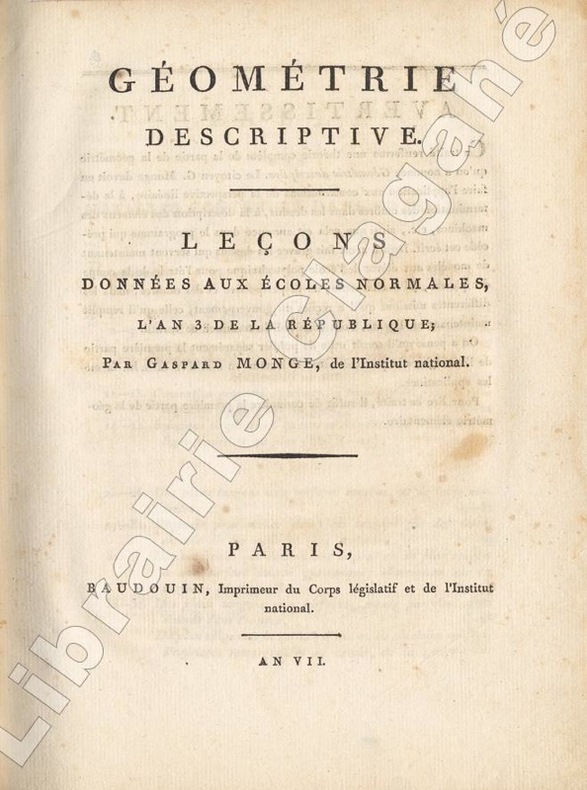
179817204Paris, Baudouin, an VII (1798-1799) ; in-4 , demi-basane marbrée, dos lisse titre en long (rel. moderne) ; VIII, la dernière blanche, 132pp., 25 planches gravées dépliantes.
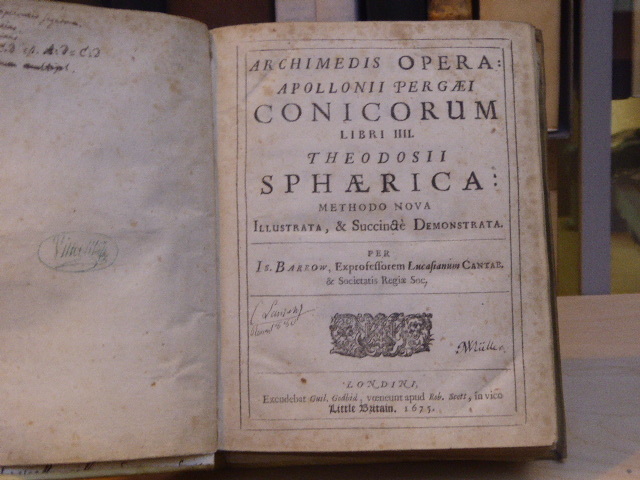
715652Excudebat Guil. Godbid, Apud Rob. Scott. Little Britain - Londini 1675 3 ouvrages reliés en 1 volume in-8 carré ( 205 X 175 mm ), plein vélin ivoire, dos lisse titré à l'encre ( Reliure de réemploi de l'époque ). 29 planches hors-texte. EDITION ORIGINALE. Présence de marginalia XVIIIe principalement sur les gardes, rousseurs passim, bon exemplaire, rare.- ARCHIMEDIS OPERA: Methodo Nova Illustrata & Succinctè Demonstrata. Per Isaacum BARROW, Exprofessorem Lucasianum Cantab. & Soc. Regiae Soc. Londini, Excudebat Guil. Godbid, voeneunt apud Robertum Scott, in vico Little Britain. 5 ffnch.-185 pages mal chiffrées la numérotation passe de la page 144 à 245 et continue en deux-centaine jusqu'à la fin sans manque. )- 1 ffnch., 14 planches dépliantes.- APOLLONII CONICA: Methodo Nova Illustrata, & Succincté Demonstrata. Per Isaacum BARROW Exprofessorem Lucasianum Cantab. & Soc. Regiae Soc. Londini Excudebat Guil. Godbid, voeneunt apud Robertum Scott, in vico Little Britain. 1675. 2 ffnch.-104 pages, 12 planches dépliantes.- THEODOSII SPHAERICA: Methodo Nova Illustrata, & Succincté Demonstrata. Per Isaacum BARROW Exprofessorem Lucasianum Cantab. & Soc. Regiae Soc. Londini Excudebat Guil. Godbid, voeneunt apud Robertum Scott, in vico Little Britain. 1675. 1 ffnch.-38 pages, 3 planches dépliantes.
In-4°, pp. (36), 320, 4 tavv ripiegate, legatura coeva in vitello marmorizzato con cornice in oro sui piatti, dorso decorato in oro con tassello e titolo manoscritto in oro al dorso. Bella e fresca copia. Prima edizione. Esame attento dell’opera di L’Hospital sul calcolo differenziale. Pastore, professore di filosofia e matematica a Groninga, Jean-Pierre de Crousaz (1663-1750) fu tutore del principe di Hesse-Cassel (nipote del re di Svezia) diventando poi consigliere delle ambasciate del re di Svezia. Membro dell'Accademia di Bordeaux, dal 1725 diventò associato estero all'Accademia delle Scienze di Parigi. La sua opera comprende trattati di teologia, matematica, fisica, logica, metafisica, estetica: al di là di questa varietà si profila l'unità di una filosofia cristiana che sa riconoscere sia nei fenomeni naturali sia nelle produzioni umane la grandezza della divina provvidenza. In-4 °, pp. (36), 320, 4 folded plates, contemporary full marbled calf binding, gilt frame on plates, decorated back with label and handwritten gilt title on the spine. First edition, good and fresh copy. Deep examination of L’Hospital’s work on differential calculus. Pastor, professor of philosophy and mathematics in Groningen, Jean-Pierre de Crousaz (1663-1750) was the tutor of the prince of Hesse-Cassel (nephew of the king of Sweden) and later became advisor to the embassies of the king of Sweden. Member of the Bordeaux Academy, from 1725 he became a foreign associate at the Paris Academy of Sciences. His work includes treatises on theology, mathematics, physics, logic, metaphysics, aesthetics: beyond this variety lies the unity of a Christian philosophy that knows how to recognize the greatness of divine providence both in natural phenomena and in human productions.
17683974DBLyon, Jean-Marie Bruyset, 1768. 8°. XXXVI, 309 S.; (4), IV, 431, (7) S.; (4), IV, 468, (4) S.; (4), VIII, (12), 346 (3) S. Mit 1 Kupferstichkarte, 1 Tabelle und 61 geom. Figuren im Text. Marmorierte Lederbände aus der Zeit mit Rückenschildchen. + Wichtig: Für unsere Kunden in der EU erfolgt der Versand alle 14 Tage verzollt ab Deutschland / Postbank-Konto in Deutschland vorhanden +, A|B|C 4 volumes. [3 Warenabbildungen] Nouvelle édition corrigée & augmentée.
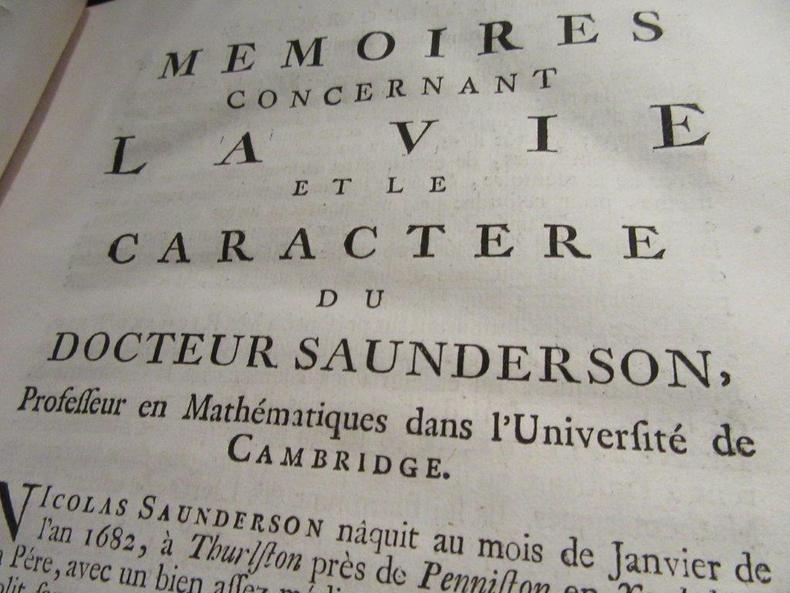
39152Paris,chez Ch-A.Jombert en 1756. Traduits de l'Anglois et augmentés de quelques remarques par Mr. de JONCOURT. 2 Tomes en 1 volume in-4. Tome I: Epître.Avertissement.Mémoires.L'Arithmétique Palpable.Table des Principaux Articles.Avis au Lecteur: 359 pages. Tome II: Table des Principaux Articles. Elements d'Algèbre: 403 pages. Portrait gravé par Vanderbanck en frontispice. 8 planches dépliantes. Reliure d'époque;dos à nerfs décoré,avec pièce de titre et tomaison. Tranches rouges. Edition rare. En bon état. Planches brunes.Quelques rousseurs.Reliure usagée.
17683974DBNouvelle édition corrigée & augmentée. 4 volumes. Lyon, Jean-Marie Bruyset, 1768. 8°. XXXVI, 309 S.; (4), IV, 431, (7) S.; (4), IV, 468, (4) S.; (4), VIII, (12), 346 (3) S. Mit 1 Kupferstichkarte, 1 Tabelle und 61 geom. Figuren im Text. Marmorierte Lederbände aus der Zeit mit Rückenschildchen.
[600 Fig. Matematica - Economia](cm. 21) ottima piena pergamena floscia originale.-cc.4 nn., pp. 240. Vari schemi numerici e molte figure xilografiche con carri, porte, botti, tini, torri, disegni geometrici ecc... opera assai celebre che per oltre 200 anni è stata il testo base di facile consultazione sui segreti della matematica, geometria, algebra e del far di conto. Smith afferma che il Feliciano ha redatto un manuale più facile e agevole pur avendo attinto all'opera del Borgo e del Pacioli. Secondo Riccardi le aggiunte sarebbero opera del celebre Bernardino Baldi. Dato l'uso pratico ben rare sono le copie in buono stato e ben complete come la nostra. Lieve menda all'angolino alto della legatuyra, peraltro esemplare molto bello, nitido e a grandi margini. * Riccardi II 22/23; * Honeyman IV 1288; * Michel-Michel III 29; Questa nostra rara edizione manca a : Choix, Sotheran, Autori italiani del 600, BM.STC. Italian, Graesse, e Brunet. [F.81] Libro
[Figurato Economia-Matematica] (cm. 15) ottima mz. pergamena e pag. di messale del '500 rosso e nero, ben restaurata sec. XIX.-- cc. 96. Marca tipografica al frontis, varie figg. geometriche e schemi nel testo. E' la prima e la più popolare aritmetica del rinascimento. Apparve nel 1540. Tratta delle proporzioni, algebra, radici e unisce l' antica scienza dei numeri all' aritmetica commerciale italiana, inoltre ragiona delle propietà occulte dei numeri. La nostra edizione è aumentata dalle annotazioni di J. Peletier ed è molto rara. Manca a: Harvard, Bm. Stc. French, Smith, Libri ed Honeyman Collection. Vecchi restauro all' ultima carta con perdita di alcune parole, eliminato il nome del Melanchthon per censura. Altrimenti esemplare molto bello e nitido. * Van Ortroi n° 65; * Adams G 378.[f42] Libro
In 8° (19x11,4 cm); (12), 104 pp. e 9 c. di tav. più volte ripiegate. Legatura coeva in piena pergamena molle con titolo manoscritto al dorso. Qualche macchiolina di foxing dovuta alla qualità della carta, ininfluenti e nel complesso in buone-ottime condizioni di conservazione. Incisione xilografica al frontespizio e alcune iniziali xilografiche nel testo. Prima assai rara edizione dell'ultima opera del celebre matematico e filosofo cremonese, Luigi Guido Grandi, pseudonimo di Francesco Lodovico Grandi (Cremona, 1º ottobre 1671 – Pisa, 4 luglio 1742) che fu tra i massimi matematici del suo tempo e uno dei primi in Itala ad introdurre le nuove concezioni filosofiche e matematiche di Leibniz e Newton. Formatosi nel Collegio dei Gesuiti di Cremona, sotto la guida di Giovanni Girolamo Sacchieri, a soli 16 anni entrò nel monastero camaldolese ravennate di Classe. Perfezionò poi i suoi studi a Roma e Firenze. Qui nel 1700 divenne professore di Filosofia nel monastero camaldolese della città. Nel 1703 pubblicò la sua prima opera matematica “La quadratura del cerchio e dell'iperbole” nella quale scoprì lo stesso paradosso matematico poi esplicato da Leibniz e che prende il nome proprio da lui la “Serie di Grandi” che definisce come la somma parziale di una serie a segni alterni di numeri può non convergere. Membro della Royal Society. La sua fama crebbe notevolmente durante gli anni, tanto che già nel 1714 divenne matematico di corte presso il Granduca di Toscana e poi professore di matematica nell'Università di Pisa. Le sue conoscenze matematiche lo portarono a ricoprire anche la carica di Sovrintendente delle Acque del Granducato. A Lui si devono importanti lavori di drenaggio per la bonifica della Val di Chiana. Esperto conoscitore dell'opera di Galileo, collaborò con Tommaso Buonaventuri per la celebre riedizione delle opere galileiane uscita nel 1718. Grandi fu anche il primo a studiare la curva algebrica da lui chiamata “rodonea” per la forma che ricorda il rosone delle chiese romaniche e gotiche. A lui si deve la prima diffusione in Italia delle analisi degli infiniti e nella sua opera “De infinitis infinitorum” applicò per primo in Italia i metodi di Leibniz e Newton. Quella che qui presentiamo è la prima rara edizione dell'ultimo e più maturo lavoro di Grandi. Pubblicato per la prima volta in latino nel 1737, l'opera ebbe tale successo da essere poi riedita in italiano e latino, più volte nel corso del XVIII° secolo. Pur essendo la sua ultima opera stampata con l'autore ancora in vita, essa risulta essere molto rara da reperirsi sul mercato librario. A good copy, rare. Rif. Bibl.: ICCU IT\ICCU\RLZE\001727, IT\ICCU\UM1E\014219.
184846603Berlin, Haude et Spener, 1848-52. 4to. No wrappers as extracted from ""Mémoires de l'Academie Royale des Sciences et Belles-Lettres"", tome II (1846), tome IV, tome VI a. tome VI. Pp. 182-224, pp. 249-291, pp. (361-) 378, pp. 413-416 and 1 folded engraved plate.
184846603Berlin Haude et Spener 1848-52. 4to. No wrappers as extracted from "Mémoires de l'Academie Royale des Sciences et Belles-Lettres" tome II 1846 tome IV tome VI a. tome VI. Pp. 182-224 pp. 249-291 pp. 361- 378 pp. 413-416 and 1 folded engraved plate. <br/><br/><em>First apperance of d'Alembert's 3 importent papers on the Calculus of Integration a branch of mathematical science which is greatly indepted to him. He here gives the proof of THE FUNDAMENTAL THEOREM OF ALGEBRA called d'Alembert's theorem and later corrected by Gauss 1799.The theorem is based on these three assumptions:Every polynomial with real coefficients which is of odd order has a real root. This is a corollary of the intermediate value theorem. Every second order polynomial with complex coefficients has two complex roots. For every polynomial p with real coefficients there exists a field E in which the polynomial may be factored into linear terms.Also with an importent paper by Leonhard Euler "Mémoire sur l'Effet de la Propagation successive de la Lumiere dans l'Apparition tant des Planetes que des Cometes" Memoir on the effect of the successive propogation of light in the appeareance of both comets and planets. Pp. 141-181 and 2 folded engraved plates. - The paper is founded on Euler's theory of light as waves and not as particles. It is from the same year as his fundamental work on light as waves: "Nova Theoria" - Enestroem E 104. </em> unknown
In-4°; pp. 12, 397, antiporta incisa su rame, nel testo numerose figure geometriche incise su legno, finalini.Riccardi I, 391 1. Legatura in piena pergamena con titolo manoscritto al dorso.
34330P., Jombert, 1753, un volume in 4 relié en pleine basane, dos orné de caissons dorés, tranches rouges (reliure de l'époque), (accroc à une coiffe, petites rousseurs à un feuillet, mouillures pâles dans la marge de deux feuillets), 8pp., 418pp., 13 PLANCHES DEPLIANTES, 3 :feuillets non chiffrés (1 ff errata + 1ff de privilège+1ff catalogue de l'éditeur)
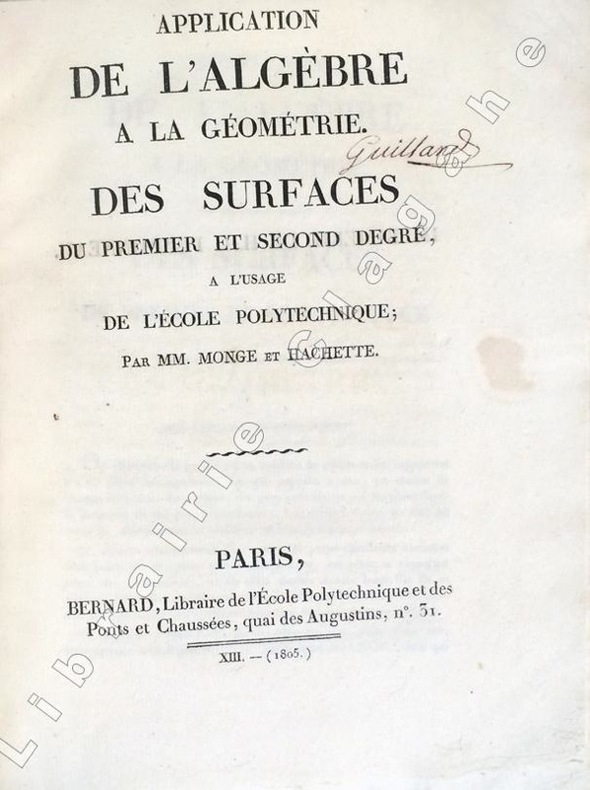
180517590Paris, Bernard (imprimerie de H.L. Perronneau), XIII-(1805) ; in-4, demi-basane marbré, dos lisse, titre en long (reliure moderne) ; (4), 56 pp., 1 planche hors texte gravée par Aubertin d'après L.J. Girard.
In 4°; (10 inclusa errata), 86 pp. Legatura coeva in mezza-pelle con titolo e fregi in oro al dorso. Piatti foderati con carta marmorizzata coeva (qualche lieve segno del tempo alla legatura). All'interno esemplare in ottime condizioni di conservazione. Prima non comune edizione di questa importante opera matematica del celebre matematico francese, Ferdinand François Désiré Budan de Boislaurent (28 settembre 1761 - 6 ottobre 1840) che divenne famoso proprio grazie al trattato qui presentato. Iniziato a studiare a Juilly, proseguì poi a Parigi, dove si iscrisse a medicina, ottenendo il dottorato con una tesi su una questione di “Economia medica” dove sosteneva la necessità di informare in modo corretto un paziente sulla sua situazione medica. Raggiunse la celebrità quando nel 1807 pubblicò il suo “Nouvelle Methode” nel quale alla stregua di Fourier ma in modo diverso e prima di questi (il lavoro Budan lo aveva già compiuto e finito nel 1803, spiega “given a monic polynomial p(x), the coefficients of p(x+1) can be obtained by developing a Pascal-like triangle with first row the coefficients of p(x), rather than by expanding successive powers of x+1, as in Pascal's triangle proper, and then summing”. Questa regola è ancora nota come il Teorema di Budan ed è un teorema di delimitazione il numero di radici reali di un polinomio in un intervallo e calcolando la parità di questo numero. Il lavoro di Budan fu ripreso, tra gli altri, da Pierre Louis Marie Bourdon (1779-1854), nel suo celebre libro di algebra, ma con il tempo , venne eclissato dal Teorema di Fourier che garantiva un risultato equivalente. Il Teorema di Budan è però stato fortemente recuperato a partire dalla fine del XIX° secolo quando ci si accorse che alcuni risultati computazionali erano più facilmente deducibili da esso che dalla versione offerta da Fourier. In particolare, furono Collins e Akritas nel 1976 a recuperarlo, per la fornitura, in computer algebra, di un algoritmo efficiente per l'isolamento di radici nei computer. All'uscita dell'opera, la fama di Boudan, iniziò ad aumentare esponenzialmente anche oltre Manica, tanto da venir citato da numerosi importanti matematici e studiosi come ad esempio Peter Barlow o Horner. Barlow lo nominò alla voce “Approssimazione” nel suo Dizionario del 1814, sebbene, erroneamente lo affiancasse al metodo di Joseph-Louis Lagrange, definendolo come accurato ma più di interesse teorico che pratico. Horner descrivendo il lavoro di Budan sull'Approsimazione nel suo celebre articolo sulle Transazioni filosofiche presentato alla Royal Society di Londra nel 1819, articolo che diede origine al termine metodo di Horner, commentò in modo scettico i risultati di Budan ma in articoli seguenti, cambiò completamente opinione, riconoscendone il valore intrinseco. Il lavoro di Budan sembra anticipare anche quello di Paolo Ruffini del 1804. Si legge in D. S. B., II, 573 : :"Budan is known in the theory of equations as one of the independent discoverers of the rule of Budan and Fourier, which gives necessary conditions for a polynomial equation to have n real roots between two given real numbers. He announced his discovery of the rule and described its use (...) and published the paper with explanatory notes, as 'Nouvelle méthode pour la résolution des équations numériques', in 1807. (...) The need for such a rule as his was suggested to Budan by Lagrange's 'Traite de la resolution des equations numeriques' (1767). (. . .) Budan's goal was to solve Lagrange's problem - between which real numbers do real roots lie? - purely by means of elementary arithmetic. Accordingly, the chief concern of Budan's 'Nouvelle méthode' was to give the reader a mechanical process for calculating the coefficients of the transformed equation in (x - p). He did not appeal to the theory of finite differences or to the calculus for these coefficients, preferring to give them 'by means of simple additions and subtractions.' (...) Budan's rule remains the most convenient for computation". Proprio grazie agli sviluppi tecnologici della fine del novecento ed essendo usato in moderni algoritmi veloci per isolare le radici reali di polinomi, l'opera qui presentata è diventata, oggi, un classico della matematica ed è qui presentata in prima edizione, in legatura coeva ed in buone-ottime condizioni di conservazione. Non comune. First edition, good copy. Rif. Bibl.: D.S.B.,II,573.
168215979ABParis, 1682. 12°. 2 Bl, 187 S, 4 Bl. 1 gest. Frontisp. u. 81 ganzs. Kupfer.. Orig.-Ldr m. Rückenverg. + Wichtig: Für unsere Kunden in der EU erfolgt der Versand alle 14 Tage verzollt ab Deutschland / Postbank-Konto in Deutschland vorhanden +
Modena, presso la Società Tipografica, 1819. In 4to grande, (cm. 30); cop. orig. in carta azzurra; pp. 126 (77-204). Alcune pagine leggermente arrossate ma bella copia con barbe. PRIMA edizione. DONO DELL’Autore. Axs
175512-0-298Franchfurt und Leipzig, Renger, 1755. kl 8°(16,5x11,5cm), Frontispiz, 9 S., 740 S., 1 nn. Bl., 22 S. (Register), 11 gefaltete Tafeln, Pappeinband
168215979ABParis, 1682. 12°. 2 Bl, 187 S, 4 Bl. 1 gest. Frontisp. u. 81 ganzs. Kupfer.. Orig.-Ldr m. Rückenverg.
2002x-0824708555Marcel Dekker Inc 2002. Paperback. New. 1st edition. 494 pages. 9.75x7.00x1.25 inches. Marcel Dekker Inc paperback