2 054 résultats
In-8°, VIII, pp.152, legatura in cartonato. Al-Karaji ha scritto su matematica e ingegneria. Alcuni lo considerano come una semplice rielaborazione delle idee degli altri (è stato influenzato da Diophantus) ma molti lo considerano più originale, in particolare per l'inizio della liberazione dell'algebra dalla geometria. Tra gli storici, il suo lavoro più ampiamente studiato è il suo libro di algebra Al-fakhri, Nel suo libro "Estrazione di acque nascoste" ha menzionato che la terra ha una forma sferica ma la considera il centro dell'universo molto prima di Galileo Galilei, Johannes Kepler o Isaac Newton, ma molto dopo Aristotele e Tolomeo. Ha esposto i principi di base dell'idrologia e questo libro rivela una profonda conoscenza di questa scienza ed è stato descritto come il più antico testo esistente in questo campo. Studiò sistematicamente l'algebra degli esponenti. Il suo lavoro su algebra e polinomi ha dato le regole per le operazioni aritmetiche per aggiungere, sottrarre e moltiplicare i polinomi; sebbene fosse limitato a dividere i polinomi dai monomi. F. Woepcke è stato il primo storico a rendersi conto dell'importanza del lavoro di al-Karaji e gli storici successivi concordano principalmente con la sua interpretazione. Ha elogiato Al-Karaji per essere stato il primo a introdurre la teoria del calcolo algebrico. Al-Karaji ha dato la prima formulazione dei coefficienti binomiali e la prima descrizione del triangolo di Pascal. Gli viene anche attribuito il merito della scoperta del teorema binomiale. In-8°, VIII, pp.152, cardboard binding. Al-Karaji wrote on math and engineering. Some consider it as a simple reuse of the ideas of others (it was influenced by Diophantus) but many consider it more original, in particular for the beginning of the liberation of algebra from geometry. Among historians, his most widely studied work is his algebra Al-fakhri book. In his book "Extraction of hidden waters" he mentioned that the earth has a spherical shape but considers it the center of the universe long before Galileo Galilei, Johannes Kepler or Isaac Newton, but long after Aristotle and Ptolomaeus. He exposed the basic principles of hydrology and this book reveals a profound knowledge of this science and has been described as the oldest existing text in this field. He systematically studied the algebra of exponents. His work on algebra and polynomials gave the rules for arithmetic operations to add, subtract and multiply polynomials; although he was limited to dividing polynomials from monomials. F. Woepcke was the first historian to realize the importance of Al-Karaji's work and subsequent historians mainly agree with his interpretation. He praised Al-Karaji for being the first to introduce algebraic calculus theory. Al-Karaji gave the first formulation of the binomial coefficients and the first description of the Pascal triangle. He is also credited with discovering the binomial theorem.
In -4°, pp. 52, cartonato, con dedica dell’autore “a Carlo Luigi Farini”, ai tempi deputato del parlamento subalpino (nel ’62 sarebbe stato presidente del Consiglio nel Regno d’Italia). Chiò era a sua volta deputato, all’epoca. Raro. Prima e unica edizione.
17174312DBHalle, Rengerische Buchhandlung, 1717. 8°. (8) Bl., 710 (recte 709), (1) S. Mit 44 (von 45) Kupfertafeln. Pergamentband der Zeit. + Wichtig: Für unsere Kunden in der EU erfolgt der Versand alle 14 Tage verzollt ab Deutschland / Postbank-Konto in Deutschland vorhanden +, A|B [2 Warenabbildungen]
1998x-0824701534Marcel Dekker Inc 1998. Paperback. New. 1st edition. 352 pages. 10.25x7.25x0.75 inches. Marcel Dekker Inc paperback
86675aafParis et Genève, Chez J.J. Paschoud, Libraire, 1809, in-4to, XII (titre, dédicace, avant-propos) + 309 p. (+1) + 1 ff. (publicité de l’éditeur), avec 3 planches gravées et pliées contenant 110 figures géométriques référencées dans le texte, très légère tache d’eau au coin droit inférieur sur les 10 dernières pages et les planches (hors texte), bon exemplaire non rogné, brochure d’attente d’époque, remarques ms. sur le plat supérieur e.a., ‘rangé par Rebour libraire au palais Royal N° 197’, non rogné, un peu usé, dos dénudé, sinon bon exemplaire.
192646991London, Roayl Society, 1926. Royal 8vo. Full cloth. Gilt lettering to spine. In: ""Proceedings of the Royal Society"". Series A, Vol. 111. V,753,LIII pp., textillustr. and plates. (Entire volume offered).
177041596(Berlin, Haude et Spener, 1770). 4to. No wrappers, as issued in ""Mémoires de l'Academie Royale des Sciences et Belles-Lettres"", Tome V, pp. 203-221, 1 plate and pp. 222-288, 1 engraved plate.
192646991London Roayl Society 1926. Royal 8vo. Full cloth. Gilt lettering to spine. In: "Proceedings of the Royal Society". Series A Vol. 111. V753LIII pp. textillustr. and plates. Entire volume offered. <br/><br/><em>First appearance of these papers constituting Dirac's own theory of quantum mechanics."Dirac wanted to establish an algebra for quantum variables or as he now termed them q-numbers. He wanted his q-number algebra to be a general and purely mathematical theory that could then be applied to problem of physics. Although it soon turned out that q-number algebra was equivalent to matrix mechanics in 1926 Dirac's theory was developed as an original alternative to both wave mechanics and matric mechanics. It was very much Dirac's own theory and he stuck to it without paying much attention to what went on inmatrix mechanics. In the summer of 1926 Dirac published a new and very general version of q-number algebra this timepresented as a purely mathematical theory. In this paper offered here he did not refer to physics at all. The work had little impact on the physics community but seems to have been appreciated by those who cultivated the mathematical aspects of quantum physics. Most of the results obtained by Dirac in his paper "The Elimination of the Nodes in Quantum Mechanics" had been found earlier by the German theorists using a method of matric mechanics but Dirac was able to improve on some of the results and deduce them from his own system of quantum mechanics."Helge Kragh. </em> hardcover
177041596Berlin Haude et Spener 1770. 4to. No wrappers as issued in "Mémoires de l'Academie Royale des Sciences et Belles-Lettres" Tome V pp. 203-221 1 plate and pp. 222-288 1 engraved plate. <br/><br/><em>Both papers first edition. The first paper is Euler's discussion of "Cramers Paradox" and it contains his inventions of 2 kinds of curves "Cusps of first kind" or keratoid cusp and "Cups of second kind" or ramphoid cusp. - Enestroem E 169.The second paper contains Euler's famous proof of "The fundamental Theorem of Algebra". - Enestroem E 170. </em> unknown
4294Paris. Quillau. 1733. In-4 en plein veau moucheté. Dos à nerfs. Caissons fleuris et pièce de titre. 8 planches dépliantes. Très bon état intérieur, sauf léger manque à la coiffe supérieure, mors fendu sur 4 cm en tête. Tampon sur la page de titre.
191013435Teubner, Leipzig 1909-1910. V, 50 u. VI, 159 Seiten. Brosch. Teil 1 mit Gebrsp., Umschlag beschädigt. Teil 2 unaufgeschnitten, sehr gut erhalten. Erstausgabe des posthum erschienenen Werkes. Mehr nicht erschienen. Sehr selten. 1. Teil: Elementarlehre. 2. Teil: Aussagetheorie, Funktionen, Gleichungen und Ungleichungen. Beide Teile mit mehrzeiliger handschriftlicher Widmung von Eugen Müller.
1700219CG1700. Kupferdruck in Schabkunst von Joh. Jakob Haid nach Johann Rudolph Huber (?-1779). Bildgrösse: 31 x 19 cm. Blattgrösse: 40 x 24,5 cm. + Wichtig: Für unsere Kunden in der EU erfolgt der Versand alle 14 Tage verzollt ab Deutschland / Postbank-Konto in Deutschland vorhanden +, 219CG
In 8 (cm 20 x 25,5), pp. (6) + 459 + (3) con 34 tavole fuori testo incise all'acquaforte con figure geometriche. Legatura coeva in piena pergamena con nervi e tassello con titolo al dorso. Vignetta e capolettera incisi all'acquaforte a pagina 1. Bell'esemplare di questa seconda edizione postuma dell'opera matematica del Marquis de l'Hospital.
In-8°, viii, 528, XIII carte di tavola ripiegate. Legatura in piena pelle coeva, titolo in oro al dorso su tassello in marocchino, nervature. Prima edizione, buona copia. In-8 °, viii, 528, XIII folding plates. Contemporary calf binding, gilt title on the spine, morocco label, bands. First edition, fair copy.
in-8, pp.(10), 112, 4 tavole f.t. incise in rame, poste in fine. Leg. coeva p.pelle (lievi difetti al dorso). L'opera presente riassume i fondamentali studi matematici, algebrici e geometrici di Ozanam (1640-1717) eletto all'Accademia Reale delle Scienze nel 1701.. .
In 8, cm 21 x 26, pp. 71 + (1). Brossura muta coeva. Edizione originale di questo importante studio matematico dedicato alla teoria dei numeri applicata all'algebra: '...j'ai conside're' particulierement les racines imaginaires de l'unite', c'est a' dier, ces differentesexpressions radicales qui produisent toutes e'galement l'unite' pour resultat...'. Per quanto Poinsot sia stato particolarmente apprezzato per i suoi studi di meccanica e geometria, meno conosciuti oggi sono i suoi lavori sulla teoria dei numeri seppure siano stati in piu' occasioni utilizzati da altri matematici. Uno studio dettagliato su questo aspetto del Lavoro di Poinsot, si puo' trovare in: J. Boucard, L. Poinsot et la theorie des nombres... In: Revue d'histoire des mathematiques. T. 17. 2011
In-8°, frontespizio, dedica, prefazione (i-vi), 330pp. Legatura in piena pelle coeva, con titolo al dorso in oro su tassello in marocchino, nervature, numerose illustrazioni nel testo. Prima edizione, buona copia. In-8°, frontispiece, dedication, preface (i-vi), 330pp. Contemporary full calf binding, glt title at the back on morocco label, bands. Illustrated with a profusion of in-text illustrations. First edition, fair copy.
1700219CG1700. Kupferdruck in Schabkunst von Joh. Jakob Haid nach Johann Rudolph Huber (?-1779). Bildgrösse: 31 x 19 cm. Blattgrösse: 40 x 24,5 cm.
175851463BB3 Teile in 1 Band. Augsburg und Freiburg, Gebrüder Jgn. und Anton Wagner 1758 4°. 8 n.n. Bl., 106 (recte 105) S.; 3 n.n. Bl., 178 S.; 152 S., Halblederband der Zeit mit schwarzgeprägtem Rückentitel.
175851463BBAugsburg und Freiburg, Gebrüder Jgn. und Anton Wagner, 1758. 4°. 8 n.n. Bl., 106 (recte 105) S.; 3 n.n. Bl., 178 S.; 152 S., Halblederband der Zeit mit schwarzgeprägtem Rückentitel. 3 Teile in 1 Band.
188512-1-269Stuttgart, Wilhelm Kohlhammer, 1885. 8°, XV, 434 S., HLn. d. Zt
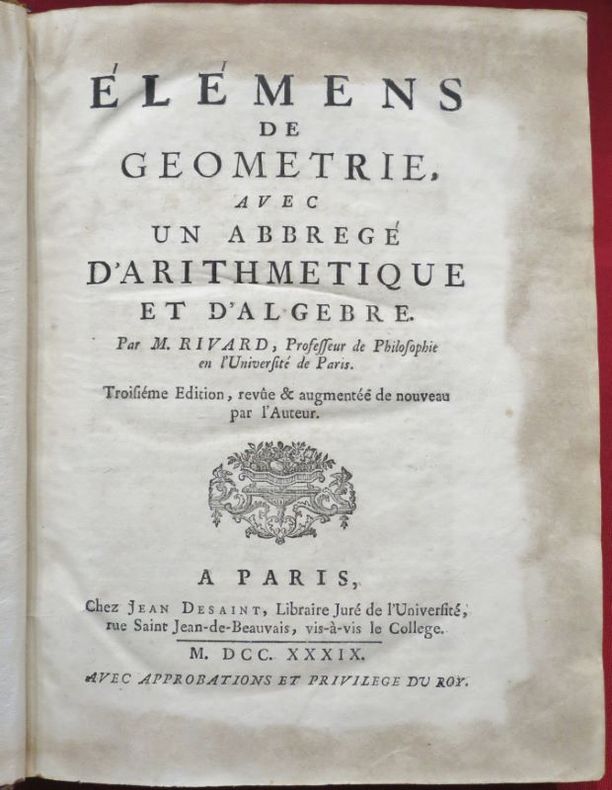
108257A Paris, chez Jean Desaint, Libraire Juré de l'Université, rue Saint Jean-de-Beauvais, vis-à-vis du College, 1739, 2 parties en 1 volume in-4 de 265x200x40 mm environ, 4ff. (titre, épître à Monseigneur le Recteur, préface, Approbations, Avertissement), ccix-2ff.(table)-225 pages, 4ff. (tables, Privilège, fautes à corriger), plein veau marbré fauve, dos à nerfs portant titres doré sur pièce de titre en maroquin bordeaux, orné de caissons à riches motifs dorés, coupes dorées, gardes marbrées, tranches mouchetées de rouge. Des rousseurs et pages brunies, petits défauts de reliure sur les coiffes, un coin émoussé, petites épidermures et craquelures sur le cuir. Avec 12 planches dépliantes dans la deuxième partie.
108258A Paris, chez Jean Desaint, Libraire Juré de l'Université, rue Saint Jean-de-Beauvais, vis-à-vis du College, 1739, 2 parties en 1 volume in-4 de 263x190x40 mm environ, 1f.blanc, 1f. (Avis), 4ff. (titre, épître à Monseigneur le Recteur, préface, Approbations, Avertissement), ccix-2ff.(table)-225 pages, 4ff. (tables, Privilège, fautes à corriger), plein veau brun, dos à nerfs portant titres doré sur pièce de titre en maroquin bordeaux, orné de caissons à riches motifs dorés, coupes dorées, gardes marbrées avec un ex-libris sur le premier contreplat, tranches mouchetées de rouge. Des rousseurs et pages brunies, tache d'encre p. cxxx, manque de papier dans la marge inférieure de la page de titre, frottements et petites épidermures sur le cuir, infime manque de texte sur le privilège (collé sur la page en regard). Avec 12 planches dépliantes dans la deuxième partie.
56280aafChristiania, Grøndahl, 1881, in-4to, 2 leaves + VIII + 621 p. + 1 blanc leaf; 2 leaves + 338 p. + 2 leaves ( 2 tables, et errata), light foxing in places, mainly limited to one margin, annexe: Niels Hendrik Abel, In Memoriam. p. 223-233, half vellum with marbled paper, upper spine hinge starting, two or three small scrapes to marbled paper of rear cover.
1979Q3067Berlin/Heidelberg/New York, Springer Verlag, 1979. "Ganzleinen mit Schutzumschlag, großes 8°, gesamt 1469 S., edited by R. Remmert and J.-P. Serre, in jedem Band ein Porträt aus den Jahren 1945, 1960 und 1975 im Frontispiz, vorwiegend in französischer Sprache, »We are happy to present the Collected Works of Henri Cartan. The first one contains acurriculum vitae, a ""breve Analyse des Travaux"" and a list of publications, including books and seminars. In addition the volume contains al papers of H. Cartan on analytic functions published before 1939. The other papers on analytic functions, e. g. those on Stein manifolds and coherent sheaves, make up the second volume. The third volume contains, with a few exceptions, all further papers of H. Cartan; among them is a repruduction of exposes 2 to 11 of his 1954/55 Seminar on Eilenberg-MacLane algebras. Each volume is arranged in chronological order.«"