2 054 résultats
EEzz4761n(Paris), Palais de la Découverte o. J. 49 (von 50) lithogr. Karten nach Kupferst. (ornamentale Kurven nach mathematischen Formeln), in roter, berieb. Kartonschuber, Karten mit geringf. Gebrauchsspuren. Design von El-Milick, M. R. E. Moritz, M. K. Kurokawa, M. G. Gyllström.
Zutphen W.J. Thieme 1931, In-8 relié cartonnage éditeur, 55 pages. Très bon état.
1931125617Zutphen W.J. Thieme Zutphen W.J. Thieme 1931, In-8 relié cartonnage éditeur, 55 pages. Très bon état.
V. Barnett - T. Lewis Outliers in statistical data. , J. Wiley and Sons 1978, Legatura ed. in tela con impressioni in oro al dorso e al piatto ant. Sovraccoperta plastificata con alette informative. Pagine integre. Buono (Good) . <br> <br> <br> <br>
Traduzione: Michetti Mario dal latino . Pagine: 110 . Formato: 16° . Rilegatura: Brossura azzurra con alette originali . Stato: Buono . Caratteristiche: Fermat, famoso per il suo teorema, prende spunto dal matematico Diofanto d'Alessandria per affrontare problemi e questioni dando la soluzione. Bruniture . Collana: Enciclopedia di autori classici .
Pierre De Fermat Osservazioni su Diofanto. , Boringhieri 1969, Particolarità: paginazione parzialmente intonsa. Taglio: irregolare in modo lieve. Pagine testo: ingiallite, brunite ai margini. Copertina: in brossura con alette, con segni d'usura ai margini, sporca lievemente, con fioriture Mediocre (Poor) . <br> <br> <br> <br>
D.W. Jorgenson-J.J. McCall-R. Radner Optimal replacement policy. , North-Holland Publ. Company Amsterdam 1967, Legatura ed. Copertina uso tela con titolo dorato al dorso. Interno ottimo. Buono (Good) . <br> <br> <br> <br>
17445061DBPadova, Nella Stamperia del Seminario, appresso Gio: Manfrè, (pubbl. dal abbate Gius Toaldo), 1744. 4°. (4) Bl., LXXXVIII, 601 S; (2) Bl., 564 S.; (2) Bl., 486 S.; (4) Bl., 342 S., (1) Bl., mit vielen Vignetten, Holzschnitt Abbildungen und Diagrammen im Text, Porträt von Galileo Galilei von Zucchi, gefalteter Kupfertafel. Kalblederbände mit Rückenvergoldung, Rückentitel und Supralibros. + Wichtig: Für unsere Kunden in der EU erfolgt der Versand alle 14 Tage verzollt ab Deutschland / Postbank-Konto in Deutschland vorhanden +, 5061DB|5061DB_2|5061DB_3|5061DB_4 4 Bände. [4 Warenabbildungen]
5 voll. Folio. viii pp. (incl. frontespizio inciso) + 596 + 607–638; + 252 (ultima carta bianca); + 244 + 84 + 184 (ultima carta bianca); + viii + 340 (ultima carta bianca) + 348 + xx (ultima carta bianca); + viii + 552 + xii + 60 + 244; + xii + 624 (ultima carta bianca) + 124 (ultima carta bianca) + 60 + 20 + 24 pp. Numerosi legni e diagrammi nel testo. Legatura in pelle coeva, dorso dorato. Bruniture omogenee della carta. The evidence of the attempts to leave the Aristotelianism for the modern method and an important proof of the Galileian revolution.Clavius's work includes in addition to commentary on arithmetic and algebra one on Euclid, Teodosio and Sacrobosco; his contribution to the study of trigonometry and astronomy; his work on the calendar. Clavius has been for mathematics in Renaissence a real turning point: “Probably the man who did the most of all the German scholars of the 16th century to extend the knowledge of mathematics… was Cristopher Clavius, a Jesuit, who passed the later years of his life in Rome. He was an excellent teacher… His Algebra appeared in 1608 and was one of the best textbooks on the subject that had been written up to that time… (he was) engaged in the reform of the calendar…” (Smith). Opera Mathematica in his third volume contains the Sphaera in his last editorial, to which Clavius worked during 1610 and which was printed in 1611. Shortly thereafter, in February 1612, Clavius was dying after a period of illness. In March 1610 following his comments on the telescope, Galileo published in Sidereus Nuncius his latest astronomical discoveries. These findings, perhaps only for a lucky snap of dates, are among the topics covered in the review of Sphaera, where Clavius shows to recognize the meaning. Clavius and the Jesuits in those years had to go back to seriously consider the observations of Galileo, and had to acquire the telescope also to repeat the observations and then verify their accuracy. Clavius led directly the observations (especially on the phases of Venus and the moons of Jupiter, but also on the lunar spots) along with a group of young Jesuit mathematicians and astronomers, first of all Grienberger, thus removing, towards the end of his life and following a long friendship with Galileo, his skepticism about the Copernican theory. Galileo himself in a letter to Madame Christina of Lorraine in 1615 wrote that “altri matematici, i quali mossi da gli ultimi miei scoprimenti, hanno confessato essere necessario mutare la già concepita costituzione del mondo, non potendo in conto alcuno più sussistere”. Galilei continues that one of them was just Clavius, and the reference is certainly to the pitch of the Opera Mathematica Tomo III, p. 75, where as the result of the list of Galileo's discoveries, the Jesuit ends “Quae cum ita sint, videant Astronomi quo pacto orbes coelestes constituendi sint ut haec phaenomena possint salvari”. It 's an extraordinary moment in the history of cosmology and Church, which has marked the highlight of the heliocentric theory, which no major scientists, mathematicians and astronomers of the Society of Jesus, thought no more be able to object. As D'Elia notes (pp. 14-15): "The confirmation from him on the discoveries of the astronomer from Pisa and on the copernican interpretation he deduced, had definitive influence and perhaps even dominate, to ensure the discoveries the almost universal acceptance in the intellectual world, even if the disappearance of the old professor and that of several of his closest disciples could not prevent the ecclesiastical Authority’s precept of 1616 and the condemnation of 1633 ". Clavius had even got that Galileo was received at the Roman College, and was himself to "explain" to Cardinal Bellarmine scientific discoveries of Galilei. So while the academic and obviously ecclesiastical circles did not leave officially by the Aristotelian position, a scientist of them, for evidence and intellectual honesty, was preparing the way for the acceptance of Galileo's discoveries, and could do so given the authority of his position, achieved mainly thanks to its capital contribution asked by Gregory XIII to reform the Julian calendar, which led to the drafting of the Gregorian Calendar. Christoph Clavius (Bamberg 1538-1612) Jesuit and mathematician, astronomer, he entered the Jesuit College in Rome in '55 and then went to Coimbra, where he studied mathematics and science; back to Rome to study theology, he remained as a professor for fortyfive years. He became a pivotal figure for the general mathematical and scientific renewal that had in the Compagnia di Gesù a driving force, entering into the main controversies of the time, from the squaring of the circle to the comparison between the Ptolemaic and Copernican theories. He was the master, among other things, of Matteo Ricci, who with the help of his students, translated many works of Clavius in China, including the six books of Euclid's Elements (1574), which had several editions and updates; a work who had an enormous influence, providing a compendium of knowledge on geometry. His other important works were the Commentaries on Sphaera di Sacrobosco, a treatise on spheres’ geometry and astronomy, and work on the astrolabe. He determined the subsequent development of algebra. De Backer & Sommervogel, 2, cols. 1222–3 (with details of contents). DSB, 3, pp. 311–2. D’Elia, Pasquale, Galileo in Cina, Roma, Università Gregoriana, 1947. Jardine, Nicholas. "The Forging of Modern Realism: Clavius and Kepler against the Sceptics." Studies in History and Philosophy of Science 10 (1979): 141-73. Lattis, James M. Between Copernicus and Galileo: Christoph Clavius and the Collapse of Ptolemaic Cosmology. Chicago: University of Chicago Press, 1994 Proceedings of the Symposium on Christoph Clavius (1538–1612), July 21, 2005, University of Notre Dame, Edited by Dennis Snow. D. E. Mungello, Curious land. Jesuit accomodation and the Origins of Sinology, 1985, p. 26. Eberhard Knobloch, Christoph Clavius – Ein astronom zwischen Antike und Kopernikus”, in Cvortrage des ersten Symposions des Bamberger Arbeitskreises Antike Naturwissenschaft und ihre Rezeption, 113-40, Wiesbaden, 1990.
Adriano Montanaro - Diego Pigozzi On the response function for the heat flux in bodies of the differential type. , Monograf 1994, Copertina: in brossura, sporca. Pagine testo: ingiallite lievemente. Interno in ottime condizioni. Buono (Good) . <br> <br> <br> <br>
C.CANCELLI E G.CHIOCCHIA ON THE ONSET OF SELF-EXCITED OSCILLATION IN A COLLAPSIBLE TUBE FLOW WITH SONIC INDEX VALUES LESS THAN ONE, MATHEMATICAL MODEL AND NUMERICAL RESULTS. , ROMA ACCADEMIA NAZIONALE DEI LINCEI 1979, Copertina: cartonata. Legatura: artigianale. Frontespizio: ingiallito lievemente. Margini delle pagine: ingialliti. SEZIONE VIII VOLUME XV SEZIONE I FASCICOLO 7 Buono (Good) . <br> <br> <br> <br>
18682706-N[Ldn.,Royal Society 1868]. Ausgebunden aus: [The Philosophical Transactions of the Royal Society of London, 1868]. kl.4°. 12 S. (S.577-588]. Hlnkart., S. 577 mit zwei hs. Notizen mit Bleistift, Blätter vereinzelt geringfügig fingerfleckig, insgesamt gut erhalten.
A.BUZZI E S.TIBALDI ON ROTATING , STRATIFIED FLOW OVER ISOLATED OBSTACLES. , ACCADEMIA NAZIONALE DEI LINCEI ROMA 1977, Copertina: cartonata. Legatura: artigianale. Frontespizio: ingiallito lievemente. SERIE VIII VOLUME XIV SEZIONE II FISICA CHIMICA GEOLOGIA PALEONTOLOGIA E MINERALOGIA Buono (Good) . <br> <br> <br> <br>
Felix Klein On Riemann's Theory of Algebraic Functions and their Integrals. New York, Dover Publications 1963 english, 76 1963. Opera con copertina morbida in brossura. ill. in b/n ft e nt. A.3.
1986A19317Paris, Les Belles Lettres, 1986. Gr.-8°. CXCI, 129 S., XXXV; CXLI, 165 S. OLn. Gering berieben, minimal fleckig auf Kopfschnitt. Innen sauber und ohne Anstreichungen. Gutes Exemplar. 2 Bde.
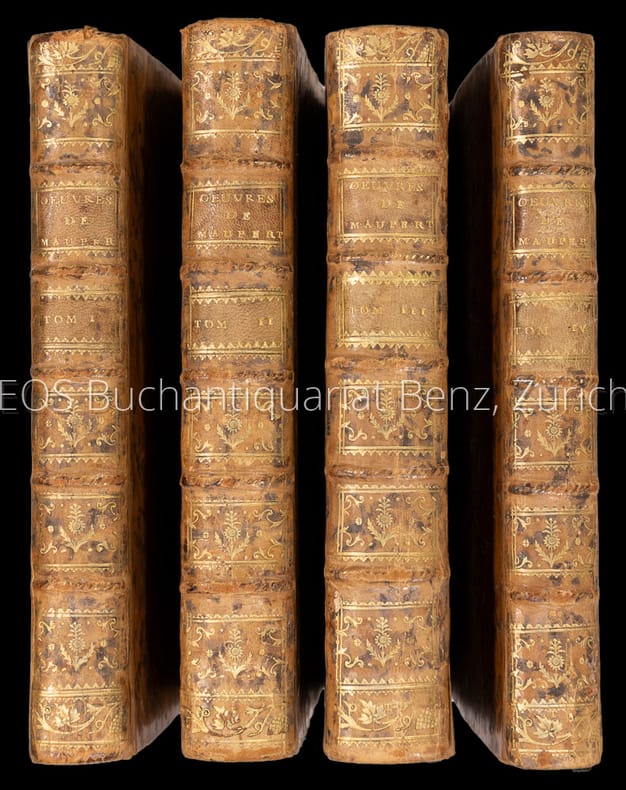
17683974DBLyon, Jean-Marie Bruyset, 1768. 8°. XXXVI, 309 S.; (4), IV, 431, (7) S.; (4), IV, 468, (4) S.; (4), VIII, (12), 346 (3) S. Mit 1 Kupferstichkarte, 1 Tabelle und 61 geom. Figuren im Text. Marmorierte Lederbände aus der Zeit mit Rückenschildchen. + Wichtig: Für unsere Kunden in der EU erfolgt der Versand alle 14 Tage verzollt ab Deutschland / Postbank-Konto in Deutschland vorhanden +, A|B|C 4 volumes. [3 Warenabbildungen] Nouvelle édition corrigée & augmentée.
Mm 230x280 Opera a cura di J.-A. Serret. Brossura originale con copertina a stampa, 427 pagine ancora intonse. Testo in lingua francese - french text. Qualche fioritura all'interno, dorso ingiallito dalla luce, ma buona-ottima copia. Spedizione in 24 ore dalla conferma dell'ordine.
Mm 230x280 Opera a cura di J.-A. Serret. Brossura originale con copertina a stampa, 370 pagine ancora intonse. Testo in lingua francese - french text. Dorso ingiallito dalla luce, ma buona-ottima copia. Spedizione in 24 ore dalla conferma dell'ordine.
Mm 230x280 Opera a cura di J.-A. Serret. Brossura originale con copertina a stampa, 454 pagine ancora intonse. Testo in lingua francese - french text. Dorso ingiallito dalla luce con una lacuna di 2 cm. alla testa e al piede, ma buona copia mai letta. Spedizione in 24 ore dalla conferma dell'ordine.
1979Q3067Berlin/Heidelberg/New York, Springer Verlag, 1979. "Ganzleinen mit Schutzumschlag, großes 8°, gesamt 1469 S., edited by R. Remmert and J.-P. Serre, in jedem Band ein Porträt aus den Jahren 1945, 1960 und 1975 im Frontispiz, vorwiegend in französischer Sprache, »We are happy to present the Collected Works of Henri Cartan. The first one contains acurriculum vitae, a ""breve Analyse des Travaux"" and a list of publications, including books and seminars. In addition the volume contains al papers of H. Cartan on analytic functions published before 1939. The other papers on analytic functions, e. g. those on Stein manifolds and coherent sheaves, make up the second volume. The third volume contains, with a few exceptions, all further papers of H. Cartan; among them is a repruduction of exposes 2 to 11 of his 1954/55 Seminar on Eilenberg-MacLane algebras. Each volume is arranged in chronological order.«"
56280aafChristiania, Grøndahl, 1881, in-4to, 2 leaves + VIII + 621 p. + 1 blanc leaf; 2 leaves + 338 p. + 2 leaves ( 2 tables, et errata), light foxing in places, mainly limited to one margin, annexe: Niels Hendrik Abel, In Memoriam. p. 223-233, half vellum with marbled paper, upper spine hinge starting, two or three small scrapes to marbled paper of rear cover.
17683974DBNouvelle édition corrigée & augmentée. 4 volumes. Lyon, Jean-Marie Bruyset, 1768. 8°. XXXVI, 309 S.; (4), IV, 431, (7) S.; (4), IV, 468, (4) S.; (4), VIII, (12), 346 (3) S. Mit 1 Kupferstichkarte, 1 Tabelle und 61 geom. Figuren im Text. Marmorierte Lederbände aus der Zeit mit Rückenschildchen.
Edizione: Prima edizione . Pagine: 178 . Formato: 16° . Rilegatura: Brossura verdolina originale . Stato: Discreto . Caratteristiche: Bruniture. Gore.Rarissimo . Autografo: Dedica ed autografo .
In 4, pp. 61-68. Br. rifatta con carta d'epoca. Stralcio dagli Atti del Real Istituto d'incoraggiamento alle scienze naturali di Napoli, tomo X, seconda serie.
In 8o, pp. 450, brossura con sovraccoperta. Seconda edizione accresciuta, edizione numerata. Qualche fioritura e minime sottolineature di studio a matita (06043/POESIA FRANCESE NOVECENTO)