19 006 résultats
London, Royal Society, 1888. 8vo (210 x 135 mm). In the original printed wrappers. In ""Proceedings of the Royal Society of London"", vol. 45, no. 274. New backstrip (presumably from having been extracted from a binding) The entire issue offered, internally fine and clean. Pp. 135-145. [Entire issue: 99-156].
186043086Leipzig, Johann Ambrosius Barth, 1860, 1861. 2 uniform contemp. hcalf, raised bands, gilt spine. A few scratches to spine. In ""Annalen der Physik und Chemie. Hrsg. von J.C. Poggendorff"", Bd. 110 a. Bd. 113. - IX,668 pp. a. 8 folded plates. X,660 a. 8 folded plates. Entire volumes offered. The 2 papers: pp. 161-189 a. pp. 337-381 and plates (one plate in chromolithography, spectra of different elements). Verso of titlepages and verso of plates with small stamps. Internally fine and clean.
191946915London, Taylor and Francis, 1919. Recent full cloth. Titlelabel in leather on spine with gilt lettering. In: ""The London, Edinburgh, and Dublin Philosophical Magazine and Journal of Science"" Sixth Series, Vol. XXXVII. Pp. VIII,616 pp. a. 6 plates. A stamp to top of p. 537. Rutherford's paper: pp. 537-587.
Paris, Crochard, 1816, 1819. Bound in 2 contemp. hcloth. Gilt lettering to spines. In: ""Annales de Chimie et de Physique"" Series 2, Tome 1 a. Tome 11. Entire volumes offered.(4),452 pp. a. 3 engraved folded plates. + 448 pp. a. 3 folded engraved plates. Fresnel's papers: pp. 239-281 a. pp. 246-296 a. pp. 337-378. Arago's paper: pp. 5-30. Some scattered brownspots.
Leipzig, Johann Ambrosius Barth, 1860, 1861. 2 uniform contemp. hcalf, raised bands, gilt spine. A few scratches to spine. In ""Annalen der Physik und Chemie. Hrsg. von J.C. Poggendorff"", Bd. 110 a. Bd. 113. - IX,668 pp. a. 8 folded plates. X,660 a. 8 folded plates. Entire volumes offered. The 2 papers: pp. 161-189 a. pp. 337-381 and plates (one plate in chromolithography, spectra of different elements). Verso of titlepages and verso of plates with small stamps. Internally fine and clean.
London, Taylor and Francis, 1919. Recent full cloth. Titlelabel in leather on spine with gilt lettering. In: ""The London, Edinburgh, and Dublin Philosophical Magazine and Journal of Science"" Sixth Series, Vol. XXXVII. Pp. VIII,616 pp. a. 6 plates. A stamp to top of p. 537. Rutherford's paper: pp. 537-587.
Kaluga, (1918). 8vo (26,8 x 18 cm). Orig. printed illustrated wrappers, inside of wrappers also illustrated with figures. One text-illustration. Uncut and mostly unopened. A few minor tears to extremities. Wrappers faded and with a horizontal folding crease in the middle. Neatly and professionally re-enforced at the spine. All in all a very good copy of this fragile publication. 24 pp.
1989173802Berlin, Springer, 1963-1989. Bibliotheks-Lwdbde. m. Rsign. Teilw. St. a. Tit. od. Tekt. a. Innendeckel. Vol. 100-106/1 OHefte.
In-8 gr. (mm. 260x190), 3 volumi (di cui 1 di tavole), p. pelle bazzana coeva (con abras.), dorso a cordoni con decoraz. e tit. oro, tagli marmorizz. L’opera è così composta: Vol. 1°: pp. (4),XVI,708 + 34 pp., con proprio frontespizio, contenenti “Observations sur les nouvelles découvertes aérostatiques, et sur la probabilité de pouvoir diriger les Ballons. Pour servir de Supplément à son Dictionnaire..”, Paris, 1784 - Vol. 2°: pp. (4),770 compreso l’Errata - Vol. 3° (Planches): pp. VI, con 90 tavole inc. in rame, ciascuna con numer. figure. "Prima edizione". Brisson (1723-1806) iniziò la sua carriera scientifica come assistente di Reaumur, classificando e avendo cura degli esemplari della sua immensa collezione di storia naturale. La morte del suo mentore segnò la fine della sua carriera di naturalista e, su consiglio di Nollet, orientò i suoi studi verso la fisica sperimentale. In questo campo fece enormi progressi, collaborando con Lavoisier e succedendo in seguito a Nollet alla cattedra di fisica sperimentale del Collegio di Navarra. Influente propagatore delle più avanzate teorie del suo tempo, pubblicò con grande successo un libro di testo ed il presente dizionario, che contiene oltre ad una eccellente presentazione dei vari aspetti della fisica, anche una importante appendice sulla "machine aérostatique" di Mongolfier. Cfr. Poggendorff, 301 - Brockett, 2213a - D.S.B. II,475. Con bruniture interc. nel t.; le tavv. portano uniformi arross. per lo più marginali.
1772LRB170903Très bon état, reliure en plein veau écaille, qqs épidermures, dos lisse à fleurons, pièce de titre noire, de tomaison rouge, tranches marbrées bleues et blanches, coins usés, coiffes légèrement usées mais toutes présentes , tranchefiles en bon état. 99 planches en couleur (complet). Ex-libris gravé sur les contre plats recto des quatre volumes. Huit planches ont quelques rousseurs, une page restaurée marginalement dans t.I partie 2. Un bel exemplaire 179p. -200p. /VIII-173p. - 172 p. /196p. - 190 p. /182p. /207 p. Seconde édition en huit livraisons (trimestrielle à partir de la fin 1772), reliée en quatre volumes in-8°. Pour être complet, chaque volume doit comporter un faux titre, le titre, le texte, les planches expliquées à chaque fin de partie, les tables et le prospectus des prix des objets pour réaliser les récréations. La numérotation de chaque partie est particulière et commence avec le faux titre. Tome I : pagination de I à XVI en chiffres romain puis début du texte avec p.17 en chiffres arabes / Tome II : numérotation indépendante de l'avertissement (I à VIII) / Tome III : présence d'un avis non folioté. Tome I : 179 p. 15 planches couleur - 200 p. 6 planches couleur / tome II : VIII- 173 p. 20 planches couleur- 172 p. 8 planches couleur / tome III 196 p. 10 planches couleur + 1 ff° - 190 p. 16 planches couleur / tome IV 182 p. 11 planches couleur / 207 p. -13 planches couleur [soit 99 planches en couleur, dont 3 dépliantes] Ex-libris gravé : Gravelle de Fontaine, conseiller au Parlement de Normandie [Jacques Nicolas Gravelle de Fontaine (1749-1813), conseiller au Parlement de Paris, maire de Versailles, animateur d'un salon d'amateurs sur Versailles]
191835773Copenhagen, Bianco Lunos, 1918. 4to. Original printed wrappers. Lower right corner of front wrapper bent. Small closed tear to front wrapper. Spine strip renewed. Otherwise fine and clean throughtout.
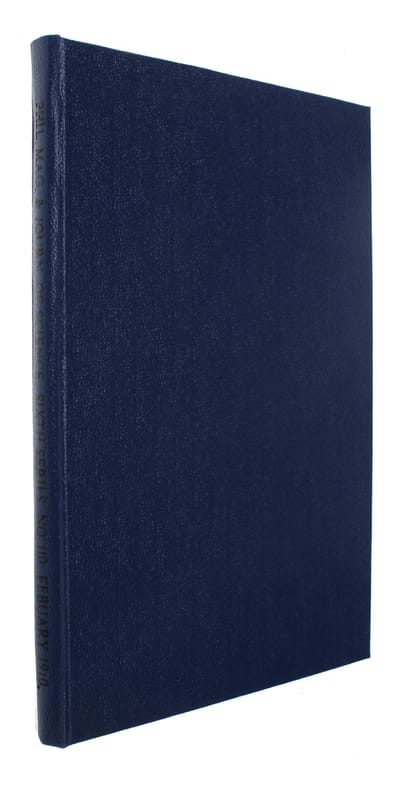
191060036London, Taylor & Francis, 1910. 8vo. Bound with the original wrappers in recent full blue cloth with black lettering to spine. In ""The Philosophical Magazine"" for February 1910, vol 19, no. 110. The entire issue offered. Wrappers reinforced in margin, otherwise a fine copy. Pp. 209-228 [Entire issue: pp. 209-336].
191341566London, 1913. Without wrappers, but stitched. In ""Philosophical Magazine and Journal of Science"", Vol. 26, No. 156. December 1913. Pp. 937-1058 a. 6 plates.(= the whole issue No 156). Moseley's paper: pp. 854-860 a. 1 plate. Fine and clean.
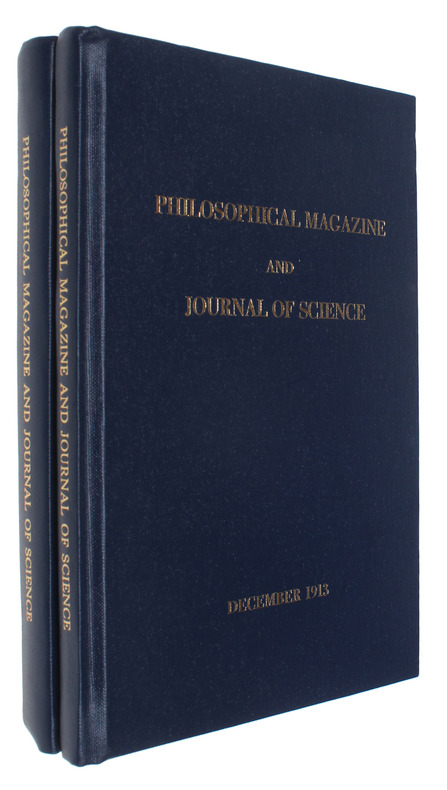
191357201London, Taylor and Francis, 1913-14. 8vo. Bound in two recent uniform full cloth bindings with gilt lettering to spines and front boards. Extracted from ""The London, Edinburgh and Dublin Philosophical Magazine"" Sixth Series Volume 26 Nos 156 and 160, entire issues offered. A fine and clean set. Pp. 1024-1034 + 1plate"" pp. 703-713.
Copenhagen, Bianco Lunos, 1918. 4to. Original printed wrappers. Lower right corner of front wrapper bent. Small closed tear to front wrapper. Spine strip renewed. Otherwise fine and clean throughtout.
(Berlin, Julius Springer, 1922-24). 8vo. In: ""Zeitschrift für Physik"", Vol. 10 (pp. 377 ff.),Vol.11 (pp.326), vol.16 (pp.228), vol.21 (pp.326-332). The entire four volumes offered here. Contemporary half cloth bindings.
Berlin, Julius Springer, 1922-24. 8vo. 4 contemporary half cloth binding: two in uniform half green cloth and two en uniform grey/blue half cloth. In ""Zeitschrift für Physik"", Bd. 10, 11, 16 & 21. Entire volumes offered. All volumes with stamp to title page and front free end paper, otherwise a fine and clean set. [Friedmann:] Bd. 10: Pp. 377-386" Bd. 21: P.p. 326-332. [Einstein:] Bd. 11:P. 326 " Bd. 16: P. 228.
London, Taylor & Francis, 1910. 8vo. Bound with the original wrappers in recent full blue cloth with black lettering to spine. In ""The Philosophical Magazine"" for February 1910, vol 19, no. 110. The entire issue offered. Wrappers reinforced in margin, otherwise a fine copy. Pp. 209-228 [Entire issue: pp. 209-336].
London, 1913. Without wrappers, but stitched. In ""Philosophical Magazine and Journal of Science"", Vol. 26, No. 156. December 1913. Pp. 937-1058 a. 6 plates.(= the whole issue No 156). Moseley's paper: pp. 854-860 a. 1 plate. Fine and clean.
London, Taylor and Francis, 1913-14. 8vo. Bound in two recent uniform full cloth bindings with gilt lettering to spines and front boards. Extracted from ""The London, Edinburgh and Dublin Philosophical Magazine"" Sixth Series Volume 26 Nos 156 and 160, entire issues offered. A fine and clean set. Pp. 1024-1034 + 1plate" " pp. 703-713.
1975ZB393202Rockefeller University Press 1975-1996. Volumes 13-70; mostly in original paper wrappers. - If you are reading this this item is actually physically in our stock and ready for shipment once ordered. We are not bookjackers. Buyer is responsible for any additional duties taxes or fees required by recipient's country. Photos available upon request. Rockefeller University Press unknown
24x17. 191h. 157h. 156p. 24x22. 532p. 330p. 5 Vols. En Vol. III. Estudio introductorio de L. Reti. Trad. A. Madinavitia. Vol. IV. Transcipción L. Reti, Trad. F. Chueca Goitia, L. Reti, A. Madinaveitia. Vol. V. Transcipción L. Reti. Trad. F. Chueca Goitia. Enc. Cart. Ed. Estuche.
7236Amsterdam, Ledet, 1738, un volume in 8 relié en plein veau glacé, dos orné de fers dorés, tranches rouges (reliure de l'époque), (habiles restaurations aux mors), 1 portrait de NEWTON, 1 portrait de VOLTAIRE, (1), 399pp., (1pp.), 6 planches hors texte, 1 tableau dépliant, nombreuses figures dans le texte
1966059777New York: Interscience Publishers / John Wiley & Sons 1966. 1st Edition 1st Printing. Hardcover. Fine/Near Fine. Xiv 394 Pp. Gray-Green Cloth Printed In Dark Green. First Printing. Near Fine Previous Owner's Name. Dj With Slight Wear Two Short Tears At Top Of Rear Panel. Remarkably Thorough Experimental And Theoretical History And Analysis. Definitive For The Advanced Student And The Expert. Per Wikipedia Chien-Shiung Wu Chinese: ; Pinyin: Wú Jiànxióng; Wade-Giles: Wu2 Chien4-Hsiung2; 1912 - 1997 Was A Chinese-American Particle And Experimental Physicist Who Made Significant Contributions In The Fields Of Nuclear And Particle Physics. Wu Worked On The Manhattan Project Where She Helped Develop The Process For Separating Uranium Into Uranium-235 And Uranium-238 Isotopes By Gaseous Diffusion. She Is Best Known For Conducting The Wu Experiment Which Proved That Parity Is Not Conserved. This Discovery Resulted In Her Colleagues Tsung-Dao Lee And Chen-Ning Yang Winning The 1957 Nobel Prize In Physics While Wu Herself Was Awarded The Inaugural Wolf Prize In Physics In 1978. Her Expertise In Experimental Physics Evoked Comparisons To Marie Curie. Her Nicknames Include The "First Lady Of Physics" The "Chinese Madame Curie" And The "Queen Of Nuclear Research". After Work On The Manhattan Project During Wwii Wu Accepted An Offer Of A Position As An Associate Research Professor At Columbia. She Would Remain At Columbia For The Rest Of Her Career And Was First Named Associate Professor In 1952 Which Made Her The First Woman To Become A Tenured Physics Professor In University History. In November 1949 Wu Experimented With The Conclusions Of Einstein's Epr Thought Experiment Which Called Quantum Entanglement "Spooky Action At A Distance". Wu Was The First To Establish The Phenomenon And Validity Of Entanglement Using Photons Through Observing Angular Correlation As Her Result Confirmed Maurice Pryce And John Clive Ward's Calculations On The Correlation Of The Quantum Polarizations Of Two Photons Propagating In Opposite Directions. Specifically The Experiment Carried Out By Wu Was The First Important Confirmation Of Quantum Results Relevant To A Pair Of Entangled Photons As Applicable To The Einstein-Podolsky-Rosen Epr Paradox. Her 1950 Letter To Physical Review Famously Identified Confirmation Of Wheeler's Ideas On Entanglement. Tsung-Dao Lee And Another Chinese Theoretical Physicist Chen Ning Yang Grew To Question A Hypothetical Law Of Elementary Particle Physics The "Law Of Conservation Of Parity". Lee And Yang Worked Out A Pencil-And-Paper Design Of An Experiment For Testing Conservation Of Parity In The Laboratory. Because Of Her Expertise In Choosing And Then Working Out The Hardware Manufacture Set-Up And Laboratory Procedures Wu Then Informed Lee That She Could Carry Out The Experiment. Wu Chose To Do This By Taking A Sample Of Radioactive Cobalt-60 And Cooling It To Cryogenic Temperatures With Liquid Gases. Cobalt-60 Is An Isotope That Decays By Beta Particle Emission And Wu Was Also An Expert On Beta Decay. The Discovery Of Parity Violation Was A Major Contribution To Particle Physics And The Development Of The Standard Model. The Discovery Actually Set The Stage For The Development Of The Model As The Model Relied On The Idea Of Symmetry Of Particles And Forces And How Particles Can Sometimes Break That Symmetry.The Wide Coverage Of Her Discovery Prompted The Discoverer Of Fission Otto Frisch To Mention That Those At Princeton Would Often Say That Her Experiment Was The Most Impactful Since The Michelson-Morley Experiment That Inspired Einstein's Theory Of Relativity. In December 1962 Wu Experimentally Demonstrated A Universal Form And More Accurate Version Of Fermi's Old Beta Decay Model Confirming The Conserved Vector Current Cvc Hypothesis Of Richard Feynman And Murray Gell-Mann On The Road To The Standard Model. <br/> <br/> Interscience Publishers / John Wiley & Sons hardcover
1992052807Plenum Press 1992. 1st Edition 1st Printing. Hardcover. Fine/Fine. Xxiv 335 Pp. Black Boards Spine Gilt. First Printing No Additional Printing Indicated. Fine In Fine Dust Jacket Priced $24.50. Laid In Loosely Is A Gift Card Signed By Wigner And Dated In 1965. Per Wikikpedia Eugene Paul Wigner 1902 - 1995 Was A Hungarian-American Theoretical Physicist Who Also Contributed To Mathematical Physics. He Received The Nobel Prize In Physics In 1963 "For His Contributions To The Theory Of The Atomic Nucleus And The Elementary Particles Particularly Through The Discovery And Application Of Fundamental Symmetry Principles". A Graduate Of The Technical Hochschule Berlin Now Technische Universität Berlin Wigner Worked As An Assistant To Karl Weissenberg And Richard Becker At The Kaiser Wilhelm Institute In Berlin And David Hilbert At The University Of Göttingen. Wigner And Hermann Weyl Were Responsible For Introducing Group Theory Into Physics Particularly The Theory Of Symmetry In Physics. Along The Way He Performed Ground-Breaking Work In Pure Mathematics In Which He Authored A Number Of Mathematical Theorems. In Particular Wigner's Theorem Is A Cornerstone In The Mathematical Formulation Of Quantum Mechanics. He Is Also Known For His Research Into The Structure Of The Atomic Nucleus. In 1930 Princeton University Recruited Wigner Along With John Von Neumann And He Moved To The United States Where He Obtained Citizenship In 1937. Wigner Participated In A Meeting With Leo Szilard And Albert Einstein That Resulted In The Einstein-Szilard Letter Which Prompted President Franklin D. Roosevelt To Authorize The Creation Of The Advisory Committee On Uranium With The Purpose Of Investigating The Feasibility Of Nuclear Weapons. Wigner Was Afraid That The German Nuclear Weapon Project Would Develop An Atomic Bomb First. During The Manhattan Project He Led A Team Whose Task Was To Design Nuclear Reactors To Convert Uranium Into Weapons Grade Plutonium. At The Time Reactors Existed Only On Paper And No Reactor Had Yet Gone Critical. Wigner Was Disappointed That Dupont Was Given Responsibility For The Detailed Design Of The Reactors Not Just Their Construction. He Became Director Of Research And Development At The Clinton Laboratory Now The Oak Ridge National Laboratory In Early 1946 But Became Frustrated With Bureaucratic Interference By The Atomic Energy Commission And Returned To Princeton. In The Postwar Period He Served On A Number Of Government Bodies Including The National Bureau Of Standards From 1947 To 1951 The Mathematics Panel Of The National Research Council From 1951 To 1954 The Physics Panel Of The National Science Foundation And The Influential General Advisory Committee Of The Atomic Energy Commission From 1952 To 1957 And Again From 1959 To 1964. In Later Life He Became More Philosophical And Published The Unreasonable Effectiveness Of Mathematics In The Natural Sciences His Best-Known Work Outside Technical Mathematics And Physics. <br/> <br/> Plenum Press hardcover