2 353 résultats
1976fr561GEP Dos carré collé 1976 In-8 (16x24 cm), dos carré collé, 198 pages, préface de Jacques Tréfouët, quelques photographies en noir et blanc dans le texte ; mors un peu frottés, pâles rousseurs sur les plats un peu salis, bon état. Livraison a domicile (La Poste) ou en Mondial Relay sur simple demande.
19621124171962 Editions Batsford Colour Book - 1962 - In-8, cartonnage marron avec titre doré au dos, sous jaquette illustrée en couleurs - 70 p. - Nombreuses reproductions photographiques en couleurs pleine page - Texte en anglais
19601124161960 Editions Batsford Colour Book - 1960 - In-8, cartonnage marron avec titre doré au dos, sous jaquette illustrée en couleurs - 70 p. - Nombreuses reproductions photographiques en couleurs pleine page - Texte en anglais
1960AE-66Amsterdam The Netherlands: Elsevier Publishing 1960. Classic comprehensive rare text translated from the original French edition with added revisions by the authors. Detailed topics include rocket propulsion elements; nozzle theory and characteristic parameters; aerothermochemistry of the combustion products; solid propellants; internal ballistics and design of solid-propellant rockets; liquid propellants and liquid propellant rockets; combustion instability in liquid-propellant rocket motors; elementary problems of overall flight performance; etc. 829 pgs. Illustrated. Stamped on endpapers outer edge and lower title pg. Small label neatly removed from spine. Gilt. Some minor rubbing to corners and edges. Binding is tight. First Edition. Hard Cover. Very Good. 8vo - over 7¾" - 9¾" tall. Ex-Technical Library. Elsevier Publishing Hardcover
101.664Paris, Librairie Delagrave, 1954. 14 x 20, 208 pp., reliure carton, bon état (couverture défraîchie).
1937GITk561Paris Société d'Editions Géograhiques Maritimes et Coloniales 1937. 2 fort volumes in-4 oblong en pagination continue totalisant 4 feuillets non chiffrés (faux-titre, titre, préface, table des matières) 2-1127pp (dictionnaire) 113 feuillets non chiffrés (planches) II-CCXX index. L'ensemble imprimé sur 5 colonnes (une pour chacune des langues). Pleine toile écrue de l'époque, dos lisse, pièce de titre imprimée appliquée sur le dos. Illustré de 113 planches avec l'explication en cinq langues en regard montrant l'évolution de la marine à voile jusqu'à l'utilisation du moteur (modèles de bateaux, détails, architecture navale, noeuds, moteurs et pièces détachées). Pliures sur la page de titre et le 1er feuillet du 2e volume. Exemplaire en bon état et complet.
19161187631916 Ernest Flammarion, éditeur, Publication Omnia - 1916 - In-8, demi basane noire à coin, dos à 4 nerfs avec titre et nom de l'auteur en doré - 334 p. - Nombreuses (244) gravures in texte en N&B
27457Paris, Bibliothèque Omnia, sd. In-8 (195x145mm) relié en percaline d'éditeur bordeaux ; 638 p. Ill. en noir. Rousseurs sur les tranches. Bon état général.
55097P., Albin Michel, 1920, grand in 8° relié demi basane verte, dos lisse orné, 552 pages ; figures dans le texte.
19498589Paris Albin Michel 1949 Petit In-4 398 pp, (.) Mécanique théorique, résistances passives, résistance des matériaux. Bibliothèque de l'ingénieur électricien-mécanicien. Exemplaire non coupé, intérieur très frais. Dos et tête du 1er plat passés, une coupure sans manque en queue
50481P., Albin Michel, 1920, in 4° broché, 399 pages ; couverture abimée et effrangée avec manques ; dos fendu.
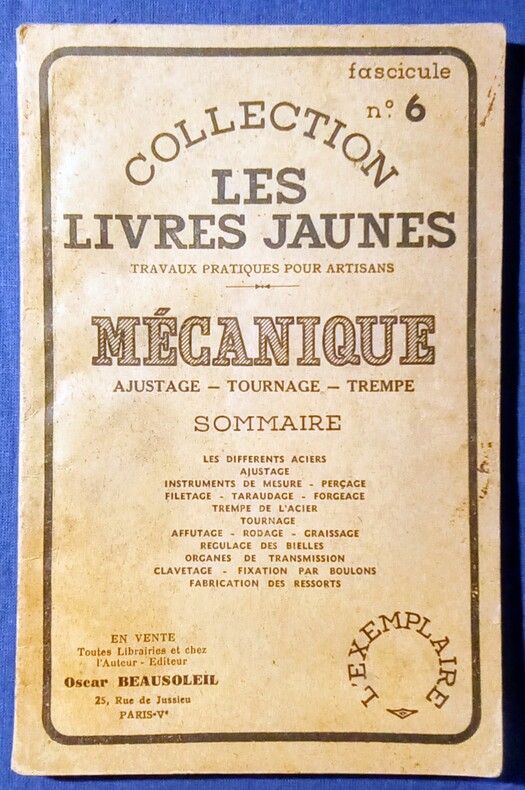
WOC-2393Ajustage – Tournage - Trempe . Avec 194 figures intercalées dans le texte. 5 ème édition. Paris, Éditions Techniques Oscar Beausoleil & Bruxelles, Les Éditions du Jour, 1957. In-12 (18x11,5cm) broché, couverture imprimée et un peu sale. 64pp. 12€
Broché. 64 pages. Manques au dos.
1739PARIS, J. Grancher - 1987 - In-4 - Reliure Editeur sous jaquette - 86 pages - Importante iconographie N. & B. et couleurs - Ex. très propre;
PARIS, J. Grancher - 1987 - In-4 - Reliure Editeur sous jaquette - 86 pages - Importante iconographie N. & B. et couleurs - Ex. très propre
Fine Fine Turkmen Original bdg. Dust wrapper. Roy. 8vo. (24 x 17 cm). Introduction in Turkmen, facsimile in Arabic. [2], 28, 256 p., color facsimiles of the earliest of all copies, dating 1206 (preserved in the Library of Topkapi Serai, Istanbul, No. 3472), color ills. [The book of knowledge of ingenious mechanical devices] Adatdan dasari mehanik gurallayn maglumaty hakda kitap. Al-Jazari was a Muslim polymath: a scholar, inventor, mechanical engineer, artisan, artist and mathematician. He is best known for writing 'The Book of Knowledge of Ingenious Mechanical Devices'. Kitab fi ma'rifat al-hiyal al-handasiya, (lit. 'Book in knowledge of engineering tricks') in 1206, where he described 100 mechanical devices, some 80 of which are trick vessels of various kinds, along with instructions on how to construct them. The only biographical information known about him is contained in his famed Book of Knowledge of Ingenious Mechanical Devices. Like his father before him, he served as chief engineer at the Artuklu Palace, the residence of the Mardin branch of the Artuqids which ruled across eastern Anatolia as vassals of the Zengid dynasty of Mosul and later of Ayyubid general Saladin. Al-Jazari was part of a tradition of artisans and was thus more a practical engineer than an inventor who appears to have been "more interested in the craftsmanship necessary to construct the devices than in the technology which lay behind them" and his machines were usually "assembled by trial and error rather than by theoretical calculation." His Book of Knowledge of Ingenious Mechanical Devices appears to have been quite popular as it appears in a large number of manuscript copies, and as he explains repeatedly, he only describes devices he has built himself. According to Mayr, the book's style resembles that of a modern "do-it-yourself" book. Some of his devices were inspired by earlier devices, such as one of his monumental water clocks, which was based on that of a Pseudo-Archimedes. He also cites the influence of the Banu Musa brothers for his fountains, al-Saghani for the design of a candle clock, and Hibatullah ibn al-Husayn (d. 1139) for musical automata. Al-Jazari goes on to describe the improvements he made to the work of his predecessors, and describes a number of devices, techniques and components that are original innovations which do not appear in the works by his precessors. The most significant aspect of al-Jazari's machines are the mechanisms, components, ideas, methods, and design features which they employ. (Source: Wikipedia). There are 50 devices that Al Jazari designed and explained how they function in his book and created technical drawings of them in such detail that allow to reconstruct in its original size, make, model and full functionally. This nice facsimile edition, fully executed in color, is based on a manuscript present in the Library of Topkapi Palace, (ms. no. 3472). It is dated 1206, andaccording to the foreword, is the earliest extant copy of al-Jazarî's work.
New English Paperback. Roy. 8vo. (24 x 17 cm). Introduction in English and Turkish; [360] p. color facsimiles of the earliest of all copies, dating 1206 (preserved in the Library of Topkapi Serai, Istanbul, No. 3472), color ills. The book of knowledge of ingenious mechanical devices.= Olaganüstü mekanik araçlarin bilgisi hakkinda kitap. [FACSIMILE]. Al-Jazari was a Muslim polymath: a scholar, inventor, mechanical engineer, artisan, artist and mathematician. He is best known for writing 'The Book of Knowledge of Ingenious Mechanical Devices'. Kitab fi ma'rifat al-hiyal al-handasiya, (lit. 'Book in knowledge of engineering tricks') in 1206, where he described 100 mechanical devices, some 80 of which are trick vessels of various kinds, along with instructions on how to construct them. The only biographical information known about him is contained in his famed Book of Knowledge of Ingenious Mechanical Devices. Like his father before him, he served as chief engineer at the Artuklu Palace, the residence of the Mardin branch of the Artuqids which ruled across eastern Anatolia as vassals of the Zengid dynasty of Mosul and later of Ayyubid general Saladin. Al-Jazari was part of a tradition of artisans and was thus more a practical engineer than an inventor who appears to have been "more interested in the craftsmanship necessary to construct the devices than in the technology which lay behind them" and his machines were usually "assembled by trial and error rather than by theoretical calculation." His Book of Knowledge of Ingenious Mechanical Devices appears to have been quite popular as it appears in a large number of manuscript copies, and as he explains repeatedly, he only describes devices he has built himself. According to Mayr, the book's style resembles that of a modern "do-it-yourself" book. Some of his devices were inspired by earlier devices, such as one of his monumental water clocks, which was based on that of a Pseudo-Archimedes. He also cites the influence of the Banu Musa brothers for his fountains, al-Saghani for the design of a candle clock, and Hibatullah ibn al-Husayn (d. 1139) for musical automata. Al-Jazari goes on to describe the improvements he made to the work of his predecessors, and describes a number of devices, techniques and components that are original innovations which do not appear in the works by his precessors. The most significant aspect of al-Jazari's machines are the mechanisms, components, ideas, methods, and design features which they employ. (Source: Wikipedia). There are 50 devices that Al Jazari designed and explained how they function in his book and created technical drawings of them in such detail that allow to reconstruct in its original size, make, model and full functionally. This nice facsimile edition, fully executed in color, is based on a manuscript present in the Library of Topkapi Palace, (ms. no. 3472). It is dated 1206, andaccording to the foreword, is the earliest extant ccopy of al-Jazarî's work.
Fine Fine Turkish Original bdg. Dust wrapper. 4to. (29 x 21 cm): In Turkish. [xci], 338 p., color and b/w ills. El-Câmi' beyne'l-'ilm ve'l-'amel en-nâfi' fî es-sinaâ'ti'l-hiyel. Prep. and translated by Sevim Tekeli, Melek Dosay, Yavuz Unat.
New New Turkish Original bdg. Dust wrapper. 4to. (29 x 21 cm): In Turkish. [xci], 338 p., color and b/w ills. El-Câmi' beyne'l-'ilm ve'l-'amel en-nâfi' fî es-sinaâ'ti'l-hiyel. Prep. and translated by Sevim Tekeli, Melek Dosay, Yavuz Unat.
43740Paris, Librairie Armand Colin, 1934. 11 x 17, 2 volumes, 200 + 208 pages, 151 figures, broché, état moyen (couverture défraîchie).
20089PAris, E.P.A., 2022. In-4, 319 pp., cartonnage éditeur illustré.
67001P., PYC Editions Desforges, 1973, in 8° relié pleine toile bleue de l'éditeur, 294 pages ; figures dans le texte.
1961AE-31The Rand Corp./Princeton University Press 1961. Classic text contains mathematical techniques and classical theories of control processes including deterministic processes stochastic processes dynamic programming sequential machines and the synthesis of logical systems. etc. 255 pgs. Prior owner's name on side outer edge and front endpaper. Minor shelfwear. First Edition. Hard Cover. Very Good/No Jacket. 8vo - over 7¾" - 9¾" tall. The Rand Corp./Princeton University Press Hardcover
2012UBENAMA00KHHearst 2012. Fine. Benford Gregory. The Amazing Weapons That Never Were. The editors of Popular Mechanics. NY: Hearst 2012. 199pp. Indexed. Illustrated. 4to. Hardcover. Book condition: Near fine. Dust Jacket Condition: Very good. Dust jacket folds out into a color poster with imagined weapons from different decades. Hearst hardcover books
2012Q-158816862XHearst 2012-11-06. Hardcover. New. New. In shrink wrap. Looks like an interesting title! Hearst hardcover