414 résultats
16422A Paris, Chez Clousier, 1789. Two pieces in 1 volume. 24 pp.; 8 pp. 8vo. Modern boards. First work: Kress B.1679; not in Goldsmiths; not in Einaudi; not in INED; not in Duveen & Klickstein; Martin & Walter, Anonymes, 11194. Second work: Kress B.1521; Goldsmiths 13850; not in Einaudi; not in Kress; not in Duveen & Klickstein; Martin & Walter, Anonymes, 228. Original editions of both works: the texts of these two publicatons can hardly have been prepared without the support of Lavoisier, if they have not been written entirely or edited entirely by him.
In 8° (20,5x13,5 cm): 4 tomi: VIII, 408, (2 b.) pp. e 2 grandi c. di tav. più volte ripiegate, VIII, 411-745, (1) pp. e XIII carte di tav. ripieg., VIII, 347, (5 b.) pp., X, (2), 251, (5 b.) pp. Il terzo e quarto tomo non presentano l'occhietto con il titolo "Trattato elementare di chimica", nel terzo volume non presenti le 4 pagine di "Avviso al lettore" evidentemente mai aggiunte in questo esemplare. Ai frontespizi, nel margine esterno bianco, antico timbro settecentesco dell'alienata "Biblioteca degli Israeliti di Mantova" dove come in altri esemplari provenienti da questa celebre biblioteca privata, è stata abrasa la parola "Mantova" (nei tomi 1 e 3 fino a crare una piccola mancanza di carta, integrata con vecchia pecetta, in corrispondenza della parola Mantova, fra l'altro perfettamente leggibile nel primo tomo, stessa piccola mancanza di carta integrata con pecetta antica, in corrispondenza di altri due timbri, sempre degli Israeliti di Mantova, presenti nel margine basso bianco a metà, circa, del tomo I e II). Legature coeve in mezza pelle caratteristiche degli Israeliti di Mantova con dorso spugnato e piatti in carta coeva color caffè. Autore, titolo e numero dei volumi impressi in oro al dorso. Prima rarissima edizione italiana a trovarsi completa, di uno dei trattati della storia della chimica, pubblicata per la prima volta in francese nel 1789, dal grande chimico, biologo, filosofo ed economista francese, Antoine-Laurent de Lavoisier (Parigi, 26 agosto 1743 – Parigi, 8 maggio 1794). Il Traité di Antoine Laurent Lavoisier (1743-1794), pubblicato in Francia nel 1789, uscì in Italia nel 1791. La prima edizione andò esaurita dopo soli quattro mesi, la seconda comparve nel 1792 e la terza nel 1796. Sappiamo che le belle tavole che accompagnano l'opera, vennero disegnate da Marie Anne Paulze Lavoisier, moglie dell’Autore. Anche lei era appassionata di chimica. Aveva tradotto per il marito il Saggio sul flogisto e la costituzione degli acidi di Richard Kirwan ed era stata allieva del celebre pittore David che, tra l’altro, la ritrasse accanto al marito. L'edizione italiana vede la cura e la traduzione del noto scienziato, politico ed agronomo, Vincenzo Dandolo (Venezia, 22 o 26 ottobre 1758 – Varese, 12 dicembre 1819). "Il suo Traité Élémentaire de Chimie (Trattato di chimica elementare, 1789), è considerato il primo moderno libro di testo di chimica; presentava una visione unificata delle nuove teorie della chimica, negava l'esistenza del flogisto e conteneva una chiara enunciazione della "legge di conservazione della materia": «Rien ne se perd, rien ne se crée» "Nulla si perde, nulla si crea". (Albert Einstein, più di cent'anni dopo, riformulò questa legge in altri termini.) Inoltre, Lavoisier chiarificò il concetto di elemento come sostanza semplice che non può essere scomposta da nessun metodo conosciuto dell'analisi chimica, e concepì una teoria della formazione dei composti chimici a partire dagli elementi. In aggiunta stilò una lista di elementi, o sostanze, che non potevano essere scomposte, che includeva ossigeno, azoto, idrogeno, fosforo, mercurio, zinco, e zolfo. La sua lista, comunque, includeva anche luce e calorico, che credeva essere sostanze materiali". Il terzo tomo contiene l'opera "Esame delle affinità chimiche" di Louis Bernard Guyton de Morveau (1737 - 1816). Il quarto tomo contiene un dizionario vecchio e nuovo di nomenclatura chimica, un dizionario nuovo e vecchio di nomenclatura chimica, la dissertazione di Lavoisier sulla respirazione, la dissertazione di Lavoisier e Seguin sulla traspirazione. Prima rarissima edizione a trovarsi completa dei quattro tomi. Rif. Bibl.: Duveen & Klickstein p.180 and p.149; Guareschi, La chimica in Italia, pp. 444-6; D.B.I., XXXII/pp. 511-516.<BR>
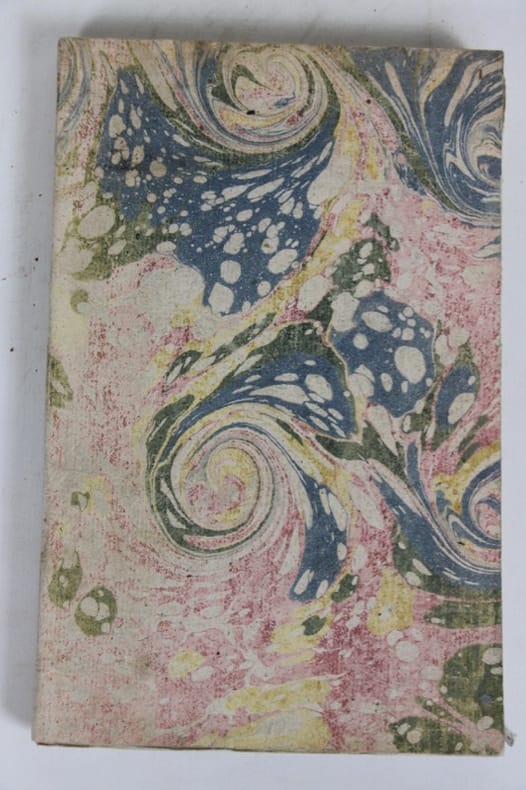
177984862A Paris, de l’Imprimerie Royale 1779 Première édition. In-8, broché couverture dite de “reliure d’attente” tardive, de papier reliure XIXeme, VIII-84pp, 4 planches rempliées en fin d’ouvrage. Orné de têtes de chapître et de culs de lampe. Mouillures sur pages de titre et pages d’introduction. Pages écornées. Ouvrage très rare. Assez Bon état.
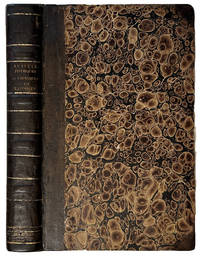
1801291810Paris: Deterville 1801. Second. hardcover. very good. Illustrated with 3 folding copper engravings. xxx ii 443 2 pages. 8vo contemporary marbled boards with mottled calf spine decorated in gilt; marbled page edges. Paris: Deterville 1801. Second Edition. Final leaf damaged else a very good clean copy.<br/><br/> "Antoine-Laurent Lavoisier a meticulous experimenter revolutionized chemistry. He established the law of conservation of mass determined that combustion and respiration are caused by chemical reactions with what he named "oxygen" and helped systematize chemical nomenclature among many other accomplishments." -- Science History Institute<br/><br/> Deterville unknown books
1801291810Paris: Deterville 1801. Second. hardcover. very good. Illustrated with 3 folding copper engravings. xxx ii 443 2 pages. 8vo contemporary marbled boards with mottled calf spine decorated in gilt; marbled page edges. Paris: Deterville 1801. Second Edition. Final leaf damaged else a very good clean copy.<br/> <br/> "Antoine-Laurent Lavoisier a meticulous experimenter revolutionized chemistry. He established the law of conservation of mass determined that combustion and respiration are caused by chemical reactions with what he named "oxygen" and helped systematize chemical nomenclature among many other accomplishments." -- Science History Institute<br/> <br/> Deterville unknown
1793ABE-1747758279317Paris: Cuchet 1793. 2nd Edition. Hardcover. Very Good. 2 Vols 8vo 2 folding tables 13 fine folding copperplates by Mme Lavoisier Second ed second issue This is authorized Chardon issue; 1st 1793 issue was pirated; 3rd 1793 issue was improved version of pirated issue by authorized publisher See Duveen and Klickstein pp 176-177 8vo 19th cent. half calf VG See A. Greenberg From Alchemy to Chemistry in Picture and Story John Wiley & Sons New York 2007 pp 313 315 316 335. Paris: Cuchet hardcover
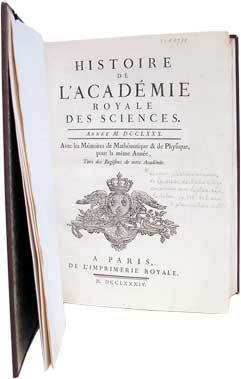
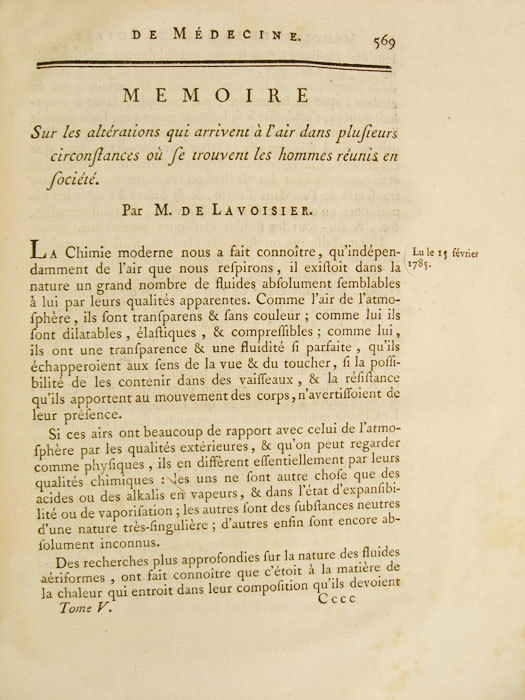
29044In-4, demi-veau fauve moderne, dos à nerfs soulignés de filets à froid et dorés, daté en pied (dos tâché), (4) f., 76 et 680 p., 12 planches gravées hors-texte. Paris, Imprimerie royale, 1784.
29015In-4, plein veau de l'époque, dos à nerfs orné, tranches rouges (accrocs aux coiffes, importantes épidermures), (4), xij, 300-582 p., planches dont dépliantes. Paris, Théophile Barrois, 1787.
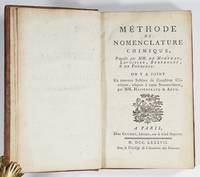
1787655401787. Paris: Chez Cuchet 1787 8° IV 314 pp. 6 gefalt. Kupfertafeln Ledereinbnand. d.Zt.; Falttabll fehlt; Rücken restauriert; feines Expl. FIRST EDITION first issue of one of the key books in the history of modern chemistry. This copy has all the features mentioned for the first issue such as the figurative title vignette and the misnumbered pages: 242/34 instead of 258/% 246/7 instead of 262/3 291 instead of 266/7 254/5 instead of 270/1. Unfortunately the table opposite page 100 is missing. Lavoisier's discoveries made a new and rational chemical nomenclature imperative. Initiated by Guyton de Morveau still an adherent of the phlogiston theory the project was taken up by Lavoisier who soon convinced Guyton of the truth of his system. They entered into collaboration with Berthollet and Fourcroy. The result of their combined efforts is contained in the present volume the most important milestone in the development of chemical nomenclature. The new nomenclature with only slight modifications is still the basis of the language of modern chemistry. The table of contents: 1 Mémoire Sur la nécessité de réformer & de nomenclature de la Chimie lu à l'Assemblée publique de l'Académie Royale des Sciences du 18 Avril 1787; Par M. Lavoisier pp. 1-25 This is the first appearance of this memoir in print. It was never published in the Mém. Acad. R. Sci. The contents are discussed in the introduction to this section. Lavosier revised the memoir and used it again for the "discours préliminaire" of this 'Traité Elementaire de Chemie. 2 Mémoire sur le développement des principes de la Nomenclature méthodique lu à l'Académie le 2 Mai 1787; Par M. de Morveau pp.26-70. 3 Appendice Contenant la nomenclature de quelques substances composées qui s ; combinent quelquefois à la manière des corps simples pp.70-74. 4 Mémoire Pour servir à l'explication du Tableau de Nomenclature. Par M. de Fourcroy pp.75-100. 5 Avertissement Sur les deux Synonimies pp.101-106. 6 Synonimie Ancienne & novelle par ordre alphabétique pp.107-143. 7 Dictionnaire Pour la nouvelle Nomenclature Chimique pp.144-237. 8 Rapport Sur la nouvelle Nomenclature pp.238-252. 8 Mémoire Sur de nouveaux Caractères à employer en Chimie. Par MM. Hassenfratz pppp.253-270. 9 IIe Mémoire Sur de nouveaux Caractères à employer en Chimie & l'arrangement que doivent avoir ces nouveaux Caractères afin de leur faire exprimer les rapports de quantité des substances simples contenues dans les mixtes. Par MM. Hassenfratz & Adet pp.271-287. As a complement to he new nomenclature Hassenfratz and Adet devised a system of symbols straight lines. Half -circles squares triangles lozenges and circles in different positions and combinations which as they intended should make possible an immediate understanding of chemical substances and their nature the world over. Ingenious though their methods seemed this sign language proved unsatisfactory and it has long been discarded. 10 Rapport Sur les nouveau Caractères chimiques pp.288-312. This memoir was never published in the Mém. Acad. R. Sci. H.F. Norman Lib. Cat. 1291. Duveen & Klickstein 126. Duveen p. 340. D.S.B. 8: 80. Cole 566. Bolton I. 58. Partington III. 372.VI. Smith Coll. p.209. Edelstein 1361. Milestones of Science 126. First issue not in Neville. Duveen-Klickstein 126 unknown
15 "leçons" en un volume in-4, cartonnage marbré à la Bradel, pièce de titre en long (rel. moderne), pagination séparée par leçon, (1) f., 4 p., 4 p., 4 p., 4 p., 4 p., 4 p., 4 p., 4 p., 4 p., (2) p., (2) p., 4 p., 2 p., 2 p., (2) p. Édition originale du recueil des quinze "cours révolutionnaires" organisés au sein de l'École polytechnique nouvellement crée, afin de propager auprès d’auditeurs venus de toute la France, les nouvelles méthodes de fabrication du salpêtre, de la poudre et des canons, fruit des recherches communes des signataires de ces cours. La rédaction est due à Guyton de Morveau. Contient deux séries de leçons. La première a pour titre de départ: "Cours révolutionnaire de la fabrication du salpêtre et de la poudre". La seconde: "Fabrication des canons de fer coulé". La première série compte neuf leçons, huit numérotées de 1 à 8, datées du 1er au 8 ventôse de l'an II [du 19 au 26 février 1794], suivies d'une dernière non numérotée, dite "supplémentaire" et datée du 19 ventôse de l'an II [9 mars 1794]. Si Lavoisier, emprisonné, ne put participer à ce travail, on y trouve sa marque à toutes les pages sans que son nom ne soit jamais cité. On y retrouve également ses trois co-auteurs de la 'Méthode de nomenclature chimique': Guyton de Morveau, Fourcroy et Berthollet. (Duveen, 'Bibliotheca Chimica', p. 486. Martin & Walter, 'Anonymes', 14623). Dos frotté. La page de titre est roussie et montée sur onglet, restauration à un coin de la page 1 avec de perte de trois mots reproduits à la plume.
3633515 "leçons" en un volume in-4, cartonnage marbré à la Bradel, pièce de titre en long (rel. moderne), pagination séparée par leçon, (1) f., 4 p., 4 p., 4 p., 4 p., 4 p., 4 p., 4 p., 4 p., 4 p., (2) p., (2) p., 4 p., 2 p., 2 p., (2) p. S.l.n.d. [Paris, Imprimerie du Comité de salut public, février-mars 1794].
179637031Venezia: dalla Tipogr. Pepoliana presso Antonio Curti 1796. Edizione terza corretta ed ampliata di due Dissertazioni inedite dell'Autore e di nuove Annotazioni del Traduttore dalla Tipogr. Pepoliana presso Antonio Curti unknown
64113Paris, Deterville, an XI-1801, in-8, XXX-443 pages, 3 planches dépliantes, veau marbré, dos à nerfs et fleuronné, tranches jonquille, Nouveau tirage de la seconde édition, avec les fautes corrigées et les planches gravées par Tardieu. En fait, il s'agit de la troisième édition de cet ouvrage qui fut imprimée durant la captivité de Lavoisier, comme le précise l'avis placé au verso de la page du faux-titre, dans lequel l'éditeur s'excuse de la mauvaise qualité de l'édition ; "on se rappellera qu'à cette époque les matières premières manquoient pour l'impression". C'est donc la première édition qui parait après la mort du fameux chimiste. Elle comprend le retirage des planches gravées en taille-douce par Tardieu. L'ouvrage s'achève sur un index-glossaire utile. Lavoisier se proposait de joindre ce recueil à la collection de ses "Mémoires et Rapports" qu'il préparait en prison. Cette publication devait comprendre 8 volumes qui, évidemment, ne furent jamais imprimés. Cependant, les "Opuscules" présentés ici furent mis en vente en 1801 par Deterville en même temps qu'une nouvelle édition, la troisième, du "Traité élémentaire de chimie" dont ils constituaient une sorte de supplément. Duveen & Klickstein, 123. Ex-dono à l'encre daté de 1856 sur une garde blanche. Reliure modeste. Couverture rigide
1803309551803. Allg. Journ. Chemie 10/59. - Berlin Heinrich Frölich 1803 8° pp.463-572 orig. Broschur; unbeschnittenes Exemplar in der sehr seltenen orig. Broschur. INCUNABULA OF MODERN PHYSIOLOGY - This is the first German translation of "Premier Mémoire sur la Transpiration des Animaux par Seguin et Lavoisier" Mémoires de l' Acad. des sc. p. Année 1790. Paris 1797 S.601-612" by Alexander Nicolau Scherer "It set a new standard of accuracy for metabolic studies and along with the "Premier Mémoire sur la Respiration des Animaux" 1789; it is one of the incunabula of modern physiology." - Duveen & KLickstein No.106 Not in Duveen und Klickstein only Italian and Spanish translation. unknown
1801S8896Paris:: Deterville An IX 1801. 1801. 8vo. 197 x 122 mm xxx 2 443 pp. Three folding engraved plates. Speckled edges; paper flaws in K2 and O5 affecting text. Quarter-bound in 19th century half calf over brown marbled boards raised bands gilt-stamped title and gilt-rules on spine; covers off. Housed in a custom folding chemise and red quarter morocco and cloth slipcase raised bands gilt rules and gilt-stamped titles; light shelf wear. Second edition second issue. "An entirely different issue of the usual 'Seconde edition.' Deterville has reprinted the entire book with the errata corrected in the text and the plates re-engraved by Tardieu l'aine Rue de Sorbonne No. 385. In the original edition the engraver had been de la Gardette who incidentally engraved Lavoisier's book-plate. The half-title with the titre de relais is present as before. The remark which appears at the end of the prior issue 'Le Privilege du Roi se trouve aux Memoires de l'Academie Royale del Sciences' is here omitted." Duveen & Klickstein. This is Lavoisier's first major work. In this work on combustion and calcination which first appeared in 1774 Lavoisier first published his investigations into the nature and properties of gases in connection with numerous experiments and laid the basis of his antiphlogistic theory. Lavoisier gives a history of gases and a detailed account of his experiments. It was in this pioneer work that he broke ground that was new to him and asserted himself on an important question that was in controversy. The Opuscules one of Lavoisier's four major works resulted from his study on combustion and experiments with phosphorus and sulfur and the conversion of calces into metals. The work consists of a historical section and an introduction on gases; the second part describes his experiments dealing with the problems of combustion calcination and air fixation. "Although Priestley isolated oxygen it was Lavoisier who discovered its real significance. He showed the true nature of the interchange of gases in the lungs and exploded Stahl's phlogiston theory." Garrison and Morton. A native Parisian Lavoisier was one of the most important scientists of the 18th century. Because of his loyalty to the Ancien Regime Lavoisier fell into disfavor with the ruling National Assembly. He and his father were both arrested on 24 December 1793 tried on 8 May 1794 and executed by guillotine the same day. As the apocryphal story goes Lavoisier appealed at his trial for time to complete some scientific work at which the presiding judge replied "The Republic has no need of scientists." Authentic however is the remark attributed to Lagrange the day after Lavoisier's execution: "It took them only an instant to cut off that head and a hundred years may not produce another like it." The titre de relais reads: "Cet ouvrage a l'exception des tables fut imprime pendant la detention du citoyen Lavoisier. Il ne faut donc pas etre surprise si l'edition n'en est pas belle; on se rappelera sans peine qu'a cette epoque les matiepremieres manquoient pour l'impression." trans.: "This work with the exception of the tables was printed during the detention of Citizen Lavoisier. One should not be surprised if the edition is not beautiful; one will note without sorrow that this impression is without the errors of the first edition.". Provenance: From the Robert Honeyman IV library sold at auction by Sotheby Park Bernet & Co. May 12 1980 Part V Lot # 1933. References: BM Readex Vol. 14 p. 998; Cole 770; DSB Vol. VIII pp. 66-91; Duveen p. 342; Duveen & Klickstein 123; Norman 1288 1st ed.; Partington III 372 V; Poggendorff I 1392. Deterville, An IX [1801]. hardcover books
1801S14204Paris :: Deterville An IX 1801. 1801. 8vo. 197 x 122 mm xxx 2 443 pp. Three folding engraved plates. Speckled edges; paper flaws in K2 and O5 affecting text. Quarter-bound in 19th century half calf over brown marbled boards raised bands gilt-stamped title and gilt-rules on spine. Housed in a custom folding chemise and red quarter morocco and cloth slipcase raised bands gilt rules and gilt-stamped titles; light shelf wear. PROVENANCE: Robert Honeyman's copy. 261 Second edition second issue. "An entirely different issue of the usual 'Seconde edition.' Deterville has reprinted the entire book with the errata corrected in the text and the plates re-engraved by Tardieu l'aine Rue de Sorbonne No. 385. In the original edition the engraver had been de la Gardette who incidentally engraved Lavoisier's bookplate. The half-title with the titre de relais is present as before. The remark which appears at the end of the prior issue 'Le Privilege du Roi se trouve aux Memoires de l'Academie Royale del Sciences' is here omitted." Duveen & Klickstein. / This is Lavoisier's first major work. In this work on combustion and calcination which first appeared in 1774 Lavoisier first published his investigations into the nature and properties of gases in connection with numerous experiments and laid the basis of his antiphlogistic theory. Lavoisier gives a history of gases and a detailed account of his experiments. It was in this pioneer work that he broke ground that was new to him and asserted himself on an important question that was in controversy. The Opuscules one of Lavoisier's four major works resulted from his study on combustion and experiments with phosphorus and sulfur and the conversion of calces into metals. The work consists of a historical section and an introduction on gases; the second part describes his experiments dealing with the problems of combustion calcination and air fixation. / "Although Priestley isolated oxygen it was Lavoisier who discovered its real significance. He showed the true nature of the interchange of gases in the lungs and exploded Stahl's phlogiston theory." Garrison and Morton. / A native Parisian Lavoisier was one of the most important scientists of the 18th century. Because of his loyalty to the Ancien Regime Lavoisier fell into disfavor with the ruling National Assembly. He and his father were both arrested on 24 December 1793 tried on 8 May 1794 and executed by guillotine the same day. As the apocryphal story goes Lavoisier appealed at his trial for time to complete some scientific work at which the presiding judge replied "The Republic has no need of scientists." Authentic however is the remark attributed to Lagrange the day after Lavoisier's execution: "It took them only an instant to cut off that head and a hundred years may not produce another like it." / The half-title reads: "Cet ouvrage a l'exception des tables fut imprime pendant la detention du citoyen Lavoisier. Il ne faut donc pas etre surpris si l'edition n'en est pas belle ; on se rappelera sans peine qu'a cette epoque les matieres premieres manquoient pour l'impression. trans.: "This work with the exception of the tables was printed during the detention of Citizen Lavoisier. One should not be surprised if the edition is not beautiful; one will note without sorrow that this impression is without the errors of the first edition. ". PROVENANCE: From the celebrated Robert Honeyman IV library sold at auction by Sotheby Park Bernet & Co. May 12 1980 Part V Lot # 1933. REFERENCES: BM Readex Vol. 14 p. 998; Cole 770; DSB Vol. VIII pp. 66-91; Duveen p. 342; Duveen & Klickstein 123; Norman 1288 1st ed.; Partington III 372 V; Poggendorff I 1392. Deterville, An IX [1801]. hardcover
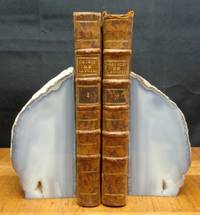
1793051313Chez Cuchet. Good with no dust jacket. 1793. Second Edition. Hardcover. Hardcover 2 volumes. Written in French no translations. Elementary Treatise on Chemistry Presented in a new order and According to Modern Discoveries. Beautiful matching mottled leather boards worn and frayed at edges some bumping. Soil and rubbing. Title labels on spines between worn raised bands. Spine ends frayed. Light foxing/soil/creasing to text. 2 fold out charts in volume 1 and 13 plates in volume 2 are all in nice condition a few rough edges from improper folding. ; 8vo 8" - 9" tall . Chez Cuchet hardcover
1801866Paris: Chez Deterville 1801. Second edition. <br /> <br /> A significant early collected work by Antoine-Laurent Lavoisier the founder of modern chemistry bringing together a series of his shorter but influential papers on physics and chemistry. Opuscules Physiques et Chimiques reflects the transitional moment in late 18th-century science when experimental chemistry began to replace older speculative systems. The volume includes studies on elastic fluids gases combustion fermentation and chemical decomposition illustrating Lavoisier’s role in redefining chemical processes through quantitative experimentation and precise observation.<br /> <br /> This 1801 second edition is particularly notable for its historical context: as stated in the prefatory note the work was printed during Lavoisier’s imprisonment amid the French Revolution shortly before his execution in 1794. As such the book stands not only as a scientific milestone but also as a poignant artifact of Enlightenment science disrupted by political upheaval. The inclusion of engraved folding plates depicting experimental apparatus underscores the practical and experimental nature of the work offering insight into early laboratory techniques that helped establish modern chemical methodology.<br /> <br /> Condition & Binding: Bound in contemporary full calf with an elaborately gilt-decorated spine and a central gilt armorial device on the boards likely institutional or academic possibly French reading “Collegium Lugdunense†or similar. Spine with gilt compartments and red morocco title label; some rubbing and wear to extremities including minor loss at head of spine. Boards show scuffing and surface wear but remain solid and attractive. Internally text is generally clean with light to moderate foxing and toning throughout. Overall- very good. Chez Deterville unknown
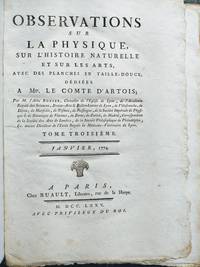
17756424Paris: Chez Ruault 1775. Original edition. Very Good. 2 volumes Quarto 28 cm; 464; 504 pages 25 engraved plates some folding and folding table. Engraved headpieces. Many pages unopened. In stiff paste paper paper labels on spine titled in manuscript and with volume numbers in ink. Old bookplate. References: For Lavoisier Duveen 24-27. <br /><br />Volumes 3 and 4 comprising the year 1774 of the lively forum for the publication of advancements in physics natural history and in mechanical arts. Electricity was in the air that year and indeed Monsieur Franklin figures heavily in reports letters addressed to him and in many articles that refer to him. While experiments with electricity are everywhere the obstetrician Sigaud de Lafond sees gold turn purple in response to a current of electricity; a Monsieur Bajon describes his research on electric eels subjects range widely. Lavoisier contributes research on white lead and other metals. Other articles investigate bird song British leather dressing rainbows epsom salts fish glue a hermaphroditic ass the Philadelphian method of drying figs and the effects of a strong dose of opium. Chez Ruault hardcover
60048Paris, 23 janvier 1880, in-8, 2 page 1/2 (126 x 220), , Passionnante lettre du petit-fils du peintre Louis David, Jules David, au Comte Bérard de Chazelles. David, alors que sa biographie et son catalogue raisonné des oeuvres de son aïeul sont "en ce moment sous presse", vient d'apprendre grâce à "Monsieur Dumas, membre de l'Institut" que l'original du seul portrait connu de Lavoisier réalisé sur le vivant par Louis David est détenu par la famille Bérard de Chazelles [comme bien d'autres objets ayant appartenu à Lavoisier, notamment ses instruments de chimie et sa bibliothèque]. Ainsi le petit-fils de David écrit à "Monsieur le Comte" afin de lui demander "quelques renseignements" : "la dimension, la date et la signature ; la grandeur des figures et s'il est peint sur toile ou sur bois". Il lui demande aussi s'il peut "avoir un dessin ou une photographie de ce tableau" afin d'enrichir la "suite d'Eaux-fortes des Oeuvres du Maitre" qu'il est en train de constituer. Jules David précise, qu'à l'époque, "cette toile est presque inconnue des amateurs". Belle lettre-enquête sur un des plus beaux portraits français de scientifique du XVIIIe siècle, acheté en 1925 par Rockfeller et acquis en 1977 par le Metropolitan Museum of Art de New York où il est exposé aujourd'hui. Couverture rigide
179061775[Paris, Clouiser, 1790, in-8, de 32 pages, exemplaire broché, sous couverture de papier marbré, Rare plaquette. Critiquant à la fois les positions de Talleyrand et celles de Mirabeau, le célèbre chimiste, député suppléant du bailliage de Blois, membre de la Société de 1789, propose, en compagnie de ses amis modérés comme La Rochefoucauld, La Fayette ou Bailly, une limitation de l'émission des assignats. Premiers et derniers feuillets roussis. Couverture rigide
17801466Paris: Hotel de Thou rue des Poitevins 1780. LAVOISIER'S OFFICIAL EASTER MEMOIR ON THE COMPOSITION OF AIR. THIS IS THE 1780 edition. WE OFFER THE 1st 1778 EDITION SEPARATELY. <br /> <br /> In this work Lavoisier proposed that ordinary air is composed of two different gases one "highly respirable" that he named "oxygen" and the other later named nitrogen that was unable to support combustion or respiration. This work is commonly referred to as Lavoisier's "Easter Memoir" because he presented an earlier version to the Academy around Easter of 1775; as this is the 1778 revised version historians regard it as Lavoisier's "official" Easter Memoir Wikipedia. <br /> <br /> In April 1778 "Lavoisier read for a second time the memoir in which he had originally demonstrated in April 1775 that mercury precipitate reduced without charcoal disengages not fixed air but the ‘air itself entire' or ‘the purest portion of the air'. He made some revisions in the text that have attracted widespread attention from historians" Holmes Lavoisier 137. <br /> <br /> In the time between 1775 and 1778 Lavoisier repeated some of performed some new experiments of his own and repeated some of Priestley's. In the 1778 ‘official' version Lavoisier "altered the language in which he had described that air calling it now ‘the most salubrious the most pure portion of the air' and air ‘in an eminently respirable state'. Fastening on to this last phrase he again referred to the air later in his memoir as ‘eminently respirable air'. At the same time he deleted references to it in the original version as ‘common air' and eliminated the experimental description that it reacted to the nitrous air test in the same manner as common air. <br /> <br /> "Historians have tended to treat with suspicion the textual changes Lavoisier made. The implication seems to be that he sought to represent himself as having clearly understood in 1775 that the air released from the mercury calx is a specific portion of the atmosphere when in fact he had then still not distinguished it unambiguously from ordinary air. If one couples this suspicion with acceptance of Priestley's charge that Lavoisier had obtained the idea for the experiment from him in the first place then one creates an image of Lavoisier as one who is known to have had an ‘occasional tendency to allow the work of others to pass as his own'. <br /> <br /> "There is however no solid evidence that in making these changes he was attempting to rewrite history. His motivation was probably simple. By the spring of 1778 when his new theoretical edifice had solidified the experiments on mercury calx would have come to appear to him as one of the decisive experimental foundations on which he had erected it. Yet when he looked back on the paper which reported these experiments from the vantage point he had since attained the descriptions of the air he had identified in it would have appeared confused ambiguous and inconsistent. <br /> <br /> "The embarrassment of allowing such flaws to remain in what he could now anticipate might someday be regarded as a classic paper is obvious. Since the paper had yet to appear in the Memoirs of the Academy chronically two to three years late in publication he had a convenient opportunity to avoid that outcome" Holmes. CONDITION: Paris: Hotel de Thou rue des Poitevins. 8vo. 6.5 x 4. 12 folding engraved copperplates. Marbled endpapers. Contemporary full leather binding. Chipped in several places. Internally fine. Hotel de Thou, rue des Poitevins hardcover
14427Paris, Londres, Hotel Serpente [Panckoucke], J. de Boffe, 1789-1791, (1795).
88774aafParis, Lacombe, (Imprimerie de Demonville), 1776, in-8vo, 622 p., (faux titre et titre inclus) + 1 ff. (d’Extrait des registres), + 3 planches dépl. reliure en veau originale. Dos richement orné, tranches rouges. Bel exemplaire.
1776EBS100409Chez Lacombe Libraire rue Christine 1776. 1st Edition. Hardcover. Very Good/No Jacket. First Edition 8vo: Marbled endpapers 55 pp including ½ title; titlepage 622 pp 3 folding plates. Slight wrinkling of some wrinkled; pp 289-296 edges somewhat oxidized. Neville II: p 20: A valuable collection of memoirs on the production of saltpeter for the manufacture of gunpowder. This extensive survey of the literature comprises extracts from the earlier works of Glauber and Stahl as well as more recent papers by Lavoisier Louis Lemery and others A rare book Duveen who lists it under Montigny. New full goatskin. VG-. From the Arthur C. Greenberg History of Chemistry Library. Chez Lacombe, Libraire, rue Christine hardcover