213 résultats
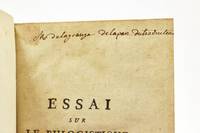
178871724Paris: S. n. 1788. Fine. S. n. Paris 1788 12.50 x 20 cm relié Essai sur le Phlogistique et sur la constitution des Acides Essay on Phlogistonn. p. Paris 1788 8vo 12.5 x 20 cm xij ; 344 pp.; 4 p. contemporary half sheep First edition and sole publication of the French translation and critical analysis under the direction of Madame Lavoisier of this text published in English the previous year under the title An Essay on Phlogiston and the Constitution of Acids. The work is made up of twelve sections all followed by critical notes by Louis-Bernard Guyton de Morveau Pierre Simon de Laplace & Gaspard Monge & Claude Louis Berthollet & Antoine François de Fourcroy. Contemporary half light brown sheep over marbled paper boards smooth leather spine decorated with gilt fillets and fleurons morocco leather title piece. Very skillfully restored joints. Interior in very good condition except for two marks left by bookmarks on pages 68-69 and 176-177. Rare autograph inscription by Marie-Anne Paulze Lavoisier to Joseph Louis de Lagrange prominent mathematician and loyal friend to Antoine Lavoisier. Valuable record of the leading role played by Marie-Anne Paulze Lavoisier in the chemical revolution at the dawn of the French Revolution. Phlogiston theory emerged at the end of the 17th century conceived by Johann Becker and developed by Georg Ernst Stahl postulating the existence of a flame element inherent in combustible bodies and released during combustion. This hypothesis was completely refuted by Lavoisier who revealed the role of oxygen in the combustion process thus inventing the theory of oxidation. Irritated by Lavoisier's skepticism with regard to phlogiston theory the eminent Irish chemist Richard Kirwan published this text titled Essay on Phlogiston. . The French chemists who rallied around Lavoisier decided to respond by translating An Essay on Phlogiston into French. Keiko Kawashima Madame Lavoisier et la traduction française de l'Essay on phlogiston de Kirwan in Revue d'histoire des sciences 2000. This text far from being a simple translation of Kirwan's work adopted the form of a manifesto in itself in which the greatest chemists of the day contested phlogiston theory dissecting its advocates' arguments one by one. The huge success of the French translation led Kirwan to attempt to refute the objections of Lavoisier and his collaborators. In 1789 he published a second edition of his work translating the French notes written by its detractors into English and adding his own refutations. He finally converted to the ideas of the anti-phlogisticians the founders of modern organic chemistry. Marie-Anne Pierrette Paulze Mme Lavoisier played a key role in the career of her husband who taught her chemistry at her request; she then became his assistant recording the experiments he carried out and their results. She very quickly took on a role that went beyond that of the devoted wife becoming a translator but also a writer: many of the notes in the Essai sur le phlogistique were written by her. At the height of her involvement it was she in her capacity as a skilled illustrator who drew all the plates in Traité élémentaire de chimie 1789 appending her signature Paulze Lavoisier Sculpsit on this occasion. This specimen includes a rare autograph inscription by the translator Mme Lavoisier to Joseph Louis de Lagrange 1736-1813 one of her husband's closest friends. It was Lavoisier who aroused the interest of Lagrange in the new science of chemistry. Together they participated in the development of a metric system that standardized weights and measures which came to light during the Revolution. Working for the revolutionary government Lagrange had more opportunities than his chemist friend who was executed as a victim of the Terror. When he learned that Lavoisier had been killed at the guillotine the mathematician declared: It took them only an instant to cut off Lavo S. n. hardcover
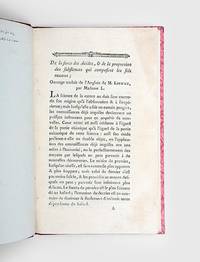
1791174569Paris: c.1791. A prime example of Madame Lavoisier's formidable analytic eye First edition scarce offprint issue of Madame Lavoisier's critical translation of the work of a prominent fellow of the Royal Society. In the UK institutional copies are recorded at UCL and in the Wellcome Collection. Marie-Anne Paulze Lavoisier 1758-1836 famously refuted the claims of the chemist Richard Kirwan 1733-1812 several times. In 1787 after he published his Essay on Phlogiston she brought out a similarly deprecatory translation complete with a preface which undermined his authority as an academic. Kirwan published Of the strength of acids and the proportion of ingredients in neutral salts in Dublin in 1791. In her translation Lavoisier's extensive annotations and critical apparatus focus on Kirwan's scientific and procedural errors. "II y a dans ces sortes d'expériences une cause d'erreurs qui paroit avoir échappé à M. Kirwan; c'est la grande quantité d'eau que l'acide carbonique est susceptible de dissoudre et qui échappe avec lui" "There is in these types of experiences a cause of errors which appears to have escaped Mr Kirwan: the large quantity of water which carbonic acid is likely to dissolve and which escapes with it" - p. 40. Marie-Anne married Antoine Lavoisier in 1771. She promoted their collaborative work to the international scientific community and used her command of languages to keep Antoine abreast of the latest developments. "Through her drawings translations interpretations of notes and skillful editing of Lavoisier's memoirs she made some important additions to the body of scientific knowledge. there are indications that she made some theoretical contributions" Ogilvie & Harvey. This translation was published in journal form in the Annales de Chimie which Antoine Lavoisier edited. Octavo 193 x 120 mm pp. 108. Woodcut headpieces and tables in the text. Recent red quarter morocco spine lettered in gilt marbled paper sides. Minimal wear minor foxing and creasing to contents: a very good copy indeed. Ogilvie & Harvey Biographical Dictionary of Women in Science II p. 753. unknown
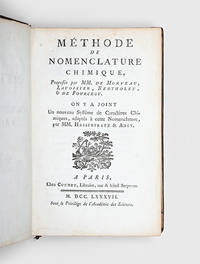
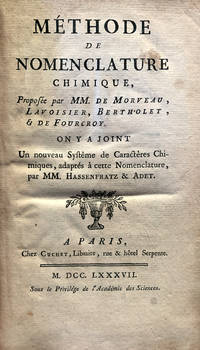
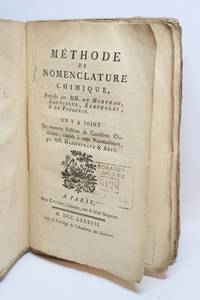
1787173027Paris: Chez Cuchet 1787. Modern chemistry therefore starts in 1787 First edition second issue of the work which introduced modern chemical terminology among the most fundamental scientific texts of the 18th century. The folding tables outline the first taxonomic system of chemical substances arranged according to their composition a system which proved immediately influential; even established figures like Priestley felt obliged to adopt the new terminology. The late 18th century witnessed considerable debates over the theory and practice of chemistry. The chief theoretical shift was the identification of oxygen in place of the hypothesized phlogiston which led many contemporaries to view the existing chemical terminology as outdated and confused. This move was largely driven by Lavoisier 1743-1791 and his fellow authors of the Méthode Louis Bernard Guyton de Morveau 1737-1816 Claude-Louis Berthollet 1748-1822 and Antoine-François de Fourcroy 1755-1809. In the Méthode they develop a systematic nomenclature largely derived from oxygen theory arguing that chemical substances should be named according to their constituents. Simple substances should receive simple names and compounds should receive complex names deriving from their constituents. "The new terms were soon translated and adapted into other languages and became the basis of the modern nomenclature of inorganic chemistry. In the purely pragmatic terms of the terminology used modern chemistry therefore starts in 1787" Crosland p. 411. There were two issues of the first edition: this second is identified by misnumbering pages 258-9 262-3 266-7 and 270-1. The first edition itself there were two in 1787 is identified by the woodcut on the title page depicting a cherub supervising distillation. Octavo 185 x 120 mm pp. 4 314. With 7 folding tables woodcut title page vignette head- and tailpieces. Contemporary mottled sheep spine with foliate decoration in gilt brown calf label lettered in gilt raised bands covers with single fillet border in blind marbled endpapers edges red pink silk bookmarker. Later pencil annotation to upper margin of p. 9. Light bumping and rubbing minor stripping to covers tail of front joint neatly repaired front inner hinge split but holding firm loss to lower outer corner of half-title inner margin of leaf G7 and outer margin of rear free endpaper none affecting text a couple of closed tears to initial folding table contents otherwise clean: a very good copy. Duveen & Klickstein 126; Norman 1291. Maurice Crosland "Chemistry and the chemical revolution" in The Ferment of Knowledge: Studies in the Historiography of Eighteenth-century Science 1980. hardcover
2757Edinburgh: Printed for William Creech and sold in London by G.G. and J.J. Robinsons 1790. Hardcover. Good. Octavo. l 511 ipp. With the half-title present. First English edition. Contemporary calf. Frontispiece portrait of Lavoisier two folding tables and thirteen plates. ESTC T138882. First English edition of one of the milestone books of chemistry. <br/> <br/> Edinburgh: Printed for William Creech, and sold in London by G.G. and J.J. Robinsons, 1790. hardcover
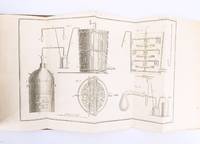
1790EBS100146Edinburgh: William Creech 1790. 1st Edition. Hardcover. Very Good/No Jacket. Robert Kerr 1755-1813 undertook this first English translation of Lavoisier's Traité elementaire de Chimie Paris 1789. Printing & the Mind of Man headlines the original edition as "A new epoch in chemistry." <br /> <br /> A more recent analysis pinpoints the importance of this book: "Lavoisier's most fundamental innovations transformed how one presents how one argues scientific knowledge and how as a result one develops and transmits it. The transformation of the terms and structures of scientific discussions had consequences beyond chemistry-consequences that Lavoisier himself did not foresee". W. C. Anderson Between the library & the laboratory John Hopkins 1984. <br /> <br /> BOOK DETAILS AND CONDITION: First Eng. Ed 8vo: 50 511 1 pp with 2 folding tables and 13 folding copper plates Duveen and Klickstein pp 180-182 Cont. leather w/some wear missing head and tail bands. Neville II p 24: Some alterations have been made in the tables in the appendix to accommodate the English reader: e.g. rules for converting French weights and measures are added and temperatures are given in degrees Fahrenheit. See A. Greenberg From Alchemy to Chemistry in Picture and Story John Wiley & Sons New York 2007 pp 309310316. Overall: VG.<br /> <br /> RARITY: Rare Book Hub shows eleven copies have sold in the last century.<br /> <br /> PROVENANCE: Signatures of three past owners in book: Alfred Brunton 1843; Henry Hallett and Charles Lucy. This book was also owned by Arthur Greenburg. Henry Hallett shared the 1936 Nobel Prize in physiology for discovery of the role of acetylcholine in neural transmission. Greenburg is a well known historian of chemistry. Edinburgh: William Creech hardcover
46368Cuchet - edition originale premier tirage In-8 iv-314pp. un grand tableau depliant 6 planches et tableaux depliants in-fine reliure demi-basane de l'epoque dos orne fers et filets dores piece de titre vert emeraude legeres usures aux coiffes ex-libris manuscrit Nb-0107 Publiee en Aout 1787 cette premiere edition regroupe et fait la synthese des differents memoires publies sur les nouvelles denominations chimiques et ses nouveaux symboles depuis 1780 habituellement attribuee a Lavoisier. unknown
178718453Paris: Chez Cuchet 1787. FIRST EDITION. With half-title 6 large folding copperplates and 1 large folding table title vignette woodcut headpiece above first text leaf pages 257-272 misnumbered. Contemporary tree calf spine label very small crack at top of spine and rear cover otherwise an excellent copy printed partially on blue paper from the library of Melchet Court Romsey and a small book label with the heraldic motto “virus in arduis†on the paste-down. First edition of one of the most important works in the history of modern chemistry. Lavoisier’s discoveries brought about a critical need to develop a new chemical nomenclature. Its importance was first recognized by Guyton de Morveau an adherent of the phlogiston theory. De Morveau was invited to join a group of the leading anti-phlogistonists to discuss the possibility of applying his nomenclature to Lavoisier’s chemistry and in the process was converted to Lavoisier’s doctrines. The result of this collaboration of Bertholet Fourcroy de Morveau Lavoisier and others is contained in this volume and marks the foundation of modern chemical nomenclature.<br /> <br /> Cole Chemical Literature 1700-1860 566C under Guyton de Morveau; Duveen 126; Duveen & Klickstein p. 127; Norman 1291; see Printing & the Mind of Man 238; Sparrow Milestones of Science 125. Chez Cuchet unknown
thl51Paris: Cuchet 1789. First Edition Second Issue of “one of the most important books in the history of chemistry which finally freed the science from its phlogiston chains and formed the starting point of its modern progress. It may be said to have done almost as much as for chemistry as Newton’s ‘Principia’ did for physics.†Zeitlinger quoted in Duveen Lavoisier’s ‘Traité’ “was a decisive move in the final overthrow of alchemy and the phlogiston theory introduced by Stahl a century earlier. By the use of the balance of weight determination at every chemical change and the building of a rational system of elements Lavoisier laid the foundation of modern chemistry. He introduced a modern definition of element and compound explained burning and rusting as a chemical combination with oxygen and included emission and absorption of heat in his chemical system. His concepts of the principles of the indestructibility and conservation of matter guided him in formulating his methods of organic analysis.†Dibner This edition contains tables and several excerpts from the records of the Academy of Sciences not included in the first edition of which only two copies are known. Dibner 43. Duveen p. 340. Grolier 64. Honeyman 1939. Printing and the Mind of Man 238. Sparrow 127. cfFerguson II p. 12. cfNeu 2253-54. 2 Volumes in 1. 8vo. pp. xliv 322; viii 323-651 2errata. with half-titles. 2 folding tables & 13 folding plates drawn & engraved by Lavoisier’s wife. woodcut ornaments & title vignettes. 19th century half calf joints cracked creases in spine library rubberstamp on front paste-down & title & number on spine of the Royal Society of Edinburgh. thl51 Paris: Cuchet, 1789 unknown
178943634Paris Rue et Hotel Serpente 1789. 8vo. Contemporary half calf. Gilt spine slightly rubbed light wear to spine ends. "Annales de Chimie: ou Recueil de Mémoires Concernant la Chimie et les Arts qui en Dépendent. Par MM. de Morveau Lavoisier Monge Berthollet De Fourcroy le Baron de Dietrich Hassenfratz & Adet." Tome Premier. 23122 pp. The entire volume offered. Some scattered brownspots. A small wormtract to upper margin of ab. 20 leaves no loss of letters. <br/><br/><em>First edition of the first volume of this very important journal founded by Lavoisier and his friends collaborating in establishing THE NEW SCIENCE of Anti-Phlogistic theory in chemistry. Crosland in "The two French Revolutions" and "The Imperial Despotism of Oxygen" claims that for a clear understanding of the CHEMICAL REVOLUTION THE NEW JOURNAL of ANNALES DE CHIMIE can be rightly considered as FUNDAMENTAL as the "Traite élementaire de Chimie"."A third and most important instrument was the establishment of a new scientific journal edited - and dominated - by the votaries of the "new chemistry". The first number of this journal of the Annales de chimie appeared in 1789 the year of the Revolution. Its editors were besides Lavoisier his early disciples - Guyton Berthollet Fourcroy and Monge - with the addition of three new recruits: the Strassbourf metallurgist the Baron de Dietrich Jean-henri Hssenfratz and Pierre Auguste Adet."DSB VIII p.81.LAVOISIER'S paper on COMBUSTION pp. 19-30 contains his important interpretation of the phenomena of combustion in air making the fundamental distinction between burning and combustion. By this "Lavoisier gave to the study of chemistry a new life a new direction and a wider outlook." Alexander Findley."The Lavoisierian memoir on combustion of iron stood out among the large number of interesting papers discussed in the first volume of the "Annales". In his account Lavoisier sustained that in nature combustion without flames did occur. Thus he clarified the distinction between ordinary burning and combustion: an issue on which the majority of traditional chemists were confused. The need for accuracy and precision in laboratory practices was emphasised in his study as it was a means to determine quantities rather than assuming them."Angela Bandinelli in "Scientific Communication During a Major Change .Empirical Research: Annales de chimie vs Obs. sur la physique/ Journal de physique 1789-1803.The volume furthermore contains important papers by: Adet Fourcroy 3 papers Berthollet 3 papers Chaptal Hassenfratz 5 papers Baron de Dietrich 2 papers Klaproth 2 papers Girtanner Dollfuss Bonz de Ettingen Crell De Morveau. </em> unknown
186225309Paris: Imprimerie Imperiale 1862. 6 volumes 4to 54 plates many folding and 2 double-p. tables; contemporary quarter brown morocco gilt-lettered direct on spine; ex-Northwestern University small labels on each spine perforated stamp on first leaf of text pocket at rear of each volume with withdrawn stamp; some wear to bindings; small tide-marks in the lower blank margins of most leaves also on some of the plates. The monumental collected edition of Lavoisier's works. "So many of the papers written by Lavoisier remained unpublished during his lifetime and can only be found in the Oeuvres particularly those of his earlier periods." Duveen & Klickstein pp. 377-456. Imprimerie Imperiale unknown
1784513931784. <p>Franklin Benjamin 1706-90; Antoine Lavoisier 1743-94 Jean-Sylvain Bailly 1736-93 et al. Exposé des expériences qui ont été faites pour l'examen du magnétisme animal lu à l'Académie des Sciences . . . 16pp. N.p. 1784. 212 x 141 mm. uncut. Original plain wrappers. Paper flaw in last leaf but fine otherwise.</p> <p> Early Octavo Edition issued in the same year as the official quarto edition printed by the Imprimerie Royale. OCLC records two octavo editions one with imprint reading "A Paris: Chez Moutard Imprimeur-Libraire de la Reine . . . M.DCC.LXXXIV" and the other simply dated "1784" with no place or publisher information as in our copy. The typesetting also differs between the two editions: The Moutard edition has 15 pages with blank page 16 while our edition has 16 printed pages. </p> <p> After the Franklin commission issued its official report on animal magnetism a shorter précis of its findings was read by Bailly before the Académie des Sciences on 4 September 1784; this was then published under the title Exposé des expériences . . . As noted above the Exposé was issued in both quarto and octavo format. Not in Duveen Bibliography of the Works of Antoine-Laurent Lavoisier which records only the Moutard edition. </p> . unknown
1787EBS100301Chez Cuchet Paris 1787. 1st Edition. Hardcover. Very Good/No Jacket. A landmark publication in chemistry where four French scientists presented a new systematic way of naming chemical substances laying the foundation for modern chemical nomenclature still used today. <br /> <br /> The late 18th century witnessed considerable debates over the theory and practice of chemistry. The chief theoretical shift was the identification of oxygen in place of the hypothesized phlogiston which led many contemporaries to view the existing chemical terminology as outdated and confused. <br /> <br /> This move was largely driven by Lavoisier 1743-1791 and his fellow authors of the Méthode Louis Bernard Guyton de Morveau 1737-1816 Claude-Louis Berthollet 1748-1822 and Antoine-François de Fourcroy 1755-1809. In the Méthode they develop a systematic nomenclature largely derived from oxygen theory arguing that chemical substances should be named according to their constituents. Simple substances should receive simple names and compounds should receive complex names deriving from their constituents. "The new terms were soon translated and adapted into other languages and became the basis of the modern nomenclature of inorganic chemistry. In the purely pragmatic terms of the terminology used modern chemistry therefore starts in 1787" Crosland p. 411. There were two issues of the first edition: this second is identified by misnumbering pages 258-9 262-3 266-7 and 270-1. <br /> <br /> The first edition itself there were two in 1787 is identified by the woodcut on the title page depicting a cherub supervising distillation. Duveen & Klickstein 126; Norman 1291. Maurice Crosland "Chemistry and the chemical revolution" in The Ferment of Knowledge: Studies in the Historiography of Eighteenth-century Science 1980. <br /> <br /> BOOK DESCRIPTION AND CONDITION: First Ed First Printing Second Issue Duveen and Klickstein pp 119-126 8vo 314pp huge folding table of Nomenclature six folded tables of chemical symbols; cherub & distillation apparatus on title page colophon p. 314. Mod. marbled boards. Very good condition throughout. The folding tables outline the first taxonomic system of chemical substances arranged according to their composition a system which proved immediately influential; even established figures like Priestley felt obliged to adopt the new terminology.<br /> <br /> PROVENANCE: From the Arthur C. Greenberg Chemical History Library. Presentation copy to Thomas Wedgwood Junior the eldest son of Thomas Wedgwood and older brother of the more well-known Isaiah Wedgwood from his cousin Thomas Byerley in 1787; T. Wedgwood Jr. and Byerley manufactured their own line of porcelain. Chez Cuchet (Paris) hardcover
thl53Paris: Cuchet 1787. First Edition First Issue of this important collaborative work which established the first systematic method of chemical nomenclature that is still in use today. “Originally suggested by Guyton de Morveau to eliminate the confused synonymy of chemistry and prefaced by a memoir of Lavoisier it emerged as a complete break with the past. In effect the scheme was based upon the new anti-phlogiston discoveries and theories…In a series of tables the ‘Nomenclature’ listed the elements substances non décomposées that is those bodies that had not been or perhaps could not be decomposed. Fifty-five in number these simple bodies included light and Lavoisier’s “matter of fire†now called “caloricâ€; the elementary gases: oxygen nitrogen azote and “inflammable air†now called hydrogen; carbon sulphur and phosphorus; the sixteen known metals; a long list of organic “radicals†i. e. accidifiable bases; and the as yet undecomposed alkaline earths and alkalis. Compounds were designated as chemists have done ever since so as to indicate their constituents." DSB VIII p. 80. Honeyman 1936. Neu 1791. Sparrow 126. 8vo. pp. 2 p.l. 256 241-256 273-314. with half-title. 6 folding engraved tables & 1 folding engraved plate. woodcut title vignette of a cherub supervising distillation. contemporary sprinkled calf gilt back small chip to head of spine short cracks in joints light dampstain to some leaves & first table stain on last leaf. thl53 Paris: Cuchet, 1787 unknown
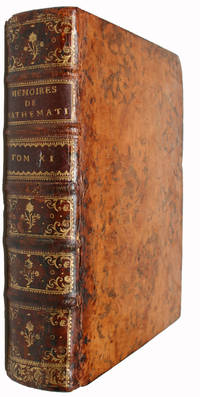
178644923Paris Moutard 1786. 4to. Contemp. full sprinckled calf with 5 raised bands on spine. Richly gilt compartments title-and tomelabels with gilt lettering. A small nich to leather at middle of front hinge. A small tear to rear hinge at upper compartment. "Mémoires fe Mathematique et de Physique Présentés à l'Academie des Sciences par divers Savans" Tome XI. 4198682 pp. Wide-margined fine and clean. <br/><br/><em>This collective work is the French Academy's monumental treatise on the chemistry and the production of Salpetre a topic of great importence for the war-industry in making gunpowder. The volume contains papers by Macquer Darcy Lavoisier Sage Baumé de la Rochefoucault Clouer and an anonymous report on experiments made in England CAVENDISH'S on the composition of nitric acid.papers by Cornette Thouvenel and Thouvenel Le Lorgna Gavinet and Chevrand de Beunie Romme Clouet and Lavoisier de Rochefoucault etc.Partington III p. 467 n."The Regie des Poudres et Salpetres had the monopoly of refining salpetre from 1775 until it was suppressed during the Revolution. Until his retirement in 1791 the leading light in it was Lavoisier who seems to have written its publications. - In 1775 the Academy offered a prize of 4000 livres for a process for procuring an abundant supply of salpetrethe announcement being written by Lavoisier. Altogether 66 papers were received and the prize was finally awarded in 1782 to the brothers Thouvenel who gave a full account of nitre plantations. The material was published in 1786 in one volume by the Academy. In it Lavoisier describes 'Experiences sur la décomposition du nitre par le charbon' said to have been made in 1784."Partington III pp. 466 ff."Peu de temps après que Lavoisier eut été nommé régisseur des poudres et salpêtres il suggéra à Turgot alors contrôleur général des finances l'idée de charger l'Académie des sciences de décerner un prix au meilleur mémoire sur la formation du salpêtre. 'Académie nomma une commission dont Lavoisier fut le rapporteur ; c'est lui qui examina tous les mémoires présentés au concours en fit l'analyse et quand l'Académie publia en 1786 un volume contenant l'histoire du prix du salpêtre et les mémoires présentés au concours c'est encore Lavoisier qui en fut le rédacteur. Ce volume fait partie du Recueil des mémoires de mathématiques et de physique présentés à l'Académie royale des sciences par divers savants et lus dans ses assemblées tome XI contenant le Recueil des mémoires sur la formation et la fabrication du salpêtre à Paris de l'imprimerie Moutard DCCLXXXVI. Sauf les mémoires des concurrents et un mémoire du duc de la Rochefoucault ce volume est tout entier de la main de Lavoisier. Il est formé de deux parties ; la première est intitulée : Histoire de ce qui s'est passé relativement au prix proposé sur la formation du salpêtre ; la seconde partie comprend les mémoires présentés au concours ainsi que des mémoires de Lavoisier et Clouet un mémoire sans signature mais qui appartient à Lavoisier le manuscrit autographe a été conservé le mémoire du duc de La Rochefoucault et les expériences de Lavoisier sur la décomposition du nitre par le charbon." </em> hardcover
177667051Paris: Chez Lacombe 1776. Fine. Chez Lacombe Paris 1776 12.50 x 20 cm relié Recueil de Mémoires et d'Observations sur la formation & sur la fabrication du salpêtre Observations on the Formation and Fabrication of Saltpeter Chez Lacombe Paris 1776 8vo 12.5 x 20 cm 622 pp 2 contemporary sheep First edition of this memoir Duveen ascribing it to Lavoisier. With three folding plates. Contemporary light brown marbled sheep spine in five compartments with gilt compartments and fleurons black morocco title label gilt arms to foot joints skilfully repaired all edges speckled blue. A few small wormholes to first compartments of spine. The upper quarter of the half-title cut away presumably to remove traces of a former owner. One faint dampstain to inside margin of final gatherings not serious. A very good and rare copy. Chez Lacombe unknown
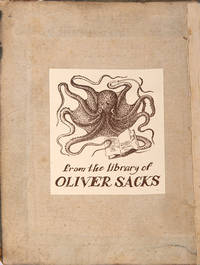
116617Edinburgh for William Church and sold by G.G. & J. Robinsons and T. Kay 1796. . Third English language edition; 8vo; 2 folding tables 13 engraved folding plates bookplate of Oliver Sacks contemporary ownership signature to title a little toning and occasional small spots to the text plates possibly added from another volume with some dampstain and tanning; original blue boards rebacked to style with printed paper label to spine boards worn very good condition; 592pp.<br /> Third English language edition of Traité Élémentaire de Chemie the text that revolutionised chemistry. From the library of Dr. Oliver Sacks with his octopus bookplate. Though best known as a neurologist Sacks had a lifelong interest in chemistry. As recounted in the book Uncle Tungsten: Memoirs of a Chemical Boyhood he spent much of his childhood performing his own experiments and reading classic chemistry texts and his thoughts on Lavoisier and Traité Élémentaire de Chemie comprise chapter ten.<br /><br />Lavoisier's remarkable experimental program elucidated several major interrelated aspects of chemistry. It 'finally established the modern conception of elements as substances which cannot be further decomposed' and the fact that matter is conserved in chemical processes i.e. elements change their arrangements but are not themselves created or destroyed. This was connected with his discovery that respiration and combustion are similar processes in which oxygen is taken from the air and added to another substance. He was therefore able to explain 'many cyclical processes in animal and vegetable life and to carry out the earliest biochemical experiments' Printing and the Mind of Man 238. <br /><br />As Sacks writes in Uncle Tungsten 'All of Lavoisier's enterprises - the algebraic language the nomenclature the conservation of mass the definition of an element the formation of a true theory of combustion - were organically interlinked formed a single marvellous structure a revolutionary refounding of chemistry. The path to his revolution was not easy or direct even though he presents it as obvious in the Elements of Chemistry. There had been violent disputes and conflicts during the years in which Lavoisier was slowly gathering his ammunition but when the Elements was finally published - in 1789 just three months before the French Revolution - it took the scientific world by storm. It was an architecture of thought of an entirely new sort comprable only to Newton's Principia'.<br /> Printing and the Mind of Man 238; Hook & Norman The Norman Library of Science and Medicine 1295 all for the first edition. Edinburgh, for William Church, and sold by G.G. & J. Robinsons, and T. Kay, 1796. hardcover
1783EBS100454Warrington: Printed by W. Eyres for J. Johnson 1783. 1st Edition. Hardcover. Very Good/No Jacket. FIRST COLLECTED EDITION of this group of papers which Lavoisier published in the Mémoires of the Académie Royale des Sciences; there is no equivalent edition in French. <br /> <br /> The first paper is the first edition in English of his Expériences sur la respiration des animaux in which he asserted that respiration involved only the air éminement respirable i.e. oxygen and that the remainder of the air is purely passive entering and leaving the lungs unchanged. This began his first serious studies of respiration which were to culminate in 1785-1789 in his classic investigations on the subject see Fulton Selected readings in the history of physiology. <br /> <br /> Other papers are on combustion and on the analysis of acids including his paper read to the Académie in 1779 which contains the first appearance of the word oxygen in chemistry although the translator uses the usual term for time dephlogisticated air and Lavoisier's original definition of it. <br /> <br /> In the eighth essay pp. 96-118 of this important work Lavoisier proposes his theory that oxygen is an essential constituent of all acids and he remarks: Here therefore we have a new road opened in chemistry. p. 115. <br /> <br /> BOOK DETAILS AND CONDITION: 8vo xx 142 pp. Without half-title and advert leaf; Bound in recent half calf and marbled paper over boards; Early leaves foxed as usual. VG <br /> <br /> RARITY: A relatively rare book. Has sold five times at auction in the last century RBH. OCLC reports 32 copies in the worlds libraries / ESTC T63988 shows 30 copies. <br /> <br /> PROVENANCE: Ex-library Franklin Institute See Duveen and Klickstein pp 368-370. From the Arthur C. Greenberg History of Chemistry Library. <br /> <br /> REFERENCES: Blake p.258; Cole 761. Duveen p. 340. Neville II p. 17. Duveen & Klickstein 336. Warrington: Printed by W. Eyres, for J. Johnson hardcover
1819123040Paris: Madame Huzard 1819. Second edition first 1791 of Lavoisier's most important contribution as an economist "a milestone in the history of economic science and national statistics and accounting" Poirier p. 266. The work was reprinted after the Terror to which Lavoisier famously fell victim in Collection de divers ouvrages d'Arithmétique politique 1797. "De la richesse territoriale. de France which was printed in 1791 by order of the National Assembly constitutes an extract from a larger work on which Lavoisier had been engaged since 1784 in an effort to complete and verify an analysis of national income undertaken by Dupont de Nemours. Lavoisier's main argument is that the monetary valuation of national income from different sources leads to double counting; that the only method exempt from such difficulties is that based on an estimate of annual consumption since exports and imports in France balance one another; and that in estimating consumption allowance must be made for the variation in the budgets of different social classes. Thus he estimated that the annual per capita income of the poorest families is from 60 livres to 70 livres but he set the value of average per capita income at 110 livres a figure admittedly similar to that of Quesnay in his Philosophie rurale 1763. The net national income computed by estimating the net revenue in the various branches of agriculture he put at only 1200000000 of which half goes to the treasury in the form of taxes and the rest constitutes the landowners' rent" ESS p. 200. The three works bound in after De la richesse territoriale are: a CHÂTEAUVIEUX Frédéric Lullin de. Lettres de Saint-James. Geneva: J. J. Paschoud 1820. Pp. 103 1. 1 folding plate. First edition of the first of five "Letters" by the influential Swiss agronomist; the remaining four were published between 1821-26. b FAURE Louis-Etienne-Baptiste. Mémoire sur les prairies artificielles. Paris: Fantin & Madame Huzard 1814. Pp. 30. First edition. Faure was the administrator of Hautes-Alpes at the time of the Revolution; in later life he devoted his time to agricultural improvements in Briançonnais. Quérard III p. 71. c LEVAVASSEUR Bernard-Marie-Francis. Mémoire sur les chemins vicinaux adressé A.S.E. le ministre de l'intérieur. Paris: Didot 1819. Pp. 46. A few small ink annotations to the text. First edition; WorldCat and Library Hub locate copies at two institutions the BnF and the University of Michigan. Bound first in a vol. of 4 related works octavo 201 x 125 mm pp. 66. Contemporary tree calf red morocco spine label spine elaborately tooled in gilt with hand written paper label "Lavoisier Richesse territoriale" to third compartment marbled endpapers and edges red bookmarker. Spine ends and corners worn corners bumped head and foot of front joint starting inner hinges cracked but firm contents lightly tanned with occasional spotting and a few leaves thinned overall a very good copy. Martin & Walter 19846; Perrot Histoire intellectuelle de l'Économie politique p. 435; Quérard IV p. 642; cf. INED 2690-1; not in Goldsmiths' or Kress. Jean-Pierre Poirier Lavoisier: Chemist Biologist Economist 1996. unknown
178990025Paris: Rue et Hôtel Serpente 1789. Fine. Opening run of the journal ""Annales de chimie"" vehicle of ""The New Chemistry"" founded and directed by Antoine de Lavoisier Rue et Hôtel Serpente Paris 1789-1792 12.8 x 19.6 cm Relié First edition highly sought after in the 19th century comprising 14 of the first 15 volumes published between 1789 and 1792 of the first series of the celebrated French scientific periodical Annales de chimie. Volume 10 missing. Contemporary full brown calf spines smooth with gilt fillets brown morocco lettering-piece and green morocco numbering-piece blind-ruled border to covers red speckled edges bookplate of P. H. Chavoix to front pastedown of each volume. Volumes 1 and 11 numbered in Roman rather than Arabic numerals. Overall discreet restorations corners rubbed occasional light foxing and browning some worming to bindings not affecting text head and tail of headcaps worn on volumes 7 13 14 and 15. The complete first series of the Annales de chimie published between 1789 and 1815 runs to 96 volumes. From 1793 to 1797 publication was suspended following the arrest of Antoine Lavoisier the journal's treasurer and in Édouard Grimaux's words its ""true director."" The opening run here contains nearly all the issues produced under the direction of and with contributions from the chemists Antoine de Lavoisier and Baron Philippe Frédéric de Dietrich. Both were condemned to the guillotine during the Reign of Terror in 1794 and 1793 respectively. This set is further illustrated with 12 scientific plates including two by the engraver Sellier as well as a map of the county of Bigorre. The majority of the articles and essays are first editions written by distinguished French and foreign chemists and physicists who helped disseminate ""The New Chemistry"": in order of appearance Louis-Bernard Guyton de Morveau Antoine de Lavoisier Gaspard Monge Claude-Louis Berthollet Anne-François Fourcroy Philippe-Frédéric de Dietrich Jean Henri Hassenfratz Pierre-Auguste Adet Jean-Antoine Chaptal Martin Heinrich Klaproth Johann Georg Albrecht Höpfner Christoph Girtanner Johann Christian Wiegleb Jacques-Anselme Dorthes Johann Friedrich Westrumb Armand Seguin Henry Cavendish William Austin Martin van Marum l'abbé René Just Haüy Peter Jacob Hjelm Jan Ingenhousz Isaac Milner Johan Gadolin James Watt Lorenz Florenz Friedrich von Crell Charles Blagden Jean Senebier Jean d'Arcet William Higgins Nicolas-Louis Vauquelin Nicolas Joseph Thiéry de Ménonville Dom Michel Rubin de Celis Jacques Louis Schurer Augustin-François de Silvestre l'abbé Claude Chappe Antoine Augustin Parmentier Nicolas Deyeux Bertrand Pelletier Charles-Augustin Coulomb Joseph Priestley Richard Kirwan Jean André de Luc Jean-François Clouet chevalier Marsilio Landriani Jean-Noël Hallé François Pierre Nicolas Gillet de Laumont Georges-Charles Bartholdi Alexandre Brongniart Jean-Michel Haussmann Henri Reboul François René Curaudau Thomas Henry Jean-Anthyme Margueron Nicolas Leblanc Johann Rudolph Deiman Pieter Nieuwland Pierre de Ribaucourt Pissis fils Jean-Baptiste Van Mons ou encore Louis François Antoine Arbogast. In 1816 the Annales de chimie was retitled Annales de chimie et de physique. In 1913 the journal split into two separate publications Annales de chimie and Annales de physique. The titles have undergone further changes up to the present day. A collection of 14 volumes from the opening run of the prestigious French scientific periodical Annales de chimie containing numerous essays and articles most in first edition published under the editorship of distinguished figures: Antoine de Lavoisier Louis-Bernard Guyton de Morveau Gaspard Monge Claude-Louis Berthollet Anne-François Fourcroy Philippe-Frédéric de Dietrich Jean Henri Hassenfratz and Pierre-Auguste Adet. Rue et Hôtel Serpente unknown
178773124à Paris: Chez Cuchet 1787. Fine. Chez Cuchet à Paris 1787 13.50 x 21 cm broché Second printing of the first edition: pages 257 to 272 are misnumbered 241-256 Duveen and Klickstein. Illustrated with a large chart and 6 folding plates at rear. Library stamp of Laboratoires Lumière on the half-title title page and several other pages. Another stamp ""G. Chicanuard"" appears on the half-title; we have found no information about this person. Temporary binding in full marbled paper. Handwritten title on spine. Some small paper losses in places and joint on second board cracked but still sound. Copy as issued with full margins. The Méthode forms a manifesto for a revolution in the world of chemistry and the birth of modern chemistry a chemistry that resolutely turns its back on the past by becoming scientific. It was Lavoisier the most influential scientist at the Academy of Sciences who brought together around his theory and to support it decisively the greatest French chemists: Fourcroy Berthollet Adet Hassenfratz and Guyton de Morveau whom the already formed group welcomed to Paris in February 1787. The latter joined them with an advanced chemical nomenclature which would be revised by Lavoisier who demanded that Morveau abandon his phlogistic theory principle of a combustible element in air dating from the 17th century since he had discovered the role of oxygen. It was at this price that he was entrusted with presenting the new nomenclature. It was in the session of May 2 1787 at the Academy of Sciences that the terms ""oxygen"" ""hydrogen"" and ""carbon"" were pronounced for the very first time. Adet and Hassenfratz were responsible for proposing symbols for ""new characters to be used in chemistry"" which would not have much success but was destined for a great future. The entire project was placed under the authority and will of Lavoisier and the decision that Morveau should carry the project was a political decision intended to ensure better reception among foreign scientists. No one was deceived because it was Lavoisier who would be attacked by Western science. Very important work that marks the birth certificate of scientific chemistry. Chez Cuchet unknown
1793EBS100381Paris: Cuchet 1793. 1st Edition. Hardcover. Very Good/No Jacket. AUTHORIZED SECOND EDITION OF LAVOISIER'S KEY WORK. This is authorized Chardon issue; 1st 1793 issue was pirated; 3rd 1793 issue was improved version of pirated issue by authorized publisher. Like the original 1789 edition the plates bear the signature of Madame Lavoisier."Although it does not show any material changes in the text nor any additions all the errata are here corrected and the plates are the original ones with Madame Lavoisier's signature. It is difficult to explain now the reasons why this edition was put out in the same year but it might be assumed that Lavoisier and Cuchet wanted to counteract the distribution of the books which had been fraudulently issued by printing an authoritative edition" Duveen & Klickstein. BOOK DETAILS AND CONDITION: 2 Vols 8vo 2 folding tables 13 fine folding copperplates by Mme Lavoisier Second ed second issue 8vo 19th cent. half calf VG See A. Greenberg From Alchemy to Chemistry in Picture and Story John Wiley & Sons New York 2007 pp 313 315 316 335 PROVENANCE: Professor A. Bernardes de Oliveira of Sao Paolo Brazil bookplate a well-known science book collector and Arthur C. Greenberg an author and expert on the history of chemistry. REFERENCES: Duveen et Klickstein 157; PMM 238 for the Paris 1789 edition. Paris: Cuchet hardcover
thl52Paris: Deterville 1801. Third Edition Corrected and Enlarged of “one of the most important books in the history of chemistry which finally freed the science from its phlogiston chains and formed the starting point of its modern progress. It may be said to have done almost as much as for chemistry as Newton’s ‘Principia’ did for physics.†Zeitlinger quoted in Duveen Lavoisier’s ‘Traité’ “was a decisive move in the final overthrow of alchemy and the phlogiston theory introduced by Stahl a century earlier. By the use of the balance of weight determination at every chemical change and the building of a rational system of elements Lavoisier laid the foundation of modern chemistry. He introduced a modern definition of element and compound explained burning and rusting as a chemical combination with oxygen and included emission and absorption of heat in his chemical system. His concepts of the principles of the indestructibility and conservation of matter guided him in formulating his methods of organic analysis.†Dibner cfDibner 43. cfDuveen p. 340. cfGrolier 64. cfHoneyman 1939. cfPrinting and the Mind of Man 238. cfSparrow 127. cfFerguson II p. 12. cfNeu 2253-54. 2 Volumes. pp. lxiv 386; vii 1 377 1errata 2publisher’s catalogue. with half-titles. index. 13 engraved plates. 2 folding tables. contemporary quarter calf head of spine of Vol. II chipped upper rear joint starting light dampstain to several leaves in Vol. II else very good. thl52 Paris: Deterville, 1801 unknown
176844940Paris L'Imprimerie Royale 1768. 4to. Extract from "Mémoires fe Mathematique et de Physique Présentés à l'Academie des Sciences par divers Savans" Tome V. With tittlepage to vol. 5. Pp. 341-357. Clean and fine. <br/><br/><em>First appearance of Lavoisier's FIRST PUBLISHED CHEMICAL PAPER introducing quantitative methods in chemistry and in which he for the first time brought a hydrometer in use to measure the specific gravities of components of a chemical solutions. Lavoisier defended the originality of his approach in the following words: "It is to the art of combination that the knowledge of the specific gravities of fluids can bring most light. This aspect of chemistry is much less advanced than we thought we possess barely the rudiments of it." "This first paper which in so many respects embodies the quantitative methods Lavoisier was to employ in his later work had in fact been largely anticipated by others notably by Marggraf who had already discovered the composition of gypsum and shown that it contained water phlegm. Yet Lavoisier’s work was more through; and his paper his first contribution to the Academy of Sciences read to the Academy on 25 February 1765 appeared in 1768. The paper offered. - Lavoisier’s earliest chemical investigation his study of gypsum was mineralogical in character; begun in the autumn of 1764 it was intended as the first paper in a series devoted to the analysis of mineral substances. This systematic inventory was to be carried out not by the method of J. H. Pott "who exposed minerals to the action of fire" but by reactions in solution by the "wet way." "I have tried to copy nature" Lavoisier wrote. "Water this almost universal solvent "is the cheif agent she employs; it is also the one I have adopted in my work." Using a hydrometer he determined with the care the solubility of different samples of gypsum samples of selenite or lapis specularis some supplied by Guettard and Rouelle. He made similar measurements with calcined gypsumplaster of paris. Analysis convinced him that this gypsum was a neutral salt a compound of vitriolic sulfuric acid and a calcareous or chalky base. Not content with having shown by analysis the composition of the gypsum Lavoisier completed his proof by a synthesis following as he said the way that nature had formed the gypsum. He further demonstrated that gypsum when transformed by strong heating into plaster of Paris gives off a vapor which he showed to be pure water making up about a quarter of the weight of gypsum. Conversely when plaster of Paris is mixed with water and turns into a solid mass it avidly combines with water. Using the expression first coined by Rouelle he called this the "water of crystallization." DSB.Partington III pp. 378-79. - </em> unknown
17833925London: Warrington Printed by W. Eyres for J. Johnston 1783. First English Language Edition. Octavo : pp. vii viii 2 141 3 List of Books lately published by J. Johnston : now custom clamshell box with red leather title panel lettered in gilt. DUVEEN 336<br /> <br /> Lacks covers and half title; toned foxed and brittle; title page detached; thereafter first gathering detached; chips and water stains. Antoine Lavoisier often referred to as the Father of Modern Chemistry and his wife Marie-Anne Pierrette Paulze Lavoisier later Countess von Rumford were eighteenth century French chemists responsible for overthrowing the "false doctrine of Phlogiston". Lavoisier relied on Paulze's translation of foreign works to keep abreast of current developments in chemistry. In the case of phlogiston it was Paulze's translation of Richard Kirwan's 'Essay on Phlogiston and the Constitution of Acids - with her own footnotes critiquing his errors - that convinced him the idea was incorrect ultimately leading to his studies of combustion and his discovery of oxygen gas. <br /> <br /> Lavoisier was a victim of The Terror of 1794 and guillotined in Paris. "It took but a moment to cut off his head; it will take a century to produce another like it" mourned his friend Lagrange the mathematician. The Autobiography of Science p.228.<br /> <br /> The collected essays show the development of Lavoisier's thinking and in the penultimate essay VIII the term "oxyginous principle" principe oxygin i.e. oxygen appears for the first time in chemistry p.98 This paper was first submitted to the Academie in 1777 and read in 1779. DUVEEN 49. Warrington, Printed by W. Eyres for J. Johnston unknown
1787612Paris: Cuchet 1787. 1st. Full mottled calf with gilt tooling along the edges gilt spine compartments with floral ornaments and leather spine label. Contemporary binding with rubbing and wear along the spine and corners. Boards show mottling and fading with some scuffing. Pages exhibit foxing toning and occasional spotting consistent with age. Folding tables are intact and legible though with some creasing and edge wear. Features: Marbled edges; multiple large folding tables and engraved charts; decorative typographic ornaments. Overall good. <p data-start="251" data-end="727">Méthode de Nomenclature Chimique Paris: Cuchet 1787 is the groundbreaking work that introduced the modern system of chemical nomenclature marking a turning point in the history of science. Written collaboratively by Morveau Lavoisier Berthollet and Fourcroy—four of the most influential chemists of the 18th century—this treatise sought to replace centuries of inconsistent and confusing chemical terminology with a rational systematic method of naming substances.</p> <br /> <p data-start="729" data-end="1178">The work introduces a new nomenclature rooted in clarity precision and universality laying the foundation for the modern language of chemistry. Included are detailed explanations of the logic behind the naming system as well as extensive tables of elements and compounds that illustrate the method in practice. The treatise also contains supplementary sections by Hassenfratz and Adet who proposed a symbolic notation for chemical substances.</p> <br /> <p data-start="1180" data-end="1537">Lavishly produced the book features large folding tables and engraved charts including the famous “Tableau de la Nomenclature Chimique†which visually organizes the new classification of substances. These elements highlight both the pedagogical and scientific ambitions of the project: to unify chemists under a single coherent system of communication.</p> <br /> <p data-start="1539" data-end="1749">This volume is considered a cornerstone of the Chemical Revolution appearing just two years before Lavoisier’s Traité élémentaire de chimie 1789 and cementing his role as the father of modern chemistry.</p> . Cuchet unknown