213 résultats
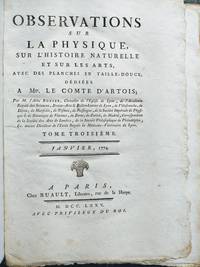
17756424Paris: Chez Ruault 1775. Original edition. Very Good. 2 volumes Quarto 28 cm; 464; 504 pages 25 engraved plates some folding and folding table. Engraved headpieces. Many pages unopened. In stiff paste paper paper labels on spine titled in manuscript and with volume numbers in ink. Old bookplate. References: For Lavoisier Duveen 24-27. <br /><br />Volumes 3 and 4 comprising the year 1774 of the lively forum for the publication of advancements in physics natural history and in mechanical arts. Electricity was in the air that year and indeed Monsieur Franklin figures heavily in reports letters addressed to him and in many articles that refer to him. While experiments with electricity are everywhere the obstetrician Sigaud de Lafond sees gold turn purple in response to a current of electricity; a Monsieur Bajon describes his research on electric eels subjects range widely. Lavoisier contributes research on white lead and other metals. Other articles investigate bird song British leather dressing rainbows epsom salts fish glue a hermaphroditic ass the Philadelphian method of drying figs and the effects of a strong dose of opium. Chez Ruault hardcover
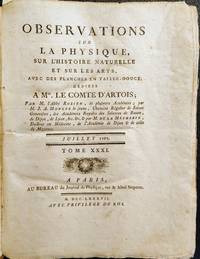
17876426Paris: Au Bureau du Journal de Physique 1787. Original edition. Very Good. Quarto 28 cm; 480 pages 12 engraved plates. Engraved headpieces. Many pages unopened. In stiff paste paper paper label on spine titled in manuscript and with volume number in ink. Old bookplate. <br /><br />Volumes 31 comprising the issues for August through December 1787 of the lively forum for the publication of advancements in physics natural history and in mechanical arts. The "Journal de Physique as it was known published monthly unlike the annals of the Royal Academy which published annually. Consequently it was able to publish innovative papers and reports of lectures given at the Academy long before their "official" appearance. The rapidity of this channel from research to publication remains a remarkable achievement. Among the papers published in this six-month period are two by Lavoisier one on oxydation one on chemical nomenclature and a letter from Benjamin Franklin to David Le Roy. Au Bureau du Journal de Physique unknown
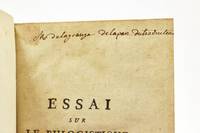
178871724Paris: S. n. 1788. Fine. S. n. Paris 1788 12.50 x 20 cm relié Essai sur le Phlogistique et sur la constitution des Acides Essay on Phlogistonn. p. Paris 1788 8vo 12.5 x 20 cm xij ; 344 pp.; 4 p. contemporary half sheep First edition and sole publication of the French translation and critical analysis under the direction of Madame Lavoisier of this text published in English the previous year under the title An Essay on Phlogiston and the Constitution of Acids. The work is made up of twelve sections all followed by critical notes by Louis-Bernard Guyton de Morveau Pierre Simon de Laplace & Gaspard Monge & Claude Louis Berthollet & Antoine François de Fourcroy. Contemporary half light brown sheep over marbled paper boards smooth leather spine decorated with gilt fillets and fleurons morocco leather title piece. Very skillfully restored joints. Interior in very good condition except for two marks left by bookmarks on pages 68-69 and 176-177. Rare autograph inscription by Marie-Anne Paulze Lavoisier to Joseph Louis de Lagrange prominent mathematician and loyal friend to Antoine Lavoisier. Valuable record of the leading role played by Marie-Anne Paulze Lavoisier in the chemical revolution at the dawn of the French Revolution. Phlogiston theory emerged at the end of the 17th century conceived by Johann Becker and developed by Georg Ernst Stahl postulating the existence of a flame element inherent in combustible bodies and released during combustion. This hypothesis was completely refuted by Lavoisier who revealed the role of oxygen in the combustion process thus inventing the theory of oxidation. Irritated by Lavoisier's skepticism with regard to phlogiston theory the eminent Irish chemist Richard Kirwan published this text titled Essay on Phlogiston. . The French chemists who rallied around Lavoisier decided to respond by translating An Essay on Phlogiston into French. Keiko Kawashima Madame Lavoisier et la traduction française de l'Essay on phlogiston de Kirwan in Revue d'histoire des sciences 2000. This text far from being a simple translation of Kirwan's work adopted the form of a manifesto in itself in which the greatest chemists of the day contested phlogiston theory dissecting its advocates' arguments one by one. The huge success of the French translation led Kirwan to attempt to refute the objections of Lavoisier and his collaborators. In 1789 he published a second edition of his work translating the French notes written by its detractors into English and adding his own refutations. He finally converted to the ideas of the anti-phlogisticians the founders of modern organic chemistry. Marie-Anne Pierrette Paulze Mme Lavoisier played a key role in the career of her husband who taught her chemistry at her request; she then became his assistant recording the experiments he carried out and their results. She very quickly took on a role that went beyond that of the devoted wife becoming a translator but also a writer: many of the notes in the Essai sur le phlogistique were written by her. At the height of her involvement it was she in her capacity as a skilled illustrator who drew all the plates in Traité élémentaire de chimie 1789 appending her signature Paulze Lavoisier Sculpsit on this occasion. This specimen includes a rare autograph inscription by the translator Mme Lavoisier to Joseph Louis de Lagrange 1736-1813 one of her husband's closest friends. It was Lavoisier who aroused the interest of Lagrange in the new science of chemistry. Together they participated in the development of a metric system that standardized weights and measures which came to light during the Revolution. Working for the revolutionary government Lagrange had more opportunities than his chemist friend who was executed as a victim of the Terror. When he learned that Lavoisier had been killed at the guillotine the mathematician declared: It took them only an instant to cut off Lavo S. n. hardcover
6203396893.Gpaperback. Good. Access codes and supplements are not guaranteed with used items. May be an ex-library book. paperback
6203396907.Gpaperback. Good. Access codes and supplements are not guaranteed with used items. May be an ex-library book. paperback
6203396826.Gpaperback. Good. Access codes and supplements are not guaranteed with used items. May be an ex-library book. paperback
6203396869.Gpaperback. Good. Access codes and supplements are not guaranteed with used items. May be an ex-library book. paperback
6202551321.Gpaperback. Good. Access codes and supplements are not guaranteed with used items. May be an ex-library book. paperback
68314Paris J. J. Fuchs an IX 1801 and Paris Bernard 1807. Two parts in two. 8vo 19.1 x 12.0 cm. ii 430 pp.; viii 334 pp. Uniform near contemporary half calf over marbled boards. Gilt lines and title on the spines. Marbled endpapers. Speckled edges. = First editions of the indexes to the first French chemical periodical founded by the leading chemists of this period Louis-Bernard Guyton de Morveau 1737-1816 Antoine Laurent Lavoisier 1743-1794 Claude-Louis Berthollet 1748-1822 Antoine François comte de Fourcroy 1755-1809 and several other important chemists. The name Claude Bernard is printed in gilt on the front boards. Boards a bit rubbed spine cover of one part partly detached some light spotting but in general a very good unmarked set. Especially the second volume is rare. hardcover
17961356738Walpole: D. Carlisle Jun 1796. Third American Edition. Hardcover. Octavo xxix 622 pp with three plates one folding plate. Third American Edition from the Fourth Edinburgh Edition. Good; bound in contemporary leather with surface marks and fading to covers cracks to front hinge and wear to corners; binding tight; text block deeply age-toned in areas; foxing and age-toning to pages and plates throughout; three plates present and intact folding plate heavily creased and accordioned; previous owner name on ffep and title page "Thomas Boyd" and "Copeland Boyd;" MF consignment. WITH THE ADDITIONS OF THE MOST APPROVED FORMULAE FROM THE BEST FOREIGN PHARMACOPOEIAS. THE WHOLE INTERSPERSED WITH PRACTICAL CAUTIONS AND OBSERVATIONS; AND ENRICHED WITH THE LATEST DISCOVERIES IN NATURAL HISTORY CHEMISTRY AND MEDICINE; WITH NEW TABLES OF ELECTIVE ATTRACTIONS OF ANTIMONAL AND MERCURIAL PREPARATIONS &C. AND SEVERAL COPPERPLATES OF THE MOST CONVENIENT FURNACES AND PRINCIPAL PHARMACEUTICAL INSTRUMENTS. BEING AN IMPROVEMENT OF THE NEW DISPENSATORY BY DR. LEWIS. WITH MANY ALTERATIONS CORRECTIONS AND ADDITIONS: AND A FULL AND CLEAR ACCOUNT OF THE NEW CHEMICAL DOCTRINES PUBLISHED BY MR. LAVOISIER. 1356738. Special Collections. D. Carlisle, Jun hardcover
1954228821954/65. London Wm. Dawson & Sonst Ltd. and E.Weil 1954/65 8° XXIII 1 491; XIII 3 173 5 pp. Frontispiece and 6 plates Facsimile bookplate of Lavoisier on front paste-down of both volumes 2 orig. publisher's cloth dustwrappers. First Edition! "The principle has been followed in this bibliography of listing each paper and every volume in which Lavoisier's name is given as one of the authors or which were issued by an organization during his tenure of executive office also in those cases in which his authorship could not be incontestably proved or even when the evidence suggested that he did not write a specific article although he signed his name to it. The circumstances are pointed out in each individual case of this type. All anonymous publications the original manuscripts of which are preserved and which are printed in the Oeuvres have also been included. In the notes to each item Lavoisier's relationship to the particular piece under consideration has always been indicated. The material thus assembled is arranged in six sections. Section A contains all his contributions to periodical works arranged in chronological order. Lavoisier's four major works are described in section B. His minor separate works and contributions to separate works will be found in section C. Section D comprises a number of miscellaneous works containing material written by Lavoisier. Section E consists of a group of works which print reports on them submitted to the Academie by Lavoisier or by him in collaboration with others. Section F lists collected works devoted to Lavoisier only and which contain more than one of his writings. The separate numbered items are not only bibliographically described but they are also analyzed as to their content and historical importance. It is realized that the analytical commentaries are extensive but it was felt that they would be especially useful owing to the scarcity and consequent difficulty in consulting the originals of many of Lavoisier's works." - Introduction. Cross references are copiously used the separate numbered items are not only bibliographically described but they are also analyzed as to their content and historical importance. hardcover
1768EBS100145In: Mémoires de Mathématique et de Physiques Présentés à l Académie Royale de Sciences par divers Savans & lûs dans ses Assemblées; Pp 341-366 in Volume 5 1768. 1st Edition. Hardcover. Very Good/No Jacket. FIRST EDITION JOURNAL ISSUE OF LAVOISIER'S FIRST CONTRIBUTION TO THE ACADEMY OF SCIENCES. "Lavoisier's earliest chemical investigation his study of gypsum was mineralogical in character; begun in the autumn of 1764 it was intended as the first paper in a series devoted to the analysis of mineral substances. 'I have tried to copy nature' Lavoisier wrote. 'Water this almost universal solvent. is the chief agent she employs; it is the one I have adopted in my work.'. Analysis convinced him that this gypsum was a neutral salt a compound of vitriolic sulfuric acid and a calcareous or chalky base. He further demonstrated that gypsum when transformed by strong heating into plaster of Paris gives off a vapor which he showed to be oure water making up about a quarter of the weight of gypsum. This first paper which in so many respects embodies the quantitative methods Lavoisier was to employ in his later work had in fact been anticipated by others." DSB. Other essays in the Mémoires include works by Chevalier Muller and Boucher. The entire volume is illustrated with 20 engraved folding plates. See Duveen and Klickstein p 14Paris: De L Imprimerie Royale 1768Large 4to Complete Volume 5 bound in cont. leather spine raised bands in compartments folding plates; Also chemical papers by Cadet 2 de Cortanvaux 2 Baumé 2 Bomare 1 plus others; VG. In: Mémoires de Mathématique et de Physiques Présentés à l Académie Royale de Sciences, par divers Savans & lûs dans ses hardcover
176844940Paris L'Imprimerie Royale 1768. 4to. Extract from "Mémoires fe Mathematique et de Physique Présentés à l'Academie des Sciences par divers Savans" Tome V. With tittlepage to vol. 5. Pp. 341-357. Clean and fine. <br/><br/><em>First appearance of Lavoisier's FIRST PUBLISHED CHEMICAL PAPER introducing quantitative methods in chemistry and in which he for the first time brought a hydrometer in use to measure the specific gravities of components of a chemical solutions. Lavoisier defended the originality of his approach in the following words: "It is to the art of combination that the knowledge of the specific gravities of fluids can bring most light. This aspect of chemistry is much less advanced than we thought we possess barely the rudiments of it." "This first paper which in so many respects embodies the quantitative methods Lavoisier was to employ in his later work had in fact been largely anticipated by others notably by Marggraf who had already discovered the composition of gypsum and shown that it contained water phlegm. Yet Lavoisier’s work was more through; and his paper his first contribution to the Academy of Sciences read to the Academy on 25 February 1765 appeared in 1768. The paper offered. - Lavoisier’s earliest chemical investigation his study of gypsum was mineralogical in character; begun in the autumn of 1764 it was intended as the first paper in a series devoted to the analysis of mineral substances. This systematic inventory was to be carried out not by the method of J. H. Pott "who exposed minerals to the action of fire" but by reactions in solution by the "wet way." "I have tried to copy nature" Lavoisier wrote. "Water this almost universal solvent "is the cheif agent she employs; it is also the one I have adopted in my work." Using a hydrometer he determined with the care the solubility of different samples of gypsum samples of selenite or lapis specularis some supplied by Guettard and Rouelle. He made similar measurements with calcined gypsumplaster of paris. Analysis convinced him that this gypsum was a neutral salt a compound of vitriolic sulfuric acid and a calcareous or chalky base. Not content with having shown by analysis the composition of the gypsum Lavoisier completed his proof by a synthesis following as he said the way that nature had formed the gypsum. He further demonstrated that gypsum when transformed by strong heating into plaster of Paris gives off a vapor which he showed to be pure water making up about a quarter of the weight of gypsum. Conversely when plaster of Paris is mixed with water and turns into a solid mass it avidly combines with water. Using the expression first coined by Rouelle he called this the "water of crystallization." DSB.Partington III pp. 378-79. - </em> unknown
a108775Paris 1793 first edition. Hardcover. 335p. One foldout plate. In French. Missing original boards; now covered in paper wrapper with original leather spine label remounted and original blue marble end papers end papers chipped. Binding very secure. Includes: Lavoisier "Suite du Memoire sur les differentes methodes proposees pour determiner le titre our la qualite du Salpetre brut - quatrieme and cinquieme parties" pp. 3-18 with large foldout chart; A F Fourcroy "Comparee des differentes especes de Concretions animales & Vegatales"; Jean Gadolin "Maniere de lessiver & purifier le salpetre crud". Small old oval library stamp on tp. Good. . hardcover
1788374291788. Crells Chem. Annalen 1788/ 67. - Helmstädt Leipzig Müller 1788 8° pp.481-574 96 pp. 2 orig. Broschur. First German Edition of the report made by Lavoisier to the Académie on the French translation of Scheele's Chemische Abhandlung von der Luft und dem Feuer. "The review is a warm one with Lavoisier expressing a greater confidence in his own ideas because of the confirmation given them by Scheele's experiments. Scheele used phlogiston to explain his results. No record has been found as to the time when Lavoisier first read ths book. previously on August 8 1781 Bertholett and Lavoisier had already submitted a joint report on Dietrich's translation of Scheele's book which was printed for the first time in his Oeuvres IV 337-379." In the second article "Lavoisier proves that air fixe rally is a compound of carbon charcoal and oxygen; he details a good many of the experiments by which this fact was established. The work thus certainly forms a plank in the platform of his new theory. He was of the opinion that all acids contain oxygen that oxygen is in fact the acidifying principle in all acids and he therefore called air fixe carbonic acid. This view was confirm to him by the fact that a solution of the gas in water exhibits acid properties." Duveen & Klickstein Nr.61 63. Fierz-David Anhang II: Entdeckungsgeschichte der Elemente 6: Lavoisier erkannte das C in reinem Zustand im Diamant vorhandnen ist. unknown
1021030406.Ghardcover. Good. Access codes and supplements are not guaranteed with used items. May be an ex-library book. hardcover
Z1-X-005-03252Hermann Glassin. Used - Good. Ships from UK in 48 hours or less usually same day. Your purchase helps support Sri Lankan Children's Charity 'The Rainbow Centre'. Ex-library so some stamps and wear but in good overall condition. 100% money back guarantee. We are a world class secondhand bookstore based in Hertfordshire United Kingdom and specialize in high quality textbooks across an enormous variety of subjects. We aim to provide a vast range of textbooks rare and collectible books at a great price. Our donations to The Rainbow Centre have helped provide an education and a safe haven to hundreds of children who live in appalling conditions. We provide a 100% money back guarantee and are dedicated to providing our customers with the highest standards of service in the bookselling industry. Hermann Glassin unknown
20122-2705683879Editions Hermann 2012. Paperback. New. 299 pages. French language. 10.79x8.19x1.02 inches. Editions Hermann paperback
20122-2705683860Editions Hermann 2012. Paperback. New. 281 pages. French language. 10.79x8.19x0.87 inches. Editions Hermann paperback
20122-2705683909Editions Hermann 2012. Paperback. New. 345 pages. French language. 10.79x8.27x1.10 inches. Editions Hermann paperback
20122-2705683887Editions Hermann 2012. Paperback. New. 271 pages. French language. 10.79x8.27x0.94 inches. Editions Hermann paperback
20122-2705683895Editions Hermann 2012. Paperback. New. 371 pages. French language. 10.71x8.27x1.26 inches. Editions Hermann paperback
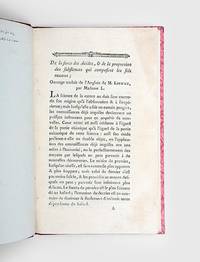
1791174569Paris: c.1791. A prime example of Madame Lavoisier's formidable analytic eye First edition scarce offprint issue of Madame Lavoisier's critical translation of the work of a prominent fellow of the Royal Society. In the UK institutional copies are recorded at UCL and in the Wellcome Collection. Marie-Anne Paulze Lavoisier 1758-1836 famously refuted the claims of the chemist Richard Kirwan 1733-1812 several times. In 1787 after he published his Essay on Phlogiston she brought out a similarly deprecatory translation complete with a preface which undermined his authority as an academic. Kirwan published Of the strength of acids and the proportion of ingredients in neutral salts in Dublin in 1791. In her translation Lavoisier's extensive annotations and critical apparatus focus on Kirwan's scientific and procedural errors. "II y a dans ces sortes d'expériences une cause d'erreurs qui paroit avoir échappé à M. Kirwan; c'est la grande quantité d'eau que l'acide carbonique est susceptible de dissoudre et qui échappe avec lui" "There is in these types of experiences a cause of errors which appears to have escaped Mr Kirwan: the large quantity of water which carbonic acid is likely to dissolve and which escapes with it" - p. 40. Marie-Anne married Antoine Lavoisier in 1771. She promoted their collaborative work to the international scientific community and used her command of languages to keep Antoine abreast of the latest developments. "Through her drawings translations interpretations of notes and skillful editing of Lavoisier's memoirs she made some important additions to the body of scientific knowledge. there are indications that she made some theoretical contributions" Ogilvie & Harvey. This translation was published in journal form in the Annales de Chimie which Antoine Lavoisier edited. Octavo 193 x 120 mm pp. 108. Woodcut headpieces and tables in the text. Recent red quarter morocco spine lettered in gilt marbled paper sides. Minimal wear minor foxing and creasing to contents: a very good copy indeed. Ogilvie & Harvey Biographical Dictionary of Women in Science II p. 753. unknown
1024591360.Ghardcover. Good. Access codes and supplements are not guaranteed with used items. May be an ex-library book. hardcover
50683040like new. unknown