74 résultats
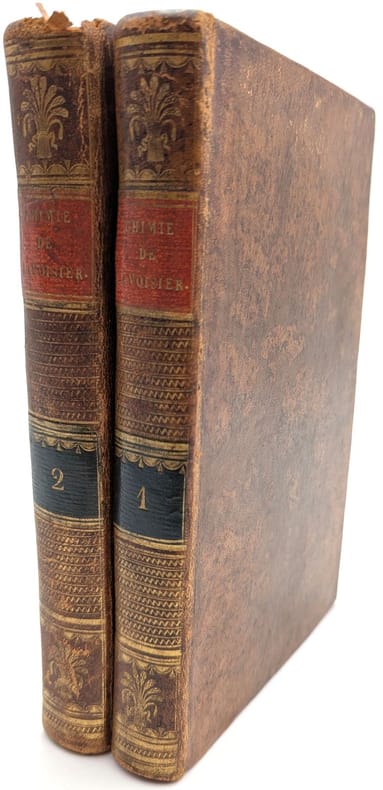
178990025Paris: Rue et Hôtel Serpente 1789. Fine. Opening run of the journal ""Annales de chimie"" vehicle of ""The New Chemistry"" founded and directed by Antoine de Lavoisier Rue et Hôtel Serpente Paris 1789-1792 12.8 x 19.6 cm Relié First edition highly sought after in the 19th century comprising 14 of the first 15 volumes published between 1789 and 1792 of the first series of the celebrated French scientific periodical Annales de chimie. Volume 10 missing. Contemporary full brown calf spines smooth with gilt fillets brown morocco lettering-piece and green morocco numbering-piece blind-ruled border to covers red speckled edges bookplate of P. H. Chavoix to front pastedown of each volume. Volumes 1 and 11 numbered in Roman rather than Arabic numerals. Overall discreet restorations corners rubbed occasional light foxing and browning some worming to bindings not affecting text head and tail of headcaps worn on volumes 7 13 14 and 15. The complete first series of the Annales de chimie published between 1789 and 1815 runs to 96 volumes. From 1793 to 1797 publication was suspended following the arrest of Antoine Lavoisier the journal's treasurer and in Édouard Grimaux's words its ""true director."" The opening run here contains nearly all the issues produced under the direction of and with contributions from the chemists Antoine de Lavoisier and Baron Philippe Frédéric de Dietrich. Both were condemned to the guillotine during the Reign of Terror in 1794 and 1793 respectively. This set is further illustrated with 12 scientific plates including two by the engraver Sellier as well as a map of the county of Bigorre. The majority of the articles and essays are first editions written by distinguished French and foreign chemists and physicists who helped disseminate ""The New Chemistry"": in order of appearance Louis-Bernard Guyton de Morveau Antoine de Lavoisier Gaspard Monge Claude-Louis Berthollet Anne-François Fourcroy Philippe-Frédéric de Dietrich Jean Henri Hassenfratz Pierre-Auguste Adet Jean-Antoine Chaptal Martin Heinrich Klaproth Johann Georg Albrecht Höpfner Christoph Girtanner Johann Christian Wiegleb Jacques-Anselme Dorthes Johann Friedrich Westrumb Armand Seguin Henry Cavendish William Austin Martin van Marum l'abbé René Just Haüy Peter Jacob Hjelm Jan Ingenhousz Isaac Milner Johan Gadolin James Watt Lorenz Florenz Friedrich von Crell Charles Blagden Jean Senebier Jean d'Arcet William Higgins Nicolas-Louis Vauquelin Nicolas Joseph Thiéry de Ménonville Dom Michel Rubin de Celis Jacques Louis Schurer Augustin-François de Silvestre l'abbé Claude Chappe Antoine Augustin Parmentier Nicolas Deyeux Bertrand Pelletier Charles-Augustin Coulomb Joseph Priestley Richard Kirwan Jean André de Luc Jean-François Clouet chevalier Marsilio Landriani Jean-Noël Hallé François Pierre Nicolas Gillet de Laumont Georges-Charles Bartholdi Alexandre Brongniart Jean-Michel Haussmann Henri Reboul François René Curaudau Thomas Henry Jean-Anthyme Margueron Nicolas Leblanc Johann Rudolph Deiman Pieter Nieuwland Pierre de Ribaucourt Pissis fils Jean-Baptiste Van Mons ou encore Louis François Antoine Arbogast. In 1816 the Annales de chimie was retitled Annales de chimie et de physique. In 1913 the journal split into two separate publications Annales de chimie and Annales de physique. The titles have undergone further changes up to the present day. A collection of 14 volumes from the opening run of the prestigious French scientific periodical Annales de chimie containing numerous essays and articles most in first edition published under the editorship of distinguished figures: Antoine de Lavoisier Louis-Bernard Guyton de Morveau Gaspard Monge Claude-Louis Berthollet Anne-François Fourcroy Philippe-Frédéric de Dietrich Jean Henri Hassenfratz and Pierre-Auguste Adet. Rue et Hôtel Serpente unknown
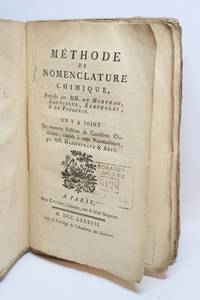
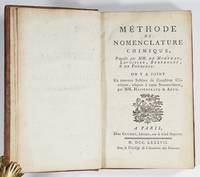
178773124à Paris: Chez Cuchet 1787. Fine. Chez Cuchet à Paris 1787 13.50 x 21 cm broché Second printing of the first edition: pages 257 to 272 are misnumbered 241-256 Duveen and Klickstein. Illustrated with a large chart and 6 folding plates at rear. Library stamp of Laboratoires Lumière on the half-title title page and several other pages. Another stamp ""G. Chicanuard"" appears on the half-title; we have found no information about this person. Temporary binding in full marbled paper. Handwritten title on spine. Some small paper losses in places and joint on second board cracked but still sound. Copy as issued with full margins. The Méthode forms a manifesto for a revolution in the world of chemistry and the birth of modern chemistry a chemistry that resolutely turns its back on the past by becoming scientific. It was Lavoisier the most influential scientist at the Academy of Sciences who brought together around his theory and to support it decisively the greatest French chemists: Fourcroy Berthollet Adet Hassenfratz and Guyton de Morveau whom the already formed group welcomed to Paris in February 1787. The latter joined them with an advanced chemical nomenclature which would be revised by Lavoisier who demanded that Morveau abandon his phlogistic theory principle of a combustible element in air dating from the 17th century since he had discovered the role of oxygen. It was at this price that he was entrusted with presenting the new nomenclature. It was in the session of May 2 1787 at the Academy of Sciences that the terms ""oxygen"" ""hydrogen"" and ""carbon"" were pronounced for the very first time. Adet and Hassenfratz were responsible for proposing symbols for ""new characters to be used in chemistry"" which would not have much success but was destined for a great future. The entire project was placed under the authority and will of Lavoisier and the decision that Morveau should carry the project was a political decision intended to ensure better reception among foreign scientists. No one was deceived because it was Lavoisier who would be attacked by Western science. Very important work that marks the birth certificate of scientific chemistry. Chez Cuchet unknown
1793EBS100381Paris: Cuchet 1793. 1st Edition. Hardcover. Very Good/No Jacket. AUTHORIZED SECOND EDITION OF LAVOISIER'S KEY WORK. This is authorized Chardon issue; 1st 1793 issue was pirated; 3rd 1793 issue was improved version of pirated issue by authorized publisher. Like the original 1789 edition the plates bear the signature of Madame Lavoisier."Although it does not show any material changes in the text nor any additions all the errata are here corrected and the plates are the original ones with Madame Lavoisier's signature. It is difficult to explain now the reasons why this edition was put out in the same year but it might be assumed that Lavoisier and Cuchet wanted to counteract the distribution of the books which had been fraudulently issued by printing an authoritative edition" Duveen & Klickstein. BOOK DETAILS AND CONDITION: 2 Vols 8vo 2 folding tables 13 fine folding copperplates by Mme Lavoisier Second ed second issue 8vo 19th cent. half calf VG See A. Greenberg From Alchemy to Chemistry in Picture and Story John Wiley & Sons New York 2007 pp 313 315 316 335 PROVENANCE: Professor A. Bernardes de Oliveira of Sao Paolo Brazil bookplate a well-known science book collector and Arthur C. Greenberg an author and expert on the history of chemistry. REFERENCES: Duveen et Klickstein 157; PMM 238 for the Paris 1789 edition. Paris: Cuchet hardcover
176844940Paris, L'Imprimerie Royale, 1768. 4to. Extract from ""Mémoires fe Mathematique et de Physique, Présentés à l'Academie des Sciences par divers Savans"", Tome V. With tittlepage to vol. 5. Pp. 341-357. Clean and fine.
176844940Paris L'Imprimerie Royale 1768. 4to. Extract from "Mémoires fe Mathematique et de Physique Présentés à l'Academie des Sciences par divers Savans" Tome V. With tittlepage to vol. 5. Pp. 341-357. Clean and fine. <br/><br/><em>First appearance of Lavoisier's FIRST PUBLISHED CHEMICAL PAPER introducing quantitative methods in chemistry and in which he for the first time brought a hydrometer in use to measure the specific gravities of components of a chemical solutions. Lavoisier defended the originality of his approach in the following words: "It is to the art of combination that the knowledge of the specific gravities of fluids can bring most light. This aspect of chemistry is much less advanced than we thought we possess barely the rudiments of it." "This first paper which in so many respects embodies the quantitative methods Lavoisier was to employ in his later work had in fact been largely anticipated by others notably by Marggraf who had already discovered the composition of gypsum and shown that it contained water phlegm. Yet Lavoisier’s work was more through; and his paper his first contribution to the Academy of Sciences read to the Academy on 25 February 1765 appeared in 1768. The paper offered. - Lavoisier’s earliest chemical investigation his study of gypsum was mineralogical in character; begun in the autumn of 1764 it was intended as the first paper in a series devoted to the analysis of mineral substances. This systematic inventory was to be carried out not by the method of J. H. Pott "who exposed minerals to the action of fire" but by reactions in solution by the "wet way." "I have tried to copy nature" Lavoisier wrote. "Water this almost universal solvent "is the cheif agent she employs; it is also the one I have adopted in my work." Using a hydrometer he determined with the care the solubility of different samples of gypsum samples of selenite or lapis specularis some supplied by Guettard and Rouelle. He made similar measurements with calcined gypsumplaster of paris. Analysis convinced him that this gypsum was a neutral salt a compound of vitriolic sulfuric acid and a calcareous or chalky base. Not content with having shown by analysis the composition of the gypsum Lavoisier completed his proof by a synthesis following as he said the way that nature had formed the gypsum. He further demonstrated that gypsum when transformed by strong heating into plaster of Paris gives off a vapor which he showed to be pure water making up about a quarter of the weight of gypsum. Conversely when plaster of Paris is mixed with water and turns into a solid mass it avidly combines with water. Using the expression first coined by Rouelle he called this the "water of crystallization." DSB.Partington III pp. 378-79. - </em> unknown
17833925London: Warrington Printed by W. Eyres for J. Johnston 1783. First English Language Edition. Octavo : pp. vii viii 2 141 3 List of Books lately published by J. Johnston : now custom clamshell box with red leather title panel lettered in gilt. DUVEEN 336<br /> <br /> Lacks covers and half title; toned foxed and brittle; title page detached; thereafter first gathering detached; chips and water stains. Antoine Lavoisier often referred to as the Father of Modern Chemistry and his wife Marie-Anne Pierrette Paulze Lavoisier later Countess von Rumford were eighteenth century French chemists responsible for overthrowing the "false doctrine of Phlogiston". Lavoisier relied on Paulze's translation of foreign works to keep abreast of current developments in chemistry. In the case of phlogiston it was Paulze's translation of Richard Kirwan's 'Essay on Phlogiston and the Constitution of Acids - with her own footnotes critiquing his errors - that convinced him the idea was incorrect ultimately leading to his studies of combustion and his discovery of oxygen gas. <br /> <br /> Lavoisier was a victim of The Terror of 1794 and guillotined in Paris. "It took but a moment to cut off his head; it will take a century to produce another like it" mourned his friend Lagrange the mathematician. The Autobiography of Science p.228.<br /> <br /> The collected essays show the development of Lavoisier's thinking and in the penultimate essay VIII the term "oxyginous principle" principe oxygin i.e. oxygen appears for the first time in chemistry p.98 This paper was first submitted to the Academie in 1777 and read in 1779. DUVEEN 49. Warrington, Printed by W. Eyres for J. Johnston unknown
1787612Paris: Cuchet 1787. 1st. Full mottled calf with gilt tooling along the edges gilt spine compartments with floral ornaments and leather spine label. Contemporary binding with rubbing and wear along the spine and corners. Boards show mottling and fading with some scuffing. Pages exhibit foxing toning and occasional spotting consistent with age. Folding tables are intact and legible though with some creasing and edge wear. Features: Marbled edges; multiple large folding tables and engraved charts; decorative typographic ornaments. Overall good. <p data-start="251" data-end="727">Méthode de Nomenclature Chimique Paris: Cuchet 1787 is the groundbreaking work that introduced the modern system of chemical nomenclature marking a turning point in the history of science. Written collaboratively by Morveau Lavoisier Berthollet and Fourcroy—four of the most influential chemists of the 18th century—this treatise sought to replace centuries of inconsistent and confusing chemical terminology with a rational systematic method of naming substances.</p> <br /> <p data-start="729" data-end="1178">The work introduces a new nomenclature rooted in clarity precision and universality laying the foundation for the modern language of chemistry. Included are detailed explanations of the logic behind the naming system as well as extensive tables of elements and compounds that illustrate the method in practice. The treatise also contains supplementary sections by Hassenfratz and Adet who proposed a symbolic notation for chemical substances.</p> <br /> <p data-start="1180" data-end="1537">Lavishly produced the book features large folding tables and engraved charts including the famous “Tableau de la Nomenclature Chimique†which visually organizes the new classification of substances. These elements highlight both the pedagogical and scientific ambitions of the project: to unify chemists under a single coherent system of communication.</p> <br /> <p data-start="1539" data-end="1749">This volume is considered a cornerstone of the Chemical Revolution appearing just two years before Lavoisier’s Traité élémentaire de chimie 1789 and cementing his role as the father of modern chemistry.</p> . Cuchet unknown
178990025Rue et Hôtel Serpente | Paris 1789-1792 | 12.8 x 19.6 cm | Relié
178773124Chez Cuchet | à Paris 1787 | 13.50 x 21 cm | broché
178949404Paris, Cuchet, 1789, in-8, IV, 259, (1bl)pp, 1 tabl, demi-veau moucheté, dos plat orné de filets dorés. (Rel. de l'ép.), Deuxième édition, second tirage. Grand tableau dépliant de la nouvelle nomenclature chimique formé de deux parties collées; détail bien conforme à l'avis au relieur que cite Duveen. C'est le tableau inchangé de la première édition de 1787. Ouvrage capital dans lequel les grands chimistes de l'époque mettent au point une nouvelle manière de dénommer les éléments et ouvrent ainsi la voie à la chimie moderne la dégageant pour toujours de la lourdeur héritée du langage des alchimistes. Notons au passage que pour cette édition les planches ne furent pas réimprimées. Bon exemplaire Couverture rigide
17781465Paris: De l'Imprimerie Royale 1778. 1st Edition. FIRST EDITION LAVOISIER'S OFFICIAL EASTER MEMOIR ON THE COMPOSITION OF AIR. <br /> <br /> In this work Lavoisier proposed that ordinary air is composed of two different gases one "highly respirable" that he named "oxygen" and the other later named nitrogen that was unable to support combustion or respiration. This work is commonly referred to as Lavoisier's "Easter Memoir" because he presented an earlier version to the Academy around Easter of 1775; as this is the 1778 revised version historians regard it as Lavoisier's "official" Easter Memoir Wikipedia. We offer the 1780 edition separately.<br /> <br /> In April 1778 "Lavoisier read for a second time the memoir in which he had originally demonstrated in April 1775 that mercury precipitate reduced without charcoal disengages not fixed air but the ‘air itself entire' or ‘the purest portion of the air'. He made some revisions in the text that have attracted widespread attention from historians" Holmes Lavoisier 137. <br /> <br /> In the time between 1775 and 1778 Lavoisier repeated some of performed some new experiments of his own and repeated some of Priestley's. In the 1778 ‘official' version Lavoisier "altered the language in which he had described that air calling it now ‘the most salubrious the most pure portion of the air' and air ‘in an eminently respirable state'. Fastening on to this last phrase he again referred to the air later in his memoir as ‘eminently respirable air'. At the same time he deleted references to it in the original version as ‘common air' and eliminated the experimental description that it reacted to the nitrous air test in the same manner as common air. <br /> <br /> "Historians have tended to treat with suspicion the textual changes Lavoisier made. The implication seems to be that he sought to represent himself as having clearly understood in 1775 that the air released from the mercury calx is a specific portion of the atmosphere when in fact he had then still not distinguished it unambiguously from ordinary air. If one couples this suspicion with acceptance of Priestley's charge that Lavoisier had obtained the idea for the experiment from him in the first place then one creates an image of Lavoisier as one who is known to have had an ‘occasional tendency to allow the work of others to pass as his own'. <br /> <br /> "There is however no solid evidence that in making these changes he was attempting to rewrite history. His motivation was probably simple. By the spring of 1778 when his new theoretical edifice had solidified the experiments on mercury calx would have come to appear to him as one of the decisive experimental foundations on which he had erected it. Yet when he looked back on the paper which reported these experiments from the vantage point he had since attained the descriptions of the air he had identified in it would have appeared confused ambiguous and inconsistent. <br /> <br /> "The embarrassment of allowing such flaws to remain in what he could now anticipate might someday be regarded as a classic paper is obvious. Since the paper had yet to appear in the Memoirs of the Academy chronically two to three years late in publication he had a convenient opportunity to avoid that outcome" Holmes. <br /> <br /> ALSO INCLUDED: An important paper by P. S. Laplace introducing the concept of the "Coriolis effect" fifty years before Coriolis. Euler had also written about the effect in 1749. "Recherches sur plusieurs points du système du monde" in Mémoires de l'Académie des Sciences Année 1775 pp. 75-182 1778. This is part one of a two part paper. CONDITION: Paris: De l'Imprimerie Royale. 4to 10.5 x 8.25. 11 folding engraved copperplates. Prior ownership name 'Bernardi' on front free endpaper. Contemporary full leather binding. Front joint between spine and boards cracking but solid. Handsome wide margins throughout. Slight toning throughout otherwise bright and very clean. Very good condition. De l'Imprimerie Royale hardcover
1787S14078Paris :: Chez Cuchet 1787. 1787. 8vo. iv 314 pp. PAGINATION NOTE: pages 257-272 are mis-numbered 241-256 Duveen. Half-title woodcut title-page vignette headpiece tailpieces 6 folding tables of chemical symbols 1 folding plate; page 1 of the text trimmed at top margin and mounted on a stub foxed. Contemporary full mottled calf red leather spine label gilt-stamped spine; foot of spine mended with kozo patch upper joint cracked corners of read cover chewed. Ownership signature on title under the vignette. Very good. 264 FIRST EDITION second issue second printing with the flowered vase on the title-page previously a cherub and no colophon on page 314. Lavoisier's new terminology of chemistry was an important part of his reforms in the science and it has been in use with some modifications ever since its introduction. "The merits of the new nomenclature are even today more than evident since with only slight modification it is still the basis of the language of modern chemistry." Duveen & Klickstein pp. 119-126. Louis Guyton de Morveau was trained as a lawyer who taught himself the subject of chemistry. From 1776-1789 he taught public courses in chemistry at the Dihon Academy. He was professor of chemistry at the Ecole Polytechnique from 1794-1811 twice serving as its director. ALL AUTHORS: LAVOISIER Antoine Laurent 1743-1794 ; Louis Bernard GUYTON DE MORVEAU 1737-1816 ; Claude-Louis BERTHOLLET 1748-1822 ; Antoine-Francois de FOURCROY 1755-1809 ; Jean Henri HASSENFRATZ 1755-1827 ; Pierre-Auguste ADET 1763-1834. PROVENANCE: Emile on title. REFERENCES: Blake/NLM p. 191 2nd printing; Cole Chemical literature 566; DSB Vol. V. pp. 600-604; Duveen Bibliotheca Alchemica et Chemica p. 340; Duveen & Klickstein 130; Gascoigne 7150.4; Partington A history of chemistry Vol. III p. 372; Poggendorf Vol. I col. 981; Wellcome III p. 185. Chez Cuchet, 1787. hardcover
1768EBS100145In: Mémoires de Mathématique et de Physiques Présentés à l Académie Royale de Sciences par divers Savans & lûs dans ses Assemblées; Pp 341-366 in Volume 5 1768. 1st Edition. Hardcover. Very Good/No Jacket. FIRST EDITION JOURNAL ISSUE OF LAVOISIER'S FIRST CONTRIBUTION TO THE ACADEMY OF SCIENCES. "Lavoisier's earliest chemical investigation his study of gypsum was mineralogical in character; begun in the autumn of 1764 it was intended as the first paper in a series devoted to the analysis of mineral substances. 'I have tried to copy nature' Lavoisier wrote. 'Water this almost universal solvent. is the chief agent she employs; it is the one I have adopted in my work.'. Analysis convinced him that this gypsum was a neutral salt a compound of vitriolic sulfuric acid and a calcareous or chalky base. He further demonstrated that gypsum when transformed by strong heating into plaster of Paris gives off a vapor which he showed to be oure water making up about a quarter of the weight of gypsum. This first paper which in so many respects embodies the quantitative methods Lavoisier was to employ in his later work had in fact been anticipated by others." DSB. Other essays in the Mémoires include works by Chevalier Muller and Boucher. The entire volume is illustrated with 20 engraved folding plates. See Duveen and Klickstein p 14Paris: De L Imprimerie Royale 1768Large 4to Complete Volume 5 bound in cont. leather spine raised bands in compartments folding plates; Also chemical papers by Cadet 2 de Cortanvaux 2 Baumé 2 Bomare 1 plus others; VG. In: Mémoires de Mathématique et de Physiques Présentés à l Académie Royale de Sciences, par divers Savans & lûs dans ses hardcover
1793103006Paris, Cuchet, 1793, in-8, 2 vol. in-8: XLIV-322 pp, 2 tabl. dép. + VIII-327 pp. 13 pl, Basane marbrée havane, dos long orné de filets et fleurons dorés, pièce de titre rouge, pièce de tomaison verte, tranches jaunes mouchetées, Édition ornée de belles planches dépliantes gravées au nombre de 13, gravées sur cuivre par Madame Lavoisier et 2 tableaux dépliants. Cette édition imprimée par Chardon et indiquée seconde, est en réalité la troisième (les deux précédentes ayant paru la même année, en 1789). Lavoisier y expose sa découverte de la nature de l'air. En mettant fin à la "théorie du phlogistique", il sépara définitivement la chimie de Stahl de celle de son époque. Bien complet des deux pages de faux-titre. Ex-libris héraldique Dyon [?]; livre de prix offert à Augustin Legros; ex-libris manuscrit d'Adèle Legros. Petites rousseurs, quelques taches, petit trou sans atteinte aux ff. A1 à A4, déchirure sans manque au f. F1, pâles décharges, petites épidermures. Cole n° 778 ; Duveen & Klickstein n° 157. Couverture rigide
1776EBS100409Chez Lacombe Libraire rue Christine 1776. 1st Edition. Hardcover. Very Good/No Jacket. First Edition 8vo: Marbled endpapers 55 pp including ½ title; titlepage 622 pp 3 folding plates. Slight wrinkling of some wrinkled; pp 289-296 edges somewhat oxidized. Neville II: p 20: A valuable collection of memoirs on the production of saltpeter for the manufacture of gunpowder. This extensive survey of the literature comprises extracts from the earlier works of Glauber and Stahl as well as more recent papers by Lavoisier Louis Lemery and others A rare book Duveen who lists it under Montigny. New full goatskin. VG-. From the Arthur C. Greenberg History of Chemistry Library. Chez Lacombe, Libraire, rue Christine hardcover
17801466Paris: Hotel de Thou rue des Poitevins 1780. LAVOISIER'S OFFICIAL EASTER MEMOIR ON THE COMPOSITION OF AIR. THIS IS THE 1780 edition. WE OFFER THE 1st 1778 EDITION SEPARATELY. <br /> <br /> In this work Lavoisier proposed that ordinary air is composed of two different gases one "highly respirable" that he named "oxygen" and the other later named nitrogen that was unable to support combustion or respiration. This work is commonly referred to as Lavoisier's "Easter Memoir" because he presented an earlier version to the Academy around Easter of 1775; as this is the 1778 revised version historians regard it as Lavoisier's "official" Easter Memoir Wikipedia. <br /> <br /> In April 1778 "Lavoisier read for a second time the memoir in which he had originally demonstrated in April 1775 that mercury precipitate reduced without charcoal disengages not fixed air but the ‘air itself entire' or ‘the purest portion of the air'. He made some revisions in the text that have attracted widespread attention from historians" Holmes Lavoisier 137. <br /> <br /> In the time between 1775 and 1778 Lavoisier repeated some of performed some new experiments of his own and repeated some of Priestley's. In the 1778 ‘official' version Lavoisier "altered the language in which he had described that air calling it now ‘the most salubrious the most pure portion of the air' and air ‘in an eminently respirable state'. Fastening on to this last phrase he again referred to the air later in his memoir as ‘eminently respirable air'. At the same time he deleted references to it in the original version as ‘common air' and eliminated the experimental description that it reacted to the nitrous air test in the same manner as common air. <br /> <br /> "Historians have tended to treat with suspicion the textual changes Lavoisier made. The implication seems to be that he sought to represent himself as having clearly understood in 1775 that the air released from the mercury calx is a specific portion of the atmosphere when in fact he had then still not distinguished it unambiguously from ordinary air. If one couples this suspicion with acceptance of Priestley's charge that Lavoisier had obtained the idea for the experiment from him in the first place then one creates an image of Lavoisier as one who is known to have had an ‘occasional tendency to allow the work of others to pass as his own'. <br /> <br /> "There is however no solid evidence that in making these changes he was attempting to rewrite history. His motivation was probably simple. By the spring of 1778 when his new theoretical edifice had solidified the experiments on mercury calx would have come to appear to him as one of the decisive experimental foundations on which he had erected it. Yet when he looked back on the paper which reported these experiments from the vantage point he had since attained the descriptions of the air he had identified in it would have appeared confused ambiguous and inconsistent. <br /> <br /> "The embarrassment of allowing such flaws to remain in what he could now anticipate might someday be regarded as a classic paper is obvious. Since the paper had yet to appear in the Memoirs of the Academy chronically two to three years late in publication he had a convenient opportunity to avoid that outcome" Holmes. CONDITION: Paris: Hotel de Thou rue des Poitevins. 8vo. 6.5 x 4. 12 folding engraved copperplates. Marbled endpapers. Contemporary full leather binding. Chipped in several places. Internally fine. Hotel de Thou, rue des Poitevins hardcover
179061775[Paris, Clouiser, 1790, in-8, de 32 pages, exemplaire broché, sous couverture de papier marbré, Rare plaquette. Critiquant à la fois les positions de Talleyrand et celles de Mirabeau, le célèbre chimiste, député suppléant du bailliage de Blois, membre de la Société de 1789, propose, en compagnie de ses amis modérés comme La Rochefoucauld, La Fayette ou Bailly, une limitation de l'émission des assignats. Premiers et derniers feuillets roussis. Couverture rigide
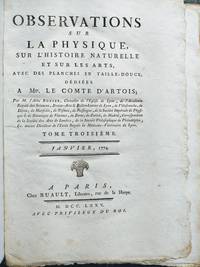
17756424Paris: Chez Ruault 1775. Original edition. Very Good. 2 volumes Quarto 28 cm; 464; 504 pages 25 engraved plates some folding and folding table. Engraved headpieces. Many pages unopened. In stiff paste paper paper labels on spine titled in manuscript and with volume numbers in ink. Old bookplate. References: For Lavoisier Duveen 24-27. <br /><br />Volumes 3 and 4 comprising the year 1774 of the lively forum for the publication of advancements in physics natural history and in mechanical arts. Electricity was in the air that year and indeed Monsieur Franklin figures heavily in reports letters addressed to him and in many articles that refer to him. While experiments with electricity are everywhere the obstetrician Sigaud de Lafond sees gold turn purple in response to a current of electricity; a Monsieur Bajon describes his research on electric eels subjects range widely. Lavoisier contributes research on white lead and other metals. Other articles investigate bird song British leather dressing rainbows epsom salts fish glue a hermaphroditic ass the Philadelphian method of drying figs and the effects of a strong dose of opium. Chez Ruault hardcover
1793051313Chez Cuchet. Good with no dust jacket. 1793. Second Edition. Hardcover. Hardcover 2 volumes. Written in French no translations. Elementary Treatise on Chemistry Presented in a new order and According to Modern Discoveries. Beautiful matching mottled leather boards worn and frayed at edges some bumping. Soil and rubbing. Title labels on spines between worn raised bands. Spine ends frayed. Light foxing/soil/creasing to text. 2 fold out charts in volume 1 and 13 plates in volume 2 are all in nice condition a few rough edges from improper folding. ; 8vo 8" - 9" tall . Chez Cuchet hardcover
179637031Venezia: dalla Tipogr. Pepoliana presso Antonio Curti 1796. Edizione terza corretta ed ampliata di due Dissertazioni inedite dell'Autore e di nuove Annotazioni del Traduttore dalla Tipogr. Pepoliana presso Antonio Curti unknown
1787655401787. Paris: Chez Cuchet 1787 8° IV 314 pp. 6 gefalt. Kupfertafeln Ledereinbnand. d.Zt.; Falttabll fehlt; Rücken restauriert; feines Expl. FIRST EDITION first issue of one of the key books in the history of modern chemistry. This copy has all the features mentioned for the first issue such as the figurative title vignette and the misnumbered pages: 242/34 instead of 258/% 246/7 instead of 262/3 291 instead of 266/7 254/5 instead of 270/1. Unfortunately the table opposite page 100 is missing. Lavoisier's discoveries made a new and rational chemical nomenclature imperative. Initiated by Guyton de Morveau still an adherent of the phlogiston theory the project was taken up by Lavoisier who soon convinced Guyton of the truth of his system. They entered into collaboration with Berthollet and Fourcroy. The result of their combined efforts is contained in the present volume the most important milestone in the development of chemical nomenclature. The new nomenclature with only slight modifications is still the basis of the language of modern chemistry. The table of contents: 1 Mémoire Sur la nécessité de réformer & de nomenclature de la Chimie lu à l'Assemblée publique de l'Académie Royale des Sciences du 18 Avril 1787; Par M. Lavoisier pp. 1-25 This is the first appearance of this memoir in print. It was never published in the Mém. Acad. R. Sci. The contents are discussed in the introduction to this section. Lavosier revised the memoir and used it again for the "discours préliminaire" of this 'Traité Elementaire de Chemie. 2 Mémoire sur le développement des principes de la Nomenclature méthodique lu à l'Académie le 2 Mai 1787; Par M. de Morveau pp.26-70. 3 Appendice Contenant la nomenclature de quelques substances composées qui s ; combinent quelquefois à la manière des corps simples pp.70-74. 4 Mémoire Pour servir à l'explication du Tableau de Nomenclature. Par M. de Fourcroy pp.75-100. 5 Avertissement Sur les deux Synonimies pp.101-106. 6 Synonimie Ancienne & novelle par ordre alphabétique pp.107-143. 7 Dictionnaire Pour la nouvelle Nomenclature Chimique pp.144-237. 8 Rapport Sur la nouvelle Nomenclature pp.238-252. 8 Mémoire Sur de nouveaux Caractères à employer en Chimie. Par MM. Hassenfratz pppp.253-270. 9 IIe Mémoire Sur de nouveaux Caractères à employer en Chimie & l'arrangement que doivent avoir ces nouveaux Caractères afin de leur faire exprimer les rapports de quantité des substances simples contenues dans les mixtes. Par MM. Hassenfratz & Adet pp.271-287. As a complement to he new nomenclature Hassenfratz and Adet devised a system of symbols straight lines. Half -circles squares triangles lozenges and circles in different positions and combinations which as they intended should make possible an immediate understanding of chemical substances and their nature the world over. Ingenious though their methods seemed this sign language proved unsatisfactory and it has long been discarded. 10 Rapport Sur les nouveau Caractères chimiques pp.288-312. This memoir was never published in the Mém. Acad. R. Sci. H.F. Norman Lib. Cat. 1291. Duveen & Klickstein 126. Duveen p. 340. D.S.B. 8: 80. Cole 566. Bolton I. 58. Partington III. 372.VI. Smith Coll. p.209. Edelstein 1361. Milestones of Science 126. First issue not in Neville. Duveen-Klickstein 126 unknown
1793ABE-1747758279317Paris: Cuchet 1793. 2nd Edition. Hardcover. Very Good. 2 Vols 8vo 2 folding tables 13 fine folding copperplates by Mme Lavoisier Second ed second issue This is authorized Chardon issue; 1st 1793 issue was pirated; 3rd 1793 issue was improved version of pirated issue by authorized publisher See Duveen and Klickstein pp 176-177 8vo 19th cent. half calf VG See A. Greenberg From Alchemy to Chemistry in Picture and Story John Wiley & Sons New York 2007 pp 313 315 316 335. Paris: Cuchet hardcover
177984862A Paris, de l’Imprimerie Royale 1779 Première édition. In-8, broché couverture dite de “reliure d’attente” tardive, de papier reliure XIXeme, VIII-84pp, 4 planches rempliées en fin d’ouvrage. Orné de têtes de chapître et de culs de lampe. Mouillures sur pages de titre et pages d’introduction. Pages écornées. Ouvrage très rare. Assez Bon état.
1776ABE-17454235012311776. 1st Edition. Hardcover. Fine. Essays Physical and Chemical. Translated with Notes and an Appendix by Thomas Henry. Volume the First ALL PUBLISHED London 1776 First Edition in English of Lavoisier`s first book 3 folding plates xxxiii 475pp Duveen and Klickstein p 118 8vo orig boards rebacked in mod. 1/4 calf See A. Greenberg From Alchemy to Chemistry in Picture and Story John Wiley & Sons New York 2007 p 307. hardcover
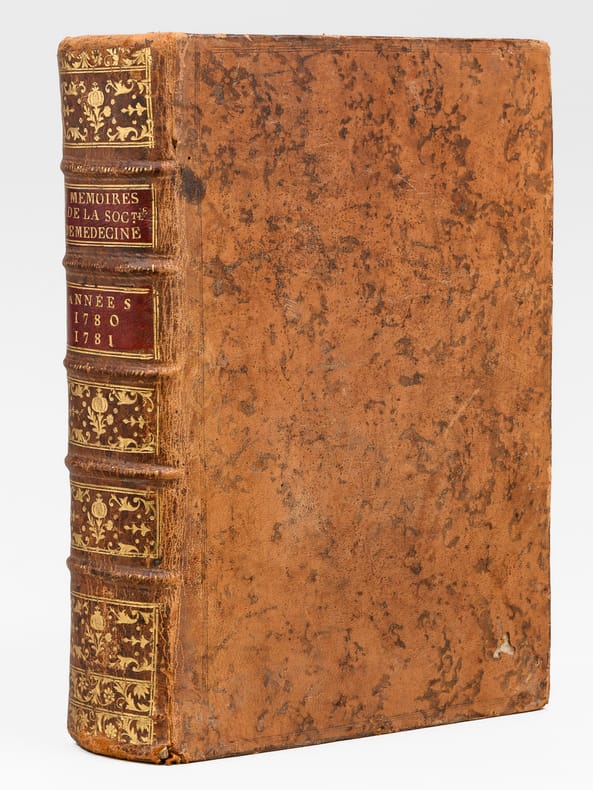
1785704301 vol. fort in-4 reliure de l'époque plein veau marbré, dos à 5 nerfs orné, Chez Théophile Barrois le Jeune, Paris, 1785, 2 ff., XVI-392-430 pp. avec 15 planches hors-texte (13 et 2, dont planches dépliantes) et 29 tableaux dépliants (28 et 1). Histoire de la Société Royale de Médecine. Années M.DCC.LXXX et LXXXI. Avec les Mémoires de Médecine & de Physique médicale, pour les mêmes Années. Tirés des Registres de cette Société [ Années 1780 et 1781 ] [ Contient notamment : ] "Observations météorologiques" pour les années 170 & 1781 (R. P. Cotte) ; "Sur les différentes manières d'administrer l'électricité, & Observations sur les effets que ces divers moyens ont produits" (Mauduyt de La Varenne) ; "Réflexions sur les effets de l'éther vitriolique & de l'éther nitreux dans l'économie animale" (Lavoisier)