2 943 résultats
1923374061923. unknown books
19152125Berlin: Verlag der Königlichen Akademie der Wissenschaften 1915. First edition. Original wrappers. Fine. FIRST PRINTING IN ORIGINAL WRAPPERS IN FINE CONDITION of Einstein's famous November 4 1915 paper introducing his new version of general relativity. By autumn 1915 Einstein experienced a "crisis" in his work on his gravitational equations and the general theory of relativity forcing him to abandon several key elements of his earlier work. In October 1915 "Einstein shifted his focus from the physical strategy which emphasized his feel for the basic principles of physics and returned to a greater reliance on a mathematical strategy which made use of the Riemann and Ricci tensors. 'Einstein's reversal' writes John Norton 'parted the waters and led him from bondage into the promised land of general relativity'. "The result was an exhausting four-week frenzy during which Einstein wrestled with a succession of tensors equations corrections and updates that he rushed to the Prussian Academy in a flurry of four Thursday lectures. It climaxed with the triumphant revision of Newton's universe at the end of November 1915" Isaacson. In this November 4th paper and lecture On the General Theory of Relativity Einstein presented "to the plenary session of the Prussian Academy a new version of general relativity" explaining "that he had 'completely lost confidence' in the equations he proposed in October 1914. His answers were still not entirely right. There was still one flaw a much smaller one which he eliminated three weeks later. But the road lay open. He was lyrical. 'No one who has really grasped it can escape the magic of this new theory'" Pais. Three weeks later - on November 25 1915 - Einstein did indeed eliminate the flaw and "presented to the physics-mathematics section of the Prussian Academy of Sciences a paper in which 'finally the general theory of relativity is closed as a logical structure'. The work is done" Pais. See: Isaacson Einstein pp. 211-221 and Pais Subtle is the Lord pp.250-261. Note: Einstein's November 11 paper was titled "Zur allgemeinen Relativitatstheorie II" but rather than a continuation or advancement of the November 4 paper it was a step backwards introducing a serious mistake that he would correct by November 25. IN: Sitzungsberichte der Königlich Preussischen Akademie der Wissenschaften. Berlin: Verlag der Königlichen Akademie der Wissenschaften 1915. Vol. 44. 778-786. Quarto original wrappers; custom box. A fine copy. RARE. Verlag der Königlichen Akademie der Wissenschaften unknown books
1929374191929. <p>Einstein Albert 1879-1955. Zur einheitlichen Feldtheorie. Offprint from Sitzungsberichten der preussischen Akademie der Wissenschaften 1 1929. 8vo. 8pp. Berlin: Verlag der Akademie der Wissenschaft 1929. 256 x 183 mm. Original printed wrappers slightly soiled and creased. Very good. </p> <p>First Separate Edition. "In 1928 Einstein embarked on a new approach to a unified field theory . . . involving what he called 'distant parallelism'. . . . By early 1929 he had solved the main problems involved in writing down field equations for his unified theory. On the day of official publication of the third of a formidably technical series of nine articles on the theory . . . excited headlines appeared in foreign newspapers throughout the world. . . . In this frenzied unscientific atmosphere Einstein's new theory was hailed in the press as an outstanding scientific advance. Yet Einstein had stated in his article that it was still tentative; and soon he found he had to abandon it Hoffman Einstein pp. 225-26. This paper is included on Shields's list of Einstein's most significant papers; see Albert Einstein Philosopher-Scientist 1949 p. 758. Weil 165. Pais Subtle is the Lord pp. 344-46. </p> . unknown books
1906602Leipzig: Barth 1906. 1st Edition. Hardcover. Fine. FIRST EDITION of two important Einstein papers including one of the two papers on his Noble Prize winning work on the photoelectric effect. On the Theory of Light Production and Light Absorption: A continuation and development of Einstein's revolutionary first paper in 1905 on the photoelectric effect "On a Heuristic Point of View about the Creation and Conversion of Light". "In a companion paper to "On a Heuristic Point." published in 1906 Einstein exposed appeal to the quantum as fundamentally counter to the ethos of classical physics: 'the theoretical bases on which Planck's radiation theory rests are different from those of Maxwell's theory'. Planck had not initially intended to quantify light-radiation itself but Einstein demonstrated that his own 'light-quantum hypothesis' was implicit in Planck's earlier work. In viewing radiation not as a continuous wave but as composed of small packets of energy later called photons Einstein was again shaking the foundations of classical physics" Honner The Description of Nature 31. Particle Physics: One Hundred Years of Discoveries: "Corpuscular-wave dualism for photons. Explanation of the photoelectric effect using the quantum hypothesis of Planck. Nobel prize to A. Einstein awarded in 1921 'for services to Theoretical Physics and especially of he law of the photoelectric effect.'" Weil 12. The Principle of Conservation of Motion of the Center of Gravity and the Inertia of Energy: Einstein's further development of E=mc2. Einstein boldly uses his relationship to insist that the conservation of mass is a special case of the conservation of energy and broadens the law to include not only mechanical but electromagnetic processes as well. Weil 13. IN: Annalen der Physik Vol. 20 pp. 199-206; 627-633. Leipzig: Barth 1906. Octavo modern full green morocco. Rippling to the first few leaves of volume not affecting Einstein papers. Provenance: with library stamp on series title from the prestigious Gmelin Institute after 1996 part of the Max Planck Institute. Very handsomely bound. Barth hardcover books
1922374051922. unknown books
1930433141930. Offprint from Sitzungsberichte der preussischen Akademie der Wissenschaften 1930. Single sheet pp. 1-2. 256 x 184 mm. Upper edge a bit creased light toning but very good. First edition offprint issue. One of Einstein's last papers on Riemann metrics and distant parallelism written the year before he abandonded this approach to constructing a unified field theory. Pais Subtle is the Lord p. 347. Weil Albert Einstein Bibliography 173. unknown books
193037422Berlin: Akad. Wiss 1930. Weil 170. Offprint from S. preuss. Akad. Wiss. Akad. Wiss unknown books
1921433161921. Offprint from Sitzungsberichte der preussischen Akademie der Wissenschaften 1921. Single sheet pp. 882-883. 256 x 184 mm. Minor marginal tears one corner chipped but very good. First ediiton offprint issue. "Since after 1917 Einstein firmly believed that light-quanta were here to stay it is not surprising that he would look for new ways in which the existence of photons might lead to observable devations from the classical picture. In this he did not succeed. At one point in 1921 he thought he had found a new quantum criterion published in the present paper but it soon turned out to be a false lead" Pais Subtle is the Lord pp. 412-413. Weil Albert Einstein Bibliography 118. unknown books
1906432891906. <p>Einstein Albert 1879-1955. Über eine Methode zur Bestimmung des Verhältnisses der transversalen und longitudinalen Masse des Elektrons. Offprint from Annalen der Physik 21 1906. 583-586pp. 223 x 145 mm. Original printed wrappers chipped spine splitting minor spotting. Light toning but very good.</p> <p>First Edition Rare Offprint Issue. In his landmark 1905 paper on special relativity Einstein used the velocity-dependent concepts of transverse and longitudinal mass for the moving electron these terms have now been replaced with the concept of relativistic mass first defined by Lewis and Tolman in 1909. In the present paper Einstein proposed an experimental method for determining the ratio of the transverse to the longitudinal mass and invited experimentalists to verify his special theory of relativity. Einstein later abandoned velocity-dependent mass concepts stating in 1948 that "it is better to introduce no other mass concept than the ‘rest mass' m" quoted in L. B. Okun "The concept of mass" Physics Today 1989: 31-36. Lavenda A New Perspective on Relativity pp. 7-8. Weil Albert Einstein Bibliography 14. </p> . unknown books
1933316570Paris: Institut International de Cooperation Intellectuelle. Societe des Nations 1933. One of 3000 copies on Chataignier paper. 62 1 1 blank 1 imprint. Printed in Dijon by Darantière. 1 vols. 8vo. Printed wrappers. Loose in binding spine toned and scuffed internally clean. Very good. One of 3000 copies on Chataignier paper. 62 1 1 blank 1 imprint. Printed in Dijon by Darantière. 1 vols. 8vo. Published simultaneously in French English and German. Institut International de Cooperation Intellectuelle. Societe des Nations unknown books
50102pamphlet. 11 pages p 1105-1115 FROM: Annalen der Physik fourth series vol. 33. Modern wrappers. Leipzig 1910.<br/><br/> unknown books
50101pamphlet. 9 pages p 1096-1104 FROM: Annalen der Physik fourth series vol. 33. 8vo Modern wrappers. Leipzig 1910.<br/><br/> unknown books
1985S4963New York:: Crown 1985. 1985. 203 x 137 mm. 8vo. vi 377 pp. Printed wrappers. Very good. Crown, (1985). unknown books
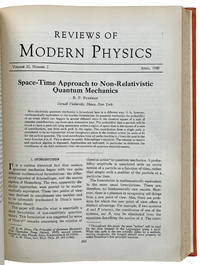
1948S10249Lancaster:: American Physical Society 1948. 1948. Large 8vo. 266 x 205 mm. iv 728 pp. Frontis. port. of Robert Andrews Millikan photos figs. tables. Later orange cloth gilt-stamped spine title; spine faded. Very good. TWO PAPERS FROM THE TWO GIANTS OF 20TH CENTURY PHYSICS AS THEY WERE ORIGINALLY PUBLISHED IN ONE COLLECTED VOLUME. Einstein's "Generalized Theory of Gravitation" is considered the last principal work issued by the 20th Century's premiere scientist. Schilpp-Shields. <br /><br /> Einstein: "A new presentation. . . which constitutes a certain progress in clarity as compared with previous presentations." from the Introduction. Feynman: "At first Feynman's fundamental article RMP 1948 did not arouse much interest among theoretical physicists who were not familiar with Feynman's new approach to doing quantum mechanics. As Feynman recalled: 'At the Shelter Island Conference. . . they asked me if I would explain my path-integral method for doing quantum mechanics so I did. I must have been preparing the manuscript for my paper RMP 1948 so that everything was organized and I explained it. It's hard to pay attention to some new idea and they didn't pay much attention to it.' However nowadays Feynman's RMP 1948 paper is one of the most well-known and widely cited papers; it is one of the cornerstones of modern theoretical physics." Mehra. <br /><br /> "It is a curious historical fact that modern quantum mechanics began with two quite different mathematical formulations: the differential equation of Schroedinger and the matrix algebra of Heisenberg. . . This paper will describe what is essentially a third formulation of non-relativistic quantum theory. This formulation was suggested by some of Paul Dirac's remarks concerning the relation of classical action to quantum mechanics. A probability amplitude is associated with an entire motion of a particle as a function of time rather than simply with a position of the particle at a particular time." from the Introduction. Provenance: David Middleton b. 1920 noted pioneer in the field of statistical communication theory last name gilt-stamped on spine. Einstein: Boni-Russ-Laurence 258; Schilpp-Shields 308 also see p. 758; Wasson Nobel Prize Winners p. 289-294; Weil 222 marked with asterisk by Weil. Feynman: Gleick Genius: The Life and Science of Richard Feynman p. 249; Mehra The Beat of a Different Drum: The Life and Science of Richard Feynman p. 200; Wasson Nobel Prize Winners p. 316-319. American Physical Society, 1948. hardcover books
199815679Ewing New Jersey U.S.A.: Princeton Univ Pr 1998. First Edition. Trade Paperback. Very Good. First Edition. Original white wrappers mildly soiled with creasing front and rear covers. Clean internally a great reading copy. This is the English translation. Title: The Collected Papers of Albert Einstein: The Berlin Years Correspondence 1914-1918 Volume 8. Trade Paperback. Princeton Univ Pr paperback books
1908432171908. <p>Einstein Albert 1879-1955 and Jakob Johann Laub 1884-1962. Über die elektromagnetischen Grundgleichungen für bewegter Körper. Offprint from Annalen der Physik 4th series 26 1908. 532-540pp. 225 x 146 mm. Original printed wrappers. Fine.</p> <p>First Edition Offprint Issue. Einstein's first paper written jointly with a collaborator on the relativistic electrodynamics of ponderable media. "In 1908 Laub wrote works together with Einstein on the basic electromagnetic equations which was aimed to replace the four-dimensional formulation of the electrodynamics by Minkowski by a simpler classical formulation. Both Laub and Einstein discounted the spacetime formalism as too complicated. However it turned out that Minkowski's spacetime formalism was fundamental for the further development of special relativity" Wikipedia. Pais Subtle is the Lord pp. 151 154. Shields 23. Weil 23.</p> . unknown books
191343305Leipzig & Berlin: Teubner 1913. 38pp. 254 x 170 mm. Original printed wrappers chipped. Library stamps. Very good. First separate edition. "After his first discussions with Grossmann Einstein had found the correct starting point for general relativity. The real work could now begin . . . The Einstein-Grossmann paper published in 1913 contains profound physical insight into the nature of measurement some correct general relativistic equations some faulty reasoning and clumsy notation" Pais Subtle is the Lord p. 216. Weil Albert Einstein Bibliography 58. Teubner unknown books
1923432881923. <p>Einstein Albert 1879-1955 and Paul Ehrenfest 1880-1933. Zur Quantentheorie des Strahlungsgleichgewichts. Offprint from Zeitschrift für Physik 19 1923. 301-306pp. Original printed self-wrappers. 230 x 157 mm. Light toning but very good.</p> <p>First Edition Offprint Issue. In 1916 after publishing his great work on general relativity Einstein returned to the question of blackbody radiation. In November 1916 he wrote to his friend Besso that "a splendid light has dawned on me about the absorption and emission of radiation" quoted in Pais p. 405 one that led him to a new derivation of Planck's radiation law and convinced him of the reality of light-quanta photons. After publishing these results in three papers culminating with the famous "Zur Quantentheorie der Strahlung" 1917 Einstein kept looking for "new ways in which the existence of photons might lead to observable derivations from the classical picture" Pais p. 413. He found none until 1923 when Arthur Compton and Peter Debye independently derived the relativistic kinematics for the scattering of a photon off an electron at rest. The work of Compton and Debye led Wolfgang Pauli to extend Einstein's work of 1917 to the case of radiation in equilibrium with free electrons see Pais p. 414n. "Pauli examined the requirements of detailed balance under Lorentz transformations and found that scattering of light by free electrons must include a term of a form which we would now call stimulated emission . . . Einstein and Ehrenfest then showed that Pauli's results could be obtained by an extension of Einstein's 1917 paper with the unnecessary specialization to discrete energy levels removed . . . The core of Einstein's argument is that the scattering process should be broken into two parts: the absorption of energy from radiation of frequency 1 and the emission of energy as radiation of frequency 2" Lewis p. 42. Lewis "Einstein's derivation of Planck's radiation law" American Journal of Physics 41 1973: 38-44. Pais Subtle is the Lord ch. 21. Weil Albert Einstein Bibliography 138.</p> . unknown books
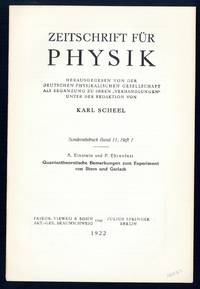
1922432871922. <p>Einstein Albert 1879-1955 and Paul Ehrenfest 1880-1933. Quantentheoretische Bemerkungen zum Experiment von Stern und Gerlach. Offprint from Zeitschrift für Physik 11 1922. 31-34pp. 229 x 155 mm. Original printed self-wrappers. Light toning but fine otherwise. </p> <p>First Edition Offprint Issue. In 1922 the physicists Otto Stern and Walther Gerlach conducted a now-classic experiment in which a beam of silver atoms was streamed through an inharmonious magnetic field in order to observe the atoms' deflection patterns. Rather than a random and continuous distribution as predicted by classical theory the atoms passing through the field were deflected up or down by a specific amount demonstrating that they had intrinsically quantum properties. The Stern-Gerlach experiment corroborated the Bohr-Sommerfeld model of the atom and strongly influenced later developments in 20th century physics. However the experiment also created some serious difficulties for quantum physicists in the period before the rise of the "new" quantum mechanics. </p> <p>Einstein and Ehrenfest addressed one of these difficulties—connected with space quantization—in their joint paper in which </p> <p>"they dealt in particular with the problem of how the orbits of the atom would obtain their discrete directions which they exhibit while passing through the inhomogeneous magnetic field. Under the assumption that the mechanism causing the orientation was provided by the interaction with the radiation field Einstein and Ehrenfest estimated that for a field strength of 10000 G a change in the direction of the orbit would take place in roughly 1011 s; this long time interval would be reduced in the presence of heat radiation at room temperature . . . to about 109 s. How could they asked the experimental situation be explained which implied that the discrete orientations of the orbits in silver atoms were obtained in less than 10-4 s. In order to deal with this evident puzzle Einstein and Ehrenfest proposed two alternatives: first that the silver atoms were always in the states of spatial quantization; second the orientations of the electron orbits arose from an interaction of the atoms with the radiation field which involved much smaller reaction times . . . However they found that both alternatives created considerable difficulties in the understanding of the atomic processes . . . Thus Einstein and Ehrenfest concluded: 'The difficulties mentioned above show how unsatisfactory are both interpretations of the results found by Stern and Gerlach'" Mehra & Rechenberg The Historical Development of Quantum Theory 1 pp. 443-444. </p> <p>Pais Subtle is the Lord p. 328. Weil Albert Einstein Bibliography 121.</p> . unknown books
193322015Völkerbund: Internationales Institut für Geistige Zusammenarbeit 1933. Binding separated from wrappers but intact; a very good copy in printed wrappers with French flaps small mark to front cover light discoloration. First Edition. Octavo. Number 600 of 2000 press-numbered copies. Text in German. Völkerbund: Internationales Institut für Geistige Zusammenarbeit unknown books
1932433001932. Offprint from Sitzungsberichte der Preussischen Akademie der Wissenschaften 32 1932. 31pp. 256 x 183 mm. Original printed wrappers a little chipped and darkened small splits in spine. Very good. First edition offprint issue. Einstein's work on semivectors "was stimulated by Ehrenfest's insistence on a better understanding of the relation between single-valued and double-valued representations of the Lorentz group . . . Einstein and Mayer went on to relate semivectors to the Dirac equation and to generalize the formalism to general relativity" Pais Subtle is the Lord pp. 451-452. Weil Albert Einstein Bibliography 186. unknown books
1915432951915. <p>Einstein Albert 1879-1955 and Wander Johann de Haas 1878-1960. Notiz zu unserer Arbeit "Experimenteller Nachweis der Ampèreschen Molekularströme." Offprint from Verhandlungen der Deutschen Physikalischen Gesellschaft 17 1915. 1 sheet p. 420. 228 x 156 mm. Original printed wrappers. Fine copy.</p> <p>First Edition Offprint Issue. In 1915 Einstein and Dutch physicist Wander Johannes de Haas conducted gyromagnetic experiments leading to the discovery of the Einstein-de Haas effect which corresponds to the mechanical rotation induced in a ferromagnetic cylinder suspended inside a coil when an impulse of electric current is sent through the coil. Einstein was very enthusiastic about the experimental results stating that he and de Haas had "given firm proof of the existence of Ampère's molecular currents" quoted in Pais Subtle is the Lord pp. 245-246. Einstein and de Haas published their results in a paper published earlier in 1915 see Weil 73; the present "Notiz" is a response to a communication from American physicist Samuel Jackson Barnett who had begun performing similar experiments in 1909 and obtained results complementing those of Einstein and de Haas. Weil Albert Einstein Bibliography 73n.</p> . unknown books
1925321321Buenos Aires: Imprenta y Casa Editora Coni 1925. First Edition. 14 pp. Plate with halftone photograph portrait of Albert Einstein by Witcomb. 8vo. Original printed wrappers. Minor browning at wrapper edges. First Edition. 14 pp. Plate with halftone photograph portrait of Albert Einstein by Witcomb. 8vo. From the Library of Einstein's Eldest Son. This scarce commemorative booklet issued on the occasion of Einstein's visit to the University of Buenos Aires contains a biography and bibliography of Einstein together with a list of Einstein's activities while in Argentina during 1925. This example with provenance to Hans Albert Einstein Albert Einstein's oldest son with his inkstamp at top of front wrapper. OCLC locates only three copies Princeton University the National Library of Israel and Hebrew University in Israel. Imprenta y Casa Editora Coni unknown books
193240505Los Angeles: Los ANgeles University of International Relations 1932. First Edition. Quarto 26cm. Pictorial card wrappers; 96pp. Mild external soil; Very Good or better. Includes a translation of Dr. Einstein's 1932 address "World Disarmament" delivered at the World Affairs Dinner in Pasadena February 1 1932. Other contributions Ken Nakazawa and N. Wing Mah on the Sino-Japanese Controversy Bernard Mollenhauer et al. Los ANgeles University of International Relations unknown books
1994S11423New York:: Warner Books 1994. 1994. Small 8vo. 179 pp. Printed wrappers. Fine. ISBN: 0446670111 Warner Books, (1994). unknown books