2 943 résultats
Q-0520004507University of California Press 1962-08-01. Paperback. New. In shrink wrap. Looks like an interesting title! University of California Press paperback
1953040592Berkeley and Los Angeles CA: University of California Press 1953. Book. Near Fine. Original Cloth. First Thus. 8vo - over 7¾" - 9¾" tall. Dark mauve cloth paper title label mounted on upper spine panel. Slight binding lean text block edges a bit toned by age. Dust jacket a bit toned along spine panel with 1" closed tear at head of front joint light shelf wear now in mylar. xxvii496 pp. Einstein's foreword in German with facing-page translation into English. University of California Press Hardcover
1953048358BERKELEY CA.: UNIVERSITY OF CALIFORNIA PRESS. SMALL CHIP TO THE DJ CLEAN UNMARKED COPY! . VG. Hardcover. First Edition. 1953. UNIVERSITY OF CALIFORNIA PRESS hardcover
ill., ril. È la formula più famosa di tutti i tempi. Ma quanti di noi sanno che cosa significa, esattamente? E perché è ancora importante per noi cent'anni dopo la sua esposizione? Il fisico di fama mondiale Christophe Galfard considera il significato reale dietro all'iconica sequenza di simboli di cui è composta la più nota equazione di Einstein. Nello stile accessibile ed evocativo che lo contraddistingue, Galfard dispiega in un racconto appassionato l'impatto di questa teoria sulla nostra visione della realtà, portandoci a una nuova comprensione della natura dello spazio e del tempo.
1997295591Frankfurt am Main : Haag und Herchen, 1997. 271 Seiten. Index ; 21 cm. Originalkarton.
Volume in brossura in condizioni perfette. Raccolta di scritti del fisico tedesco. brossura
Kleine Lesespuren am Umschlag aber keine Einträge o.ä.,, ein gutes und sauberes Exemplar. - "man brüllt seine Lieben zunächst einmal an" -- Schuljahre: auf dem Wege zum "Einspänner" -- Umwege eines "Wunderkinds" -- "Vagabund und Eigenbrödler". Student in Zürich -- "Gott schuf den Esel und gab ihm ein dickes Fell" -- Experte III. Klasse "viel zu denken" -- "Herr Doktor Einstein" und die Realität der Atome -- Die Lichtquanten "sehr revolutionär" -- Die Relativbewegung "mein Leben für sieben Jahre" -- Die Relativitätstheorie "eine Modifikation der Lehre von Raum und Zeit" -- "viel Würdigung". Facetten zum Auftritt des Jahrhundertgenies -- Experte II. Klasse "mit Arbeit arg überladen" -- Vom "Treppenwitz" zum Herrn Professor -- "man lernt viel dabei". Professor in Zürich -- Ordinarius in Prag, aber nicht lange -- Ein Mann fällt vom Dach: Auf dem Wege zur Allgemeinen Relativitätstheorie -- "ich weiß nicht, ob ich noch Eier legen kann". Von Zürich nach Berlin -- "im Narrenhaus". Als Pazifist in Preußen -- "die höchste Befriedigung meines Lebens". Die Vollendung der Allgemeinen Relativitätstheorie -- "ganz >oben<, aber allein". Kriegsjahre in Berlin -- "fiel aus wegen Revolution" -- "daß ich das habe erleben dürfen". Die Bestätigung der Lichtablenkung und der "plötzlich berühmte Dr. Einstein" -- "alles Zeitungsgeschrei". Relativität im Rampenlicht "in Honig geschrieben". Relativität, Philosophie und -- Erkenntniskritik -- "Reisender in Relativität" -- "meine stärkste menschliche Bindung". Judentum -- Zionismus und die Reise nach Amerika -- "so lange der Rummel anhält". Weite Reisen, viel Politik und ein wenig Physik -- Wie Einstein den Nobelpreis erhielt, dadurch Preuße wurde und es vorläufig auch blieb -- "Das marmorne Lächeln der unerbittlichen Natur". Die Suche nach der einheitlichen Feldtheorie -- "lieber Angestellter in einer Spielbank". Die Aporien der Quantentheorie -- "nicht der wahre Jakob". Kritik an der Quantenmechanik -- "nach meinem eigenen Gusto". Politik, Patente, Krankheit und ein "wundervolles Ei" -- "ich revanchiere mich dafür". Öffentliches und Diskretes aus dem Leben eines "Unverbundenen" -- Adieu Berlin: "da es hier für mich brenzlig wird" -- Exil als Befreiung: "Ich werde das Land meiner Geburt wohl nicht mehr sehen." -- Princeton: eine "Schicksalsinsel" -- "Wenn schon, denn schon." Physikalische Realität und ein Paradoxon, Relativität und vereinheitlichte Theorie -- Der Krieg, ein Brief und die Bombe -- Zwischen der Bombe und den Gleichungen: "aber die Gleichungen sind für die Ewigkeit" -- "eine alte Schuld" ISBN 351840489X
192249429Berlin Julius Springer 1922-24. 8vo. 4 contemporary half cloth binding: two in uniform half green cloth and two en uniform grey/blue half cloth. In "Zeitschrift für Physik" Bd. 10 11 16 & 21. Entire volumes offered. All volumes with stamp to title page and front free end paper otherwise a fine and clean set. Friedmann: Bd. 10: Pp. 377-386; Bd. 21: P.p. 326-332. Einstein: Bd. 11:P. 326; Bd. 16: P. 228. <br/><br/><em>First printing of these four landmark paper in which Friedman "introduced into cosmology two concepts of revolutionary importance the age og the world and the creation of the world" Kragh Cosmology and Controversy. "In his paper of 1922 Friedmann offered a complete analysis of the solutions of Einstein's cosmological field equations that went beyond the earlier solutions of Einstein and de Sitter as it also included nonstatic solutions. Friedmann did so clearly and explicitly: "The purpose of this note" he wrote "is firstly to show that the cylindrical Einsteinand spherical de Sitter worlds are special cases of more general assumptions and secondly to demonstrate the possibility of a world in which the curvature of space is independent of the three spatial coordinates but does on time".Ibid.In 'Über die Krümmung des Raumes' Friedman derived the non-stationary solutions to Einstein's field equations. Einstein quickly responded in a short comment 'Bemerkung' in which he expressed his suspicion of such a model of the Universe and apparently pointed out an error in Friedman's calculations. However Friedman now wrote a letter to Einstein in which he enclosed his full calculations. Shortly after this Einstein submitted a short notice Notiz in which he admitted that he himself had performed a calculation error and that Friedman's solutions which shed new light on the matter were valid. Friedman's expanding universe model was corroborated by Edwin Hubble's red-shift observations in 1929. In 'Über die Möglichkeit einer Welt mit konstanter negativer Krümmung des Raumes' Friedman derived the Friedman-equations and demonstrated that he had command of all three Friedman-models describing positive zero and negative curvature respectively nearly a decade before the independent discoveries of the same models by Lemaître Robertson and Walker. "Friedmann made a valuable contribution to Einstein's general theory of relativity. As always his interest was not limited simply to familiarizing himself with this new field of science but led to his own remarkable investigations. Friedmann's work on the theory of relativity dealt with one of its most difficult questions the cosmological problem. In his paper "Über die Krümmung des Raumes" 1922 he outlined the fundamental ideas of his cosmology: the supposition concerning the homogeneity of the distribution of matter in space and the consequent homogence of "world" time for which at any moment in time the metrics of space will be identical at all points and in all directions. This theory is especially important because it leads to a sufficiently correct explanation of the fundamental phenomenon known as the "red shift." This solution of the Einstein field equations obtained from the above propositions is the model for any homogeneous and isotropic cosmological theory. It is interesting to note that Einstein thought that the cosmological solution to the equations of a field had to be static and had to lead to a closed model of the universe. Friedmann discarded both conditions and arrived at an independent solution. Einstein welcomed Friedmann's results because they showed the dispensability of the ad hoc cosmological term Einstein had been forced to introduce into the basic field equation of general relativity". DSB. Weil 122 & 130. </em> hardcover
192225530Braunschweig & Berlin Germany: Friedr. Vieweg & Sohn/Julius Springer 1922 1923 1924. First Edition. Hardcover. Very Good. Alexander Alexandrovich Friedmann 1888-1925 was a Russian mathematician and physicist who built upon Einstein's theory of relativity and further expanded his own theories that the universe has both homogeneous looks the same from every location and isotropic looks the same in every direction. The following articles expand upon these theories: "Über die Krümmung des Raumes" "On the Curvature of Space" by Alexander Friedmann Zeitschrift für Physik 10 pp. 377-386 1922. "Notiz du der Arbeit von A. Friedmann ‘Über die Krümmung des Raumes'" "Note on the work of A. Friedmann ‘On the Curvature of Space'" by Albert Einstein Zeitschrift für Physik 16 p. 228 1923. "Über die Möglichkeit einer Welt mit konstanter negativer Krümmung des Raumes" "On the possibility of a world with constant negative curvature of space" by Alexander Friedmann Zeitschrift für Physik 21 pp. 326-332 1924. Volume 10: iv 413 pp. 8vo; Volume 16: iv 409 1 pp. 8vo; Volume 21: iv 382 pp 8vo. Each volume is ex-library with brown patterned paper boards lighter brown cloth spines and corner tips; gold embossed titling to spine. Library stamps within including stamps on title page of each volume very clean with card pocket remaining on the rear pastedown of each volume. All text in German. Friedr. Vieweg & Sohn/Julius Springer hardcover books
192234667Berlin Julius Springer 1922-24. 8vo. In: "Zeitschrift für Physik" Vol. 10 pp. 377 ff.Vol.11 pp.326 vol.16 pp.228 vol.21 pp.326-332. The entire four volumes offered here. Contemporary half cloth bindings. <br/><br/><em>Two landmark papers in the history of cosmology: All first editions. In 'Über die Krümmung des Raumes' Friedman derived the non-stationary solutions to Einstein's field equations. Einstein quickly responded in a short comment 'Bemerkung' in which he expressed his suspicion of such a model of the Universe and apparently pointed out an error in Friedman's calculations. However Friedman now wrote a letter to Einstein in which he enclosed his full calculations. Shortly after this Einstein submitted a short notice Notiz in which he admitted that he himself had performed a calculation error and that Friedman's solutions which shed new light on the matter were valid. Friedman's expanding universe model was corroborated by Edwin Hubble's red-shift observations in 1929. In 'Über die Möglichkeit einer Welt mit konstanter negativer Krümmung des Raumes' Friedman derived the Friedman-equations and demonstrated that he had command of all three Friedman-models describing positive zero and negative curvature respectively nearly a decade before the independent discoveries of the same models by Lemaître Robertson and Walker. </em> hardcover
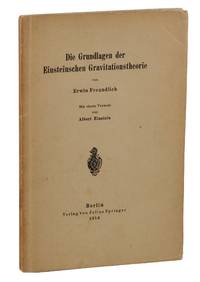
1916140945574Berlin: Verlag von Julius Springer 1916. First edition. First edition. 64 pp. Bound in publisher's wraps. Very Good with slightly toned wraps tiny stain to back wrap slightly bumped corners bookplate on verso of front wrap. <p>An early German language work on Einstein's theory of gravitation with a foreword by the man himself. Freundlich's first book. Verlag von Julius Springer unknown
192425388London:: Methuen 1924. Second edition revised and enlarged. publisher's cloth in dust jacket. . Very good or better in a jacket with an L-shaped closed split at the bottom of the jacket spine a label had been removed from the bottom of the spine which has skinned a few of the letters in the imprint; also there is some splitting along folds. An uncommon book in jacket. . 8vo. With a Preface by Albert Einstein. Methuen, hardcover
197172758Braunschweig: Vieweg (uni-text), 1971. M.I.T. Einführungskurs Physik. Lehrbuch für Lehrbuch für Studenten aller naturwissenschaftlichen und technischen Fachrichtungen ab 3. Semester 287 S. (23 cm) Broschierte Ausgabe
Hier et Demain 1979, grand In-8 broché, 333 pages + index des noms et des sujets traités + illustrations. Cachet de bibliothéque. Trés bon état.
197999925571Hier et Demain 1979 Hier et Demain 1979, grand In-8 broché, 333 pages + index des noms et des sujets traités + illustrations. Cachet de bibliothéque. Trés bon état.
19798467San Francisco, W.H. Freeman, 1979. An Introduction to Einstein's Theory XVIII, 172 S. (23,5 cm) Broschur / Fadenheftung
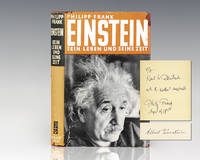
1949133215Munchen: Paul List Verlag 1949. First German edition of this classic work by Frank a famed contemporary of Einstein. Octavo original cloth. Signed by Albert Einstein on the slip to the title page and inscribed by the author on the front free endpaper "To Karl W. Deutsch with the author's compliments Philipp Frank August 10 1950." Philipp Frank was a physicist mathematician and also a philosopher during the first half of the 20th century. He was a logical-positivist and a member of the Vienna Circle. He was influenced by Mach and was one of the Machists criticised by Lenin in Materialism and Empirio-criticism. He studied physics at the University of Vienna and graduated in 1907 with a thesis in theoretical physics under the supervision of Ludwig Boltzmann. Albert Einstein recommended him as his successor for a professorship at the German Charles-Ferdinand University of Prague a position which he held from 1912 until 1938. Very good in a good dust jacket. Much has been written about Albert Einstein technical and biographical but very little remains as valuable as this unique hybrid of a book written by Einstein's colleague and contemporary. Both rich in personal insights and grounded in a deep knowledge of twentieth-century science Phillip Frank's biography anchors the reader with a lucid overview of physics and draws an intimate portrait of the Nobel Prize–winner. Paul List Verlag hardcover
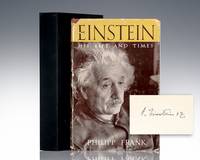
1947147192New York: Alfred A. Knopf 1947. First edition of this classic work by Frank a famed contemporary of Einstein. Octavo original cloth. Signed by the subject in the year of publication on the front free endpaper "A. Einstein 47." Translated from a German manuscript by George Rosen. Edited and Revised by Shuichi Kusaka. Housed in a custom half morocco slipcase. Rare and desirable signed by Einstein. Much has been written about Albert Einstein technical and biographical but very little remains as valuable as this unique hybrid of a book written by Einstein's colleague and contemporary. Both rich in personal insights and grounded in a deep knowledge of twentieth-century science Phillip Frank's biography anchors the reader with a lucid overview of physics and draws an intimate portrait of the Nobel Prize–winner. Very good in a very good dust jacket name to the front pastedown side edges. Alfred A. Knopf hardcover
in-8°, 435 p., broche, couverture illustree Bel exemplaire. [CA28-2][SC-4vf][TX-15]
1953200315New York, Knopf, 1953. M. 16 Taf. XXVII, 298, XII S. OLwd.
Albin Michel 1950, In-8 broché, 429 pages. Bon état.
19141199Braunschweig: Friedr. Vieweg & Sohn 1914. 1st Edition. FIRST EDITION FULL VOLUME OF THE FRANCK-HERTZ EXPERIMENT: THE FIRST ELECTRICAL MEASUREMENT TO CLEARLY SHOW THE QUANTUM NATURE OF ATOMS - PROOF OF THE QUANTIZED MODEL OF THE BOHR ATOM & OF PLANCK'S QUANTUM THEORY. Note that this volume includes both the first and second Franck-Hertz experiment. In the first they demonstrate that atoms can only absorb and be excited by specific amounts of energy; in the second experiment performed the same year they demonstrate that the frequency of the light emitted following the collision of electrons with mercury atoms corresponds precisely with the energy lost by the electrons in the collision. Franck and Hertz received the Nobel Prize for this work specifically "for their discovery of the laws governing the impact of an electron upon an atom" Nobel Prize Committee. <br /> <br /> Of equal import this volume also contains a paper by Einstein in which he uses the light quantum hypothesis to give new derivations of Planck's radiation law and Nernst's third law of thermodynamics. His "proofs introduced the quantum hypothesis" Calaprice The Einstein Almanac 40. <br /> <br /> In 1914 James Franck and Gustav Hertz were working together in the Physics Institute of Berlin and were "particularly interested in ionization i.e. in the process in which an electron is removed from an atom" The Harvest of a Century" p. 102-103. The experiment they devised now known commonly as the Franck-Hertz experiment is "a vivid illustration of the quantization of energy" that relied on methodology so simple "that it is now carried out regularly by undergraduates. They accelerated electrons through a low-pressure gas of mercury. When the electrons' energy reach the energy of a stationary state of mercury they gave up a quantum of energy to the mercury resulting in a stepwise shape to the curve of current through the apparatus. This demonstrated that atoms could absorb energy only in discrete amounts" Peacock The Quantum Revolution 40. <br /> <br /> "Franck and Hertz had not only shown for the first time that electrons lose their kinetic energy to mercury atoms in energy quanta but also that these energy quanta are equal to the energy of the light emitted by the same atoms if interpreted with Einstein's light-quantum hypothesis.This was the first experimental determination of Planck's constant not using blackbody radiation" Brandt 103. CONDITION & DETAILS: Braunschweig: Friedr. Vieweg & Sohn. 8vo. Unobtrusive stamp on front paste down and title page. In-text figures throughout. Tightly bound in leather over marbled paper boards; gilt-lettered and tooled at the slightly faded and spotted spine which looks worse in the image due to the bright light than it does to the eye. Unusually beautiful marbled paper edges. Bright and very clean throughout. Near fine. Friedr. Vieweg & Sohn hardcover
5925P., A.Michel, 1950, un volume in 8, broché, couverture imprimée, 435pp.
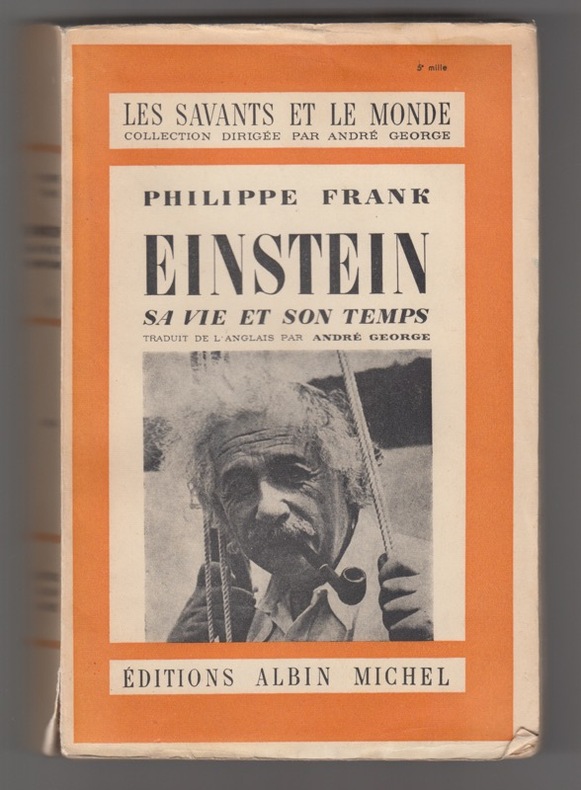
195010252Paris Albin Michel 1950 Petit In-8 435 pp, traduit de l'anglais par André George, VIII reproductions photographiques en noir hors-texte.
12463Albin Michel, Paris, 1950. Un volume in-12 broché de 440 pages. Traduit de l'anglais. Photos hors-texte. Collection "Les savants et le Monde". bon état.