"FRIEDMANN, ALEXANDER (+) ALBERT EINSTEIN.Livre Rare Book

2 944 résultats
192249429Berlin, Julius Springer, 1922-24. 8vo. 4 contemporary half cloth binding: two in uniform half green cloth and two en uniform grey/blue half cloth. In ""Zeitschrift für Physik"", Bd. 10, 11, 16 & 21. Entire volumes offered. All volumes with stamp to title page and front free end paper, otherwise a fine and clean set. [Friedmann:] Bd. 10: Pp. 377-386" Bd. 21: P.p. 326-332. [Einstein:] Bd. 11:P. 326" Bd. 16: P. 228.
192338826Berlin, Verlag der Akademie der Wissenschaften, 1923. 4to. Uncut and partly unopened in orig. wrappers to issue XXVIII-XXIV of ""Sitzungsberichte der Preussischen Akademie der Wissenschaften"". Wrappers with nicks and tears, especilly frontwrapper with marginal loss. Die Energieschwankungen...pp. 350-354. - Bemerkung zu Quantenstatistik...pp. 355-58.- Bietet die Feldtheorie...pp. 359-364. - Zur Theorie der von glühende...pp. 334-348.
188748810Leipzig, Barth, 1887-91. 8vo. No wrappers. 4 papers. In: ""Annalen der Physik und Chemie. Hrsg. von G. Wiedemann"", Neue Folge, Bd. XXX, No. 4, XXXI, No 6, XXXII, No. 11, XLIV, No. 11. - Pp. 545-704 a. 1 plate, pp. 145-336 a. 1 plate, pp. 337-528 a. 1 plate, pp. 385-576 a. 1 plate. With titlepge to vol. XXX, htitlepage to vol. XXXI, titlepage to vol. XXXII and titlepage to vol. XLIV. Titlepages with a stamp and on verso. Planck's papers: pp. 562-582, pp. 189-203, pp. 462-503 and pp. 385-428. Clean copies.
192210378Paris: Albin Michel 1922. Fine. Albin Michel Paris 1922 12 x 19 cm broché First edition of which there were no deluxe copies. Rare and handsome copy. Albin Michel unknown
192230290Paris: Payot 1922. Fine. Payot Paris 1922 12 x 19 cm broché First edition. A nice copy. Payot unknown
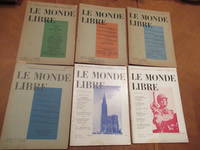
1944020487Montreal / London 1944 and 1945: Free World Inc 1944. First Editions . Printed Wrappers. Very Good. Drawings and Other Artwork. Six Issues. The French Language Edition Of "The Free World". No. 1 Has Chipping At Lower Corner Of Front Cover And Adjacent Pages Adjacent To Spine; Others Are Vg To Near Fine. <br/> <br/> Free World Inc unknown
a743771969. Article at pp. 968-981 in the American Journal of Physics Volume 37 No 10. October 1969. Included in a complete issue which has numerous additional articles. 4to. original printed peach colored wraps. Fine. . paperback
in-8°, 114 pages, illustrations hors-texte, broche, couverture illustree Tres bel exemplaire. [SC-3]
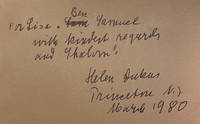
197932820372FIRST EDITION. <b>Presentation copy inscribed by Einstein's longtime assistant Helen Dukas: "For Lisa Ben Samuel with kindest regards and Shalom Helen Dukas Princeton N.J. March 1980."</b><p>Helen Dukas became Einstein's secretary in 1928 and after his death in 1955 served as a trustee of his literary estate and archivist of his papers. This volume prints letters and documents selected by Dukas over the years to shed light on Einstein's character and personality.</p><br /><p>Original cloth and dust jacket. Some rubbing to jacket else very good.</p><br /> Princeton: University Press
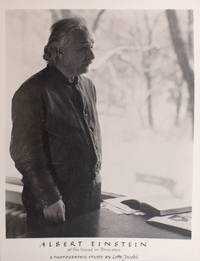
19403293321940. Black and white photographic print. 6 1/2 x 4 7/8 in. Fine. Black and white photographic print. 6 1/2 x 4 7/8 in. unknown
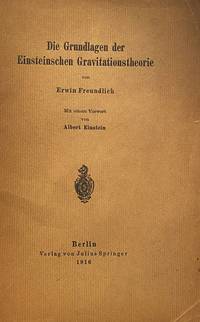
191632820373<p>Original wrappers. Very good.</p><p>FIRST EDITION. This work on Albert Einstein's theory of gravitation contains a foreword by Einstein. Freundlich is best known for his attempts to experimentally test the general theory of relativity using astronomical observations based on the gravitational redshift.<br /><br />Freundlich worked as an assistant at the University Observatory in Berlin at the time he published this work. In 1920 he moved to the Astrophysical Observatory in Potsdam where he was director from 1921-33</p><br /> Springer paperback
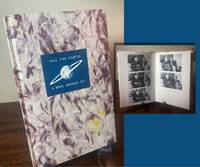
195533869New York: The Ram Press 1955 1955. First Edition. Hardcover. Fine/Dust Jacket Included. First Edition. Hardcover. For the Einstein enthusiast. First Edition. Limited to 3000 Copies in the original glassine outer wrapper. 8vo. 40 pp. With black and white photographs of Albert Einstein and Frank Back. A fine copy in handmade decorative paper covered boards printed glossy paper label to the upper cover. The volume dedicated to Albert Einstein is the only book written by Dr. Frank Back "The Father of the Zoom Lens" and creator of the first widely used zoom lenses for film and television. Dr. Back a close friend of Albert Einstein was persuaded by Einstein to take the trip commemorated in this beautifully produced volume in order to capture the total eclipse of the sun which occurred on June 20 1955. Dr. Back intended to provide conclusive evidence for Einstein's theory of relativity by calculating the optical distortion if any of starlight caused by the sun's gravity. In 1919 Einstein's general relativity principles were supported by observations of a solar eclipse. The two scientists conferred on the project for over a year. Armed with a special Zoomar designed and built wide-angle solar-eclipse spectrograph Dr. Back was off to the Philippine Islands to board a military jet and chase the eclipse. Einstein however died while Back was on his way to Manila. Unable to report the excursion to his friend Dr. Back dedicated this book to his memory. <br /> In a TBCL dark green cloth slipcase. Size: 8vo - over 7¾" - 9¾" tall. The Ram Press, (1955) hardcover
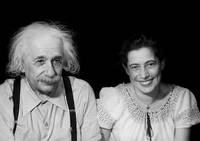
195032820550<p>This photograph shows a reunion of friends. The Sternbergers and Einstein had known one other in Europe and met again in Princeton. Ilse was Sternberger's wife collaborator and perennial foil. She was a constant source of warmth during sometimes-contentious sittings. She also helped document their life publishing several articles on Sternberger's work and their sessions with famous sitters after his death.</p><br /><p>Gelatin silver print 20 x 30 in. Archivally framed. Estate Edition a limited edition of 10 copies embossed and numbered.</p><br /><p><b>$2500 unframed; framed: $3000 </b></p>
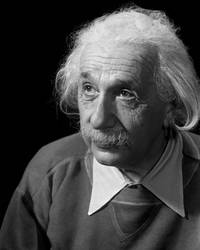
195032820558<p>In this portrait Sternberger shows Einstein dressed informally. Einstein was keenly aware of his public image and often attempted to show a cheerful visage. The common backgrounds of the two men helped the photographer to put Einstein in a relaxed state and to capture him in a more vulnerable pose.</p><p>Marcel Sternberger and Albert Einstein had known each other in Europe long before the two met again in Princeton New Jersey for this session. Before the men left Europe Einstein had furnished the preface to a book written by Sternberger.</p><p>After a warm welcome and lemonade the men settled in for the sitting. They discussed various topics including World War II and the state of American education. Although some photographs from the session show Einstein with a telltale twinkle in his eye here the great scientist appears fatigued. The seriousness of their conversation seems to have worn him down.</p><p>Still the conversation had its moments of levity. At one moment Sternberger asked Einstein to remove his suspenders. Einstein replied "I am going to lose my trousers! I can't." Einstein instead put on one of his trademark sweatshirts.</p><p>Here modern science's greatest mind is forever immortalized as only Sternberger could. He has found a depth of personality exceeding photographs produced without regard to the sitter's inner psychological state.</p><br /><p>Gelatin silver print 16 x 20 in. Archivally framed. Estate Edition a limited edition of 20 copies embossed and numbered.</p><br /><p><b>$1250 unframed; framed: $1650 </b></p>
1921553355Boston: Talmud Society 1921. Softcover. Fine. First edition. 12mo. 64pp. Original cord-tied wrappers printed in red and black. The first and last leaf toned from interaction with the wrappers else about fine. An August issue of the magazine apparently used in October to promote the short-lived magazine this copy with a printed slip affixed to the front wrap: “October 1921. Specimen Copy. Containing an article on the Einstein Theory of Anti-Semitism.†Photographic portrait of Einstein on page 14; along with an English translation of his essay: "Jewish Nationalism and Anti-Semitism: Their Relativity" which originally appeared in the London Jewish Chronicle. Talmud Society unknown
a92175Single complete issue of Proceedings of the American Philosophical Society volume 93 number 7. December 30 1949. first edition. Original printed 4to wraps. pp. 521-548 iv. VG minor uneven fading of cover slight toning along spine no ownership marks. Text fine and clean. Pictures available on request. . paperback
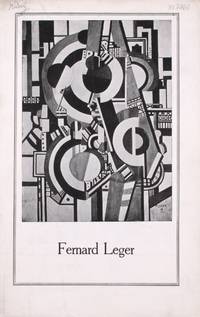
1925333269New York: Société Anonyme Inc 1925. First edition. 6 black and white illustrations 11 pp. 8vo. Side-stapled printed wrappers somewhat soiled. First edition. 6 black and white illustrations 11 pp. 8vo. Published in conjunction with an exhibition of Leger's work by the Société Anonyme from November 16th to the 28th 1925. Includes an introduction by Dreier a creative piece translated from the French of Karl Einstein and "Notations on Plastic Values" by Léger. Scarce OCLC only records a copy at Yale from the papers of Katherine S. Dreier. Collection of the Société Anonyme p. 218 Société Anonyme, Inc unknown
a90181Leipzig 1909 Hirzel. first edition. One full year of this semi-monthly German publication bound in one hardcover volume. Articles by many of the great names in physics and mathematics including Ladenburg Planck Hilbert Hahn Meitner Ramsey Zeeman Zamboni Zorn Thomson Curie Born Poincare and many more luminaries. Of special interest are H. Minkowski's "Raum und Zeit" p. 104-111 where time is posed as a fourth dimesion in a space-time representation of reality and 3 articles by Albert Einstein including his seminal paper where light is treated as both a wave and a particle. Hardcovers. Lg.4to. 1040p. XXVI photo plates complete text illustrations. Cover tips and backstrip dark brown leather with black boards. Institute name stamp on front blank and blindstamp on titlepage - no other ownership marks no pocket no spine numbers. Binding very secure; hinges not cracked in or out. Text clean. VG plus lightwear on cover spine edges and extreme tips. . hardcover
1995030660Las Vegas: Mike O=Callagghan Middle School. A near fine or better copy. Has some little known history of Las Vegas. Illustrated Size: 4to - over 9¾" - 12" Tall . Near Fine. 1995. Mike O=Callagghan Middle School unknown
1986117899ABLeipzig, Offizin Andersen Nexö, 1986. 5,3 x 5,3 cm. 378 S., 3 Blatt mit zahlreichen teils farbigen Abb. auf Tafeln. Olivgrüner Original-Lederband mit Goldprägung in OSchuber.
1986122238ABLeipzig, Offizin Andersen Nexö, 1986. 5,3 x 5,3 cm. 378 S., 3 Blatt mit zahlreichen teils farbigen Abb. auf Tafeln. Olivgrüner Original-Lederband mit Goldprägung in OSchuber.
GF15174Dessin original à l'encre de chine sur calque signé - format 13,5 x 10,5 cm -
2006LFA-126720087Revue de 120 pages, format 145 x 205 mm, illustrée, brochée couverture couleurs, publiée en 2006, bon état
200510073Stockholm, Bermann Fischer Verlag, 1947 ; in-8, 636 pp., cartonnage de l'éditeur avec jaquette. Jaquette abîmée.
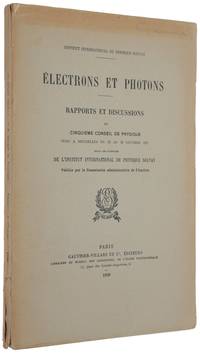
19286594Paris: Gauthier Villars 1928. First edition. <p>First edition rare in the original printed wrappers of the proceedings of the Fifth Solvay Congress 1927-the most celebrated of the Solvay conferences and the setting in which the Bohr-Einstein debate over the consistency and completeness of quantum mechanics first took public programmatic form. Convened under the banner "Electrons and Photons" the meeting brought together nearly all the principal architects of the old and the new quantum theory; seventeen of the twenty-nine participants were or became Nobel Prize laureates.</p>. The Bohr-Einstein Debate Begins. <p>First edition rare in the original printed wrappers of the proceedings of the fifth Solvay Congress where the debate between Bohr and Einstein on the consistency and completeness of quantum mechanics began. It was at this the most famous of the Solvay conferences that Einstein disenchanted with Heisenberg's uncertainly principle made his famous remark that "God does not play dice" to which Niels Bohr replied "Einstein stop telling God what to do!" Seventeen of the twenty-nine attendees which included nearly all the principal architects of the old and the new quantum theory were or became Nobel Prize winners. "The three and a half years since the fourth Solvay Conference . were marked by enormous progress in quantum physics. Partly based on discoveries and ideas that had been available already before 1924 − such as the Compton effect and matter waves − the new atomic theory had arisen which did more than throw new light on the difficulties discussed at the 1924 conference: quantum or wave mechanics went right to the heart of the problems posed by atomic phenomena. The two subjects put programmatically into the title of the fifth Solvay Conference − electrons and photons − designated the crucial points of interest because 'electrons' also stood for the smallest massive constituents of matter and they now became associated with waves and 'photons' a name given only recently in October 1926 by the physical chemist Gilbert N. Lewis to Einstein's light-quanta characterized the quantum-theoretical aspect of electromagnetic radiation. It was the declared intention of the Scientific Committee of the Institut International dePhysique Solvay to contribute by scientific reports and discussions about them to the clarification of the scientific concepts in the physics of the day. In retrospect one may indeed attribute an important success to the 1927 Solvay Conference in marking the completion of the ideas that had first been discussed in the international physics community sixteen years previously at the first Solvay Conference of 1911" Mehra & Rechenberg pp. 233-4. Following a 'Notice nécrologique' by Lorentz the present volume contains the following reports and discussions about them by the participants all articles in French: 'The Intensity of the Reflection of X-rays' by Bragg; 'Disagreement between Experience and the Electromagnetic Theory of Radiation' by Compton; 'The New Dynamics of Quanta' by de Broglie;<br /> 'The Mechanics of Quanta' by Born and Heisenberg; 'The Mechanics of Waves' by Schrödinger;<br /> 'The Quantum Postulate and the New Development of Atomic Theory' by Bohr. No copies located in auction records.</p> <br /> <p>In 1911 the Belgian industrialist Ernest Solvay invited a group of the world's most prominent physicists including Einstein Planck Lorentz Sommerfeld Rutherford and Marie Curie to participate in a scientific conference on the difficulties of reconciling classical physics with quantum theory. The conference "set the style for a new type of scientific meetings in which a select group of the most well informed experts in a given field would meet to discuss the problems at its frontiers and would seek to define the steps for their solution" Mehra Solvay Conferences p. xv. The first Solvay Conference-widely considered a turning point in the history of modern physics-was so successful that in the following year Solvay established a foundation now known as the International Solvay Institutes for Physics and Chemistry "to encourage the researches which would extend and deepen the knowledge of natural phenomena" ibid. and to sponsor further conferences. The next two Solvay Conferences met in 1913 and 1921; subsequent conferences have been held every three years except during wartime.</p> <br /> <p>"From amongst the members of the Scientific Committee of the 1927 Congress two had already played a leading role in 1911: the Chairman Hendrik Lorentz and Albert Einstein; the latter had presented then the most revolutionary report on the light quantum. In spring 1926 in the early stage of preparing for the new conference Lorentz again requested Einstein to write a report. The latter answered promptly: 'If you wish that I take over the report on quantum statistics I shall do so with pleasure; because without being in great difficulty I shall never say "no" to you' Einstein to Lorentz 1 May 1926 . On 17 June 1927 Einstein wrote to Lorentz: 'I recall having committed myself to you to give a report on quantum statistics at the Solvay Conference. After much reflection back and forth I came to the conclusion that I am not competent for giving such a report in a way which really corresponds to the state of the thing. The reason is that I have not been able to participate as intensively in the modern development of quantum theory as would be necessary for that purpose. This is in part because I have on the whole too little receptive talent for fully following the stormy developments in part also because I do not approve of the purely statistical way of thinking on which the new theory is founded .' As a substitute speaker for the topic assigned to him he proposed either Enrico Fermi from Italy or Paul Langevin from France. Ultimately however neither of them gave the report on Einstein's subject. Instead Niels Bohr agreed to contribute a report on a different topic: namely on his latest considerations on the problem of the interpretation of quantum mechanics.</p> <br /> <p>"The rapporteurs at the fifth Solvay Conference fell into three groups: the experimentalists Bragg and Compton; the theoreticians advocating the Gottingen-Cambridge-Copenhagen versions of quantum mechanics − Bohr Born and Heisenberg; and those of the wave-mechanical camp − de Broglie and Schrodinger.</p> <br /> <p>"The selection of Arthur Holly Compton seemed to be most appropriate because the Compton effect − discovered in late 1922 − had been one of the crucial results triggering the entire development which ended with the new atomic theory by providing Einstein's light-quantum hypothesis of 1905 a firm experimental foundation. Since its discovery and even more so after the refutation of the Bohr-Kramers-Slater theory of radiation . Einstein's fundamental light-quantum conception . became a physical reality. Compton's report dwelt on the conceptual consequences rather than on experimental details. In particular he addressed the questions of the aether and of electromagnetic waves on the one hand and the phenomena contradicting the classical wave concepts such as the photoelectric effect X-ray diffraction certain electron-recoil effects observed by C. T. R. Wilson and W. Bothe in 1923 and the individual interaction between radiation-quanta and electrons i.e. the Compton effect. Compton showed also in some detail how the Bohr-Kramers-Slater theory failed to account for these observations.</p> <br /> <p>"The report of William Lawrence Bragg a regular participant in the Solvay Conferences since 1913 appeared to address on first inspection less central points. However from his presentation of the material on reflection of X-rays one easily recognizes the strategy of the Scientific Committee of the Conference: Bragg had to take over the task of stressing those radiation phenomena that could be described by the wave theory namely the diffraction of X-rays by crystal lattices. Consequently he gave the story from Laue's discovery in 1912 over the subsequent work of his father William Henry Bragg and himself to the later investigations of Paul Ewald William Duane and others. Bragg demonstrated in detail how the old and the new wave theories worked to describe the phenomena of diffraction and refraction of X-rays. In the discussion of Bragg's report Hendrik Kramers presented at some length the recent development of the dispersion theory by himself and Ralph Kronig.</p> <br /> <p>"Both experimental reports served as a firm basis for the discussion of the theoretical concepts which provided the central theme of the conference. This significance was shown by the discussions immediately following them. Compton's talk especially gave rise to a lively exchange of ideas and arguments in which besides the experimentalists e.g. Bragg Madame Curie O. W. Richardson and C. T. R. Wilson almost all of the theoretical experts present participated i.e. Bohr Born Debye Dirac Ehrenfest Lorentz Pauli and Schrödinger − with one important exception: according to the published proceedings of the fifth Solvay Conference offered here Einstein remained silent after the presentations of Compton and Bragg .</p> <br /> <p>"The presentation of the theoretical reports at the Solvay Conference proceeded by following the historical order in which the ideas had been published between 1923 and 1926: thus de Broglie's talk came first then Born and Heisenberg's followed by Schrödinger's and finally Bohr's .</p> <br /> <p>"In the course of the year 1927 the Copenhagen physicists Heisenberg among them clarified their ideas on the interpretation of atomic phenomena. Although they admitted the existence and persistence of statistical relations in quantum mechanics they searched for − and succeeded in − formulating principles that in their opinion at least provided the deeper reason for these statistical features: the uncertainty relations and the complementarity principle. In spite of this difference in attitude toward what they regarded as truly fundamental and actually derived Heisenberg felt no difficulty in preparing a joint Solvay report together with his former teacher Max Born. Their report provided a view of the work performed in Göttingen and Cambridge in establishing quantum mechanics with chapters on matrix mechanics and its transformation into wave mechanics I the physical interpretation of the theory II and the uncertainty principle III. The balance in representing the main interests of the two authors was achieved insofar as Section II dealt with Born's statistical interpretation and Section III with Heisenberg's limitation on measurements in quantum mechanics. Moreover the Born-Heisenberg report also signaled the agreement reached by Heisenberg and Niels Bohr during the summer of 1927 .</p> <br /> <p>"Louis de Broglie entitled his report 'The new dynamics of quanta'; he covered the story from his first ideas on matter waves in 1923-24 to the advent of Schrödinger's equation in 1926 and on to the new pilot-wave theory in 1927. He further applied the pilot-wave theory to the problem of the hydrogen atom and claimed that the treatment yielded an easier understanding of the actual situation; finally he spoke about the experimental verification of matter waves obtained recently in the experiments of Clinton Joseph Davisson and Lester Halbert Germer and George Paget Thomson and Alexander Reid . Erwin Schrödinger on the other hand concentrated on the mathematical aspects of his wave-mechanical scheme the time-independent as well as the time-dependent equations the formal equivalence of wave mechanics to the Born-Heisenberg-Jordan matrix scheme and the relativistic wave equation. At the end of the conference Niels Bohr presented a modified version of his Como lecture under the title 'The Quantum Postulate and the New Development of Atomic Theory' .</p> <br /> <p>"Although the Born-Heisenberg and Schrödinger reports provoked only technical questions that of de Broglie and especially the one of Bohr stimulated some conceptual discussion. Thus Lorentz asked de Broglie how the old Sommerfeld quantum conditions could be obtained from the new matter-wave ideas and Pauli provided an appropriate calculation using the conservation law for the relativistic electric current; also Leon Brillouin illustrated some 'optical' applications of matter waves. Finally Bohr's report at the end provided the proper start for a very excited 'General Discussion of the New Ideas Put Forward.'</p> <br /> <p>"Upon an opening reflection of Hendrik Lorentz − who expressed some reservation with respect to the new pictures of electrons in quantum and wave-mechanics − and a technical illustration of Max Born for dealing with many-electron systems in the probability scheme Einstein addressed an elementary problem in the physical interpretation of the theory. He suggested in particular to consider an electron passing through a slit in a screen and to discuss the diffraction phenomena obtained. He claimed that 'with respect to quantum mechanics one can take two standpoints regarding its validity' namely:</p> <br /> <p>Interpretation I: The de Broglie-Schrodinger waves do not correspond to a single electron but to an electron cloud extended in space. The theory does not give then any information about an ensemble of an infinity of elementary processes.</p> <br /> <p>Interpretation II: The theory claims to be a complete theory of individual processes. Each particle which moves towards the screen as far as one can determine from its position and velocity is described by a de Broglie-Schrödinger wave packet of small length and small aperture. This wave packet is diffracted and after diffraction arrives partly at the film where it is registered in a resolved state Einstein in the present work pp. 254-5.</p> <br /> <p>"Evidently Interpretation II went beyond I and even included the latter; it also implied that the conservation laws especially for momentum were valid for individual atomic processes thus explaining the Bothe-Geiger experiment as well as other experiments. Still Einstein also objected to this interpretation because: 'If Ψ2 where Ψ is the wave function were simply considered as the probability for a particle to be at a place at the definite instant it might happen that one and the same elementary process would cause an action at two or more places on the screen' which would imply an action-at-a-distance hence a violation of the relativity postulate. The only way out of this difficulty had to be sought with de Broglie in further attempts to localize the microscopic particle. Einstein claimed further that the multidimensional phase space assumed for many-particle systems in quantum or wave mechanics and the corresponding permutation properties contradicted the new statistical results.</p> <br /> <p>"Although Lorentz tried to illuminate the statistical argument further Wolfgang Pauli contradicted Einstein by referring to the recent work of Paul Dirac Pascual Jordan and Oskar Klein on field quantization. He also refuted another argument of Einstein's that the range of forces in quantum mechanics might create problems by pointing to the work of Walter Heitler and Fritz London on molecular binding. Dirac at first supported Pauli's plea; then he stated his 'opinion about determinism and the significance of numbers which occur in the calculus of quantum theory' notably: 'In the classical theory one starts from certain numbers which completely specify the initial state of the system and one deduces certain numbers which specify the final state. This determination applies only to an isolated system' Dirac in the present work p. 261.</p> <br /> <p>"Now according to Bohr isolated systems are by definition unobservable because any observation must disturb the system; as a result already 'the classical deterministic theory cannot be defended.' Furthermore: 'In the quantum theory one starts from certain numbers from which one deduces certain other numbers . The perturbations which an observer inflicts on a system in order to observe it are directly subject to his control and are acts of his free will. It is exclusively the numbers which describe these acts of free choice that can be taken as initial numbers for a calculation in the quantum theory. Other numbers specifying the initial state of the system are fundamentally unobservable and do not appear in the quantum-theoretical treatment' Dirac loc. cit. .</p> <br /> <p>"After Dirac had illustrated his interpretation of the quantum-mechanical process and its observation in the case of a sample collision experiment Heisenberg remarked that he did 'not agree' with Dirac saying 'that in the experiment described nature makes a choice' because: 'Even if you place yourself very far from your scattering material and if you measure after a very long time you can obtain interference by taking two mirrors. If nature were to make a choice it would be difficult to imagine how the interference can be produced. Evidently we can say that nature's choice can never be known until the decisive experiment has been done; for this reason we cannot make any real objection to this choice because the expression "nature makes a choice" does not have any physical consequences. I would say as I have done in my latest paper that the observer himself makes the choice because it is not until the moment when the observation is made that the "choice" becomes a physical reality and that the phase relation in the waves i.e. the ability to interfere is destroyed' Heisenberg in the present work pp. 264-5 .</p> <br /> <p>"The differences in interpretation among the main pioneers of quantum mechanics that showed in this exchange notably between Bohr and Heisenberg and Dirac would become more pronounced in the future .</p> <br /> <p>"In the recollections of some participants of the fifth Solvay Conference the exchange between Bohr and Einstein on fundamental questions concerning the interpretation of quantum mechanics stands out vividly. Thus Bohr after more than twenty years wrote a detailed account of his 'Discussions with Einstein on Epistemological Problems in Atomic Theory' where he introduced the important part dealing with the 1927 exchange by saying: 'At the general discussions in Como we all missed the presence of Einstein but soon after in October 1927 I had the opportunity to meet him in Brussels at the Fifth Physical Conference of the Solvay Institute . At the Solvay meetings Einstein had from their beginning been a most prominent figure and several of us came to the Conference with great anticipations to learn his reaction to the latest stage of the development which to our view went far in clarifying the problems which he had himself from the outset elicited so ingeniously. During the discussions where the whole subject was reviewed by contributions from many sides Einstein expressed however a deep concern over the extent to which causal account in space and time was abandoned in quantum mechanics.'</p> <br /> <p>"The official discussions referred to above throw light on some of the exchanges on the questions that did interest Einstein although Bohr's participation in them does not seem to have been so active. For example no answer from Bohr to Einstein's analysis of the electron's passage through a slit or screen was recorded. Bohr just made some notes which are to be found in his files and as Louis de Broglie recalled: 'Also Einstein said hardly anything beyond presenting a very simple objection to the probability interpretation. Then he fell silent'. However Heisenberg took away quite a different impression from the conference and decades later he wrote enthusiastically: 'The discussions were soon focused upon a duel between Einstein and Bohr on the question as to what extent atomic theory in its present form could be considered to be the final solution of the difficulties which had been discussed for several decades. We generally met already at breakfast in the hotel and Einstein began to describe an ideal Gedanken experiment in which he thought the inner contradictions of the Copenhagen interpretation were especially clearly visible. Einstein Bohr and I walked together from the hotel to the conference building and I listened to the lively discussion between those two people whose philosophical attitudes were so different and from time to time I added a remark on the structure of the mathematical formalism. During the meeting and particularly in the pauses we younger people mostly Pauli and I tried to analyze Einstein's experiment and at lunch time the discussions continued between Bohr and the others from Copenhagen. Bohr had usually finished the complete analysis of the ideal experiment by late afternoon and would show it to Einstein at the supper table. Einstein had no good objection to this analysis but in his heart he was not convinced. Bohr's friend Ehrenfest who was also a close friend of Einstein said to him 'I am ashamed of you Einstein! You put yourself here just in the same position as your opponents in their futile attempts to refute your relativity theory."</p> <br /> <p>"Thus by piecing together the contemporary documents of 1927 with the later recollections of the participants a fairly consistent historical picture of the great epistemological debate between Bohr and Einstein has arisen. The fifth Solvay Conference would not end this debate however. Both participants returned to the problems involved again and again especially at the sixth Solvay Conference in 1930 and a few years later in 1935. Still quantum mechanics had already scored the main points in its favour. 'The most important success of the Brussels meeting was that we could see that against any objections against any attempts to disprove the theory we could get along with it' Heisenberg summarized the result in an interview in 1963 and added: 'At that time in 1927 it was practically Bohr Pauli and myself perhaps just the three of us. That very soon spread out'" Mehra & Rechenberg The Historical Development of Quantum Theory vol. 6 pp. 232-256.</p> <br /> <p>For an English translation and detailed analysis of the conference reports see Bacciagaluppi & Valentini Quantum Theory at the Crossroads. Reconsidering the 1927 Solvay Conference Cambridge 2009.</p> <br/> <br/> 8vo 255 x 165 mm pp. viii 289 with frontispiece portrait of Lorentz. Original printed wrappers spine ends slightly chipped upper margin of front wrapper sunned. Gauthier Villars unknown