1 803 résultats
193313747Los Angeles 1933. Signed by the photographer Aaron Tycko of Los Angeles. Prominently signed “Albert Einstein. 1933†below image. Rarely seen photograph of the famous scientist taken during his last visit to Southern California in January 1933 the month Hitler took power in his native Germany. During the five-month trip Einstein 1879-1955 spent most of his time at the Mount Wilson Observatory and the California Institute of Technology where he was offered a position. Later that year he renounced his German citizenship and accepted a professorship at the Institute for Advanced Studies in Princeton New Jersey.<br /> <br /> Tycko 1893-1975 was based in Los Angeles and often photographed Einstein along with other Hollywood icons of the early twentieth century including Irving Berlin. At the time this photograph was taken Tycko also shot a well-known photograph of Einstein with his wife Elsa. Interestingly Tycko is mention in Einstein’s FBI files because a Hollywood informant reported that the photographer believed Einstein was a communist. This informant contended that Tycko thought Einstein was “the brain that was setting up Hollywood in the 1930’s for the big Communist push . . . He was one of the most dangerous and powerful figures in what has become the Communist movement.†<br /> <br /> Jerome The Einstein File: J. Edgar Hoover’s Secret War Against the World’s Most Famous Scientist. unknown
190519259Leipzig: Johann Ambrosius Barth 1905. FIRST EDITION. Line-block and halftone text illustrations one folding table 3 halftone plates 1 collotype plate. Contemporary cloth-backed marbled boards title and date in gilt on spine; an excellent copy with the small stamp of the University of Basel on the fly-leaf preserved in a clamshell box. First edition journal issues of three important early papers by Einstein. In the first paper “Einstein suggested that light be considered a collection of independent particles of energy which he called ‘light quanta.’ Such a hypothesis he argued would provide an answer to the problem of black-body radiation where classical theories had failed and would also explain several puzzling properties of fluorescence photoionization and the photoelectric effect†Norman. It was for this paper together with one of the photoelectric effect “Zur theorie der Lichterzeugung und Lichtabsorption†published in 1906 that Einstein was awarded the Nobel Prize in Physics in 1921.<br /> <br /> The second paper proved according to Einstein himself that “according to the molecular theory of heat bodies of dimensions of the order of 1/1000 mm. suspended in liquid experience apparent random movement due to the thermal Brownian molecular movement quoted by R.W. Clark Einstein New York 1984 p. 87. Experimental verification of the predictions made in this paper contributed to proving the physical reality of molecules.<br /> <br /> The third paper on the electodynamics of moving bodies was Einstein’s first statement of the special theory of relativity. In it he argued that all motion is relative to the inertial system in which it is measured and that matter and energy are equivalent. As he himself remarked “it modifies the theory of space and time.â€<br /> <br /> I: Weil 6; Norman 689; II: Weil 8 Norman 690; III: Weil 9 Dibner Heralds of Science 167; Grolier/Horblit 26b Norman 691A. Johann Ambrosius Barth unknown
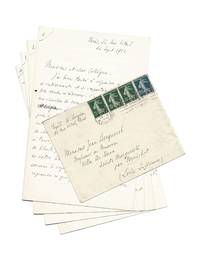
1922Bergson2<p><strong>EINSTEIN BERGSON Henri 1859-1941</strong></p><p>Autograph letter signed " Henri Bergson " to Jean Becquerel<br />Paris 24 September 1922 16 pages in-8° with envelope<br />Some typographic pencil notes</p><p><strong>A highly significant letter on the issues and interpretation of the theory of relativity</strong><br /><strong>This intervention of the philosopher continues up to this day to create multiple controversies</strong></p><p><u>We transcribe here only a few fragments of this letter which although known in its substance has remained unpublished to this day</u></p><p><em>" Monsieur et cher collègue</em><br /><em>J'ai bien tardé à répondre à la lettre si intéressante et si importante que vous avez bien voulu m'adresser. C'est qu'elle est allée me chercher de divers côtés et m'a atteint en Suisse à un moment où j'étais pris à Genève par le travail de " Coopération intellectuelle " qui nous avait été confié par la Société des nations. Me voici de retour à Paris ; je profite de mes premiers instants de liberté pour vous écrire. Le passage essentiel de votre lettre est naturellement celui qui concerne le voyage en boulet. Laissez-moi reprendre ce que j'ai dit dans mon livre</em> Durée et simultanéité paru à l'été 1922 <em>en y joignant quelques explications complémentaires.</em><br /><em>Il y a d'abord deux remarques importantes à faire.</em><br /><em>1° <strong>Si l'on se place en dehors de la Théorie de la Relativité on conçoit un mouvement absolu et par là même une immobilité absolue ; il y aura dans l'univers des systèmes réellement immobiles. Mais si l'on pose que tout mouvement est relatif que devient l'immobilité </strong> Ce sera l'état du système de référence je veux dire du système où le physicien se suppose placé à l'intérieur duquel il se voit prenant des mesures et auquel il rapporte tous les points de l'univers.</em> …<br /><em>2° Si l'on se place en dehors de la Théorie de la Relativité on conçoit très bien un personnage Pierre absolument immobile au point A à côté d'un canon absolument immobile ; on conçoit aussi un personnage Paul intérieur à un boulet qui est lancé loin de Pierre se mouvant en ligne droite d'un mouvement uniforme absolu vers le point B et revenant ensuite en ligne droite et d'un mouvement uniforme absolu encore au point A. <strong>Mais du point de vue de la Théorie de la Relativité il n'y a plus de mouvement absolu ni d'immobilité absolue</strong></em> … <em>Paul une fois lancé dans l'espace n'est plus qu'une représentation de l'esprit une image — ce que j'ai appelé un " fantôme " ou encore une " marionnette vide ". C'est ce Paul en route ni vivant ni conscient n'existant plus que comme image qui est dans un Temps plus lent que celui de Pierre.</em> … <em>Le Paul qui sort du boulet au retour du voyage le Paul qui fait de nouveau partie alors du système de Pierre est quelque chose comme un personnage qui sortirait en chair et en os de la toile où il était représenté en peinture : c'était à la peinture et non pas au personnage c'était à Paul référé et non pas à Paul référant que s'appliquaient les raisonnements et les calculs de Pierre pendant que Paul était en voyage.</em> … <strong><em>Je ne voudrais pas clore sans saisir l'occasion qui s'offre à moi de vous dire combien m'a intéressé et instruit votre beau livre sur " Le principe de relativité " et la " Théorie de la gravitation " – livre indispensable à tous ceux qui ont le souci d'approfondir la théorie d'Einstein.</em></strong><em> Veuillez Monsieur et cher collègue agréer l'expression de mes sentiments les plus distingués et dévoués</em><br /><em>H. Bergson "</em></p><p>In publishing <em>Durée et simultanéité</em> published by Alcan in the summer of 1922 Bergson was taking a risk that he probably did not measure himself. The purpose of this essay was to discuss the philosophical issues of the theory of relativity. The criticism of his scientific colleagues was not long in coming. Those of Einstein in the first place deploring the "blunders" or "dumplings" of the philosopher. In France it was Jean Becquerel who opened fire with a letter addressed directly to the author and of which this document constitutes the reply.<br />At the time Becquerel held a chair of applied physics at the Museum of Natural History. He wrote a textbook entitled <em>Le Principe de relativité et la théorie de la gravitation</em> Gauthier-Villars 1922 which made him one of the first introducers of Einsteinian theory in the French context. Two sources give an idea of the content of Becrerel's letter: his article published the following year "Critique de l'ouvrage durée et Simultaneity de M. Bergson"<em> Bulletin scientifique des étudiants de Paris</em> 10 2 March-April 1923 and the extract given by Bergson himself in the first of three appendices added to the 1923 edition of <em>Durée et simultanéité</em> – appendix which also contains with a few lines the entirety of his answer. Bergson then chose to preserve the anonymity of his correspondent in order to avoid giving the impression of a "polemic" according to the interview of December 30 1923 with Jacques Chevalier. He merely evokes "a letter very interesting which was addressed to us by a most distinguished physicist."<br />The discussion crystallizes on a specific point: the interpretation of the slowdown of moving clocks predicted by the theory. The famous "twin paradox" attributed to Paul Langevin provides a pictorial version of the problem as part of a Jules Verne-style narrative: an astronaut here "Paul" embarked on a "ball journey" would find himself on his return younger than his twin brother who remained on Earth here "Pierre" as if time had passed less quickly for him! In his letter Becquerel insists on the fact that the theory of relativity speaks of time actually measured on both sides by observers in relative motion. Bergson repeats by clarifying it the argument developed in his book namely that the differences relate less to real times than to fictitious times that is to say times attributed to other observers who acquire at the same time the status of simple images or "ghosts". Thus the "dilation" of durations associated with the slowing down of moving clocks is only a "perspective effect". Bergson is led to this conclusion by a strict interpretation of the principle of relativity: between two observers in relative motion there is a "perfect symmetry" each can consider itself motionless or mobile with respect to the other. Multiple empirical confirmations have since objectively proved the philosopher wrong but the question of the status of time in relativity as well as that of the relevance of the arguments exchanged continues to fuel contemporary philosophical debates. In that sense that letter constitutes a key part of the case.</p><p>We thank Mr. Elie During for the information he kindly communicated to us</p>
18299Couverture rigide. Bon/1924. in-8. Paris Gauthier-Villars 1924-1926 in-8 2 vol. XVI 331 1; XVI 318pp Demi-percaline lie de vin à coins avec titre encollé sur le dos Première édition française traduite par Gustave Létang d'après la quatrième édition allemande revue et augmentée par l'auteur. Dans cet important ouvrage qui fut publié à Brunswick en 1911 et 1916 l'auteur énonce diverses applications sur le principe de la relativité. Premier volume : le principe de la relativité et la transformation de Lorentz. Second volume : la relativité générale et la théorie de la gravitation d'Einstein cf. DSB VIII p. 53. Max von Laue 1879-1960 obtint le prix Nobel de physique 1914 pour ses recherches sur les images de la diffraction des rayons X par les cristaux. Nombreuses annotations manuscrites au stylo sur plusieurs pp Exemplaires en parfait état. unknown
191426027AB1914. Berlin Arthur Tetzlaff 1914. 8°. 4 230 2 Seiten. Hardcover / Library Binding. Bibliotheksbindung. Ehemaliges Exemplar der Harvard College Library. Mit dem Besitzvermerk von Prof. Gerald Holton. Die private Bibliotheksbindung mit mehreren Defekten. Vorsatzblatt lose und stark angerändert. Mit zahlreichen handschriftlichen Annotationen Holton's im Beitrag von Joseph Petzoldt: "Die Relativitätstheorie der Physik". Holton verweist in einem Absatz auf eine Peinlichkeit in Petzoldt's Aeusserung und merkt dazu an: "Embarrassing no wonder AE refused P invite to join Blackmore H. J. T. Blackmore and K. Hentschel" / Former copy of Harvard College Library with ownership-stamp of Nobel Laureate Prof. Gerald Holton. Several annotations in pencil by Holton in Joseph Petzoldt's contribution on the "Theory of Relativity of Physics". Holton notes for instance: "Embarrassing no wonder AE refused P invite to join Blackmore H. J. T. Blackmore and K. Hentschel" Zeitschrift für positivistische Philosophie. 2. Band. hardcover
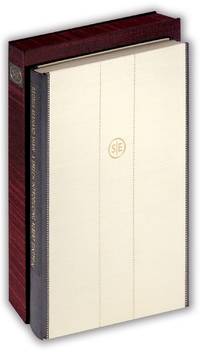
35452Rockport ME: Two Ponds Press 2015. Fine. Number 35 of 75 copies signed and numbered by Joseph Goldyne. Joseph Goldyne was born in 1942 in Chicago IL. He came to prominence as an artist on the West Coast. He has been credited as one of the artists responsible for the rebirth of monotype and monoprint as valuable approaches to art. He is also known for his artist's books often done in collaboration with printer Peter Rutledge Koch. <br /> <br /> From the Prospectus: "Joseph Goldyne brought this project to our attention and the Press was convinced that this little-known oratory by George Bernard Shaw deserved wider recognition one that Goldyne thought a most unexpectedly wondrous and humorous introduction to Albert Einstein perhaps the most transformative and towering figure of the twentieth century. Goldyne's own introduction " An Introduction to an Introduction" speaks to his discovery of Shaw's speech its presentation Shaw's record of condemning anti-Semitism and his public support for Einstein. The full text of Shaw's speech is reprinted together with Einstein's response delivered in German and printed here in English translation. Goldyne illustrates the volume with five drypoint etchings created especially for this publication. They pay tribute to the featured speakers as well as to the sense of the event." <br /> <br /> Beautifully bound in cream paper covered boards with gilt dotted rulings and ornament on front cover of circle with initials "SE" in its center. Gray leather spine and trim along front edges with gilt titling on spine. Printed in Monotype Bembo and Gill Sans types on paper handmade at the Velké Losiny mill in the Czech Republic. Letterpress printing by Arthur Larson at Horton Tank Graphics with additional hand composition by Rose Ku'ulealoha Wisotzky. Design and typography planned by Michael Russem Housed in a slipcase covered in dark red cloth with "SE" symbol on spine. Accompanied by prospectus. A lovely book in fine condition. Measures 6.5 x 10 inches. 39 pages. PRI/112321. Two Ponds Press unknown
19772080202103703852Asahi 1977. Soft Cover. Fine. Page size: 36 13 p. Size: 19 cm B6 Asahi paperback
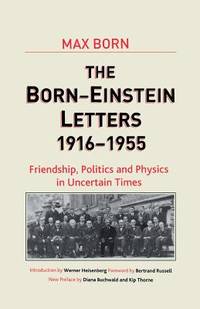
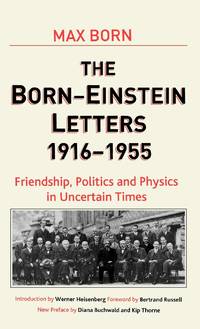
ria9781403944962_inpHardcover. New. New Book; Fast Shipping from UK; Not signed; Not First Edition; Albert Einstein and Max Born were great friends. Their letters span 40 years and two world wars. In them they argue about quantum theory agree about Beethoven's heavenly violin and piano duets that they played together when they met hardcover
44385542-nnew. unknown
44383708-nnew. unknown
44383708like new. unknown
44385542like new. unknown
ria9783112590591_inpHardcover. New. New Book; Fast Shipping from UK; Not signed; Not First Edition; N/A hardcover
ria9783112590577_inpHardcover. New. New Book; Fast Shipping from UK; Not signed; Not First Edition; N/A hardcover
19842-8875921334Ricordi 1984. Paperback. New. French language. 9.37x6.30x1.42 inches. Ricordi paperback
19872083002116406316David company 1987. Soft Cover. Fine. The book is in fine condition. David company paperback
ria9783112595992_inpHardcover. New. New Book; Fast Shipping from UK; Not signed; Not First Edition; N/A hardcover
ria9783112596012_inpHardcover. New. New Book; Fast Shipping from UK; Not signed; Not First Edition; N/A hardcover
44383559-nnew. unknown
44386213-nnew. unknown
44386213like new. unknown
44383559like new. unknown
2000x-0312231024Palgrave Macmillan 2000. Hardcover. New. 253 pages. 9.00x5.75x1.00 inches. Palgrave Macmillan hardcover
1979N2216Braunschweig / Wiesbaden: Fiedr.Vieweg & Sohn 1979. Original Cloth with d/j. Near Fine. 8vo. XV22pp. A fine copy with fine DJ. <br/> <br/> Fiedr.Vieweg & Sohn hardcover