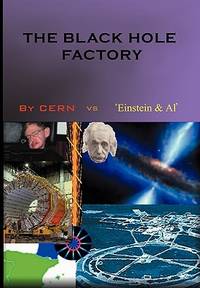
Al', Cern Vs 'Einstein EtBiblio.com
1 803 résultats
1450072178.Ghardcover. Good. Access codes and supplements are not guaranteed with used items. May be an ex-library book. hardcover
6378555261Princeton University Press . Hardback. New. Princeton University Press hardcover
19941596653539Easton Press 1994. Unknown. Like New. Pages are clean and are not marred by notes or folds of any kind. ~ ThriftBooks: Read More Spend Less.A clean copy in excellent condition appears unread. Sealed in plastic for shipping. Secure packaging for safe delivery.Dust jacket quality is not guaranteed. Easton Press unknown
MA06C-03367Pantheon Irodalmi Intezet. Used - Acceptable. Budapest: Pantheon Irodalmi Intezet 1922. 12mo hardcover. Rebound gray cloth with original front paper wrap bound in. 94pp. Hungarian. Fair book. Ex-Library copy from the New York Public Library with usual markings and pocket on front pastedown in Hungarian. Dampstaining and red paint flecks on front board. Upper corner dampstained throughout. Albert Einstein Theory of Relativity Books in Hungarian Inquire if you need further information. Pantheon Irodalmi Intezet hardcover
61266827Nova Science Publishers Incorporated pp. xiii 239 Index. Hardback. Used. Nova Science Publishers, Incorporated hardcover
1930021309London: The Soncino Press 1930. 1st Edition . Hardcover. Fair/Fair. Hardcover book in fair condition. Dust jacket included in poor to fair condition showing toning light staining and tears. Book dampstained closer to spine crack to binding starting at middle. A few instances of marked lines in the margins not affecting text. An excellent resource copy of this scarce first edition. Questions welcome. We ship internationally from the United States and Canada every week. If buying internationally please be aware that additional charges may apply for heavier books. We guarantee a safe quick and secure transaction. 10 years in online bookselling experience. <br/> <br/> The Soncino Press hardcover
ria9783642649127_inpPaperback. New. New Book; Fast Shipping from UK; Not signed; Not First Edition; N/A paperback
19811-0691023689Princeton Univ Pr 1981. Paperback. New. 167 pages. 8.00x5.25x0.50 inches. Princeton Univ Pr paperback
2004L3 box782 b4<p>Albert Einstein: Über den Frieden: Weltordnung oder Weltuntergang German Edition. Herausgegeben von Otto Nathan und Heinz Norden; Vorwort von Bertrand Russell; Ubersetzung der englischen und franzosischen Originale von Will Schaber; Erste deutsche Originalausgabe mit 15 Fotographien und Faksimiles. 2004 Melzer Verlag. Hardcover 675 pp.</p> Melzer Verlag. hardcover
ria9783528063368_inpPaperback. New. New Book; Fast Shipping from UK; Not signed; Not First Edition; N/A paperback
1949343971949. <blockquote><p>On scientists and military work: “The majority of really good scientists in this country have withdrawn from military work…The young ones who cannot lean upon a standing of their own have generally given in to the almost irresistible pressure. One cannot expect it to be any different.""</p><p> </p><p>Einstein and other scientists faced the harsh reality of the product of their work after the war and the bombing of Japan; Here Einstein in a way grapples with his own role</p></blockquote><p> </p><blockquote><p>On the timeless nature of fighting for what you believe: “The truth appears foolish to the insane.Lost people are content to find themselves in agreement with the masses.""</p></blockquote><p><img class=""alignnone wp-image-34606 size-post-window"" src=""https://cdn.raabcollection.com/wp-content/uploads/20251001204256/Einstein_Letter_11-1-1600x897.jpg"" alt="""" width=""1600"" height=""897"" /></p><p>Although Albert Einstein’s participation in the production of the atomic bomb was limited the public perceived his role as crucial and he was in fact the face of the project to many. The reasons were that although he did not work on the Manhattan Project the US effort to build the bomb his famous equation E=mc2 provided the theoretical basis for understanding the immense energy released in nuclear fission which is the process that powers the bomb. And his 1939 letter to President Roosevelt co-signed by Leo Szilárd alerted the US government to the potential of nuclear weapons and prompted the start of research that eventually led to the Manhattan Project. Feeding the public perceptions of his responsibility were publications like The Smyth Report a history of the development of the bomb published the day after the bombing of Nagasaki which ascribed great historical weight to Einstein’s 1939 letter to President Franklin D. Roosevelt in catalyzing the development of the bomb. In 1946 Time magazine published the famous cover featuring Einstein’s portrait backgrounded by an enormous mushroom cloud emblazoned with “E=mc2†and the accompanying article by Whittaker Chambers referred to him as “the father of the bomb†a title which resonated in the popular imagination. A March 1947 Newsweek cover featured Einstein above the headline “Godfather of the Atomic Bombâ€. Einstein was hounded by the association throughout the rest of his life culminating in his November 1954 admission to Linus Pauling “I made one great mistake in my life when I signed the letter to President Roosevelt recommending that atom bombs be made….â€</p><p>Albert Einstein was known for his dedication to morality which he said was “of the highest importance†as well as beliefs that stemmed from morality like pacifism anti-militarism and loyalty to the facts taught by science. He viewed morality as fundamentally human and believed that ethical behavior should form a basis for both individual well-being and the collective good of humanity. Thus for Einstein the pursuit of morality was the most vital human endeavor essential for bringing beauty and dignity to life and ensuring the survival and thriving of the human race. He shared these beliefs with Dr. Herbert Jehle.</p><p>Dr. Jehle was a pioneering theoretical physicist whose work spanned quantum field theory biophysics and astrophysics. He was a student and friend of Einstein in the 1920s in Germany; and a disciple and friend of Dietrich Bonhoeffer. At Princeton in 1947 he provided Richard Feynman with the spark which would lead to his path integral formulation. Einstein had left for the United States in 1933 the same year that Jehle received his doctorate from the Technische Hochschule Berlin. In the same year Dietrich Bonhoeffer Jehle's friend and mentor stepped down from his professorship at Berlin in protest of the Nazi ascent to power. In 1940 Jehle refused to assist in the German armament and atomic project and was interned in concentration camps. Escaping in 1941 with the help of Quaker and Christian relief organizations Jehle made his way to the United States where he took a position at Harvard University until leaving for Princeton in 1947. At Princeton Jehle's pacifist beliefs coincided with Einstein's own and they reconnected bonding over shared views of social responsibility and ethics in science and playing music together regularly Einstein on violin Jehle on the piano.</p><p>Jehle was also the editor of the Society for Social Responsibility in Science newsletter of which Einstein was a member. Jehle additionally submitted articles to other science publications. During the 1950s Jehle collaborated with Linus Pauling on DNA research as well as advocating with Pauling for peace. In the early 1960s Jehle worked as a consultant to Marshall Nirenberg at the NIH on DNA-coding for which Nirenberg also won a Nobel Prize for in 1968.</p><p>Jehle's 1949 article ""For a Universal Morality"" asserted that ""participation in war preparations posed a challenge to man's conscience under any circumstances. and urged that scientists refuse to participate in war work under any government democratic or totalitarian"" see Nathan & Norden Einstein on Peace p 514. The editor of the Bulletin Eugene Rabinowitch rejected the article in a letter to Einstein to which Einstein replied advocating Jehle's position praising Jehle for not being “deterred by taboos†and then sent this letter to Jehle.</p><p>It is interesting to think how time and war had affected Einstein's thinking. Where his letter did much to advance the nuclear militarization and as a scientist he felt a need to intervene here is advocating the opposite.</p><p><strong>Autograph letter signed</strong> on paper watermarked <em>""Whiting Mutual Bond Rag Content""</em>Princeton 1949 to Herbert Jehle endorsing the article by Jehle that had been submitted to the Bulletin of Atomic Scientists on the topics of science and morality and cautioning Jehle on the complications of his position in the post-war world. <em>“I have read your article several times and find that it agrees exactly with my thinking. In accordance with your wishes I am sending your paper with my recommendation to the Bulletin of Atomic Scientists in the hope that they will publish it.</em></p><p><em>“I doubt however that the effect will correspond with the good intentions of the article. The truth appears foolish to the insane. He suspects disloyal intent and revolts against the thought that the 'foreigner' considers himself a better judge of what Americans should do. There are after all few who think and feel in a supra-national manner. Lost people are content to find themselves in agreement with the masses.</em></p><p><em>“The majority of really good scientists in this country have withdrawn from military work more so than it was ever the case in Germany. The young ones who cannot lean upon a standing of their own have generally given in to the almost irresistible pressure. One cannot expect it to be any different since few are born to be martyrs - if no mass movement drives them in that direction. I see the real justification of your approach in the attempt to help generate such a mass movement.</em></p><p><em>“The predicament in which we are is in a certain sense timeless. The public institutions necessarily represent a rather low moral level as do the men who stand behind these institutions. The individual is at the mercy of these institutions the standards of which he must recognize to be low if he is conscientious and not completely without ideas. He is thus forced into some compromise since he sees that that kind of necessarily imperfect institution cannot be dispensed with.</em></p><p><em>“If those who see the light do not stand honestly and courageously for the good the world will get deeper and deeper into the morass. In expressing my joy that you have acted in this way and continue to do so I remain with friendly greetings. Yours A. Einstein.â€</em></p><p>With: <strong>Autograph statement</strong> as a PS from Einstein in German with Jehle's autograph English translation beneath and annotations above transcribing his recommendation for Jehle which Einstein sent to the editor of the Bulletin. <em>“I am sending you this book article. It comes from a younger physicist who is courageous enough to simply say what is evident without being deterred by taboos. I hope that his note can be published in the Bulletin.â€</em></p><p>An important letter reflecting Einstein's post-war advocacy for morality and peace and assessments of the place of scientists in the moral sphere as well as realistic observations on and understanding of world politics.</p><p>We obtained this letter directly from the Jehle family.</p><p><img class=""alignnone wp-image-25018 size-post-window"" src=""https://cdn.raabcollection.com/wp-content/uploads/20231204144051/Folder-site-11-1600x1327.jpg"" alt="""" width=""1600"" height=""1327"" /></p> unknown
342445/11/19. <blockquote><p>A remarkable letter before his great fame referencing and shown to Marie Curie</p><p> </p><p>Einstein who helped free so many from the jaws of Nazism makes an impassioned plea for a World War I German POW in France who would escape but later die in the Holocaust</p></blockquote><p>In 1905 while a young patent clerk and physicist in Bern Switzerland Albert Einstein obtained his doctorate and published a paper that explained his newly developed Special Theory of Relativity. This unlocked many mysteries of the universe and introduced the world to the idea equating mass and the speed of light with energy which we know today as e=mc2. Einstein's insight and one element that distanced his work from that of Newton was to recognize that mc2 was the proper energy of mass the energy associated with that mass and was independent of its motion. Mass must be measured in this way as resting mass. This was a foundation of e=mc2. The breakdown of molecules therefore released energy. This energy is often used by cells to perform work such as powering movement.</p><p>In the early years of the 20th century thanks to the development of mass spectrographs science had acquired the capacity to ""weigh"" atoms with extreme precision. Indeed Einstein provided the theoretical explanation for Brownian motion while French Chemist Perrin experimentally verified Einstein's theory solidifying the evidence for the existence of atoms.</p><p>Scientists among them Perrin noted that when comparing the mass of a helium nuclei to that of the four elementary nuclei it was made of there was a slight discrepancy—one helium atom was slightly lighter than four hydrogen atoms; in other words the whole was smaller than the sum of the parts. Where did the missing mass go Einstein knew the answer: in accordance with his famous E=mc_ equation a tiny fraction of the mass had been transformed into a formidable quantity of energy.</p><p><img class=""alignnone wp-image-34256 size-post-window"" src=""https://cdn.raabcollection.com/wp-content/uploads/20250724151316/Einstein-Nov-1919-1-1600x709.jpg"" alt="""" width=""1600"" height=""709"" /></p><p>The French mathematician Paul Langevin understood the formidable source of energy that resulted from these ""transmutations."" But it was Jean Perrin a professor of physical chemistry in Paris who first proposed in 1919 that the fusion of hydrogen into helium was the energy source of the Sun and stars accounting for the billions of years of sunshine past and the billions of years to come.</p><p>During this time radiation studies too were in their infancy. Marie Curie famously decided to do her thesis on radiation recently discovered in uranium by Henri Becquerel. She found that an ore containing uranium was far more radioactive than could be explained by its uranium content. This led her and her husband Pierre to the discovery of a new element that was 400 times more radioactive than uranium. In 1898 it was added to the Periodic Table as polonium named after Curie’s birth country.</p><p>Then Curie discovered an even more radioactive element radium and through observation of radium made a fundamental discovery: Radiation wasn’t dependent on the organisation of atoms at the molecular level; something was happening inside the atom itself. The atom was not as scientists believed at the time inert indivisible or even solid.</p><p>This discovery led to an overlapping one: At the time people did not know what powered the Sun. Many however thought it was Radium. Perrin was one of those who believed this. His hypothesis borrowing from E=MC2 was that radiation in the form of Radium was emanating from bodies like earth causing the breakdown of molecules on the Sun and that the breakdown was powering the Sun and other stars. In 1919 Perrin sent to Einstein his new publication proposing this theory.</p><p>Einstein's response notes the breakdown of molecules and the released energy can likely be accomplished by other means than radiation. He uses the mathematical equation for the breakdown of one molecule into atoms. He references a first order reaction a chemical reaction where the rate of the reaction is directly proportional to the concentration of only one reactant. In simpler terms if you double the concentration of that reactant you double the reaction rate. A common example is radioactive decay.</p><p>And he gives his best to the Madame Curie. Einstein had last met in Paris with Perrin Pierre Langevin Professor of Experimental Physics at the Collège de France and Curie then Professor of Physics at the Sorbonne on the occasion of Einstein’s lecture to the French Physical Society in late March 1913. They first met at the Solvay Congress in Brussels in autumn 1911.</p><p>At the same time Einstein who helped so many Jews escape Germany during World War II had a distant cousin the geologist August Moos who had volunteered in the German infantry at the start of the First World War in 1914. After being taken prisoner in 1915 he made several attempts to escape which resulted in a sentence that prevented his release after the armistice of 1918. His mother asked for help from Einstein who turned to his friend Perrin as well as mathematician and statesman Paul Painlevé asking them to intercede. Moos was finally released in February 1920. He would work as an oil geologist in the interwar period before being tragically arrested due to his Jewish heritage under the Nazi regime. Moos would die in the Buchenwald concentration camp during World War II.</p><p><strong>Typed letter signed</strong> in French signed <em>“A. Einstein""</em> November 5 1919 to Professor Jean Baptiste Perrin who would go on to win the Nobel Prize for Physics in 1926 for his work on the atomic structure of matter. <em>""Dear Perrin! I received your publications and thank you cordially. Your opinion of the primary importance of radiation for all chemical reactions still seems to me dubious even if it was certain which it is not that reactions of the type J_ - JJ added by hand are of the first order. It would be possible for example that J_ molecules whose internal energy exceeds a certain limit would decompose in accordance with radioactive bodies.</em></p><p><em>""One more prayer. One of the parents of one of my cousins—a geologist—is a prisoner of war in France. His widowed mother having lost her other son in the war is in the greatest pain for her only son since he had tried to flee several times. She shudders at the thought that the man—through his old efforts to flee in a very difficult situation—might try to flee again and be shot. Wouldn't it be possible to do something for this young scholar"" He goes on to give the address of August Moos held in Charleville Ardennes and concludes by offering his ""many friendships for you Mr. Langevin and Madame Curie.""</em> Below he notes an ink spill draws an arrow and writes <em>""drop of editorial sweat from editing.""</em></p><p>Perrin responded the very same day confirming that he believed rays from Earth were breaking down molecules in the sun and that he assumed the first order nature of the reaction. In other words he did not agree with Einstein that radiation was not breaking down molecules releasing energy and powering the sun. ""I do indeed believe that I2 Einstein used J but Perrin used I decomposes like radioactive bodies and I devoted a chapter of my work to this but precisely on the conviction that radioactive bodies like I2 are decomposed by light for radium ultra-short X rays emanating from the Earth at _ = 10–11 light which suddenly increases the internal energy. I read your letters to Mrs. Curie and to Langevin. They too send you their very best regards."" Perrin and </p><p>In addition to this important family and political content Einstein comments on a theory that Perrin had developed in which all chemical transformations including radioactive decay are triggered by radiation calling it ""dubious."" Also significant is the date: one day before the official report of Eddington's expedition debuted before the Royal Society of London confirming Einstein's theory of general relativity. Widespread newspaper coverage of the results vaulted Einstein into immediate international fame. An altogether remarkable letter from one Nobel Prize winner to another shown to yet a third and using the chemical equation for the breakdown of molecules into atoms in his own hand.</p><p><img class=""alignnone wp-image-25018 size-post-window"" src=""https://cdn.raabcollection.com/wp-content/uploads/20231204144051/Folder-site-11-1600x1327.jpg"" alt="""" width=""1600"" height=""1327"" /></p> unknown
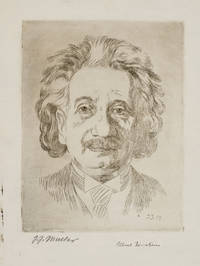
1933H-217<p>A stunning portrait etching of one of the greatest human minds signed by both the artist J J Muller and Albert Einstein.</p><p>The sketch is signed in ink by Einstein and by the artist J. J. Muller in pencil n.p. 1933. Plate 195 x 150mm; sheet 253 x 200mm.</p><p>A true collector's copy of a beautiful signed portrait.</p>
2000Q-0517209845Randon House 2000-01-01. Hardcover. New. In shrink wrap. Looks like an interesting title! Randon House hardcover
1951108Book is in good condition. Some darkening evident on ends of pages. Dust jacket is worn but intact and has been wrapped in Mylar for protection. Tudor Publishing Company hardcover
19542625423/02/1954. <blockquote><p>An increasingly uncommon letter of Einstein on the role of religions philosophy peace and the dangers of the atomic age that he helped usher in</p></blockquote><p><img class=""alignnone wp-image-26334 size-post-window"" src=""https://cdn.raabcollection.com/wp-content/uploads/20231204132831/Einstein-Feb-28-1954-1-e1674939062835-1600x216.jpg"" alt="""" width=""1600"" height=""216"" /></p><p>Albert Einstein believed that wars stood in the way of human progress and he was a lifelong pacifist though he did not believe in pacifism at any price or in all situations. He was also an active promoter of world peace from the days of World War I right up to his death in 1955. In fact one of his last acts before his death was to add his signature to a statement of nine scientists warning that the world risked universal annihilation unless the institution of war was abolished. Knowing his stance people from all over the world appealed to him to assist various causes consistent with these beliefs and to give statements supporting individuals and groups that did so.</p><p>Einstein was also not a member or follower of any organized religion. He considered himself a Jew but was not a practicing Jew. And as for the Christian churches he felt that it “since Constantine has always favored the authoritarian State as long as the State allows the Church to baptize and instruct the masses"". Their conduct in the years up to World War II was worse than disappointing he thought as they made the devil’s bargain - the evil compromise - with the Hitler regime. Einstein addressed this saying “Since when can one make a pact with Christ and Satan at the same time"" He added ""The Church has always sold itself to those in power and agreed to any bargain in return for immunity…If I were allowed to give advice to the Churches I would tell them to begin with a conversion among themselves and to stop playing power politics.†This idea of an evil compromise or devil's pact is central to his feelings about organized religion.</p><p>There was one exception to his criticism of religions - the Quakers. Their community aims at purifying the Christian world and generating social reform by creating direct experience with God without intervention of clergy or other expressions of church. The Quakers greatly influenced science and industry and their community is noted for the pursuit of peace and non-violence. Thus Einstein’s views fit into their belief system. “If I were not a Jew I would be a Quaker†he once wrote. Speaking to a Quaker gathering in 1938 he said ""With admiration and respect I have seen in the course of many years how successfully and selflessly the Society of Friends has worked in the entire world to lessen human suffering and to make the teachings of Christ apply to real life. Everyone who is concerned about a better lot and a more dignified stature for humanity owes deep gratitude to the Society of Friends. This Society is an admirable testimony against the assertion that every organization by its very nature kills the spirit which has called it into life.â€</p><p><img class=""alignnone wp-image-26335 size-post-window"" src=""https://cdn.raabcollection.com/wp-content/uploads/20231204132818/Einstein-Feb-28-1954-2-e1674939294283-1600x653.jpg"" alt="""" width=""1600"" height=""653"" /></p><p>In 1949 the Australian pathologist Alton R. Chapple who was a Quaker wrote to Einstein in the then-current climate of concern regarding the perils of the atomic age for ""a few words of leadership and hope"". Einstein responded stressing the necessity for moral courage by the individual. He said that power is often in the hands of power-loving persons who know very little restrictions when it comes to the realization of their ambitious goals; and answering negatively the question whether self-restraint on what “productive thinkers and explorers†research might not prevent further development of means of mass destruction. He gave three main reasons: 1 The already existing means of destruction are effective enough to bring about total destruction; 2 People really devoted to the progress of knowledge concerning the physical world like Faraday or Rutherford have never worked for practical goals let alone military goals. And nobody could know in advance what kind of application might be developed on the basis of their discoveries; and 3 People of technical skill are so numerous and so dependent economically that they cannot be expected to refuse employment offered them by the state or private industry even if they were able to clearly recognize that their work will lead to disaster on a world-wide scale. He concluded that hope can only be based on the intellectual and moral independence of a sufficient number of people since “honesty and courage of the individual to stand up for his convictions on every occasion is the only essential thingâ€.</p><p>Chapple wrote Einstein again in 1954 about the Quakers and a perceived contradiction that Chapple discerned in the 1949 letter thinking that Einstein stated that he does not expect people to refuse to work in research that generates knowledge for the means of mass destruction. Einstein responded to Chapple giving a virtual primer on his world view and opinions on how a religion and religious individuals could live a moral life and contribute something valuable to society and the cause of peace. This he felt the Quakers did.</p><p><strong>Typed letter signed</strong> on his blind-embossed letterhead Princeton February 23 1954 to Alton Chapple in Australia illuminating Einstein’s judgment and standards of conduct. <em>“Thank you for your letter of February 16th. I consider the Society of Friends the religious community which has the highest moral standards. As far as I know they have never made evil compromises and are always guided by their conscience. In international life especially their influence seems to me to be very beneficial and effective.</em></p><p><em>“There seems to me to be no contradiction in my remarks in my former letter to you. The rules applying to a moral elite can not be expected to be followed by the rank and file.â€Â </em></p><p>So here Einstein praises those religions with “the highest moral standardsâ€. He especially lays out the need for them and for individuals to avoid “evil†compromises and to always be guided by conscience. If an individual does these things or a dedicated group like the Quakers they will gain influence that is both beneficial and effective. Einstein does stand by his statement in the 1949 letter maintaining that from his experience moral elites lead and that those in rank and file don’t necessarily follow that lead. In a sense he is saying that an ethical elite exercising leadership has the best chance of saving the world.</p><p>An increasingly uncommon letter of Einstein on philosophy peace the role of religions and religious individuals and the dangers of the atomic age that he helped usher in.</p><p><img class=""alignnone wp-image-25018 size-post-window"" src=""https://cdn.raabcollection.com/wp-content/uploads/20231204144051/Folder-site-11-1600x1327.jpg"" alt="""" width=""1600"" height=""1327"" /></p> unknown
2034512/12/30. <blockquote><p>We obtained this photograph directly from the Guard heirs and it has never before been offered for sale</p></blockquote><p>In December 1930 Albert Einstein visited America for the second time. It was originally intended as merely a two-month working visit as a research fellow at the California Institute of Technology but Einstein’s popularity made the trip headline news. After arriving in New York City Einstein was taken to various places and events including Chinatown a lunch with the editors of The New York Times and a performance of Carmen at the Metropolitan Opera on December 12 where Einstein an opera buff who revered Mozart Bach and other great composers was cheered by the audience on his arrival.</p><p>William Guard was engaged by the Manhattan Opera Company as a press representative upon its organization in 1906. Upon the company's dissolution he took a similar position with the Metropolitan Opera remaining with the company until his death in 1932. Einstein met Guard at his office on his visit to the Met.</p><p><img class=""alignnone wp-image-26178 size-post-window"" src=""https://cdn.raabcollection.com/wp-content/uploads/20231204133729/Einstein-Opera-1-e1673307039907-1600x1193.jpg"" alt="""" width=""1600"" height=""1193"" /></p><p>Newspapers reported on December 14 1930: “Einstein Theory Defined in Sentenceâ€. “At last Prof. Einstein has hit upon a one sentence definition of relativity which anyone can understand. He was chatting recently in the office of William Guard factotum of the Metropolitan Opera. ‘Professor’ said Guard ‘I have a definition of your relativity theory and I would like to know if it is correct.’ The Professor smiled. There are presumed to be only a handful of wise men in the entire world who are able to understand it. ‘My definition is this’ said Guard. ‘There is no hitching post in the universe—so far as we know.’ Einstein laughed and nodded assent vigorously.â€</p><p>A spectacular 8 by 10 inch <strong>photograph</strong> of Einstein <strong>inscribed</strong> and presented by the great scientist to Guard on his visit to the Met: <em>""Mr. William J. Guard / A. Einstein / 12. XII.30.â€</em> We obtained this photograph directly from the Guard heirs and it has never before been offered for sale.</p> unknown
19351383623/05/1935. <blockquote><p style=""text-align: left;"">He prophesizes however that the road ahead for the Jews will be “arduous and very painfulâ€</p></blockquote><p>The Institute for Advanced Study in Princeton New Jersey was founded in 1930 by educator Abraham Flexner with funding from department store magnate Louis Bamberger. Flexner first recruited noted mathematicians from Princeton University to join the Institute then broadened its scope by including established scholars in economics politics and humanistic studies. In 1932 Flexner offered Einstein a faculty position at the Institute. Einstein’s decision was effected by historical events as in January 1933 Adolf Hitler became Chancellor of Germany. Soon after Einstein made the decision to resign from his Berlin position give up his German citizenship and accept the position in Princeton. The ocean liner Westmoreland which carried Einstein at age 54 to what would become his new home country arrived in New York Harbor on October 17 1933.</p><p><img class=""alignnone size-full wp-image-24695"" src=""https://cdn.raabcollection.com/wp-content/uploads/20231204145639/einsteinsig.gif"" alt="""" width=""1920"" height=""1080"" /></p><p>Einstein found the Institute and life in the United States congenial so in April 1934 just six months after his arrival Einstein announced that he was staying in Princeton indefinitely and assuming a permanent full-time status at the Institute. He would remain in the United States the rest of his life. Meanwhile he was very much a celebrity and was invited to the White House to meet with the Roosevelts. He politely declined saying he did not want to call attention to himself a position that German Jews had become accustomed to adopting during the rise of Naziism. However the First Lady Eleanor Roosevelt intervened writing Einstein directly requesting his presence. So Einstein and his wife Elsa arrived at the White House on January 24 1934 had dinner and spent the night. President Roosevelt was able to converse with them in passable German. Among other things they discussed Roosevelt’s marine prints and Einstein’s love for sailing. On learning that the Einsteins had decided to stay in the United States Roosevelt suggested that the Einsteins should accept the offer of some Congressmen to have a special bill passed on their behalf that he would sign granting them citizenship so that they would not have to endure the five year waiting period. The Einsteins declined the President’s generous suggestion saying they wanted to be treated like any other applicant for American citizenship. Because the Einsteins had not been sure of their ultimate destination and declared themselves as visitors instead of immigrants when they arrived in October 1933 this meant that they would need to leave the U.S. and return again to declare intention to seek citizenship.</p><p>The United Jewish Appeal UJA planned a fund-raising dinner in Einstein’s honor for May 28 1935. This was exactly the time the Einsteins had set aside to leave the country to perfect their citizenship so he was forced to decline the invitation. He did however provide them with a statement that was received by the UJA on <span class=""aBn"" tabindex=""0"" data-term=""goog_1737904750""><span class=""aQJ"">May 25</span></span> the very day the Einsteins stepped onboard the Queen Mary to travel to British-owned Bermuda for a few days to satisfy the formalities. The royal governor was there to greet them when they arrived in Hamilton and he recommended the island’s two best hotels. Einstein found them stuffy and pretentious. As they walked through town he saw a modest guest cottage and that is where they ended up.</p><p><img class=""alignnone wp-image-32085 size-post-window"" src=""https://cdn.raabcollection.com/wp-content/uploads/20240908143641/Einstein-May-23-1935-1-1600x968.jpg"" alt="""" width=""1600"" height=""968"" /></p><p><strong>Typed statement signed</strong> in German Princeton May 23 1935 time stamped as received on <span class=""aBn"" tabindex=""0"" data-term=""goog_1737904751""><span class=""aQJ"">May 25</span></span> to be read at the UJA dinner and issued to the press accordingly. It takes the moral high ground but warns of great dangers ahead. <em>â€Unfortunately because of non-deferrable obligations I can only express in writing my recognition and gratitude for the assistance provided to the many unfortunate people by the dinner on the <span class=""aBn"" tabindex=""0"" data-term=""goog_1737904752""><span class=""aQJ"">28th of May.</span></span> We can gain consolation in this critical time if we compare the moral standard of our friends and our enemies with each other. The result of such a comparison shows us that our way for world history can be considered the better one even if at times it is arduous and very painful.â€</em> Our research indicates that this important statement is unpublished as the dinner was postponed and it was never released to the press.</p><p>But even this moving and forceful statement was not enough for the event organizers. Learning that Einstein could not attend they postponed the dinner. Instead the $50-a-plate dinner for the benefit of the UJA arranged by that organization and the Council of Jewish Organizations was held in New York City on <span class=""aBn"" tabindex=""0"" data-term=""goog_1737904753""><span class=""aQJ"">June 26</span></span> with Einstein in attendance. About 1000 people attended the banquet at which Einstein spoke. In his speech Einstein returned to the same theme of morality as in the above statement saying that the ""moral disintegration and intensified national egoism"" of the times requires all Jews to strengthen their ranks to preserve Jewry. Of foremost importance he said was the upbuilding of the settlement in Palestine. On <span class=""aBn"" tabindex=""0"" data-term=""goog_1737904754""><span class=""aQJ"">June 28</span></span> the UJA announced it was using the proceeds from the dinner to aid German refugees in New York City by allocating funds to local agencies equipped to care for the refugees.</p><p>Einstein reentered the U.S. from Bermuda on June 3 1935. On January 15 1936 the Einsteins submitted their declaration of intention to become citizens of the United States.</p><p><img class=""alignnone wp-image-25018 size-post-window"" src=""https://cdn.raabcollection.com/wp-content/uploads/20231204144051/Folder-site-11-1600x1327.jpg"" alt="""" width=""1600"" height=""1327"" /></p> unknown
36130<blockquote><p>In the poem he apologizes for leaving Von Neumann’s party early and incurring the wrath of his wife calling himself a “thick skinned fool†and a “clumsy bullâ€</p><p> </p><p>Einstein urges Von Neumann not to be angry that “regret creeps at the memory†and that he is filled with dismay</p><p> </p><p>This is a real rarity and is the only poem by Einstein that we have ever carried; it has been in a private collection for a generation</p></blockquote><p>embedhttps://vimeo.com/1180595880share=copy&fl=sv&fe=ci/embed</p><p> </p><p>John Von Neumann was a mathematician physicist computer scientist and engineer who in 1933 Von Neumann accepted a tenured professorship at the Institute for Advanced Study in Princeton. This was also where Albert Einstein worked so the two were colleagues. Von Neumann had perhaps the widest coverage of any mathematician of his time integrating pure and applied sciences and making major contributions to many fields including mathematics physics economics computing and statistics. He was a pioneer in building the mathematical framework of quantum physics and the digital computer. His analysis of the structure of self-replication preceded the discovery of the structure of DNA. During World War II Von Neumann worked on the Manhattan Project. Before and after the war he consulted for many organizations including the Office of Scientific Research and Development the U.S. Army’s Ballistics Research Laboratory and the Oak Ridge National Laboratory. At the 1950s he chaired a number of Defense Department committees. He was also a member of the influential Atomic Energy Commission in charge of all atomic energy development in the country.</p><p>Von Neumann and Einstein shared a similar cultural background but had different personalities and differed in work style sometimes creating friction. Working just a few offices down from each other Einstein was exceptionally irked by the loud music that often emanated from Von Neumann’s office. In time Einstein would admire Von Neumann’s intellect but be critical of both his work and style; and Von Neumann would become envious of Einstein. Colleagues considered von Neumann's mind faster and more acute while viewing Einstein's understanding as deeper more original and more foundational to physical reality. In summary while von Neumann may have had more raw lightning-fast processing power Einstein had a greater depth in understanding the universe.</p><p>Von Neumann was socially active within the local academic community. He was a renowned high-energy party host in Princeton known as a ""bon vivant"" who loved socializing loud music and dancing. His parties were frequent and often featured fine wine off-color jokes and a mix of academic and social guests. Among his guests was Albert Einstein. It is said that Von Neumann could attend parties until the early hours of the morning and then deliver a lecture at 8:30 am. Whereas Von Neumann was known for social parties Einstein was more of an introvert who actively embraced solitude and tended to avoid displays of luxury.</p><p><strong>Autograph manuscript signed</strong> being a poem in German Princeton no date to Von Neumann and his wife apologizing for his bad behavior at their cocktail party.<em> “Dear Neumanns The following Knittel traditional German poem of rhyming couplets known for their humorous or satirical nature verses should help you forgive my clumsiness:</em></p><p><em>“You thick skinned fool you clumsy bull</em><br /><em>So rang the scold in my ear so full</em><br /><em>Which met me once down the stairs</em><br /><em>As I made my way to the cars.</em></p><p><em>""And she was right I swear</em><br /><em>The lady of the gentle sex so fair</em><br /><em>That I did neglect the Neumanns</em><br /><em>As I took off without any plans</em></p><p><em>""I now shudder thinking back</em><br /><em>At the wild looks of the spouse’s attack</em><br /><em>Regret creeps at the memory</em><br /><em>That I should so forgetful be.</em></p><p><em>""And I am filled with such dismay</em><br /><em>Such a thing will never do again or say</em><br /><em>Laugh it off but anger not</em><br /><em>May this poem help a lot.</em></p><p><em>""Yours truly A. Einsteinâ€</em></p><p>This provides a fascinating window into how Einstein saw his relationship with Von Neumann and the strain it was under as well as on Einstein’s own behavior calling himself a “thick skinned fool you clumsy bullâ€.</p><p>This is a real rarity and is the only poem by Einstein that we have ever carried.</p><p><img class=""alignnone wp-image-25018 size-post-window"" src=""https://cdn.raabcollection.com/wp-content/uploads/20231204144051/Folder-site-11-1600x1327.jpg"" alt=""historical memorabilia dealer"" width=""1600"" height=""1327"" /></p> unknown
2005b0979<p>Chamberlain Bros. 2005. X310 pages. New Hardcover with sealed CD. New DJ. 8.5"x5.8"x1.0". be35</p> Chamberlain Bros. hardcover
2005G9875505870I5N00Longseller 2005. Paperback. Acceptable. Readable copy. Pages may have considerable notes/highlighting. ~ ThriftBooks: Read More Spend Less.Dust jacket quality is not guaranteed. Longseller paperback
1920171530Friedr. Vieweg und Sohn January 1920. Paper Back. Very Good. apart from small chip at top of spine and slightly browned pages in hgreat condition and unmarked Friedr. Vieweg und Sohn unknown
B9781403944962Hardback. New. A classic collection of correspondence between two Nobel Prize winners The Born-Einstein Letters is also highly topical: scientists continue to struggle with quantum physics their role in wartime and the public's misunderstanding. hardcover
B9781258001582Hardback. New. hardcover
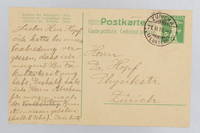
191083637Zurich Zurich 1910. Fine. Einstein writes to a friend who introduced him to Carl Jung Zurich Zurich 21 juin 1910 9 x 14 cm une carte postale Autograph postcard signed by Albert Einstein to Ludwig Hopf. 18 lines written verso and recto address also in Einstein's handwriting. Postmarked June 21 1910. Published in The Collected Papers of Albert Einstein Volume 5: The Swiss Years: Correspondence 1902-1914 Princeton University Press 1993 n°218 p. 242. An exceptional and highly aesthetic card from Albert Einstein to ""the friend of the greatest geniuses of his time"" - according to Schrödinger - mathematician and physicist Ludwig Hopf who introduced Einstein to another 20th-century genius: Carl Jung. The master invites his pupil Hopf to a dinner party whose guests include scientist Max Abraham future great rival during Einstein's Zurich years and a fervent opponent of his theory of relativity. The recipient Ludwig Hopf joined Einstein in 1910 as an assistant and student at his physics and kinetic theory seminars at the University of Zürich. They signed two fundamental papers on the statistical aspects of radiation and gave their names to the ""Einstein-Hopf"" velocity-dependent drag force. Their letter exchanges retrace the complex path of Einstein's work on relativity and gravitation bearing witness to their great complicity and Hopf's invaluable contribution to the Master's research. A few months after writing the postcard Hopf even found an error in Einstein's calculations of the derivatives of certain velocity components which Einstein corrected in a paper the following year. They also formed a musical duo Hopf accompanied on the piano the Master's violin performing pieces by great musical geniuses like Bach and Mozart. With this card Einstein invited his pupil and friend Hopf to dinner with Max Abraham at the dawn of a major scientific controversy that would pit them against each other from 1911 onwards. Abraham's theory of special relativity failed to convince Einstein who criticized its lack of observational verification and its failure to predict the gravitational curvature of light. In 1912 their dispute became public through scientific articles. Abraham never acknowledged the validity of Einstein's theory. During their brilliant artistic and intellectual exchanges Hopf undoubtedly succeeded where Freud had failed as he declared to him in a letter: ""I shall break with you if you boast of having converted Einstein to psychoanalysis. A long conversation I had with him a few years ago showed me that analysis was as hermetic to him as the theory of relativity can be to me"" Vienna September 27 1931. As a fervent supporter of psychoanalysis Hopf is known to have introduced the famous psychoanalyst Carl Jung to Einstein. Hopf and his teacher both left for Prague's Karl-Ferdinand University in 1911 where they met writer Franz Kafka and his friend Max Brod in Madame Fanta's salon. With the rise of the Nazi regime the fates of the two theoreticians were plagued by persecution and exile. Einstein first took refuge in Belgium Hopf in Great Britain after his dismissal in 1934 from the University of Aachen because of his Jewish origins. They continued their prolific correspondence in the midst of the turmoil Einstein suggesting to Hopf the opening of a university abroad for exiled German students. Hopf died shortly after his appointment as chair of Mathematics studies at Trinity College Dublin in July 1939. A precious invitation from the great physicist to one of the final dinner gatherings of the ""old school"" of science embodied by Max Abraham on the eve of the publication of the theory of general relativity which would overturn classical conceptions of space and time and propel Science into the 20th century. unknown