Albert EinsteinBiblio.com

2 944 résultats
ria9781020352256_inpHardcover. New. New Book; Fast Shipping from UK; Not signed; Not First Edition; This book is a collection of research papers published in the prestigious journal Mathematische Annalen. It features groundbreaking work by prominent mathematicians such as David Hilbert and Albert Einstein spanning topics from geometr hardcover
ria9781021110886_inpHardcover. New. New Book; Fast Shipping from UK; Not signed; Not First Edition; Mathematische Annalen is a seminal mathematics journal that has published many groundbreaking papers and provided a venue for the most important mathematical discoveries of the past century. This anthology contains some of the most impo hardcover
ria9781020331084_inpHardcover. New. New Book; Fast Shipping from UK; Not signed; Not First Edition; Mathematische Annalen is a scientific journal dedicated to mathematics published by Springer-Verlag. This book is a compilation of articles published in Mathematische Annalen from the years 1869 to 1949 written by some of the most prom hardcover
47003244like new. unknown
A9781345227048Hardback. New. hardcover
A9781345247725Hardback. New. hardcover
3856655107.Ghardcover. Good. Access codes and supplements are not guaranteed with used items. May be an ex-library book. hardcover
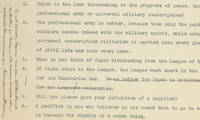
15022446215/02/1933. <blockquote><p>He revises the typescript of his interview with the War Resisters League of which he was Honorary Chairman and calls out William Randolph Hearst and the head of the press and film empire in Germany who aided Hitler’s rise</p><p> </p><p>On philosophy: “The intellect without the emotions is insignificantâ€; On racism: “The main thing is that minority groups should be allowed security in the community.†They ought to be “accepted with friendliness as equal membersâ€</p><p> </p><p>On the press: He criticizes William Randolph Heart by name but says “The freedom of the press is necessary despite all the dangers or abuse that come with it.â€.</p><p> </p><p>On pacifism and peace keeping: “A pacifist is one who believes in his heart that to go to war is beneath the dignity of a human being†“Society needs some form of organization for security and protection in international life†and “An international police force…is almost absolutely necessary as one step toward achieving peace. Force when used by an impartial third party to achieve law and order it's not contrary to pacifismâ€.</p><p> </p><p>This document has never previously been offered for sale and was acquired by us from the family that has had it all this time</p></blockquote><p>Einstein was well known as a pacifist until Hitler’s rise to power. In 1930 on his second visit to America he joined the War Resisters League and accepted the office of Honorary Chairman. Einstein spoke to the organization that year saying “True pacifists must publicly declare in time of peace that they will not take up arms under any circumstances… even if only 2% of those assigned to perform military service should announce their refusal to fight governments would be powerless they would not dare send such a large number of people to jail.†The league then issued a pamphlet “Einstein on War Resistance†that was widely read and discussed.</p><p>Meanwhile back in Germany the rising Nazi movement found a convenient target in Einstein and relativity branding the latter “Jewish physics†and sponsoring conferences and book burnings to denounce Einstein and his theories. The Nazis even enlisted other physicists to denounce Einstein; “One Hundred Authors Against Einstein†was published in 1931. When asked to comment on this denunciation of relativity by so many scientists Einstein replied that to defeat relativity one did not need the word of 100 scientists just one fact.</p><p><img class=""alignnone wp-image-24605 size-post-window"" src=""https://cdn.raabcollection.com/wp-content/uploads/20231204150044/Einstein-Feb-15-1933-3-1-1600x209.jpg"" alt="""" width=""1600"" height=""209"" /></p><p>In December 1932 Einstein decided to leave Germany. The reason: it became obvious to him that his life was in danger. A Nazi organization published a magazine with Einstein’s picture and the caption “Not Yet Hanged†on the cover. There was even a price on his head. In January 1933 Einstein came to the United States to serve at the California Institute of Technology in Pasadena California as a visiting professor. The appointment of Adolf Hitler as chancellor took effect late that month and Einstein decided he would not return to his home in Germany where he had been a professor at the Berlin Academy of Sciences. He would instead return to Europe and assess the situation from there. He and his wife Elsa returned by ship to Belgium in March 1933 to find that that their residences in Germany had been raided numerous times. Einstein accepted the fact that he could not return to Germany and turned in his passport to the German consulate; he also formally renounced his German citizenship. By the summer Einstein learned that his name was on a list of assassination targets. He resided in Belgium for some months and then moved to England for a short period. On October 17 1933 he returned to the US and took up a position at the Institute for Advanced Study at Princeton in New Jersey. And there he remained until his death.</p><p>On February 15 1933 after Hitler had taken power but before Einstein learned that his homes had been raided he granted an interview to the War Resisters League at the home of one of its officials John Dorland. Dorland wanted the interview to be read aloud at the upcoming March 2 meeting of the members in Pasadena. He prepared a five page typescript of the interview and sent it to Einstein to review. As Dorland said in his cover letter to Einstein “Would you be kind enough to read it and if the answers misrepresent you in any detail may we request that you revise it in such particular as we are very anxious to have these correct.†He also asked Einstein's permission to read the interview aloud.</p><p>This is the <strong>original typescript</strong> of the Einstein interview sent to Einstein by Dorland complete with Einstein’s handwritten notations. It is the only such annotated interview of Einstein that we have seen and it covers important topics.</p><p><img class=""alignnone wp-image-24606 size-post-window"" src=""https://cdn.raabcollection.com/wp-content/uploads/20231204150037/Einstein-Feb-15-1933-2-1-1600x247.jpg"" alt="""" width=""1600"" height=""247"" /></p><p>On page one Einstein makes it clear he was not ready to abandon his resistance to war. <em>“The War Resistersâ€</em> he stated at the interview <em>“are doing a fine work. They have done more than any other peace group. A strong organized minority who have declared themselves absolutely against war is very powerful.â€</em> Question from Dorland. <em>“Can we hope to convince everybody†Answer: “Oh no we cannot convince everybody but we do not need to. One strong man is worth much and has great influence Individuals thoroughly convinced and small groups working earnestly are of the utmost value.â€</em> Q: <em>“In trying to arouse interest is it better to appeal to the intellect or the emotionsâ€</em> A: <em>“To both; the intellect without the emotions is insignificant.â€</em></p><p>On page two Einstein states that “<em>Public protests are very valuableâ€</em> as is control over munitions production. <em>“The private munitions business is a great threat to the peace of the world and there should be government control. Public opinion is not yet awake to the atrocities of the munitions firms.â€</em> Then Dorland changes the subject to <em>“race relations.â€</em> Einstein responded <em>“The main thing is that minority groups should be allowed security in the community.â€</em> Then Einstein hand writes in some thoughts. If they are not afforded such security <em>“they should isolate themselves from the rest of society since they are not accepted with friendliness as equal members.â€</em> Then some fascinating free thoughts emerge. Clearly thinking of the Jews in Germany he crosses out <em>“It insecurity is not so badâ€</em> and instead says <em>“They can achieve a healthy existenceâ€</em>. But thinking of the current situation he finishes the thought by adding at least <em>“Up until now!â€</em> He surely had less confidence about the future.</p><p>On page three Einstein discusses the part to be played by international organizations. “<em>The main thing is organization. Disputes will always come but we must have other methods than war for settling them. Society needs some form of organization for security and protection in international life.â€</em> Einstein then writes in <em>“Obligatory court of arbitration. Unconditional obligation of the states to accept their verdicts and enforce them.â€</em> He is then asked which is less threatening to the progress of peace a professional army or universal military conscription. Einstein answers<em> “The professional army is better because then only the professional soldiers become imbued with the military spirit.â€</em> Asked about Japan leaving the League of Nations he hand writes <em>“It is better to let Japan secede from the League of Nations rather than have it the League compromised by a bad compromise.â€</em> Sooner let them go than compromise principles to keep them in. Lastly he is asked for his definition of a pacifist and responds <em>“A pacifist is one who believes in his heart that to go to war is beneath the dignity of a human being.â€</em></p><p><img class=""alignnone wp-image-24607 size-post-window"" src=""https://cdn.raabcollection.com/wp-content/uploads/20231204150030/Einstein-Feb-15-1933-5-1-1600x242.jpg"" alt="""" width=""1600"" height=""242"" /></p><p>On page four Einstein continues by saying that a pacifist <em>“must be active in the prevention of war; that is he must support justice arbitration and conciliation.â€</em> In terms of having some international force enforce the peace Einstein is in favor. <em>“an international police force as suggested by the French is almost absolutely necessary as one step toward achieving peace. Force when used by an impartial third party to achieve law and order it's not contrary to pacifism. This international force would exist only for a transition perhaps 20 years.â€</em> Dorland then asks Einstein <em>“What do you think of the control over public opinion by the pressâ€</em> Einstein in the interview stated it was not good but in this document he elaborated further. <em>“The freedom of the press is necessary despite all the dangers or abuse that come with it. This is the point with the biggest dependence of the peace movement peace work on economic circumstances. Hearst in America and Hugenberg in Germany demonstrate this fact with frightening clarityâ€.</em> Alfred Hugenberg was the head of a press and film empire in Germany who aided Hitler’s rise. Einstein’s comparison of William Randolph Hearst with him is interesting. He clearly feels that the press in the wrong hands motivated by profit and political power was a danger. The next question was <em>“Are religious bodies a power for peaceâ€</em> Einstein’s answer: <em>“Not greatly now.â€</em></p><p>On the final page Einstein states his belief that though no one can change human nature <em>“we can change traditional institutions.â€</em></p><p><img class=""alignnone wp-image-24608 size-post-window"" src=""https://cdn.raabcollection.com/wp-content/uploads/20231204150023/Einstein-Feb-15-1933-4-1-1600x231.jpg"" alt="""" width=""1600"" height=""231"" /></p><p>This document is full of gems: <em>“The intellect without the emotions is insignificantâ€; “The main thing is that minority groups should be allowed security in the community.â€</em> They ought to be <em>“accepted with friendliness as equal membersâ€; “Society needs some form of organization for security and protection in international lifeâ€; “A pacifist is one who believes in his heart that to go to war is beneath the dignity of a human beingâ€; “An international police force…is almost absolutely necessary as one step toward achieving peace. Force when used by an impartial third party to achieve law and order it's not contrary to pacifismâ€</em>; and “<em>The freedom of the press is necessary despite all the dangers or abuse that come with it.â€</em></p><p>This is a great and fascinating rarity. A search of public sale records going back over 40 years turns up only one other example of an Einstein annotated interview nor have we ever had one.</p><p>It wasn’t long in 1933 before the intensity of the threat from Naziism convinced Einstein that only force would be a deterrent a Hitler triumph. He resigned from the War Resisters League later in 1933. To Einstein pacifism became not an absolute concept but one that had to be re-examined depending on the magnitude of the threat.</p><p><img class=""alignnone wp-image-24457 size-post-window"" src=""https://cdn.raabcollection.com/wp-content/uploads/20231204150746/Folder-site-8-1600x1327.jpg"" alt="""" width=""1600"" height=""1327"" /></p> unknown
I4-4WQM-FTTZEditora Nova Fronteira. New. Editora Nova Fronteira unknown
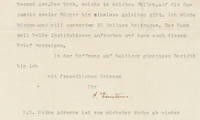
19413262211/9/41. <blockquote><p>A generous demonstration by Einstein of his loyalty to friends and belief in the importance of music</p></blockquote><p>Dr. Theodor Rosenheim was a physician at the famed Medical University Clinic of the Charité in Germany in the 1880s. He was primarily concerned with the physiology and pathology of the digestive tract. He published an early textbook on the “Pathologie und Therapie der Krankheiten des Verdauungsapparatesâ€. Rosenheim was one of the first in Germany to describe and publish on ulcerative colitis. He was intensively involved in the technical development of esophagoscopy and gastroscopy which at that time were only possible with rigid instruments. The Rosenheim line which was named after him described the largest diagonal diameter of the gastric percussion figure.</p><p>Rosenheim was appointed professor extraordinarius at Berlin University in 1921. He also founded a polyclinic and a private sanatorium for stomach and intestinal patients. He was well respected in Berlin and his private practice developed successfully with a large circle of patients including Albert Einstein.</p><p>Theodor’s wife was Hedwig Rosenheim and their daughter Kate was a hero of the Holocaust. She helped several thousand children from Jewish families to escape from Germany. She personally accompanied the legendary Kindertransporte to England among other places. She travelled to the USA in 1936 to negotiate directly with the aid organizations there. She then returned to Germany to actively continue the aid campaigns. Theodor died in 1939. Käte Rosenheim was able to flee Berlin together with her 72-year-old mother Hedwig Rosenheim on January 23 1941. They reached Havana Cuba via France Spain and Portugal. From there they were able to continue to New York where they arrived on April 1 1941.</p><p>Albert Einstein was an accomplished violinist and music lover who was inspired by music in his scientific work. He often said that he would have been a musician if he hadn't pursued science. Another music lover was Hedwig Rosenheim. She had escaped Germany without her possessions especially her precious musical instruments. Upon arrival in the United States she contacted the old family friend Albert Einstein hoping he could help her get a flute either for herself or another escapee one who may have agreed to look for her. Einstein was sympathetic and rose to the occasion. He even contributed some of his personal funds to secure the flute.</p><p><strong>Typed letter signed</strong> his vacation house in Knollwood at Saranac Lake N.Y. September 11 1941 to his old friend Mrs. Hedwig Rosenheim in New York City.<em> “ The matter of i.e. the quest for the flute shall not fail. First one should know what the committee is giving out – or loaning. Second there is the Hebrew Free Loan Society 108 Second Ave. New York which in such cases provides interest-free loans in exchange for the backing of two guarantors. I will serve as a guarantor and contribute 20 dollars on top of that. The man should visit both institutions and can show this letter. In the hope of receiving a positive report soon I remain with warm greetings your A. Einstein.â€</em> <em>“PS. Starting next week my address will again be in Princeton.â€</em> The committee he referred may have been the American Jewish Joint Distribution Committee though there were others as well.</p><p>It shows a lot about Einstein - his generosity his continued concern for old friends who had escaped from Germany and love for music - that he volunteered to make a personal financial contribution to obtaining the flute.</p><p><img class=""alignnone wp-image-25018 size-post-window"" src=""https://cdn.raabcollection.com/wp-content/uploads/20231204144051/Folder-site-11-1600x1327.jpg"" alt="""" width=""1600"" height=""1327"" /></p> unknown
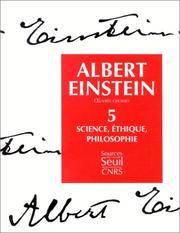
1991H-528-724Seuil / CNRS Editions 1991. Very Good. Former library book. No dust jacket. Volume 5. Ammareal gives back up to 15% of this item's net price to charity organizations. Seuil / CNRS Editions unknown
BN327717Seuil / CNRS Editions. Oeuvres choisies tome 5 : Science éthique philosophie <br/><br/>Oeuvres choisies tome 5 : Science éthique philosophie Albert Einstein Seuil / CNRS Editions unknown
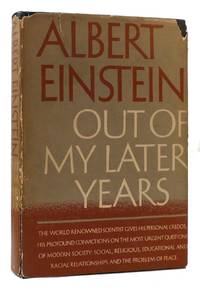
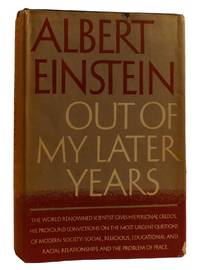
1950176621New York: Philosophical Library 1950. First Edition; First Printing. Hardcover. Very Good in a Very Good dust jacket. Rubbing open tearing along panel edges. Philosophical Library hardcover
19506000330Philosophical Library 1950. Hardcover. Very good/Good. Covers edgeworn. Front hinge cracked. Dust jacket soiled and chipped. Philosophical Library hardcover
1950213518New York: Philosophical Library 1950. First Edition; First Printing. Hardcover. Good in a Very Good dust jacket. FEP clipped. Rubbing along panel edges. Light chipping at spine crown/heel. Philosophical Library hardcover
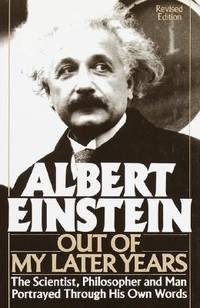
19939780517093801-2025Gramercy 1993. Hardcover. New/New. <p><strong>Author:</strong> Albert Einstein</p><p><strong>Publisher:</strong> Gramercy</p><p><strong>Binding:</strong> Hardcover</p><p><strong>ISBN:</strong> 9780517093801</p><p><strong>Release Date:</strong> 1993</p><p><strong>Number Of Pages:</strong> 288</p><p><strong>Details:</strong> Albert Einstein among the greatest scientists of all time was also a man of profound thought and deeply humane feelings. His collected essays offer a fascinating and moving look at one of the twentieth century's leading minds.Covering a fifteen year period from 1934 to 1950 the contents of this book have been drawn from Einstein's articles addresses letters and assorted papers. Through his words you can understand the man and gain his insight on social religious and educational issues.</p> Gramercy hardcover
19799780806503578-2025Citadel Press 1979. Hardcover. New/New. <p><strong>Author:</strong> Albert Einstein</p><p><strong>Publisher:</strong> Citadel Press</p><p><strong>Binding:</strong> Hardcover</p><p><strong>ISBN:</strong> 9780806503578</p><p><strong>Release Date:</strong> 1979</p><p><strong>Number Of Pages:</strong> 286</p><p><strong>Details:</strong> In a remarkable collection of essays the renowned scientist speaks on a variety of moral political social and religious issues revealing the workings of a powerful mind and deeply humane sensibility. Includes his lucid explanation of the theory of relativity.</p> Citadel Press hardcover
195046353New York: Philosophical Library 1950. First Edition; First Printing. Hardcover. Very Good in a Very Good dust jacket. Chipping to jacket. Owner inscription to FEP. Markings to jacket at front panel. ; 8vo 8" - 9" tall. Philosophical Library hardcover
1527933717.Ghardcover. Good. Access codes and supplements are not guaranteed with used items. May be an ex-library book. hardcover
9355845219.Ghardcover. Good. Access codes and supplements are not guaranteed with used items. May be an ex-library book. hardcover
B9781006727368Hardback. New. hardcover
B9781006714139Hardback. New. hardcover
ria9781006714139_inpHardcover. New. New Book; Fast Shipping from UK; Not signed; Not First Edition; Relativity: The Special and the General Theory began as a short paper and was eventually published as a book written by Albert Einstein with the aim of giving: "an exact insight into the theory of relativity to those readers who from a hardcover
ria9781006727368_inpHardcover. New. New Book; Fast Shipping from UK; Not signed; Not First Edition; The present book is intended as far as possible to give an exact insight into the theory of Relativity to those readers who from a general scientific and philosophical point of view are interested in the theory but who are not conv hardcover
ria9798331255169_inpPaperback. New. New Book; Fast Shipping from UK; Not signed; Not First Edition; N/A paperback