Einstein, AlbertBiblio.com
1 803 résultats
2000Q-0806503572Citadel Press 2000-09-30. paperback. New. New. In shrink wrap. Looks like an interesting title! Citadel Press paperback
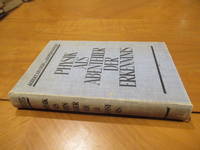
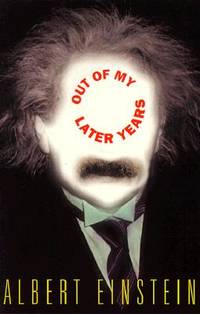
195017988New York: Philosophical Library. 1950. Hardcover. Very Good in Very Good- dust jacket. DJ browned and with light chipping. Rough spot on front free endpaper from removed sticker. ; The beliefs and philosophies of the noted scientist. A nice early edition; 8vo; 282 pages . Philosophical Library hardcover
195032447N.Y. Philosophical Library 1950. Orig. full cloth. Very light wear to spine ends. 7282 pp. <br/><br/><em>First edition. Schilpp:446 - Weil: Appendix. </em> hardcover
dola812London: Thames And Hudson 1950. First Edition. 8vo. pp. viii 282. frontis. portrait. index. cloth light stain on upper cover spine ends starting to fray London: Thames And Hudson, [1950] hardcover
195018266New York: Philosophical Library. 1950. Hardcover. Very Good in Very Good dust jacket. The beliefs and philosophies of the noted scientist. A nice early edition; 8vo; 282 pages . Philosophical Library hardcover
195015962New York: Philosophical Library. 1950. First Edition. Hardcover. Very Good in Very Good- dust jacket. DJ browned and with light chipping especially to DJ spine ends ; The beliefs and philosophies of the noted scientist from essays published 1934-1950.; 8vo 8" - 9" tall; 282 pages . Philosophical Library hardcover
0078822106.Gpaperback. Good. Access codes and supplements are not guaranteed with used items. May be an ex-library book. paperback
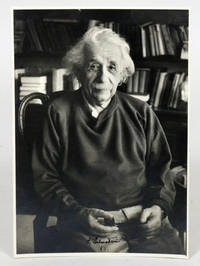
19542832Princeton NJ: np 1954. First edition. nb. Fine. EXTREMELY RARE AND BEAUTIFUL SIGNED PHOTOGRAPH OF EINSTEIN BY FREDERICK PLAUT. SIGNED ON THE IMAGE BY EINSTEIN: "A. Einstein 54". A fine photograph of Einstein in 1954 a year before his death sitting in his Princeton home surrounded by books and holding his pipe gazing slightly away from the camera. <br /> <br /> In his 1964 collection of photographs The Unguarded Moment the photographer Frederick Plaut explains the circumstances of his evocative photo of the elderly Einstein: <br /> <br /> "There must be a moment in every professional photographer's life when he is so in awe of his subject that he can scarcely focus his camera. That moment for me was when I met Albert Einstein at his home in Princeton. Certainly the great man was not formidable; he greeted my wife and me graciously and proceeded to chat with her while I went to work. I remember that she asked him about his music and when he told her that he no longer played his violin she murmured 'That's too bad.' He smiled 'Ah no. It would have been too bad if I went on.' In the final moments of our visit Einstein looked at me very seriously. 'I hope' he said 'you can sell these pictures for a good price.' Astounded I blurted out: 'Oh no Sir. I have nothing to sell. I just wanted to photograph you.' His face clouded. 'Not sell them If I had known that I never would have let you take them.' After we left I realized the significant of a delightful remark attributed to Mrs. Einstein. Someone once asked Mrs. Einstein whether she understood Professor Einstein's theory of relativity. She answered without hesitation 'No but I understand Professor Einstein'" Frederick Plaut The Unguarded Moment A Photographic Interpretation. <br /> <br /> The photographer Frederick Plaut moved to the United States from Europe in 1940. After being "discovered" by the legendary photographer Edward Steichen Plaut soon was invited to exhibit in numerous exhibitions. "At the Museum of Modern Art his photographs have been shown in many exhibitions including: 'The Family of Man' 'Music and Musicians' 'The Exact Instant' and others. Plaut's work has appeared in Time Life Esquire Look Saturday Review Vogue U.S. Camera Modern and Popular Photography andRealities et al" The Unguarded Moment. <br /> <br /> Provenance: Acquired directly from the family of the original recipient Arthur Klein with the original mailing envelope stamped "Jan 27 '54" from The Institute for Advanced Study in Princeton where Einstein was working at the time. Arthur Klein is primarily known for founding with his wife Luce Spoken Arts a highly influential company formed in the 1950s that created and distributed recordings of the works of famous writers and artists usually reading from their own works. <br /> <br /> Princeton NJ: 1954. Silver gelatin print approximately 4.75 x 6.75 inches. With Plaut's studio stamp on verso. Fine condition with Einstein signature - nicely centered at the base of the photograph - particularly strong. As Plaut mentioned in his account of the photographic session he never intended to sell this photograph and it is likely very few of these photos were printed and distributed. <br /> <br /> EXTREMELY RARE: WE CAN FIND NO OTHER EXAMPLE OF THIS PHOTOGRAPH SIGNED BY EINSTEIN. np unknown
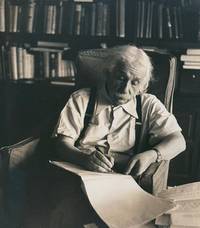
19502896Princeton: np 1950. Very Good. A beautiful photo of Einstein at work in his study seemingly absorbed with his thoughts. The photographer Hermann Landshoff like Einstein was a German-Jewish émigré who settled in the United States in the 1930s. His large body of work encompasses portraits of some of the most influential figures of the century. Landshoff was highly respected by his peers with his work prompting the American photographer Richard Avedon to claim "I owe everything to Landshoff."<br /> <br /> Landshoff visited Einstein to photograph him several times in the 1940s and early 1950s showing Einstein in quieter moments at his home or study in Princeton.<br /> <br /> With Landshoff's copyright stamp on verso marking this as a "Sample copy" and "Not for sale or reproduction." Also with Landshoff's signature on the original matte board. The original non-archival matte was removed during framing to better preserve the photo but the signature was preserved and is now displayed on verso. <br /> <br /> Gelatin silver print with sepia tones. Taken c.1950 likely a contemporary or early printing. Approx. 9.25 x 10.5 in 235 x 263 mm. Archivally framed under museum glass to a size of 16 x 17.5 in. A few tiny spots to image generally in fine condition handsomely framed. np unknown
19321864np: np 1932. First edition. nb. UNPUBLISHED CANDID PHOTOGRAPHS OF EINSTEIN AND LETTERS BY WILLIAM HUBBARD OFFERING AN INTIMATE VIEW OF THE SCIENTIST ON VACATION. On March 2 1932 at the height of his career and world fame Albert Einstein and his wife Elsa set off on a vacation to their German homeland departing from Los Angeles on the M. S. San Francisco. Another passenger aboard the ship was the renowned music scholar William Lines Hubbard. Famous in his own right Hubbard was the music critic for the Chicago Tribune and author of a definitive 11-volume work on the history of opera published 1908. Accompanying Hubbard was his companion Julia Reid their cabins adjacent to that of the Einstein's. As was the practice during this era Hubbard kept detailed journals and letters of his travel experiences. <br /> <br /> This collection from the estate of Hubbard contains the following items: <br /> <br /> 1. Three unpublished small black-and-white and sepia photographs. The first photograph 4.5" x 2.5" pictures Einstein his wife Elsa the Ship's Captain Hubbard the tall figure and three other of the ship's passengers dated 3/14/32. The second photograph 3.5" x 3.25" is an outstanding full front image of Einstein his wife Elsa and the ship's Captain. The final photograph 4.5" x 2.5" is a full frontal image of Einstein and his wife Elsa both seated in deck chairs with the ship's Captain standing behind. <br /> <br /> 2. Typed letter dated March 22 1932 written while sailing through the South Atlantic. Six pages typed front and back on two pieces folded of the ship's original stationary approx. 7.5x11 in. Excerpts on Einstein include: <br /> <br /> Of our Six Passengers two are Prof. Einstein and wife. They are proving very delightful companions-- sincere unaffected and jolly. At first they were very reserved and merely bowed and smiled and "Guten-Morgan-ed" when entering and leaving the dining room but when they had become rested and saw that none of the rest of us planned to intrude they came forward and have been very genial. She is a great talker but talks interestingly. He walks deck smoking his stubby black pipe or whistling cheerily his gray hair blowing in the breeze. Each forenoon and sometimes in the afternoon he goes to the piano and plays for half hour or so. Plays in that satisfying manner peculiar to a man to whom music is a comfort and who thinks musically. It is in no wise brilliant playing but it is throughly enjoyable to hear. The rest of the time he sits in his steamer chair or in his cabin reading or thinking. On the 14th he had his 53rd birthday and the Capt had ordered from La Libertad Salvador where we had taken cargo the day before large bunches of easter and tiger lilies which in the morning were on the Einstein table together with a birthday cake the ship's cook had made and countless cards and letters which friends had sent. It was all a complete surprise to them both and their happiness was childlike in its spontaneity and sincerity. It was heart warming to watch them. <br /> <br /> They seem to appreciate being left to themselves and not being lionized. It is the third time they have come through the canal on these boards an they enjoy it to the full. <br /> <br /> 3. Typed letter dated April 1 1932 written while entering the English Channel. Seven pages on two approx. 8.5x11in sheets folded of the ship's original stationary. Excerpts on Einstein include:<br /> <br /> We had good fun watching for crocodiles along the banks as we came up the cut and Prof Einstein was especially gleeful when he discovered one.<br /> <br /> Professor Einstein loves the roung sic weather and has reveled in it. He and the Mme are proving very delightful fellow passengers. She is very chatty but chats interestingly and he struts up and down deck smoking his stubby pipe or whistling like a jolly kid his white hair blowing in the breeze. <br /> <br /> We have some talks occasionally and he yesterday when he saw the copy of Living Philosophies which I had given me sic before I left San Diego and in which his article is the first took the book and autographed his picture and wrote in remembrance of the happy days on board the San Francisco. I don't think I told you of his birthday which occurred on the 14 of March the day before we reached the Canal. The Capt came to know if it and when the Einsteins came to their table at breakfast they found it decorated with three huge vases of Easter and Tiger lilies which the Capt had secured in La Libertad. The cook had made a gorgeously decorated Torte-- one of the filled and frosted German cakes-- and there were letters and telegrams from friends which had been sent in the Capt's care. It was a complete surprise to the Einsteins and they were like two happy kiddies. It was gladdening to watch their simple and keen enjoyment. Later we had pieces of the Torte which were a bit of muchness for breakfast but which of course we ate.<br /> <br /> 4. Typed letter dated April 24 1932 written in Merano Italy. Six pages on five 5.5x7in sheets. While recalling a cargo transfer on the M. S. San Fransisco Hubbard writes: <br /> <br /> The Einsteins were especially enthusiastic and we had a great fun over the boss of the unloading. He was a huge and tremendously rotund gent wearing a soft felt hat and a short overcoat the buttons of which seemed fated to "bust off" at any moment. His chief employment seemed to be running about from side to side of the dock into the warehouse and out again clambering onboard and then clambering off and all the time shouting orders at the top of his voice and gesticulating wildly. Einstein had been reading the "Living Philosophies" which I had loaned him and was especially curious concerning Mencken and how he happened to be included in the great ones in the book. I gave him an outline of Mr. M's greatness and assured him that the book cold sic well largely on account of M being included. All of which amused the Einsteins greatly. So when this wild boss hove into sight that morning and began his excited directing Mrs E said "there is Mister Mencken" and thus he remained so long as we were in Rotterdam.<br /> <br /> The Einsteins were starting early the next morning for Berlin so they went about 9 pm to the custom house and had their 16 packages bundles and gifts examined. Frau Professor had a funny story to tell of their experience with the 150 pound bag of coffee that had been presented them in Salvador.<br /> <br /> 5. An official passenger list from the M. S. San Francisco printed on the ship's original stationary 4.75" x 8.25" dated March 2 1932. With "Professor Albert Einstein" and "Mrs. Albert Einstein" shown under the list of cabin passengers going from Los Angeles to Bremen. <br /> <br /> 6. A postcard depicting Hubbard's profile in black and white 3.45" x 5.45". <br /> <br /> All items in very good condition letters with wear and soiling at folds and housed in a custom cloth presentation folder. <br /> <br /> RARE FIRST-HAND TESTIMONY REVEALING THE PERSONALITY OF EINSTEIN IN RELAXED AND INFORMAL MOMENTS. np unknown
1938031895Leiden: A. W. Sijthoff's Uitgeversmaatschappij N. V. 1938. First Edition 1st Printing. Light Blue Cloth. Very Good/No Jacket. 9 7/8" Tall. Drawings. 222 Pp. True First Edition Of "The Evolution Of Physics" Issued Just Prior To The English Translation. Blue Cloth Printed In Black. Clean Unmarked. Covers With Slight Sunning To Spine Points Of Fraying At Two Front Tips Hinges Tight 1 1/2" Diameter Ring Mark At Left Fore Edge Of Rear Cover; Light Foxing Spots To Fore Edges Of Page Block But Pages Themselves Clean And Bright Without Spotting. <br/> <br/> A. W. Sijthoff's Uitgeversmaatschappij N. V. hardcover
1938009528Leiden: A. W. Sijthoff's Uitgeversmaatschappij N. V. 1938. First Edition 1st Printing. Light Blue Cloth. Near Fine/Very Good Dust Jacket. 9 7/8" Tall. Drawings. Viii 222 Pp. Light Blue Cloth Stamped In Dark Blue. True First Edition Of "The Evolution Of Physics" Issued Just Prior To The English Translation. A Clean Unmarked Copy With Signs Of Removal Of A Single Bookplate On The Front Endpaper No Other Marks. Dust Jacket With Some Wear And Browning Also With A 1 3/8" X 1 5/8" V-Chip At Top Of Rear Panel Adjacent To The Spine Very Small Chips At Tips With A 1" X 1/8" Loss Along Top Of Front Flap Fold And A 1/2" Closed Tear At Top Of Rear Panel With A Few Small Chips And Very Short Closed Tears. A Nice Copy In The Nearly Complete And Scarce Jacket. <br/> <br/> A. W. Sijthoff's Uitgeversmaatschappij N. V. hardcover
193842901Paris Freien Deutschen Hochschule 1938. Orig. printed wrappers. In. "Zeitschrift für Freie deutsche Forschung" Vol. I no. 1:pp. 5-19 a. no. 2 pp. 1-14. Whole issues present: "Nummer" 1 u. 2. pp. 1-168 a. pp. 1-144. <br/><br/><em>The German version from the same year in which the paper was printed in "Franklin Institute Journal" vol. 221 1936. - Weyl. 197. </em> unknown
1938165146Paris 1938. paperback. Pp. 5-19 IN: Zeitschrift fur Freie Deutsche Forschung. Jahrgang 1 Nummer 1. Herausgegeben von der Freien Deutschen Hochschule in Paris. 168p. printed wrappers. Paris Juli 1938.<br/> <br/> First number of this scarce short-lived exile publication featuring German & Austrian writers and scholars. Fine.<br/> <br/> unknown
a107840Leipzig 1913 Hirzel. 4to. 2 Hardcover volumes. Brown and yellow marbled boards with green cloth spine and tips. In German 560p. with 20 plates.and pp. 561-1312 with 36 plates. In addition to the important Einstein article "Zum Gegenwartigen stande des Gravitationsproblems" the volume contains important articles by other scientists including Max Born and Courant "Zur Theorie des Eotvosschen Gesetzes"; V F Hess "Uber den Ursprung der Durchdringenden Strahlung"; Otto Hahn and Lise Meitner "Radioaktinium und Aktinium" etc. Many important articles in history of science especially of physics. Light board edge wear. No owner marks. Pictures available on request. Near Fine. Two volumes. . hardcover
a94363Leipzig 1916 first edition. Hirzel. Hardcover 4to. xiii 626p. Includes Einstein's Obituary for Ernst Mach on p. 101-104 Many significant scientific articles by Max Born Angstrom Sommerfeld Seeliger Freundlich others. Dark brown cloth with gilt spine lettering; brown papercoverd boards. VG. no owner marks. text clean and binding secure. light wear. . hardcover
a90182Leipzig 1908 Hirzel. first edition. Physikalische Zeitschrift. One full year of this semi-monthly German publication bound in one hardcover volume. Articles by many of the great names in physics and mathematics xix 928p. text illustrations 8 plates. "Eine neue Elektrostatische Methode zur Messung kleier Elektricitatsmengen" by Albert Einstein is on pp. 216-217; "Atomzerfall und Serienspektren "; Hahn and Meitner "Ueber Absorption der B-Strahlen" Planck "Theorie Dispersion" Lord Kelvin Helmoltz more. Cover tips and backstrip dark brown leather with black boards. Institute name stamp on front blank and blind stamp on titlepage but no other ownership marks no pocket no spine numbers. Binding very secure; hinges not cracked in or out. Text clean. VG plus light wear on cover spine edges and extreme tips. . hardcover
a91657Leipzig 1913 Hirzel. first edition. Physikalische Zeitschrift . Issues for Januar to Dezember bound in one hardcover 4to. Articles by many of the great names in physics and mathematics xxxi 1312p. 56 plates; text illustrations. In addition to the important Einstein article "Zum Gegenwartigen stande des Gravitationsproblems" the volume contains important articles by other scientists including Max Born and Courant "Zur Theorie des Eotvosschen Gesetzes"; V F Hess "Uber den Ursprung der Durchdringenden Strahlung"; Otto Hahn and Lise Meitner "Radioaktinium und Aktinium" etcBlack cloth. Ex-university library but no spine numbers. VG just light cover wear. Very heavy volume - may require extra postage. . hardcover
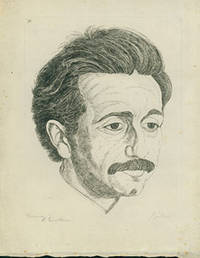
51-1799Berlin: Circa 1917. Etching on Old Japanese Paper. 30 x 23 cm. on sheet size 40 x 32 cm.Light foxing and folds in the margins.Signed in pencil by Büttner lower right and by Einstein lower left. Indistinct pencil annotations above Einstein’s’ signature.Provenance: A Berkeley academic family.Porträt von Albert Einstein. Radierung auf Bütten. Rechts unten von Erich Büttner links unten von Albert Einstein signiert.At the beginning of the years Einstein suffers from various illnesses among other things from a liver disease and a stomach ulcer. His cousin Elsa takes care of him. It will last several years until he recovers completely. He writes a work on cosmology with the cosmologic term which shall guarantee a limited universe. He will refer to this cosmologic term later as his “biggest idiocyâ€. He takes over the management of the Kaiser Wilhelm Institute for Physics on October 1. Berlin: Circa 1917. unknown
19482327Princeton NJ: np 1948. framed. Fine. ONE OF THE MOST CELEBRATED IMAGES OF EINSTEIN SIGNED BY MASTER PHOTOGRAPHER YOUSUF KARSH. On February 11 1948 Yousuf Karsh perhaps the most accomplished portrait photographer of his generation visited The Institute for Advanced Study in Princeton to fulfill a dream of his: to photograph Albert Einstein. As he later explained: "Among the tasks that life as a photographer had set me a portrait of Albert Einstein had always seemed a 'must' - not only because this greatest refugee of our century has been accounted by all the world as the most outstanding scientist since Newton but because his face in all its rough grandeur invited and challenged the camera." Karsh: Beyond the Camera David Travis ed. "At Princeton's Institute for Advanced Study I found Einstein a simple kindly almost childlike man too great for any of the postures of eminence. One did not have to understand his science to feel the power of his mind or the force of his personality" official Karsh website. "Awed before this unique intellect I yet ventured to ask Einstein his views on human immortality. He mused for a moment and then replied 'What I believe of immortality There are two kinds. The first lives in the imagination of people and is thus an illusion. There is a relative immortality which may conserve the memory of an individual for some generations. But there is only one true immortality on a cosmic scale ant that is the immortality of the cosmos itself. There is no other.' "He spoke of these ultimate mysteries as calmly as he might a student's question about mathematics - with such an air of quiet confidence indeed that I found his answer profoundly disturbing to one who held other views. Knowing him to be an accomplished violinist I turned the conversation and asked if there were any connection between music and mathematics. 'In art he said 'and in the higher ranges of science there is a feeling of harmony which underlies all endeavour. There is no true greatness in art or science without that sense of harmony. He who lacks it can never be more than a great technician in either field.' "Was he optimistic about the future harmony of mankind itself He appeared to ponder deeply and remarked in graver tones: 'Optimistic No. But if mankind fails to find a harmonious solution than there will be disaster on a dimension beyond anyone's imagination.' To what source should we look for the hope of the world's future 'To ourselves' said Einstein. He spoke sadly yet serenely as one who had looked into the universe far past mankind's small affairs. In this humor my camera caught him. the portrait of a man who had traveled beyond hope or despair." Yousuf Karsh Regarding Heroes. Opening quote from: Colin Naylor ed. Contemporary Photographers. Silver print. Photo taken Princeton 1948. Printed later. Signed by Karsh in full beneath the image on photographer's mount. With Karsh's original calling "card" - a 4x10 inch cardboard slip - included. Image: 8x9 inches. Framed to an overall size of 12x15 inches. Fine condition. np unknown
0582029635.Ghardcover. Good. Access codes and supplements are not guaranteed with used items. May be an ex-library book. hardcover
a107843bLeipzig 1914 first edition. Hirzel. hardcover thick 4to. 956p. 15 plates. 3/4 maroon leather with brown and red marbled boards. Raised spine bands. Einstein article pp. 176-180. VG bookplate of previous owner blind stamp on tp several library stamps properly de-accessioned. Board tips and edges a bit worn but binding quite secure; hinges not cracked and text clean. . hardcover
191850342Leipzig 1918. Prinzipielles zur allgemeinen relativitätstheorie. In Annalen der Physik 55 241-244 pp. Red cloth with gilt lettering on the spine. Bookbinder's embossed stamp of ffep. Whole volume: 632 pp. 1 folding plate. Figs. Text-illust. 210 x 130 mm. Very good. Approximate English translation of title: "On the foundations of the general theory of relativity."</p> <br /> <br /> <p> "Here we are given the first new presentation of the foundations of general relativity since the developments of March 1916 when Einstein gave his first systematic exposition." p. 300. Calaprice Kennefick & Shulmann. An Einstein Encyclopedia. 2015. </p> <br /> <br /> <p>Weil's Einstein Bibliography no. 96. <br> Boni's Checklist no. 100.</p> <br /> <br /> <p>Also in this volume: Born Max 1882-1970. Elektronentheorie des Natürlichen optischen Drehungs vermögens isotroper und anisotroper Flüssigkeiten pp. 175-240. Approximate Eng. translation of title: "Electron theory of the natural optical rotation ability of isotropic and anisotropic liquids". Max Born 1882-1970 was a German physicist and mathematician who was instrumental in the development of quantum mechanics. He also made contributions to solid-state physics and optics as well as supervised a number of notable physicists in the 1920s and 1930s. Born won the 1954 Nobel Prize in Physics "for his fundamental research in quantum mechanics especially in the statistical interpretation of the wave function." In 1919 a chance meeting with Fritz Haber 1868-1934 led to the discussion of how an ionic compound is formed when a metal reacts with a halogen - a process now known as the Born-Haber cycle Wikipedia. </p> . unknown
191840496Leipzig Johann Ambrosius Barth 1918. Without wrappers as extracted from "Annalen der Physik" Vierte Folge Bd. 55 Heft 4. The whole number present pp. 241-336. Einsteins paper pp. 241-244. <br/><br/><em>First printing the periodical form. Einstein believed around 1918 "in the relativity of inertia that in 1918 in the paper offered he stated as being on equal footing three principles on which a satisfactory theory of gravitation should rest: 1. The principle of relativity as expressed by general covarianc. 2. The principle of equivalence. 3. Mach's principle the first time this term entered the literature: 'Das G-Feld ist 'restlos' durch die Massen der Körper bestimmt.' that is the g. are completely determined by the mass of bodies more generally bu T."Pais The Science of Albert Einstein p.287. - Weil:96. - Boni: 100. </em> unknown
1918581Leipzig: Johann Ambrosius Barth 1918. 1st Edition. FIRST EDITION OF EINSTEIN'S DISCUSSION OF MACH'S PRINCIPLE a theory Einstein names and one which was historically important to the inspiration that would lead to general relativity. Mach's principle states that "local physical laws are determined by the large-scale structure of the universe" Wikipedia. To Einstein Mach's principle posited the belief that inertia originates in a kind of interaction between bodies. <br /> <br /> "So strongly did Einstein believe at that time in the relativity of inertia that in this paper he stated it as being on equal footing three principles on which a satisfactory theory of gravitation should rest: 1. The principle of relativity as expressed by general covariance. 2. The principle of equivalence. 3. Mach's principle the first time this term entered the literature" Pais The Science of Albert Einstein 287. <br /> <br /> Einstein brought Mach's principle into mainstream physics while working on general relativity. Indeed it was Einstein who first coined the phrase Mach's principle. Weil 96. Boni 100. Collected Papers 1918e. <br /> <br /> ALSO IN THIS VOLUME Max Born's Electron theory of natural optic rotation processes in isotropic and anisotropic liquids pp. 177-240. CONDITION & DETAILS: Leipzig: Johann Ambrosius Barth. 8vo. 8 x 5 inches; 200mm x 125mm; Full volume with front original wrap of each issue 1-8 is bound in the rear. Handsomely rebound in three-quarter calf over marbled paper boards; four raised bands at the spine; gilt-lettered and tooled. Very tightly bound. Ex-libris with five numbers written in a light hand on the title page and a very occasional round stamp within. Very good condition. Johann Ambrosius Barth hardcover