EINSTEIN - Traduction par Caroline André - Présentation par Helen Dukas et Banesh HoffmannLivre Rare Book

2 944 résultats
19801215111980 Editions InterEditions - 1980 - In-8, broché - 197 p. - Ouvrage bilingue (français-allemand)
19801215101980 Editions InterEditions - 1980 - In-8, broché - 130 p. - Ouvrage bilingue (français-allemand)
23638Edition Albin Michel, collection ",Les savants et le monde",, couverture cornée et légèrement abîmée au niveau de la tranche.
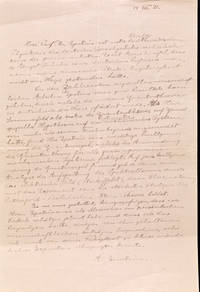
19211206201921. Signed. EINSTEIN Albert. Autograph letter signed. No place August 14 1921. Single sheet of cream lined paper measuring 7-1/2 by 11 inches; p. 1. $35000.Rare heartfelt autograph letter of recommendation written and signed by Einstein in German enthusiastically recommending his friend and colleague physicist Prof. Dr. Paul Epstein for an academic position.The autograph letter dated ""14 VIII 21"" written entirely in Einstein's hand reads translated from the original German: ""Prof. Dr. Epstein is certainly one of the most prominent living theoretical physicists of the German-speaking world. Without a doubt he would have been appointed to a German professorship a long time ago had his Russian nationality not stood in the way. Among Epstein's numerous original scientific papers two findings which advanced the modern quantum theory in crucial ways should be noted. After Mr. Sommerfeld as the first physicist who on the basis of special hypotheses had applied the quantum theory to a certain mechanical system of more than one degree of freedom Mr. Epstein discovered an important generalization of the quantum principle which established the application of the quantum theory for all quasi-periodic mechanical systems. Based on that general application of the quantum principle he then provided an analysis of the splitting of spectral lines in the electrical field Stark effect the accordance of which with the experiment provides one of the strongest supports for the Rutherford-Bohr atomic theory. I would like to add that I have also come to appreciate Mr. Epstein in personal interactions as a human being and that I had the pleasure of attending several scientific lectures given by him which enabled me to convince myself of his competence in delivering clearly understandable oral exposition. / A. Einstein.""Einstein and Epstein were friends and longtime correspondents who shared an interest in physics Judaism and the founding of Israel. Paul Epstein was a Russian-American mathematical physicist. He remains best known for his contributions to the development of quantum mechanics. Indeed he was one of a select group that included Lorentz Einstein Minkowski Thomson Rutherford Sommerfeld Röntgen von Laue Bohr de Broglie Ehrenfest and Schwarzschild. Born in Warsaw then part of Imperial Russia Epstein was brought up solidly middle class. He later stated that his mother recognized his potential at the age of four and predicted his future as a mathematician. Epstein studied mathematics and physics for his entire university career eventually earning a degree from the Imperial University of Moscow. He then went on to earn a Ph.D. at the Technical University of Munich in 1914 concentrating on a problem in the theory of diffraction of electromagnetic waves. However the outbreak of World War I rendered Epstein an enemy alien in Germany. Sommerfeld intervened on his behalf and he was allowed to stay as a private citizen and continue his research. In 1916 Epstein published an important paper explaining the Stark Effect using the Bohr-Sommerfeld quantum theory. After the war Epstein went to Leiden and worked as an assistant for Lorentz and Ehrenfest. In 1921the year this letter was writtenEpstein was recruited by Robert Millikan to join the physicists at the California Institute of Technology. Epstein accepted the position and stayed there for the rest of his career publishing extensively on quantum theory. Epstein was something of polymath and worked in numerous areas outside of quantum theory including work on air resistance the settling of gasses the theory of vibration and the absorption of sound. He was an avid supported of Freudian psychoanalysis including as one of the founding members of the Psychoanalytic Study Group that later merged with the Los Angeles Institute for Psychoanalysis. Epstein was also notably anti-communist and worried about the threat of nationalism.The areas of study mentioned in Einstein's letter of recommendation all came together to help form the science behind atomic and hydrogen bombs though neither Einstein nor Epstein anticipated quite where the science was headed in 1921. The letter mentions the Stark effect which is the shifting and splitting of spectral lines of atoms and molecules due to the presence of an external electric field. It is analogous to the Zeeman effect in which a magnetic field is the influence. The Rutherford-Bohr model presented in 1913 is a system consisting of a small dense nucleus surrounded by orbiting electronssomewhat like the Solar System but with electrostatic forces instead of gravity. The Bohr model came to be recognized as a relatively primitive model of the hydrogen atom compared to the valence shell atom model. However because of its simplicity and the correct results it generates for certain systems it is still commonly used to introduce students to quantum mechanics.Overall this letter provides valuable insight into the scientific world during the height of Einstein's international career right when he first began traveling abroad and meeting fellow scientists internationally. The letter reflects Einstein's importance in the community and is a testament to Epstein's ability as a physicist. Original mailing creases. Fine condition. unknown
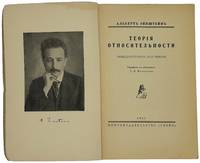
lom-MS001965In Russian. Short description: Einstein A. Teoriya otnositelnosti. Theory of Relativity. Public presentation. Translated from German by G.B. Itelson. Berlin: Slovo 1921. - 150 2 p. 1 sheet portrait. Publisher's cover. Format 215x140 mm. Lifetime edition of one of the founders of modern physics Nobel Prize winner Albert Einstein 1879-1955. First Russian edition. Please feel free to contact us for a detailed description of the copies available. SKUMS001965 kn_nat unknown
50495Petite Bibliothèque Payot In-12 288pp. illustr. Nb-0120 unknown
65642Gauthier-Villars Paris 1956 In-8 23 cm 179pp couverture avec dos restaure etat moyen Ats30 traduit de l'allemand par Maurice Solovine unknown
190725711Weinheim: Offprint from: Zeitschrift für Elektrochemie. Nr. 6. 1907 February. First Edition Offprint Issue from Volume 13 number 6. Single sheet approximately 10" x 8" pp 41-42 pp. A very fine example of this rare issue a very minor and unobtrusive stain to an upper corner. SCARCE OFFPRINT ISSUE OF AN IMPORTANT EINSTEIN PAPER OF STATISTICAL MECHANICS and a continuation of his remarkable 1905 and 1906 publications on Brownian Motion which not only led to the proof of the existence of the atom but also worked to determine the size of atoms and how many atoms there are in a mole or the molecular weight in grams of a gas. This paper also contains a note on the technical meaning of "average velocity. Offprint from: Zeitschrift für Elektrochemie. Nr. 6. unknown
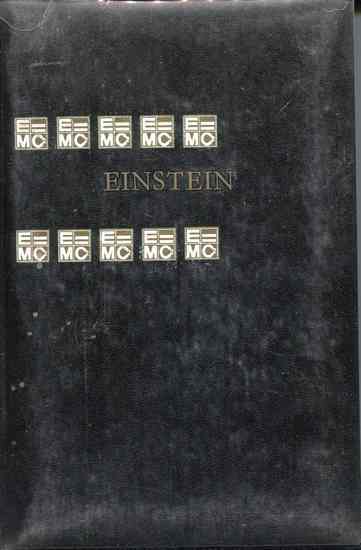
202449805Folio Society 2024. 8vo. First Edition thus with portrait frontispiece; pictorial boards a near fine copy in publisher's blocked slip-case. Includes the author's 1923 Nobel Prize lecture. Folio Society, hardcover
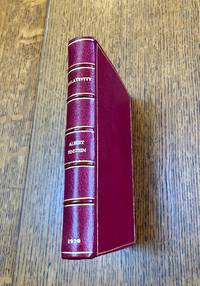
192011566<p>Methuen & Co. Ltd. London. 1920. FIRST ENGLISH EDITION. 8vo. 7.7 x 5.2 inches. Portrait frontis and five line diagrams within the text. Complete with the 8pp publishers adverts at back of book. Overall a clean bright copy in recent fine binding of full red morocco. Spine with raised bands compartments ruled decorated and lettered in gilt. Single gilt ruled border on boards. Top edge gilt others untrimmed with rough edges. ------ This important translation apart from being the first English edition also contains new text written by Einstein specially for this edition-- Appendix III The Experimental Confirmation of the General Theory of Relativity.</p> Methuen & Co. Ltd. London. 1920 hardcover
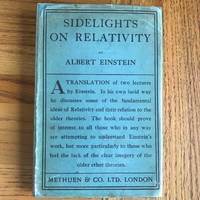
1922355490717346London: Methuen 1922. First Edition. Hard Cover. Dust Jacket. First UK Edition. Contains 2 Essays: "Ether and Relativity" and "Geometry and Experience". Translated by G.B. Jeffrey and W. Perrett. Publisher's original blue boards with gilt spine lettering. Foxing to the page block edges and slight fading to the edges of the boards otherwise a VG copy In the RARE FRAGILE D/W priced 3/6 net to the spine as called for. The D/W is in good condition with chipping at the head of the spine removing most of "SIDE" and at the base of the spine not affecting any lettering. At the edge of the rear flap a former owner has written in fountain pen: 13 6/- per week. It looks much better than it sounds. Rare. Methuen hardcover
19461206241946. Signed. EINSTEIN Albert. Typed letter signed. Princeton April 3 1946. Single sheet of gray letterhead measuring 8-1/2 by 11 inches; p. 1. Matted and framed with a portrait entire piece measures 19 by 15-1/2 inches. $9500.Original typed letter signed by Albert Einstein thanking his friend Dr. Isadore Held for his birthday wishes as well as for sending a new book that Einstein found both ""extraordinarily enlightening"" and humorous. Text in German.The letter typed on Einstein's personal letterhead with his name and Princeton address blindstamped at the top reads in full translation: ""3 April 1946. Dear Mr. Held: I would like to express my sincere thanks for your birthday wishes and for the sending of the last work of this wonderful contemporary. I have already read quite a bit and find that it is extraordinarily enlightening. His penetration into the mentality of far-off times and attitudes toward thinking is most remarkable and his humor no less. With fond greetings to you and your dear wife. Yours signed Albert Einstein."" This letter was written to Austrian-American medical Dr. Isadore Held who was friends with Einstein since at least 1938. Held and Einstein shared numerous interests particularly related to Jewish humanitarian relief and Israel. At Held's death Einstein wrote to his widow that ""True goodness emanated from this man who alleviated the harshness of human relations and who understood and forgave all weaknesses As a role model for his fellow men he was the best that a human being can be."" Einstein was not a huge fan of birthdays though he happily acknowledged well wishes from friends. Just before turning 65 Einstein crankily said to a New York Times interviewer: ""What is there to celebrate Birthdays are automatic things. Anyway birthdays are for children."" In a 1954 letter to physicist Hans Mühsam Einstein described his birthday as ""a natural disaster a shower of paper full of flattery under which one is drowned."" Einstein was generally quite shy and did not like to be the center of attention particularly from strangers obsessed with his accomplishments and fame. However well-meaning letters and small gifts like the book given by Held were always welcomed and graciously accepted by Einstein. Original mailing creases and a few pinpoint holes along top edge possibly from stapling. About-fine condition. unknown
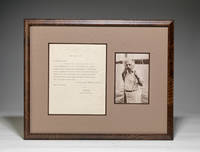
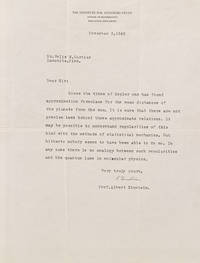
19421265881942. Signed. EINSTEIN Albert. Typed letter signed. Princeton November 3 1942. One sheet measuring 8-1/2 by 11 inches typing on recto only; matted and framed with a portrait of Einstein entire piece measures 21 by 17 inches. $38000.An exceptional typed letter signed by Einstein on precursors like Johannes Kepler's work to his Special and General Theories of Relativity beautifully framed.The letter on letterhead from the Institute for Advanced Study in Princeton reads in full: ""November 3 1942. Mr. Felix W. Cartier. Laconite Minn. Dear Sir: Since the times of Kepler one has found approximation formulaes for the mean distances of the planets from the sun. It is sure that there are not precise laws behind those approximate relations. It may be possible to understand the irregularities of this kind with the methods of statistical mechanics. But hitherto nobody seems to have been able to do so. In any case there is no analogy between such regularities and the quantum laws in molecular physics. Very truly yours signed A. Einstein. Prof. Albert Einstein.""Early in the 17th century Johannes Kepler 1571-1630 discovered that planets orbit the sun in ellipses rather than perfect circles. This great discovery paved the way for Isaac Newton's laws of gravity and for Albert Einstein's general and special theories of relativity. Previous to Einstein's time people believed in real distances and absolute time and showed that instruments could not objectively measure the distances between planets. Einstein's theories which hypothesized that light and space curve near a massive object revolutionized scientific thought and gave man an exciting new perspective of his universe.Einstein's letter reflects on some of the most important scientific revelations in the history of physics and astronomy. Kepler defined three laws of planetary motion; however the one specifically referred to in this letter is that all planets move about the Sun in elliptical orbits having the Sun as one of the foci. If the Universe then consisted only of two point massesthe Sun and a planetthe orbit of that planet would make a perfect closed ellipse that returned the world to its starting location with each trip around the Sun. But in a Universe governed by Newtonian gravity with a plethora of massive bodies in our Solar System that ellipse will precess or rotate slightly in its orbit.In the mid-1800s orbital deviations of Uranus from its predicted motions led to the discovery of Neptune as the outermost world's gravitational influence accounted for the excess motion. But in the inner Solar System the nearest planet to the Sun Mercury was experiencing a similar problem. With detailed accurate observations going back to the late 1500s thanks to astronomer Tycho Brahe we could measure how Mercury's perihelion its closest orbital point to the Sun was advancing. The number we came up with was 5600"" per century just over 1.5 degrees over a 100 year period. But of that 5025"" came from the precession of Earth's equinoxes a well-known phenomenon while 532"" was due to Newtonian gravity.But 5025"" plus 532"" comes up short by a small but significant amount. Attempts at explanationincluding the existence of an unknown inner planet interior to Mercuryall failed. But after Einstein's special theory of relativity came out in 1905 mathematician Henri Poincare showed that the phenomena of length contraction and time dilation contributed a fraction between 15-25% of the needed amount towards the solution dependent on the error. That plus Minkowski's formalization of space and time as not separate entities but as a single structure bound together by their union spacetime led Einstein to develop the general theory of relativity. On November 25 1915 he presented his results computing the spectacular figure that the contribution of the extra curvature of space predicted an additional precession of 43"" per century exactly the right figure needed to explain this observation sending shockwaves through the astronomy and physics communities. Less than two months after this Karl Schwarzschild found an exact solution predicting the existence of black holes. The deflection of starlight and gravitational redshifts/blueshifts were realized as possible tests and finally the solar eclipse of 1919 validated general relativity as superseding Newtonian gravity. Expected fold lines. An incredible letter scarce in its important content. unknown
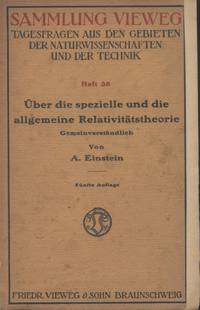
1920108736Friedr. Vieweg und Sohn in Braunschweig 1920. Paperback. <b>Livre en anglais</b>. Couverture souple. Mit 3 Figuren. Fünfte Auflage. Sammlung Vieweg. Heft 38. Broché. 83 pages. Papier bruni. Couverture légèrement défraîchie. Découpure de quelques millimètres sur la longueur des plats. <i>ref. 108736</i> Friedr. Vieweg und Sohn in Braunschweig paperback
192917857Berlin: Verlag Der Akademie der Wissenschaften 1929. An important offprint first edition. With mathematical formulas in text. Small folio in the original orange off-print paper wrappers printed in black on both covers. 8 pp. Very fine nearly as new. A RARE AND IMPORTANT OFFPRINT. EINHEITLICHEN FELDTHEORIE which means "A Coherent Theory of the Electro-Magnetic Field" and is the title of a five-page paper of highest mathematical formulae which Relativist Albert Einstein worked on for ten years. His report is a purely mathematical extension of the general theory of relativity to include gravitational and electromagnetic phenomena.<br> His relativity theory which he phrased within only three printed pages made time & space the creator of matter. When this paper on the Unified Field Theory was published it was a headline story in the newspapers. Few if any people understood the complex mathematics but many were fascinated by the thought that Einstein had possibly came up with a new theory expanding on "General Relativity" and unifying the fundamental forces of nature. It is considered Einstein's last important scientific work Weil #165.<br> "In 1928 Einstein embarked on a new approach to a unified field theory. involving what he called 'distant parallelism'. By early 1929 he had solved the main problems involved in writing down field equations for his unified field theory. On the day of official publication of the third of a formidably technical series of nine articles on the theory. excited headlines appeared in foreign newspapers throughout the world. In this frenzied unscientific atmosphere Einstein's new theory was hailed in the press as an outstanding scientific advance. Yet Einstein had stated in his article that this was still tentative; and soon he found he had to abandon it" Hoffmann/Dukas ''Albert Einstein: Creator and Rebel'' 1972 pp. 225-226 Verlag Der Akademie der Wissenschaften unknown
lom-MS001965In Russian. Short description: Einstein A. Teoriya otnositelnosti. [Theory of Relativity]. Public presentation. Translated from German by G.B. Itelson. Berlin: Slovo, 1921. - 150, [2] p., 1 sheet portrait. Publisher's cover. Format 215x140 mm. Lifetime edition of one of the founders of modern physics, Nobel Prize winner Albert Einstein (1879-1955). First Russian edition. Please feel free to contact us for a detailed description of the copies available. SKUMS001965 kn_nat
2006S12505Sagamore Beach:: Science History Publications 2006. 2006. 8vo. xii 228 pp. Illus. bibliography appendix index. Black silver-stamped cloth dust-jacket. Fine. ISBN: 0-88135-283-7 ". . . In tandem with the revival of quantum skepticism in physics Elzinga's book helps us recover Einstein's story from the tendentious interpretation of it that has gone unchallenged far too long."—BJHS ". . . The great value of Einstein's Nobel Prize is its detailed analysis of relevant documents showing how the academy managed to give Einstein the prize despite his work on relativity. . . "—Isis. Science History Publications, 2006. hardcover books
In-16 (cm. 19.20), brossura illustrata, pp. 267, (5). Con interventi di Wolfgang Pauli, Max Born, Walter Heitler, Niels Bohr, Henry Margenau, Hans Reichenbach e Kurt Godel. Traduzione di Augusto Gamba. Piccola etichetta al piatto posteriore e prima carta parzialmente scollata; peraltro, testo in buono stato (text in good condition).
16775,Paris, Hachette Collection 'Génies et Réalités' 1966, 295 pp., 1 vol. in 8 relié
33600Paris Le Club Français du Livre 1969 in 8 (21,5x14) 1 volume reliure toilée beige de l'éditeur, 241 pages [1]. Traduit de l'allemand par Maurice Solovine. Edition numérotée hors-commerce. Bel exemplaire ( Photographies sur demande / We can send pictures of this book on simple request )
5104Paris Flammarion In-12 258 pp, Bibliothèque de philosophie scientifique, exemplaire non coupé, dos abîmé
48656Paris, FLAMMARION, 1958; in-8 broché, 218 pp. BON ETAT
1999R240090652FLAMMARION. 1999. In-12. Broché. Bon état, Couv. convenable, Dos satisfaisant, Intérieur frais. 189 pages - illustration en noir et blanc sur le 1er plat.. . . . Classification Dewey : 500-SCIENCES DE LA NATURE ET MATHEMATIQUES
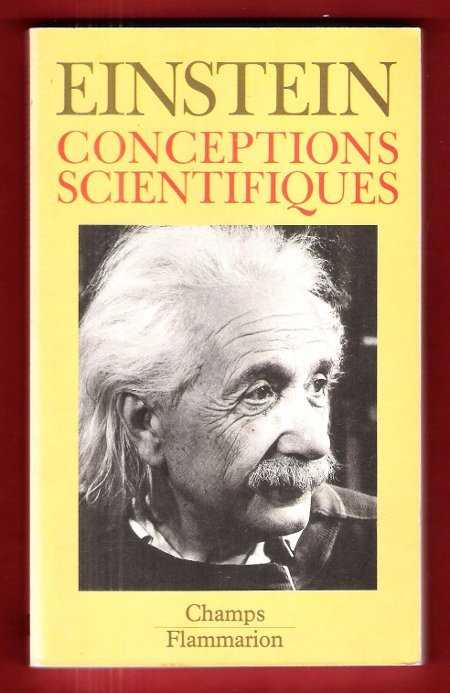
1990016758Paris Flammarion 1990 In 12 Collection " Champs Flammarion " Intérieur comme neuf , couverture avec de légers défauts . - 188 p. , 300 gr.
1992R100062454Flammarion. 1992. In-12. Broché. Bon état, Couv. convenable, Dos satisfaisant, Intérieur frais. 188 pages.. . . . Classification Dewey : 500-SCIENCES DE LA NATURE ET MATHEMATIQUES