Einstein, AlbertBiblio.com

1 803 résultats
19211014Paris: Gauthier-Villars 1921. 1st Edition. FIRST FRENCH EDITION OF A 1921 LECTURE BY EINSTEIN ON THE "GEOMETRIZATION OF PHYSICS AND RELATIVITY AND THE RELATION OF MATHEMATICS TO THE EXTERNAL WORLD" Dictionary of Scientific Biography 4 330. WEIL 115b. French translation by Maurice Solovince. <br /> <br /> In the same year in which he won the Nobel Prize 1921 Einstein delivered this paper as a lecture at "a commemorative session of the Prussian Academy of Sciences in honor of Frederick the Great" Calaprice Einstein Almanac 65. In "Geometrie und Erfahrung" Geometry and Experience Einstein advances his theory that space conforms to non-Euclidean principles of geometry -- a corollary of the Theory of Relativity - and as stated generally sums up his views on the "geometrization of physics and relativity and the relation of mathematics to the external world" DSB. <br /> <br /> It is in this lecture that Einstein also provides his famous answer to the puzzling question of why mathematics should be so well adapted to describing the external world: "Insofar as the laws of mathematics refer to the external world they are not certain; and insofar as they are certain they do not refer to reality" ibid. Calaprice put it like this: "He questioned whether human reasoning even without direct experience could lead to an understanding of the properties of real things merely through thought" Calaprice 1921. CONDITION & DETAILS: Paris Gauthier-Villars. 8vo. 9 x 5.75 inches; 225 x 143mm 2 19 1. Two in-text illustrations. Very slight soiling to the front wrap. Minor chipping lower right corner. Bright and clean throughout. See photos. Gauthier-Villars unknown
8493427810.Gpaperback. Good. Access codes and supplements are not guaranteed with used items. May be an ex-library book. paperback
20071-0980224853La Prensa Quimica 2007. Paperback. New. escolastica edition. 1 pages. Spanish language. 40.00x5.30x5.30 inches. La Prensa Quimica paperback
20071-0980224829La Prensa Quimica 2007. Map. New. escolastica edition. 1 pages. Spanish language. 40.00x5.30x5.30 inches. La Prensa Quimica unknown
192230290Paris: Payot 1922. Fine. Payot Paris 1922 12 x 19 cm broché First edition. A nice copy. Payot unknown
19502946629Buenos Aires.: Emecé. 1950. Hardcover. Cubierta deslucida. Good. 19 cm. 215 p. Encuadernación en tapa dura de editorial. Cubierta deslucida. Física.530.12 530 Emecé. hardcover
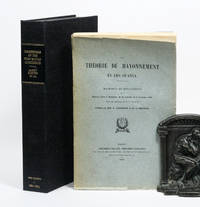
19122508Paris: Gauthier-Villars 1912. First edition. Original wrappers custom box. Very Good. RARE FIRST EDITION IN ORIGINAL WRAPPERS OF THE REPORTS FROM THE HISTORIC FIRST SOLVAY CONFERENCE "THE FIRST INTERNATIONAL CONFERENCE IN PHYSICS EVER ORGANIZED" AND A CRITICAL MOMENT IN THE BIRTH OF QUANTUM PHYSICS. In the short time that followed Planck's hypothesis of the universal constant that would bear his name the greatest minds in physics were largely at a loss about how to deal with the bizarre theoretical results that followed let alone the experimental results which confirmed them!. Much of the focus at the time was on black-body radiation including work by Planck himself as well as Lorentz Rayleigh and Jeans. However shortly before the first Solvay conference a young Einstein had also started investigating the related question of materials' specific heat. Kuhn. "The purpose of the first Solvay Conference was thus two-fold: first there was the need to examine whether classical theories molecular-kinetic theory and electrodynamics could in some undiscovered ways provide an explanation of the problem of black-body radiation and of the specific heat of polyatomic substances at low temperatures; secondly to consider phenomena in which the theory of quanta could be successfully used." Mehra.<br /> <br /> Underlying these questions was the more fundamental mystery of how to interpret the existence of the Planck constant. There were two camps both of which were represented at the conference. Planck's took the constant to indicate some fundamental constraint on the radiative processes of emission and absorption. For example "Sommerfeld introduced a version of the quantum hypothesis which he considered to be compatible with classical electrodynamics. He postulated that in 'every purely molecular process' a quantized quantity of action is exchanged." Staumann. Einstein's camp on the other hand took the quantum of action to represent the physicality of a perhaps pseudo-corpuscular theory of energy exchange - his photons of light.<br /> <br /> Although the debates that followed the lectures included in the proceedings did not rise to the famous heated exchange that Einstein would have with Bohr at the 1927 Solvay conference we do see some of the young Einstein's hotheadedness as he opens the debate following Planck's plenary lecture: "What I find strange about the way Mr. Planck applies Boltzmann's equation is that he introduces a state probability W without giving this quantity a physical definition. If one proceeds in such a way then to begin with Boltzmann's equation does not have a physical meaning." As translated by Straumann.<br /> <br /> It would take another 14 years for quantum mechanics to be fully formalized but the first Solvay conference represents a pivotal point in quantum history:<br /> <br /> "During 1911 the situation changed quickly. Articles that applied the quantum to other topics then outnumbered those on blackbody radiation for the first time and some were backed by impressive experimental evidence. In part because of that evidence physicists like Planck and Lorentz who had previously taken the constant h to be characteristic only of the radiation problem began to consider additional areas in which others had earlier staked quantum claims." Kuhn.<br /> <br /> Albert Einstein and the Solvay Conference:<br /> <br /> Among the most renown scientists of the day - including Ernest Rutherford Marie Curie and Max Planck - Einstein made quite an impression. At age 32 he was the second youngest participant in the conference. The youngest was British physicist Frederick Lindemann later to become scientific adviser to Winston Churchill.<br /> <br /> Although "Einstein had already published so many masterpieces none had actually been put to the test and his theories were looked on rather as tours de force than as definitive additions to knowledge. But his pre-eminence among the twelve greatest theoretical physicists of the day was clear to any unprejudiced observer." Frederick Lindemann quoted in Brian.<br /> <br /> References: Headline quote from the Solvay Institute website. Kuhn T. 1978 Black Body Theory and the Quantum Discontinuity 1894-1912. University of Chicago Press. Mehra J. 1975 The Solvay Conferences on Physics: Aspects of the Development of Physics Since 1911. Straumann N. 2011. On the first Solvay Congress in 1911. The European Physical Journal H 363 379-399. Denis Brian Einstein: A Life p.82.<br /> <br /> Paris: Gauthier-Villars 1912. Octavo original wrappers; custom box. Splits to top and bottom joint of upper wrapper two creases to front wrapper. Text in fine condition largely unopened. <br /> <br /> FIRST PRINTINGS IN ORIGINAL WRAPPERS ARE EXTREMELY SCARCE. Gauthier-Villars unknown
31310Couverture rigide. Bon/1956. in-8. Paris Gauthier-Villars 1956 in-8 179pp broché Superbe exemplaire! unknown
65642Gauthier-Villars Paris 1956 In-8 23 cm 179pp couverture avec dos restaure etat moyen Ats30 traduit de l'allemand par Maurice Solovine unknown
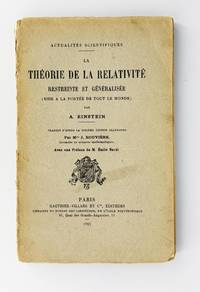
1921009633Paris: Gauthier-Villars 1921 12mo 19 cm XXII 120 pp. Printed wrappers wrappers slightly stained and frayed; small portions of paper missing from the spine; paper toned inside. Early French edition of Einstein's celebrated popular exposition of the theory of relativity intended to make the fundamental ideas of both the special and the general theory accessible to non-specialists. With a preface by the renowned mathematician Émile Borel who emphasizes the scientific importance of Einstein's work and its profound implications for modern physics. Einstein's text explains the essential concepts of space time motion gravitation and the structure of space-time in clear largely non-technical language presenting the empirical and conceptual foundations of relativity to a broad readership. The French translation was prepared by Maurice Solovine one of Einstein's close early collaborators and an important mediator of his ideas to the French-speaking public. Boni-Russ-Laurence 91.B. Gauthier-Villars paperback
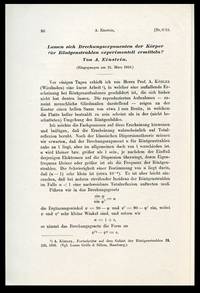
1061Braunschweig: Druck und Vieweg. 1st Edition. FIRST EDITION FULL VOLUME OF THE PAPER IN WHICH EINSTEIN PROVIDES THE FIRST DESCRIPTION OF THE NATURE OF THE REFRACTIVE INDEX FOR X-RAYS here clearly demonstrating that phase contrast effects are significant. <br /> <br /> "Inspired by the presence of fringes at the edges of objects in early X-ray images and by considerations of optical dispersion theory Einstein suggested in 1918 that the real part of the index of refraction for X-rays in matter is slightly less than unity. This was confirmed in 1924 by Larsson et al. in measurements of wavelength-dependent refraction of X-rays by a prism" Hornberger Quantitative Amplitude 1. "A century later most x-ray microscopy and nearly all medical imaging remains based on absorption contrast even though phase contrast offers orders of magnitude improvements in contrast and reduced radiation exposure at multi-keV x-ray energies"ResearchGate November 2015. Weil 104. Note that we offer this paper separately in its original printed wraps. <br /> <br /> ALSO INCLUDED: Einstein's reply to Gehrcke's paper "Über den Äther" also present in this volume pp. 165-169.<br /> <br /> ALSO INCLUDED: Papers by E. Goldstein A. Landé Max Born and J. Petzoldt. CONDITION & DETAILS: Braunschweig: Druck und Vieweg. Full volume. Complete. 4to 9.25 x 6.25 inches; 225 x 150mm. Ex-libris with armorial bookplate on the front pastedown. Bound in brown cloth rubbed at the edges; the cloth has torn at the spine and has been re-glued. Clean throughout. Good . Druck und Vieweg paperback
18299Couverture rigide. Bon/1924. in-8. Paris Gauthier-Villars 1924-1926 in-8 2 vol. XVI 331 1; XVI 318pp Demi-percaline lie de vin à coins avec titre encollé sur le dos Première édition française traduite par Gustave Létang d'après la quatrième édition allemande revue et augmentée par l'auteur. Dans cet important ouvrage qui fut publié à Brunswick en 1911 et 1916 l'auteur énonce diverses applications sur le principe de la relativité. Premier volume : le principe de la relativité et la transformation de Lorentz. Second volume : la relativité générale et la théorie de la gravitation d'Einstein cf. DSB VIII p. 53. Max von Laue 1879-1960 obtint le prix Nobel de physique 1914 pour ses recherches sur les images de la diffraction des rayons X par les cristaux. Nombreuses annotations manuscrites au stylo sur plusieurs pp Exemplaires en parfait état. unknown
1944020487Montreal / London 1944 and 1945: Free World Inc 1944. First Editions . Printed Wrappers. Very Good. Drawings and Other Artwork. Six Issues. The French Language Edition Of "The Free World". No. 1 Has Chipping At Lower Corner Of Front Cover And Adjacent Pages Adjacent To Spine; Others Are Vg To Near Fine. <br/> <br/> Free World Inc unknown
ria9780323878173_inpPaperback / softback. New. New Book; Fast Shipping from UK; Not signed; Not First Edition; N/A paperback
1987AME_9780135280508PrenticHall 1987. 1st. Paperback. New/New. PrenticHall paperback
22953Halbleinen; 136 Seiten dies ist ein regulär ausgesondertes Bibliotheksexemplar aus einer wissenschaftlichen Bibliothek keine Markierungen/Anmerkungen Deckellaminat leicht verletzt von entfernter Rückensignatur das Buch ist ansonsten gut erhalten unknown
192749047Berlin: Ernst Wasmuth A.-G 1927. First edition. Good- to fine condition. 176/330. 41 1pp. 42 plates with printed tissue guards. Original quarter vellum over brown paper-covered boards with gilt vignette on cover gilt lettering on spine. Title page with publisher's device and black double frame. Cover design by Lucian Zabel. With an introduction on Russian culture the tradition of ballet and theater set and costume design by Carl Einstein. Many of the plates with dates ranging from 1910 to 1923 including motifs created during the war. The motifs of the plates range from close-up figure drawings to simple folk costumes elaborate gowns for members of the Court mystical figures and various set designs.<br /> <br /> Illustrated with forty-two plates nineteen of them fully or partially colored by hand or pochoir some heightened in gilt or silver three b/w one sepia-toned lithograph and nineteen plates reproduced in high quality offset printing. The title page calls for forty-two plates and six illustrations in the text. Our copy is illustrated with seven tipped-in color offset reproductions and one b/w lithograph as endpiece on page seventeen.<br /> <br /> In addition the work is extra-illustrated with five color offset reproductions: one full-page embossed color plate with extensive hand-applied gilt overlay facing page seven Le Roi a full-page embossed color offset reproduction with extensive silver overlay facing plate one Phedre Thesee dated 1923 and three full page color offset reproductions facing plates fifteen L'Amazone with black overprinting twenty-five Scheherazade embossed and heightened in silver and Lampe d'Aladin multicolor overprint and thirty-six La Sultane embossed and overprinted in gilt facing the same image though with greater detail.<br /> <br /> The copies listed in OCLC vary in publication dates all calling for 42 plates and six in-text illustrations. Auction records call for 1925. One auction record for the 1925 edition calls for the lithograph line drawing in the text. Our copy contains two plates dated 1922 in addition to others dated 1917. We've been unable to find any bibliographic record that describes seven in-text illustrations or the five additional illustrations facing four of the plates and the first page of the text as described.<br /> <br /> Text in German. Binding with light wear along edges but vellum smudged and variously discolored. Block lightly starting at a few plates 11 15 19 27 30 42. A couples of tissue guards for plates loose but present. Binding in overall good- plates in very good to fine condition. Leon Bakst 1866-1924 was a Russian painter costume and set designer. Bakst studied art at the St. Petersburg Academy of Arts and was a member of the Sergei Diaghilev circle. In 1893 he moved to Paris for four years studying at the Academy Julian. He founded the magazine 'Mir Iskusstva World of Art' with his friends Alexander Benois Sergei Diaghilev and Valentin Serov. Bakst is best known for his work in set and costume design for the Ballet Russes. Ernst Wasmuth A.-G unknown
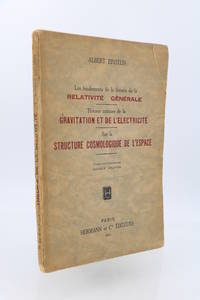
193391965Paris: Hermann & Cie 1933. Fine. Hermann & Cie Paris 1933 16 x 25 cm Broché First edition of the French translation illustrated with a photographic portrait of Albert Einstein as frontispiece. A small loss at the foot of the spine which also shows rubbing along the joints upper right corner of the front board starting to come loose a slight marginal tear just below pleasant internal condition manuscript bookplate at the head of a flyleaf. Annotations and markings in red pen on pages 8 and 9. Work illustrated with figures in the text. Hermann & Cie unknown
2008Q-0385315937Dial Press Trade Paperback 2008-04-08. Paperback. New. In shrink wrap. Looks like an interesting title! Dial Press Trade Paperback paperback
1979P-18052Princeton NJ: Princeton University Press 1979. First Edition. Hardcover. As New/As New. Octavo. With the reeata slip laid in. First publication of these letters by Einstein. A clean unmarked and unclipped copy. Princeton University Press hardcover
1993R3215France: Éditions du Seuil Collection Science ouverte 1993 ÉPUISÉ mais DISPONIBLE. « La correspondance du couple s'étend de 1897 à 1903 peu après leur mariage. Ces lettres révèlent un Einstein peu connu optimiste confiant et heureux malgré les difficultés familiales et professionnelles qu'affronte le jeune couple. Mileva y montre une forte personnalité - « mon égal » dit Einstein qui admire sa maturité affective et intellectuelle. Elle contribuera de façon essentielle aux succès scientifiques d'Einstein.». Couverture souple. Comme neuf. Éditions du Seuil (Collection Science ouverte) paperback
1912011596Leipzig: Johann Ambrosius Barth 1912. In bound volume of Annalen der Physik. Vierte Folge Band 38 pp. 355-69. Volume also includes 1 Einstein "Nachtrag zu meiner Arbeit:: 'Thermodynamische Begrundung des photochemischen Aquivalentgesetzes" pp. 881-84; 2 "Antwort auf eine Bermerkung von J. Stark p. 888; and 3 "Relativitat und Gravitation Erwiderung auf eine Bermerkung von M. Abraham" pp. 1059-64. Paper label on spine top of which is worn; library bookplate; perforated stamp on half-title and title page. First Edition. Library Buckram. Good. Johann Ambrosius Barth Hardcover
1912008413Leipzig: Johann Ambrosius Barth 1912. Small pieces missing from spine; rear wrapper carefully reattached; ink stamp on front wrapper; small piece of paper stuck to first page. . First Edition. Original Printed Wrappers. Good. Johann Ambrosius Barth Paperback
191229311Leipzig Barth 1912. 8vo. Orig. printed wrappers. Backstrip taped. Kept in a cloth-box. In: "Annalen der Physik IV Bd. 38" pp. 355-369 and pp. 443-458. The whole issue present= Bd. 38 Heft 2 pp.249-472. <br/><br/><em>Both papers in first edition and they are considered as the first appearance of a Nonlinear Field Equation for Gravitation. - "Einstein published two remarkable memoirs in 1912 which were efforts to construct a complete theory of gravitation incorporating the equivalence principle. In these memoirs Einstein supposed that the gravitational field can be characterized completely by one function the local speed of light analogous to the Newtonian description where only the gravitational potential appears. By an extraordinary argument he extended the potential equation of Newton.In his second Memoir in 1912 he used the equivalence principle to show the influence of a static gravitational field on electromagnetic and thermal processes." DSB IV p.320 ff. - Weil No. 47 and 48. </em> hardcover
191249779Leipzig Barth1912. 8vo. No wrappers. In: "Annalen der Physik IV Bd. 38" No 7. Pp.249-472 a. 3 plates. Entire issue offered. Einstein's papers: pp. 355-369 and pp. 443-458. Clean and fine. <br/><br/><em>Both papers in first edition and they are considered as the first appearance of a Nonlinear Field Equation for Gravitation. "Einstein published two remarkable memoirs in 1912 which were efforts to construct a complete theory of gravitation incorporating the equivalence principle. In these memoirs Einstein supposed that the gravitational field can be characterized completely by one function the local speed of light analogous to the Newtonian description where only the gravitational potential appears. By an extraordinary argument he extended the potential equation of Newton.In his second Memoir in 1912 he used the equivalence principle to show the influence of a static gravitational field on electromagnetic and thermal processes." DSB IV p.320 ff. - Weil No. 47 and 48. </em> unknown