187 résultats
19171127481917. Rare large etching of Albert Einstein done by well-known artist Erich Buttner. Signed by both Einstein and Buttner. In fine condition. Double matted and framed the entire piece measures 12.25 inches by 15 inches. An exceptional piece. In the 1920s he created a series of portraits of his friends and fellow artists including Lovis Corinth George Grosz Arno Holz and Heinrich Zille. He produced a very fine book of exlibris bookplates in Berlin 1921. This book contains the exlibris of Albert Einstein 1917 probably Einstein's only bookplate. The etching measures 12.5 inches by 9.5 inches. Double matted and framed. The entire piece measures 18.75 inches by 15.75 inches. Hermann Struck was a German Jewish artist known for his etchings. In 1908 Struck published "Die Kunst des Radierens" "The Art of Etching" which became a seminal work on the subject. His students included Marc Chagall Lovis Corinth Jacob Steinhardt Lesser Ury and Max Liebermann. Struck did commissioned portraits of Albert Einstein Ibsen Nietzsche Freud Herzl Oscar Wilde among others. unknown books
1923958901923. Etch bust of Albert Einstein done by well-known artist Hermann Struck. Signed by both Einstein and Struck numbered 49/150. In fine condition. Double matted and framed the entire piece measures 12.25 inches by 15 inches. An exceptional piece. Hermann Struck was a German Jewish artist known for his etchings. In 1908 Struck published "Die Kunst des Radierens" "The Art of Etching" which became a seminal work on the subject. His students included Marc Chagall Lovis Corinth Jacob Steinhardt Lesser Ury and Max Liebermann. Struck did commissioned portraits of Albert Einstein Ibsen Nietzsche Freud Herzl Oscar Wilde among others. unknown books
1921874301921. Etched portrait of Albert Einstein by well-known Polish-American Jewish artist Lionel S. Reiss. Signed by both Einstein and Reiss. In fine condition. Double matted and framed the entire piece measures 13.5 inches by 16.5 inches. An exceptional piece. Polish-American Jewish painter Lionel S. Reiss immigrated with his parents to the United States in 1898 at the age of four joining the ranks of other Eastern European Jews fleeing their native countries at the start of the 20th century. His family settled in New York's Lower East Side where Reiss would ultimately spend the majority of his life and become an established portraitist particularly known for his intimate portraits of Jewish people. In 1938 Reiss published his book My Models Were Jews in which he argued against the idea of a singular "Jewish Ethnicity" and that the Jewish people were rather a cultural group composed of a number of significantly diverse communities. unknown books
192625045<p><b>ALBERT EINSTEIN.</b>Autograph Correspondence Card Signed to Michele Besso May 1 1926 Berlin. In German. 1 p. 4¼ x 5⅞ in. </p><b>Complete Translation</b><p><i> 1 May 1926</i></p><p><i>Dear Michele</i></p><p><i> I read that paper</i><i>right away at the time but I don't think that anything more profound lies behind it. There is naturally a rough connection between a decrease in volume and energy and from here one can try to come nearer to the empirical phenomena by introducing further parameters. But this happens in such a way that neither rhyme nor reason can be made of it. It is very reminiscent of Traube. Using such apothecary's methods one cannot reveal any of God's secrets I think. Schrödinger did a couple of wonderful studies on quantum rules Ann d Physik.</i> <i>That has the scent of a deeper truth. Let it be explained to you.</i></p><p><i> I'm coming to Switzerland in July. End of July is LN meeting in Geneva.</i> <i>Then I'm going somewhere in the mountains with Tete. So I'll visit you or else we can meet.</i></p><p><i> Warm regards also to Anna and Vero your</i></p><p><i> Albert</i></p><p><b>Historical Background</b></p><p>Early in 1926 Michele Besso sent Einstein an early draft of a paper by Swiss chemist Gottfried Beck on quantum mechanics. Beck had initially submitted the paper to the Swiss scientific journal <i>Helvetica Chemica Acta</i> which rejected it as too speculative. On April 25 1926 Besso wrote to Einstein about Beck's paper. After discussing the details he writes "This surely is an amusing thing; I was surprised that you didn't write me anything about it. Here too reality is once again simpler than the theoretical conceptions would lead one to expect."</p><p>Three months later Einstein wrote to Besso regarding Beck's paper: "it is obviously particularly painful to use the quantum condition together with the equations of motion here because the validity of the latter appears to be irreconcilable with the validity of the former." Einstein was skeptical that Beck's equation "has any reality left within it in the face of quanta. I vigorously doubt it." However Einstein found the construction of the left side of the equation "surely contains a deeper truth." Einstein declared to Besso "I cannot make myself glue two things together like the left- and right-hand sides of this equation that have nothing to do with each other logico-mathematically."</p><p><b>Michele Besso</b> 1873-1955 was born in Zurich Switzerland into an Italian Jewish family. He was a close friend of Albert Einstein when they worked together at the Federal Polytechnic Institute in Zurich and at the patent office in Bern where Einstein helped Besso get a job. Besso met his future wife Anna Winteler through Einstein in June 1897. In 1898 their son Vero was born in Winterthur Switzerland. Einstein referred to Besso as "the best sounding board in Europe" for scientific ideas. Besso died in Geneva just over one month before Einstein died in Princeton New Jersey.</p><p><b>Johann Gottfried Beck</b> 1900-1992 received his Ph.D. in chemistry from the University of Bern in December 1925. He worked as an assistant to Heinrich Zangger at the Institute for Forensic Medicine at the University of Zurich.</p><p><b>Isidor Traube</b> 1860-1943 was born in Hanover the son of a wealthy German-Jewish merchant. He received his doctorate in organic chemistry in 1882. He founded capillary chemistry and conducted advanced research on liquids helping to define the concepts of surface tension and critical temperature. In 1882 he joined the faculty of Technische Hochshule in Berlin and became a professor of chemistry there in 1900. Unacceptable to National Socialists Traube was barred from his laboratory and he left Germany in 1934. Through the aid of British colleagues he was provided with a laboratory at the University of Edinburgh. During his long career he was a persistent and stubborn controversialist in opposition to various theories.</p><p><b>Erwin Schrödinger</b> 1887-1961 was born in Vienna Austria. He was a commissioned officer in the Austrian fortress artillery during World War I. After the war he advanced through the academic ranks to become a full professor in 1921 in Breslau now Wroclaw Poland. That year he moved to the University of Zurich and in 1927 to the Friedrich Wilhelm University in Berlin. He received the Nobel Prize in Physics in 1933 and left Germany as he opposed the Nazis. After brief positions in a number of places he settled in Dublin Ireland in 1940 where he remained until retiring in 1955. During his career Schrödinger developed a number of fundamentals of quantum theory including the wave equation. He also published many works in various fields of physics. Although Schrödinger was an atheist he believed his scientific work was an approach to the godhead in a metaphorical sense.</p><p><b>Eduard Einstein</b> 1910-1965 was born in Zürich Switzerland to Albert and Mileva Marić Einstein. In 1914 his parents separated and his mother returned to Zürich with Eduard and older brother Hans Albert who were both deeply affected. Eduard was interested in music art and poetry. Unlike his father Eduard was a good student. He had started to study medicine and psychiatry but in 1930 was diagnosed with schizophrenia. He was first institutionalized in 1932; it is not clear if his treatment particularly electroconvulsive therapy did more good than harm. Albert fondly referred to Eduard as "Tete" for <i>petit</i> and they corresponded regularly but never saw each other after a heart-breaking final visit in 1933. Marić and Eduard's Swiss citizenship undoubtedly saved Eduard from Aktion T4 the Nazi euthanasia program and perhaps both of them from the Holocaust. His mother cared for Eduard until her death in 1948 and Eduard thereafter lived mostly at a psychiatric clinic in Zurich where he died from a stroke in 1965.</p> books
1984S12510Princeton:: Princeton University Press 1984. 1984. 8vo. xxxii 439 pp. Illus. index. Printed wrappers. Very good. ISBN: 0691023832 Princeton University Press, (1984). unknown books
1972RH1339New York:: Times Mirror 1972. 1972. 8vo. xv 272 pp. Illus. index; text pages browned. Printed wrappers. Very good. Times Mirror, (1972). unknown books
192043308Berlin: Springer 1920. 15pp. 221 x 146 mm. Original printed wrappers foxed. Minor internal foxing but very good. First edition cover title does not include the date Einstein delivered his lecture; see Weil. "By royal decree of June 24 1920 a special chair in Leiden University was created for Einstein enabling him to come to that university for short periods of his choosing. On October 27 1920 Einstein began his new position with an inaugural address on aether and relativity theory" Pais Subtle is the Lord p. 313. Weil Albert Einstein Bibliography 111. Springer unknown books
192037403Berlin: Springer 1920. Springer unknown books
193110574New York: The Macmillan Company 1931. First American Edition. Cloth. Near fine/good. First American edition of About Zionism: Speeches and Letters by Professor Albert Einstein in scarce dust jacket. Twelvemo 8 9-94pp. Green cloth title stamped in gilt on spine. Published "February 1931" statement on copyright page. Uncut outer edge clean text throughout. Sound binding. In the scarce publisher's dust jacket price clipped retail price of $1.50 stamped on front flap chipping and some loss along top edge shelf wear to both covers a stable but well-worn example. Boni Russ & Laurence 306 An exceptionally scarce example of this work in the publisher's original dust jacket. First published in London in 1930 by The Soncino Press this work was translated into English by Leon Simon. The Macmillan Company unknown books
2007032156Philadelphia and London: Running Press 2007. Edited with commentary by Stephen Hawking. xi 468p. dj. Running Press unknown books
1988S4425In:: American Scientist Vol. 76 No. 2 March-April 1988. 1988. 277 x 211 mm. 4to. 154-158 pp. 4 figs. Pictorial wrappers Einstein and Chaplin. Fine. American Scientist, Vol. 76, No. 2, March-April 1988. unknown books
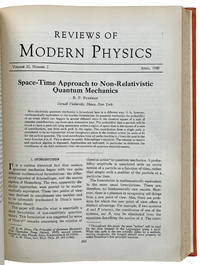
1948S10249Lancaster:: American Physical Society 1948. 1948. Large 8vo. 266 x 205 mm. iv 728 pp. Frontis. port. of Robert Andrews Millikan photos figs. tables. Later orange cloth gilt-stamped spine title; spine faded. Very good. TWO PAPERS FROM THE TWO GIANTS OF 20TH CENTURY PHYSICS AS THEY WERE ORIGINALLY PUBLISHED IN ONE COLLECTED VOLUME. Einstein's "Generalized Theory of Gravitation" is considered the last principal work issued by the 20th Century's premiere scientist. Schilpp-Shields. <br /><br /> Einstein: "A new presentation. . . which constitutes a certain progress in clarity as compared with previous presentations." from the Introduction. Feynman: "At first Feynman's fundamental article RMP 1948 did not arouse much interest among theoretical physicists who were not familiar with Feynman's new approach to doing quantum mechanics. As Feynman recalled: 'At the Shelter Island Conference. . . they asked me if I would explain my path-integral method for doing quantum mechanics so I did. I must have been preparing the manuscript for my paper RMP 1948 so that everything was organized and I explained it. It's hard to pay attention to some new idea and they didn't pay much attention to it.' However nowadays Feynman's RMP 1948 paper is one of the most well-known and widely cited papers; it is one of the cornerstones of modern theoretical physics." Mehra. <br /><br /> "It is a curious historical fact that modern quantum mechanics began with two quite different mathematical formulations: the differential equation of Schroedinger and the matrix algebra of Heisenberg. . . This paper will describe what is essentially a third formulation of non-relativistic quantum theory. This formulation was suggested by some of Paul Dirac's remarks concerning the relation of classical action to quantum mechanics. A probability amplitude is associated with an entire motion of a particle as a function of time rather than simply with a position of the particle at a particular time." from the Introduction. Provenance: David Middleton b. 1920 noted pioneer in the field of statistical communication theory last name gilt-stamped on spine. Einstein: Boni-Russ-Laurence 258; Schilpp-Shields 308 also see p. 758; Wasson Nobel Prize Winners p. 289-294; Weil 222 marked with asterisk by Weil. Feynman: Gleick Genius: The Life and Science of Richard Feynman p. 249; Mehra The Beat of a Different Drum: The Life and Science of Richard Feynman p. 200; Wasson Nobel Prize Winners p. 316-319. American Physical Society, 1948. hardcover books