Al', Cern Vs 'Einstein EtBiblio.com
1 803 résultats
1450072178.Ghardcover. Good. Access codes and supplements are not guaranteed with used items. May be an ex-library book. hardcover
10096294like new. unknown
Q-0070195315McGraw-Hill Companies. paperback. New. New. In shrink wrap. Looks like an interesting title! McGraw-Hill Companies paperback
1980Q-0690018983Lippincott & Crowell 1980-01-01. Hardcover. New. In shrink wrap. Looks like an interesting title! Lippincott & Crowell hardcover
1944556012New York: The American Christian Palestine Committee 1944. Softcover. Very Good. First separate edition. Small octavo. 12pp. Stapled self-wrappers. Slight age-toning on the wrappers and very tiny nicks soiling and light wear very good or better. Two articles jointly written by Einstein and Kahler in response to two articles laying out anti-Zionist testimony given by Dr. Philip Hitti of Princeton before the Committee on Foreign Affairs of the House of Representatives. Both of Hitti's articles and the Einstein and Kahler articles were all published in The Princeton Herald. This publication doesn't include the Hitti articles but summarizes them in the Einstein and Kahler rejoinders. Scarce. The American Christian Palestine Committee unknown
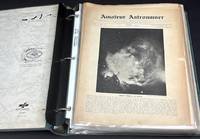
1936H40351New York: Amateur Astronomers Association 1936. Very good. Old cloth 3-ring binder with acetate sheaths containing the issues. This started out as a 4 pp. periodical but expanded in later issues. In 1936 the journal merged with The Sky published by Hayden Planetarium which subsequently merged with The Telescope in 1941 to become Sky & Telescope which is still being published. Condition is mainly very good although the first three issues we have have some damage to fore-edges. The first issue has a supplementary sheet laid in "Professor Einstein Sends Greetings to the Amateur Astronomers Association" reprinting in facsimile the handwritten note with a printed translation and a facsimile of another note from Einstein. We have Vol. I nos. 1 & 2 April and May 1929; Vol. 2 nos. 1 September 1929 - 9 May-June 1930 -- the April 1930 issue has a cover story on the discovery of Pluto then considered the ninth planet. Pluto was first discovered on February 18 1930 by Clyde Tombaugh at the Lowell Observatory in Flagstaff Arizona.The discovery was announced on March 13 1930 in the Astronomical Journal.; Vol. III nos. 1 October-November 1930 - 7/8 May-June 1931; Vol. IV nos. 1 September-October 1931 - 8 Summer 1932; Vol. V nos. 1 September-October 1932 - 3 March 1933 -- these expanded to 6 pp. each; Vol. VI nos. 1 - 3 Winter & Spring 1933-1934 - Summer 1934 -- beginning with Vol. VI these are 16 pp. each; with the Spring issue cover story on Hayden Planetarium; Vol. VII nos. 1 Autumn 1934 - 3 Spring 1935; Vol. VIII nos. 1 Autumn 1935 - 3 Spring 1936. We don't know if we're missing any or not but it's a nice early run of this rare astronomical journal. Amateur Astronomers Association unknown
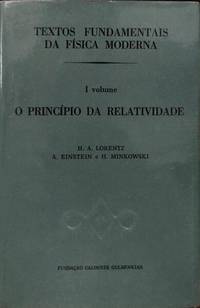
2007SA051<p>Colectânea de artigos com um ensaio de H. Weyl notas de O. Sommerfeld e prefácio de A. Blumenthal. Prefácio de Manuel dos Reis. Tradução de Mário José Saraiva. Fundação Calouste Gulbenkian. Lisboa. 1972.</p>_x000d_<p>De 22x14 cm. Com 279 vi págs. Encadernação do Editor. Com sobrecapa de protecção. Ilustrado com fórmulas matemáticas e fotografia de Albert Einstein.</p> I-133-B-13 unknown
1944182569London: The Jewish Agency for Palestine 1944. First separate edition of Einstein's appeal for Zionism. Einstein was one of the most prominent international supports of Zionism. He argues Palestine is the only place historically spiritually and culturally tied to the Jewish people. Whereas the Arabs with many homelands the Jews have nowhere else to go. Their claims are rooted not in conquest or nationalism but in justice and survival. The article was originally published in the Princeton Herald earlier that year. This publication prints the article alongside other speeches and letters by Einstein extracted from his 1930 About Zionism. Provenance: Jews' College Library London with their shelf mark to the front wrapper and their stamp to the front wrapper verso. Octavo. Original wrappers. Library markings see note a little creased and spotted. A good copy. unknown
19212545920Madrid. 1921. Hardcover. Cubierta deslucida. Good. 24 cm. 79 p. Encuadernación en tapa dura artesanal con lomo en piel. Einstein Albert 1879-1955. Über die spezielle und die allgemeine Relativitätstheorie. Traducida de la 12ª ed. alemana por F. Lorente de Nó. Imp. de Suc. de S. Peláez. Relatividad Física . Cubierta deslucida. Física.530.12 530 hardcover
19212827000Madrid.: S.n. 1921. Paperback. Good. 24 cm. 79 p. Encuadernación en tapa blanda artesanal. Einstein Albert 1879-1955. Über die spezielle und die allgemeine Relativitätstheorie. Traducida de la 12ª ed. alemana por F. Lorente de Nó. Imp. de Suc. de S. Peláez. Relatividad Física . Física.530.12 530 [S.n.]. paperback
1922R5312Berlin: Slovo 1922. Third edition. Paperback. Good. Original wraps; pp. 152 with frontispiece portrait of the author and his preface to the Russian edition. Front cover and endpaper detached but present; cheap paper tanned along the edges and a bit brittle. <br/><br/> Slovo paperback
feb89147Used. For more details please contact me unknown
feb89171Used. For more details please contact me unknown
145837Used. For more details please contact me unknown
8585910275.Gpaperback. Good. Access codes and supplements are not guaranteed with used items. May be an ex-library book. paperback
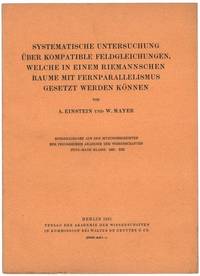
1931270891931. S.Ber. Akad. Wiss. Berl. 1931/13. - Berlin Verlag der Akademie der Wissenschaften 1931 8° 11 S. orig. Broschur. First Edition; the rare off-print from the "Sitzungsberichte". More and more frequently Einstein chose his assistants from mathematicians." One of the chief of them at that time was Professor Walter Mayer a small round individual who at first sight seemed crushed beneath the personality of Einstein. Einstein's family called him Mayerle and this Swabian diminutive suited him to perfection. But in Mayer's self-effacement there was more affection than respect. He gently contradicted Einstein interrupted him when necessary follwed up an argument and smiled a little mysteriously his head on one side as he watched the figures drawn up in front of him. "It is he who produced all my calculations; his skill is fantastic you know "Einstein used to say. In October 1933 Mayer followed Einstein in his American exile. -cf. Alicke Weil No.180; Schilpp-Shields No. 250; Alicke No. 149. unknown
193138647Berlin Akademie der Wissenschaften 1931. 4to. Orig. printed green wrappers in Sitzungsberichte 1931 Heft XIII-XV pp. 257-65. Small nicks to frontwrapper. <br/><br/><em>First edition in the periodical form. - Weil: 180. </em> unknown
193128368Berlin Gruyter & Co. 1931. 4to. Orig. printed orange wrappers. Offprint/Sonderausgabe aus Sitzungsberichten.pp. 1-11. Fine fresh copy. <br/><br/><em>First edition of the rare Offprint with separate title and separate pagination. Se Weil No. 180 where this is not mentioned. - Mayer came to America in 1933 and about him as his collaborator Einstein said "It is he who produced all my calculations his skill is fantastic You know."The early Offprints from "Sitzungsberichten." are called "Sonderabdruck" up to Weil No.165 including this. From Weil 166 they are called "Sonderausgabe.". - Before 161 up to 160 the Offprints do not have separate title and pagination the pagination follows the numbering in the periodical. From 166 the Offprint has both separate printed title and pagination. - So Weil Nos 161-165 is still "Abdruck" but with separate title and pagination. These facts are not mentioned in the bibliographies. </em> unknown
193137424Berlin: Akad. Wiss 1931. Weil 180. Offprint from S. preuss. Akad. Wiss. Akad. Wiss unknown
192539308Paris Gauthier-Villars et Cie 1925. Small8vo. Uncut in orig. printed wrappers. Portrait. 4562 pp. Publisher's Cat. 6 pp. 2 leaves with an insignificant small loss of upper right corner. A fine copy. <br/><br/><em>First French edition of the initials papers on Special Relativity. It is a translation of the 2 Einstein-papers which appeared in 1905 "Elektrodynamik bewegter Körper" and "Ist die Trägheit eines Körpers von seinem Energieinhalt abhängig ". Published in the series "Les Maitres de la Pensee scientifique". - Weil: 9 c - Schielpp-Schields: 189. - Boni-Laurence: 9 B and 10 B. </em> unknown
31311Couverture rigide. Bon/1925. in-12. Paris Gauthier-Villars 1925 in-12 56pppp broché Superbe exemplaire! unknown
192579Paris: Gauthier-Villars 1925. First French edition of Zur Elektrodynamik bewegter Korper On the Electrodynamics of Moving Bodies and 1st die Tragheit eines Korpers von seinem Energieinhalt abhangig Does the Inertia of a Body Depend on its Energy Content. Both 1905 treatises are "beyond compare and without precedent one of the greatest scientific achievements in content and one of the most brilliant in style" Gosling Albert Einstein. <br /> <br /> The first paper is "a landmark in the development of physics one of the two papers that laid out the theory of special relativity formulated a new conception of time. By assuming that the speed of light is the same to every observer moving at a constant velocity Einstein showed that space and time were not independent: spacetime was born. According to Hermann Weyl in 1918 this theory ‘led to the discovery that time is associated as a fourth coordinate on an equal footing with the other three coordinates of space and that the scene of material events the world is therefore a four-dimensional metrical continuum.' It was a revolutionary piece of scientific work" Calaprice The Einstein Almanac 15. <br /> <br /> In the second work Einstein uses "the postulates of the special theory of relativity Einstein showed that energy radiated is equivalent to mass lost. For the first time he concluded that ‘the mass of a body is a measure of its energy content'" ibid 16. CONDITION & DETAILS: Paris: Gauthier-Villars 1925. Small 8vo. 4 56 2 6 catalog. ILLUSTRATION: Frontispiece portrait of Einstein. EXTERIOR: Complete issue bound in original light brown stiff wraps. Some light surface dirt on the front wraps and a small area in the lower right where a piece of tape has been removed. Two barely visible repairs at the spine. Tightly bound. INTERIOR: Complete. Very small spot at the upper margin of page 3. Otherwise very good condition throughout. Gauthier-Villars paperback
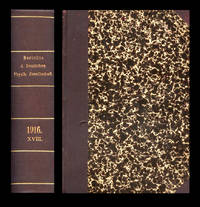
19162364Braunschweig: Druck und Verlag von Friedr Vieweg and Son 1916. First edition. Original wrappers. Very Good. FIRST PRINTING IN ORIGINAL WRAPPERS OF ONE OF EINSTEIN'S MAJOR WORKS: HIS FIRST PAPER ON THE DERIVATION OF PLANK'S LAW AND PROVIDING THE THEORETICAL BASIS FOR THE LASER. "Einstein commended the 'unparalleled boldness' of Planck's derivation of 1900 meaning not only the problem itself but also the fact that it was based on assumptions that were not entirely free of contradictions. Einstein now succeeded in the first of two papers in eliminating that flaw. More interesting than the derivation itself was the general character of his methods. Einstein proceeded from Niels Bohr's basic--and by then well tested--assumption that the electrons within an atom occupy a number of discrete energy states and are able through emission or absorption of radiation to pass from one of those states to another. Added to this was an assumption of thermodynamic equilibrium between radiation field and atom as well as a consideration of the 'classical' limiting case at high temperatures--and there was Planck's formula. This brief argument. also covers emission stimulated by the radiation field; thus the formulas already by implication contain the theory of the laser though it was to take nearly half a century to be realized" Folsing Albert Einstein 389. Weil 85.<br /> <br /> The "implication" containing the theory of the laser was more fully developed in his companion paper "On the Quantum Theory of Radiation" published a few weeks later. In the first paper Einstein wrestled with the concept that the atomic emission of radiation could be a directed process; in the second paper he convincingly demonstrates that this is indeed the case.<br /> <br /> IN: Verhandl. D. Deutch. Phys. Ges. Vol 18 pp. 318-323. Braunschweig: Druck und Verlag von Friedr. Vieweg and Son 1916. Octavo original wrappers; housed in custom half leather chemise. One thread literally resewn on wrappers a little creasing and soiling. A beautiful copy. RARE IN ORIGINAL WRAPPERS. Druck und Verlag von Friedr Vieweg and Son unknown
19161614Braunschweig: Druck und Verlag von Friedr. Vieweg and Son 1916. 1st Edition. FIRST EDITION OF AN IMPORTANT WORK BY EINSTEIN: HIS FIRST PAPER ON THE DERIVATION OF PLANCK'S LAW HERE INTRODUCING THE THEORY OF THE STIMULATED EMISSION OF ELECTROMAGNETIC RADIATION INTO THE QUANTUM THEORY. "EINSTEIN'S CONCEPT OF STIMULATED EMISSION IS THE OPERATING PRINCIPLE OF THE NOW UBIQUITOUS LASER" Brandt Harvest of the Century 136. <br /> <br /> In 1900 Max Planck laid the foundation for quantum theory with his publication of Planck's law. Though Einstein commended Planck in his own "light-quantum hypothesis of 1905 he Einstein postulated that the energy quantization is a property of the radiation field itself and not due to the material resonators as Planck believed" ibid. "Einstein found a similarity between a cavity filled with radiation consisting of quanta and a vessel filled with gas consisting of atoms" Brandt Harvest of the Century 136. Einstein believed that "although either part of Planck's derivation was in itself consistent their combination was logically incompatible.For Einstein this inconsistency was no reason to reject Planck's quantum theory as such" it was a reason to study the foundations of traditional radiation theory and if needed revise them Jammer The Conceptual Development of Quantum Mechanics 26. <br /> <br /> "After completion of his general theory of relativity in 1916 Einstein was able to derive Planck's original quantum law to his satisfaction "by considering the possible interactions between radiation and matter" Brandt. From there he was able to suggest that in addition to spontaneous emission and absorption a process of stimulated emission could also take place. <br /> <br /> In Einstein's derivation of Planck's law he treats "the interaction between light quanta and atoms in the formalism of his A and B coefficients. They describe the probabilities for the absorption and emission of a light quantum of a given energy. The probability of absorption is of course proportional to the density of the radiation of that frequency. The emission is in part spontaneous like radioactivity but there is also stimulated emission which again is proportional to the density of the radiation of that frequency ibid. This is one of two papers Einstein wrote on the subject. <br /> <br /> Einstein's derivation "predicted that as light passed through a substance it could stimulate the emission of more light. This effect is at the heart of the modern laser" The Quantum and the Cosmos I History AIP portal. CONDITION & DETAILS: Braunschweig: Druck und Verlag von Friedr. Vieweg and Son. 8.5 x 6 in. vi 485 1 2 368. 2. Ex-libris with few markings and non at the spine see scan. Tightly bound. Brown cloth over marbled paper boards; gilt- ruled and lettered at the spine. Clean and bright throughout. Near fine. This volume is bound together with the 1916 volume titled Halbmonatliches Literaturverzeichnis der "Fortschritte der Physik" Bi-monthly bibliography of the "Advances in Physics". Druck und Verlag von Friedr. Vieweg and Son hardcover
1990237634PN. New. 1990. Soft Cover. Date is original print. This is a reprint edition . PN paperback