1 504 résultats
312p. Hardcover Very good condition good
No marks or inscriptions. A very clean very tight copy with bright unmarked boards and bump to lower rear corner. Dust jacket not price clipped or marked with small repair to lower rear corner and minor creasing to upper edge. 256pp. Detailed study of the 1950s as the world changed massively after the austerity of the Second World War. Well illustrated.
No marks or inscriptions. A very clean very tight copy with bright unmarked boards and no bumping to corners. Dust jacket not price clipped or marked with creasing to upper edge and general traces of storage. 256pp. Detailed study of the 1950s as the world changed massively after the austerity of the Second World War. Well illustrated.
192146992(London, Taylor and Francis), 1921. Blank wrapper. In: ""The London, Edinburgh, and Dublin Philosophical Magazine and Journal of Science"" Sixth Series, Vol.42, No. 252, December 1921. Pp. 873-1024, textillustr. a. 1 plate. (Entire issue offered). Chadwick & Bieler's paper: pp. 923-940, textillustr.
196348073Macmillan and Co, London , Quantum Books Malicorne sur Sarthe, 72, Pays de la Loire, France 1963 Book condition, Etat : Bon hardcover, under illustrated dust-jacket In-8 1 vol. - 108 pages
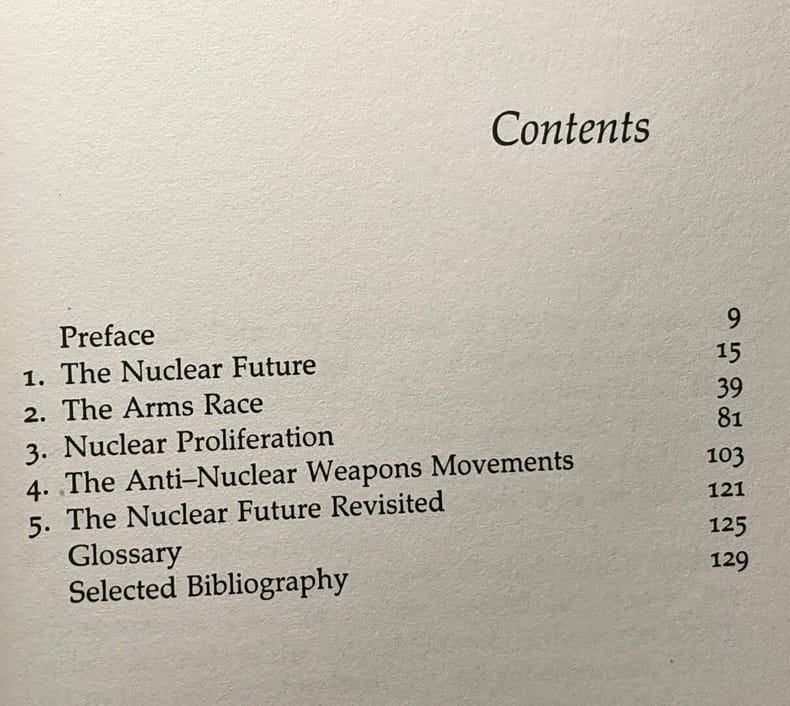
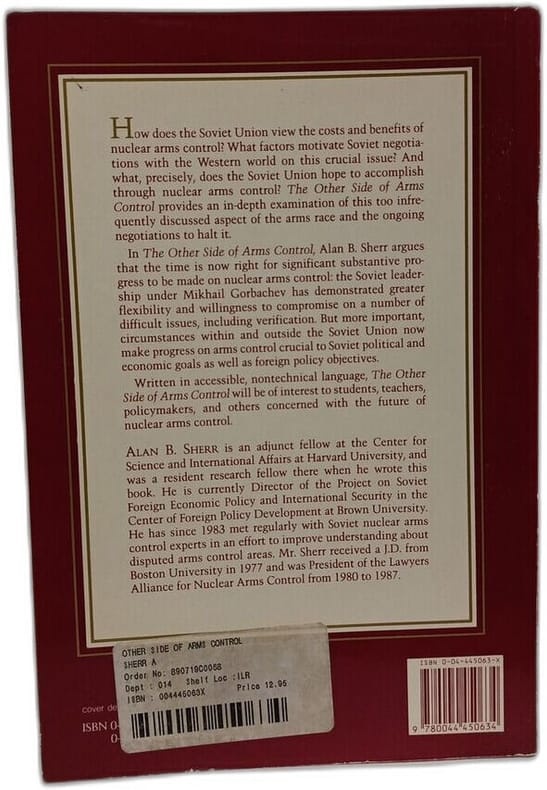
1983100128319Cornell university press 1983 128 pages 15 24x1 27x22 352cm. 1983. Broché. 128 pages.
1988100137900Unwin hyman 1988 325 pages in8. 1988. Broché. 325 pages.
7 quartini sciolti con riproduzioni al tratto di disegni di Baj sui due lati. Senza testo . 8vo. pp. 28. . Molto buono (Very Good). . . .
200582408Washington DC: Department of Homeland Security Science and Technology Radiological and Nuclear Countermeasures Program 2005. Presumed First Edition First printing. Wraps. Very good. 4 31 1 pages. Illustrations. Cover has slight wear and soiling. Executive Summary. Technology Summary. Supporting Information. A. Context for the Use of Radiation Injury Assessment Tools. B. Current Methods and Tools for Triage and Emergency Dose Assessment. Assessment of Emerging Dosimetry Technologies. References. Appendix A. Joint Interagency Working Group Participants. Appendix B. List of Abbreviations. Some bibliographic references cite the authors as: Turteltaub K W; Hartman-Siantar C; Easterly C; Blakely W. all of the Lawrence Livermore National Laboratory. A Joint Interagency Working Group JIWG under the auspices of the Department of Homeland Security Office of Research and Development conducted a technology assessment of emergency radiological dose assessment capabilities as part of the overall need for rapid emergency medical response in the event of a radiological terrorist event in the United States. The goal of the evaluation is to identify gaps and recommend general research and development needs to better prepare the Country for mitigating the effects of such an event. Given the capabilities and roles for responding to a radiological event extend across many agencies a consensus of gaps and suggested development plans was a major goal of this evaluation and road-mapping effort. The working group consisted of experts representing the Departments of Homeland Security Health and Human Services Centers for Disease Control and the National Institutes of Health Food and Drug Administration Department of Defense and the Department of Energy's National Laboratories see appendix A for participants. The specific goals of this Technology Assessment and Roadmap were to: 1 Describe the general context for deployment of emergency radiation dose assessment tools following terrorist use of a radiological or nuclear device; 2 Assess current and emerging dose assessment technologies; and 3 Put forward a consensus high-level technology roadmap for interagency research and development in this area. This report provides a summary of the consensus of needs gaps and recommendations for a research program in the area of radiation dosimetry for early response followed by a summary of the technologies available and on the near-term horizon. We then present a roadmap for a research program to bring present and emerging near-term technologies to bear on the gaps in radiation dose assessment and triage. Finally we present detailed supporting discussion on the nature of the threats we considered the status of technology today promising emerging technologies and references for further reading. Department of Homeland Security, Science and Technology, Radiological and Nuclear Countermeasures Program paperback
1987778891PN. New. 1987. Soft Cover. Date is original print. This is a reprint edition. . PN paperback
199774858Washington DC: Nuclear Energy Institute 1997. Xerox-type of agenda and presentation vugraphs. Binderclipped loose pages. Fair. Unpaginated approximately 150 pages. Very scarce surviving meeting materials. Some pages of inferior copy quality but are quite readable. This meeting was held near the Nuclear Regulatory Commission and was foundational to the U.S. MOX decisions. This package of materials includes a copy of the agenda and copies of each presentation listed on the agenda. These are: Site Infrastructure & Building Feasibility Review for a MOX Fabrication Facility by Damian Peko Office of Fissile Materials Disposition U. S. Department of Energy; BNFL MOX Fabrication and Licensing Experience by Bryen Martin BNFL; Belgonucleaire MOX Fabrication and Licensing Experience by Michel Debauche Manager MOX Plant Engineering Belgonucleaire; COGEMA Inc. MOX Fabrication and Licensing Experience by Gerard Lebastard Director International Business COGEMA and Siemens Power Corp. MOX Fabrication and Licensing Experience by Carl A. Duckwitz Consultant. Marvin Fertel Vice President Suppliers International and Fuels Nuclear Energy Institute welcomed the attendees at the start and summarized the discussion at the end no vugraphs associated with his remarks. The U.S. Department of Energy DOE signed a contract with Duke COGEMA Stone & Webster DCS now called Shaw AREVA MOX Services MOX Services or the applicant to design build and operate a Mixed Oxide MOX Fuel Fabrication Facility MFFF. On February 28 2001 the applicant submitted a request to the U.S. Nuclear Regulatory Commission NRC to construct a MFFF on the DOE's Savannah River Site SRS near Aiken South Carolina. On March 30 2005 the Commission issued the construction authorization CA. Two years after the CA was issued the construction started. In 2006 MOX Services submitted a license application to possess and use byproduct and special nuclear material SNM at the MFFF. When the facility is authorized to use and possess SNM it will take surplus weapon-grade plutonium remove impurities and mix it with uranium oxide to form MOX fuel pellets for reactor fuel assemblies. These assemblies will be irradiated in commercial nuclear power reactors. Following irradiation the resulting spent fuel would contain plutonium in a form less usable for nuclear weapons. Nuclear Energy Institute unknown
199659760Washington DC: Research Reactor Spent Nuclear Fuel Task Team 1996. Wraps. Very good. No dust jacket. 92 p. Includes: illustrations diagrams. Volume I ONLY. Prepared for The Department of Energy Office of Spent Fuel Management. During the six-month period from November 1995 through April 1996 the Task Team examined the wide-ranging technical issues attendant to achieving safe and cost-effective dispost of the aluminium-based spent nuclear fuel under DOE's jurisdiction. This fuel is from research and test reactors. This report offers a path forward. Volume I provides a technical synopsis of the fuel in question and the issues involved and summarized the Team's evaluations findings and recommendations to DOE. Volume II is a compendium of supporting technical information. Research Reactor Spent Nuclear Fuel Task Team paperback
B9781497373235Paperback / softback. New. paperback
1497373239.Gpaperback. Good. Access codes and supplements are not guaranteed with used items. May be an ex-library book. paperback
1962RO80198407ARMEE DE L'AIR. 1962. In-4. Broché. Etat d'usage, Couv. défraîchie, Agraffes rouillées, Intérieur frais. Environ 240 pages - Nombreuses figures et schémas en noir et blanc dans et hors texte -. . . . Classification Dewey : 539-Physique nucléaire
7800Paris, Éditions Gérard Lebovici, 1987. In-8, broché.
1987R200072600OCDE. 1987. In-8. Broché. Bon état, Couv. convenable, Dos satisfaisant, Intérieur frais. 105 pages. Quelques graphiques en couleurs ou noir et blanc.. . . . Classification Dewey : 539-Physique nucléaire
2001RO80147811DU ROCHER. Juin 2001. In-12. Broché. Bon état, Couv. convenable, Dos satisfaisant, Intérieur frais. 371 pages. Quelques planches illustrées de cartes en couleurs et en noir et blanc.. . . . Classification Dewey : 539-Physique nucléaire
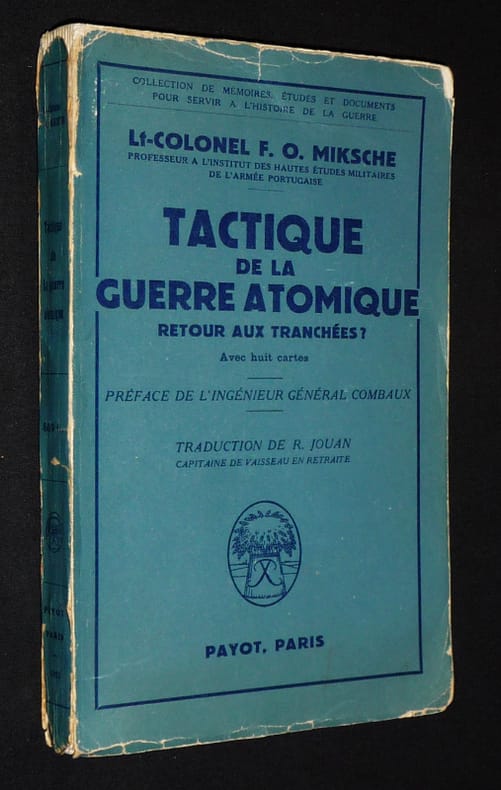
1955fy1170Payot De Mémoires, Etudes et Documents pour Servir à l'Histoire de la Guerre Broché 1955 In-8 (14,2 x 22,8 cm), broché, 216 pages, avec 8 cartes ; pliures au dos et sur les bords des plats, mors usés réparés à la colle, passages soulignés au stylo, en l'état. Livraison a domicile (La Poste) ou en Mondial Relay sur simple demande.
1957705492PN. New. 1957. Soft Cover. Date is original print. This is a reprint edition. . PN paperback
196159628Oak Ridge TN: Union Carbide Nuclear Company 1961. Presumed First Edition First printing thus. Wraps. Good. No dust jacket. vi 80 pages. Highlighting/underlining. Name of previous owner present. Ink notation on front cover. Cover has some wear and soiling. Underlining noted at one line of text. Report Number KOA-888. Marked UNCLASSIFIED. Prepared for the Atomic Energy Commission under U. S. Government Contract W7405 eng 26. There are mathematical formulae and a large number of numerical values presented. There is only a limited amount of text. K-25 was the codename given by the Manhattan Project during World War II for the project to produce enriched uranium for atomic bombs using the gaseous diffusion method. Over time it came to refer to the production facility located at the Clinton Engineer Works in Oak Ridge Tennessee the main gaseous diffusion building and ultimately the site. When it was built in 1944 the four-story K-25 gaseous diffusion plant was the world's largest building with over 1640000 square feet of floor space and a volume of 97500000 cubic feet . The highly corrosive uranium hexafluoride UF6 was the only known compound of uranium sufficiently volatile to be used in this process. Slightly enriched product from the S-50 thermal diffusion plant was fed into the K-25 gaseous diffusion plant. The enriched uranium was used in the Little Boy atomic bomb used in the atomic bombing of Hiroshima. In 1946 the K-25 gaseous diffusion plant became capable of producing highly enriched product. After the war four more gaseous diffusion plants were added to the site named K-27 K-29 K-31 and K-33. The K-25 site was renamed the Oak Ridge Gaseous Diffusion Plant in 1955. Production of enriched uranium ended in 1964. Union Carbide Nuclear Company paperback
199970684Washington DC: United States. Department of Defense 1999. First Edition stated. Presumed First Printing. Trade paperback. Very good. xviii 62 pages. Includes: Illustrations Diagrams. Acronyms and Abbreviations. Cover has slight wear and soiling. Nuclear weapons life extension and countering nuclear threats will continue to be a central concern for the United States and the Department of Defense. The Department has identified the dual missions of sustaining a safe secure and effective nuclear deterrent and countering the threat from nuclear terrorism and nuclear proliferation as among the most important for U.S. national security priorities. Nuclear Matters serves as the focal point for these missions within the Department of Defense. "To deter nuclear war and serve as last resort weapons of self-defense. In this sense U.S. nuclear weapons are fundamental to our nation's security and have historically provided a deterrent against aggression and security assurance to U.S. allies. A robust flexible and survivable U.S. nuclear arsenal underpins the U.S. ability to deploy conventional forces worldwide; provides the Commander-in-Chief with credible response options to strengthen deterrence; and supports U.S. nonproliferation goals by extending deterrence to allies thereby dissuading them from developing their own nuclear weapons." Secretary of Defense Mattis at his confirmation hearing January 2017 This was intended to be a basic reference on the nuclear hardening of military systems. This Guidebook was not intended to be a definitive document on the effects of nuclear weapons or a "how to" guide for Project Managers but rather it provides information to staff officers who require a basic understanding of nuclear hardening as it relates to the acquisition of nuclear survivable systems. The information is this Guidebook was current as of September 1999. Nuclear weapon system survivability is concerned with the ability of U.S. nuclear deterrent forces to survive against the entire threat spectrum that includes but is not limited to nuclear weapon effects. The vast range of potential threats include: · conventional and electronic weaponry; · nuclear biological and chemical weapons; · advanced technology weapons such as high-power microwaves and radio frequency weapons; · terrorism or sabotage; and · the initial effects of a nuclear detonation. Put simply nuclear weapon effects survivability refers to the ability of any and all personnel equipment and systems including but not limited to nuclear systems to survive nuclear weapon effects. Nuclear weapon system survivability refers to nuclear weapon systems being survivable against any threat including but not limited to the nuclear threat. Nuclear hardness describes the ability of a system to withstand the effects of a nuclear detonation and to avoid internal malfunction or performance degradation. Hardness measures the ability of a system's hardware to withstand physical effects such as overpressure peak velocities energy absorbed and electrical stress. This reduction in hardware vulnerability can be achieved through a variety of well-established design specifications or through the selection of well-built and well-engineered components. This appendix does not address residual nuclear weapon effects such as fallout nor does it discuss nuclear contamination survivability. United States. Department of Defense paperback
ISBN : 2020054035. Le Seuil. 1980. In-12 Carré. Broché. Bon état. Couv. convenable. Dos satisfaisant. Intérieur frais. 532 pages. Illustré de nombreux schémas, graphiques et photos en noir et blanc, dans et hors texte. Annotations dans le texte. 'Points', S4, Sciences. Nouvelle édition.
1980RO40209098Le Seuil. 1980. In-12. Broché. Bon état, Couv. convenable, Dos satisfaisant, Intérieur frais. 532 pages. Illustré de nombreux schémas, graphiques et photos en noir et blanc, dans et hors texte. Annotations dans le texte.. . . . Classification Dewey : 539-Physique nucléaire