HUSELER (Konrad)Livre Rare Book
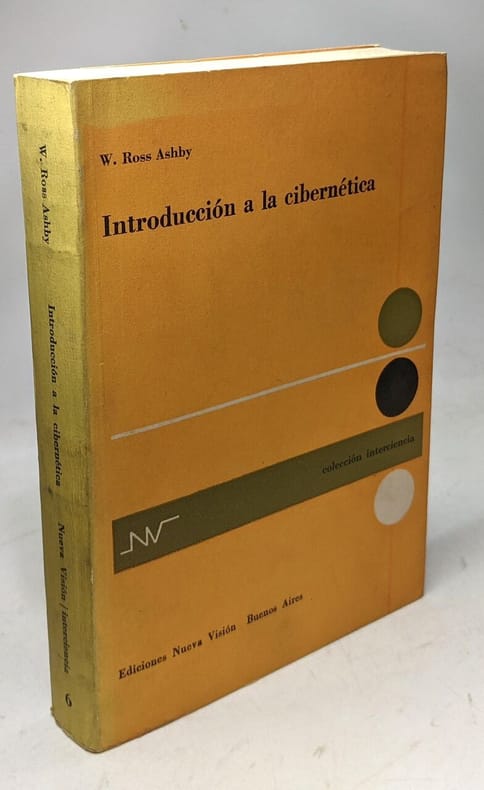
Ross Ashby WLivre Rare Book
Introduccion a la cibernética
1960100128402Nueva Vision 1960 in8. 1960. Broché.
Un Autre Monde · Val Couoesnon, France60,00 €
2 160 résultats
VLE-378Stuttgart, , 1956-1958, 3 volumes in-8, XVI+478 pp. illustrées de 570 figures en 312 planches et de 67 planches de marques reliés pleine toile éditeur sous jaquettes et emboitages
VLE-415P., Au Sans Pareil, 1928, in-8, 381 pp. illustrées d'ornements de J.E. Laboureur relié plein cartonnage éditeur en couleurs (petits manques à la pièce de titre)
VLE-425P., Albanel et Martin, 1840, 3 volumes in-12, 406+413+486pp. Cachet d'appartenance sur les pages de titres des 3 tomes. Léger manque de papier sur la page de titre du tome 3 relié pleine basane au plats décoré d'un motif à froid encadré d'un filet doré, dos lisses à décor d'entrelacs et fleurons dorés. Exemplaires frottés
VLE-459Nantes, Chiffoleau, sd (1952), in-4, album de 16 caricatures, précédé d'un envoi dédicatoire de Jacques Villon, tiré à 100 exemplaires sur bristol multicolore, numérotés et signés par l'auteur broché à anneaux
VLE-573P., Plon, 1892, in-12, 291 pp. illustrées de gravures et d'une carte hors-texte relié pleine percaline , dos lisse orné de filets, couverture conservée
VLE-588P., Lafitte, 1911, in-8, 341pp. illustrées d'un portrait en frontispice, de 32 reproductions photographiques dont 2 en couleurs ainsi que 32 illustrations photographiques en noir et une carte en couleurs. Avec une introduction du président des Etats-Unis Théodore Roosevelt. Première édition française. Rousseurs par endroits relié plein cartonnage éditeur toilé illustré
VLE-589Rouen, , 1952, in-4, 82 pages illustrées de nombreuses eaux-fortes en noir et en bistre, in et hors texte, de Emile-Henry Tilmans, petites décharges d'encre par endroits sans gravité. Ouvrage tiré à 225 exemplaires numérotés et signés par le graveur (n°53) en feuilles sous couverture titrée et emboitage
VLE-648A P., De l'Imprimerie Royale, 1751, in-12, XII+144pp. illustrées d'un bandeau et de 4 planches dépliantes. Exemplaire d'intérieur très frais relié pleine basane racinée, dos à nerfs en partie brûlé, rendu muet, coins écrasés
VLE-656P., Champion, 1901, in-8, XI+365pp broché, dos cassé avec manques
VLE-671, , 1974, in-4, 540pp. ornées de nombreuses illustrations, photographies, plans, cartes et tableaux, et un feuillet d'errata volant relié pleine toile sous jaquette illustrée en couleurs
1960100128402Nueva Vision 1960 in8. 1960. Broché.
VLE-680P., Firmin-Didot, 1837, in-8, 400pp. illustrées de 96 gravures sur acier hors-texte comprenant une carte dépliante. Texte en 2 colonnes relié demi-basane verte, dos orné de filets (légères rousseurs)
VLE-718P., Plon-Nourrit, 1905, in-8, XVI+496pp. illustrées de gravures in et hors-texte et de cartes dont une dépliante, et avec un Appendice de technique navale broché
VLE-735P., Lecoffre, 1858, in-8, 460pages relié demi-basane, dos lisse avec pièce de titre, orrné de filets dorés et fleurons à froid, liserés de cuir marron formant faux-nerfs, premier plat légèrement insolé
VLE-779P., Imp. Nat., 1917, in-4, XV+130 pp. illustrées de 5 planches hors-texte, de lettrines, d'en-tête, de culs-de-lampe, de portraits , de cartes et de plans. Edition tirée à 1000 exemplaires numérotés broché, couverture rempliée poussiéreuse
110 pages. Features: Garden Railroading and the Internet; A Scratchbuilt Live Steam 2-6-2; On-Line Train Storage; Stretching the Smoke; The Pfetzing Valley Railroad; Structures for Outdoor Railroads - Part 9; The View from Vincent Gap; Yes, You can use Overhead Wire; Small Cars for Small Railroads - Part 4; A Flower Show Primer; Build a Logging Caboose. Moderate wear. A sound copy. Book
0692755039.Gpaperback. Good. Access codes and supplements are not guaranteed with used items. May be an ex-library book. paperback
2000100113032SNEDIT LA DISPU 2000 405 pages 14x3 4x22 4cm. 2000. Broché. 405 pages.
VLE-527P., Hachette, 1861, in-12, 382pp. illustrées de 24 planches par Gustave Doré. Rares rousseurs relié demi-chagrin vert, dos à nerfs orné de filets à motifs géométriques dorés. Armes impériales de Napoléon III au premier plat
VLE-526P., Hachette, 1861, in-12, 365pp. illustrées de 12 planches relié demi-chagrin armorié, dos à nerfs décoré de fleurons et filets d'encadrement dorés. Armes impériales de Napoléon III au premier plat. Rousseurs sur les tranches.
VLE-776P., Fréal, 1971, in-8, 550pp. illustrées de 390 figures et photographies relié plein cartonnage illustré
1938628New York: Oxford University Press 1938. Presumed First Edition First printing. Hardcover. Good. vi 323 3 pages. Frontis illustration. Dunant's Principal Works. Works Consulted. No DJ present. Boards discolored and scuffed discoloration inside boards and stamp inside front board. Martin Gumpert 13 November 1897 - 18 April 1955 was a German-born physician dermatologist historian and author. Born in Berlin Gumpert specialized in dermatology and medical history. His early life included service as a medical orderly during WI and academic pursuits in Berlin and Heidelberg culminating in a dissertation on syphilis in 1923. Gumpert also engaged in expressionist poetry and literature. He went on to write texts on pediatrics and developmental deformity. In 1933 Gumpert was forced out of his medical position by the Nazi rise to power. Over the next few years he wrote several texts of literature and the history of science and medicine. He was further excluded from the association of German writers the Reichsverband deutscher Schriftsteller as a Jew in 1935 and emigrated to the United States in 1936. Gumpert opened a dermatology practice in New York in 1936 and became a US citizen in 1942. During these years Gumpert became a friend of the siblings Erika and Klaus Mann and in 1949 visited their father Thomas Mann in Germany. Thomas Mann used Gumpert's medical knowledge on the course of syphilis in writing his novel Doktor Faustus. From 1952 Gumpert edited the gerontology journal Lifetime Living and worked as a geriatrician at the Jewish Memorial Hospital New York. Gumpert continued to write about the exile experience in poems and literary publications. Henry Dunant born Jean-Henri Dunant; 8 May 1828 - 30 October 1910 also known as Henri Dunant was a Swiss humanitarian businessman social activist and the co-founder of Red Cross movement. His humanitarian efforts won him the first Nobel Peace Prize in 1901.<br /> Dunant was born in Geneva to a devout Calvinist family and had business interests in French Algeria and Tunisia. In 1859 while on his way to petition Napoleon III he witnessed the aftermath of the Battle of Solferino in northern Italy. Horrified by the suffering of the wounded and the lack of care they received Dunant took the initiative to organize the local population in providing aid for the soldiers. After returning to Geneva he recorded his experiences in the book A Memory of Solferino in which he advocated the formation of an organization that would provide relief for the wounded without discrimination in times of war. In February 1863 Dunant was a member of a five-person committee that sought to put his plan into action which in effect founded the organization that would become the International Committee of the Red Cross. A year later he took part in a diplomatic conference organized by the Swiss government that led to the signing of the First Geneva Convention. . In 1895 Dunant was rediscovered by a journalist which brought him renewed attention and support and in 1901 he was awarded the first Nobel Peace Prize alongside French pacifist Frédéric Passy. The organized International Red Cross and Red Crescent Movement is a humanitarian movement with approximately 16 million volunteers members and staff worldwide. It was founded to protect human life and health to ensure respect for all human beings and to prevent and alleviate human suffering. Within it there are three distinct organizations that are legally independent from each other but are united within the movement through common basic principles objectives symbols statutes and governing organizations. In 1863 Gustave Moynier a Geneva lawyer and president of the Geneva Society for Public Welfare received a copy of Dunant's book and introduced it for discussion at a meeting of that society. As a result of this initial discussion the society established an investigatory commission to examine the feasibility of Dunant's suggestions and eventually to organize an international conference about their possible implementation. The members of this committee which has subsequently been referred to as the "Committee of the Five" aside from Dunant and Moynier were physician Louis Appia who had significant experience working as a field surgeon; Appia's friend and colleague Théodore Maunoir from the Geneva Hygiene and Health Commission; and Guillaume-Henri Dufour a Swiss army general of great renown. Eight days later the five men decided to rename the committee to the "International Committee for Relief to the Wounded". The Swiss government invited the governments of all European countries as well as the United States the Empire of Brazil and the Mexican Empire to attend an official diplomatic conference. Sixteen countries sent a total of 26 delegates to Geneva. On 22 August 1864 the conference adopted the first Geneva Convention "for the Amelioration of the Condition of the Wounded in Armies in the Field". Representatives of 12 states and kingdoms signed the convention. Oxford University Press hardcover
Grey-silver octavo; xii, 438 p, b&w illus ; 24 cm. Contents: The first experimental cryptanalysis of the Data Encryption Standard / Mitsuru Matsui -- Linear cryptanalysis of the Fast Data Encipherment Algorithm / Kazuo Ohta and Kazumaro Aoki -- Differential-linear cryptanalysis / Susan K. Langford and Martin E. Hellman -- Linear cryptanalysis using multiple approximations / Burton S. Kaliski, Jr. and M.J.B. Robshaw -- Hashing with SL[subscript 2] / Jean-Pierre Tillich and Gilles Zemor -- Design of elliptic curves with controllable lower boundary of extension degree for reduction attacks / Jinhui Chao, Kazuo Tanada and Shigeo Tsujii -- Cryptographic protocols based on discrete logarithms in real-quadratic orders / Ingrid Biehl, Johannes Buchmann and Christoph Thiel -- Designated confirmer signatures and public-key encryption are equivalent / Tatsuaki Okamoto -- Directed acyclic graphs, one-way functions and digital signatures / Daniel Bleichenbacher and Ueli M. Maurer.; An identity-based signature scheme with bounded life-span / Olivier Delos and Jean-Jacques Quisquater -- More flexible exponentiation with precomputation / Chae Hoon Lim and Pil Joong Lee -- A parallel permutation multiplier for a PGM crypto-chip / Tamas Horvath, Spyros S. Magliveras and Tran van Trung -- Cryptographic randomness from air turbulence in disk drives / Don Davis, Ross Ihaka and Philip Fenstermacher -- Cryptanalysis of the Gemmell and Naor multiround authentication protocol / Christian Gehrmann -- LFSR-based hashing and authentication / Hugo Krawczyk -- New bound on authentication code with arbitration / Kaoru Kurosawa -- Multi-secret sharing schemes / Carlo Blundo, Alfredo De Santis, Giovanni Di Crescenzo, Antonio Giorgio Gaggia and Ugo Vaccaro -- Designing identification schemes with keys of short size / Jacques Stern -- Proofs of partial knowledge and simplified design of witness hiding protocols / Ronald Cramer, Ivan Damgard and Berry Schoenmakers.; Language dependent secure bit commitment / Toshiya Itoh, Yuji Ohta and Hiroki Shizuya -- On the length of cryptographic hash-values used in identification schemes / Marc Girault and Jacques Stern -- Incremental cryptography: the case of hashing and signing / Mihir Bellare, Oded Goldreich and Shafi Goldwasser -- An efficient existentially unforgeable signature scheme and its applications / Cynthia Dwork and Moni Naor -- Bounds for resilient functions and orthogonal arrays / Jurgen Bierbrauer, K. Gopalakrishnan and D.R. Stinson -- Tracing traitors / Benny Chor, Amos Fiat and Moni Naor -- Towards the equivalence of breaking the Diffie-Hellman protocol and computing discrete logarithms / Ueli M. Maurer -- Fast generation of provable primes using search in arithmetic progressions / Preda Mihailescu -- Attack on the cryptographic scheme NIKS-TAS / Don Coppersmith -- On the risk of opening distributed keys / Mike Burmester.; Cryptanalysis of cryptosystems based on remote chaos replication / Th. Beth, D.E. Lazic and A. Mathias -- A Fourier transform approach to the linear complexity of nonlinearly filtered sequences / James L. Massey and Shirlei Sercouek -- The security of cipher block chaining / Mihir Bellare, Joe Kilian and Phillip Rogaway -- A chosen plaintext attack of the 16-round Khufu cryptosystem / Henri Gilbert and Pascal Chauvaud -- Ciphertext only attack for one-way function of the MAP using one ciphertext / Yukiyasu Tsunoo, Eiji Okamoto and Tomohiko Uyematsu -- Pitfalls in designing substitution boxes / Jennifer Seberry, Xian-Mo Zhang and Yuliang Zheng -- A randomness-rounds tradeoff in private computation / Eyal Kushilevitz and Adi Rosen -- Secure voting using partially compatible homomorphisms / Kazue Sako and Joe Kilian -- Maintaining security in the presence of transient faults / Ran Canetti and Amir Herzberg. || Computers; Technology.
Black octavo ; 1044 p ; 24 cm Advanced Reader's Edition with letter from the publisher laid in // Computer games -- Fiction -- Virtual reality -- Money laundering -- Science Fiction
ria9780197509685_inpHardback. New. New Book; Fast Shipping from UK; Not signed; Not First Edition; Rethinking Cyber Warfare provides a fresh understanding of the role that digital disruption plays in contemporary international security and proposes a new approach to more effectively restrain and manage cyberattacks. hardcover