709 résultats
174595840London: Printed by James Bettenham for the Society for the Encouragement of Learning 1745. First edition in English of the mathematical appendixes to <span class="match">Newton</span>'s fundamental 1704 Opticks one of the greatest works of science ever published. Translated from the Latin by James Bettenham Professor of Mathematics at the University of Aberdeen. Quarto bound in contemporary calf gilt titles to the spine burgundy morocco spine label rebacked woodcut diagrams throughout the text engraved tailpiece. In very good condition with some light wear and browning to the text with wide margined text. Exceptionally rare and desirable first editions are scarce with only four appearing at auction in the last 90 years. English mathematician astronomer theologian author and physicist Sir Isaac Newton is widely considered one of the most influential scientists of all time and a key figure in the scientific revolution. In one of his most important works Philosophiae Naturalis Principia Mathematica Newton formulated the the laws of motion and universal gravitation that formed the dominant scientific viewpoint until being superseded by the theory of relativity. Considered one of the greatest works of science ever published Newton's second major book Opticks analyzes the fundamental nature of light by means of the refraction of light with prisms and lenses the diffraction of light by closely spaced sheets of glass and the behavior of color mixtures with spectral lights or pigment powders. Printed by James Bettenham for the Society for the Encouragement of Learning unknown books
1803122898London: Printed for H.D. Symonds 1803. First complete edition in English of Sir Isaac Newton's Principia the greatest work of physics in the exceedingly rare original boards. Octavo 3 volumes bound in original boards uncut 54 folding copper-engraved plates of diagrams and figures all but one folding; 2 folding tables. with 22 folding. In near fine condition with light toning to the text. An exceptional example rare and desirable in the original boards. Housed in a custom clamshell box. "Newtons Principia is generally described as the greatest work in the history of science. Copernicus Galileo and Kepler had certainly shown the way; but where they described the phenomena they observed Newton explained the underlying universal laws. The Principia provided the greatest synthesis of the cosmos proving finally its physical unity. Newton showed that the important and dramatic aspects of nature that were subject to the universal law of gravitation could be explained in mathematical terms with a single physical theory. With him the separation of the natural and supernatural of sublunar and superlunar worlds disappeared. The same laws of gravitation and motion rule everywhere; for the first time a single mathematical law could explain the motion of objects on earth as well as the phenomena of the heavens. The whole cosmos is composed of inter-connecting parts influencing each other according to these laws. It was this grand conception that produced a general revolution in human thought equaled perhaps only by that following Darwins Origin of Species Newton is generally regarded as one of the greatest mathematicians of all time and the founder of mathematical physics" PMM 161. "It is perhaps the greatest intellectual stride that it has ever been granted to any man to make" Einstein. Printed for H.D. Symonds hardcover books
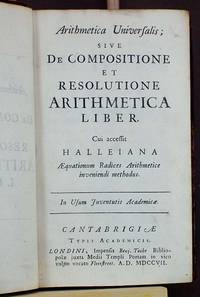
17076325Cambridge and London: Typis Academicis; Benj. Tooke 1707. First edition. Very Good/William Whiston the successor to Newton's chair at Cambridge "extracted from Newton a somewhat reluctant permission to print" this remarkable "schoolbook" based on Newton's lecture notes Babson Catalogue. So reluctant in fact that Newton kept his name out of it and supposedly considered purchasing the press run in order to destroy it! He later republished it himself. Several new theorems are laid out including a formula to determine the number of imaginary roots of any equation. The rule is complicated and is offered without proof. Yet 180 years later the rule was proven by rigorous analysis. The text also includes Edmond Halley's "Aequationum radices arithmetice inveniendi methodus. Octavo 19cm; 8 343 1 pages the last page blank . Figure and diagrams in text. Running-title: Algebrae elementa. Editor's preface signed: G.W. i.e. William Whiston. In contemporary paneled calf rebacked with new burgundy morocco spine label. Edges of boards rubbed. Early ink ownership inscriptions on blank endleaves the contemporary autograph of Edward Harington and the 19th-century mathematician William Fleetwood Sheppard. Half-title present. References: Babson Newton Collection; 199; ESTC; T018645; Bowes and Bowes 277. Typis Academicis; Benj. Tooke hardcover books
18481803065Daniel Adee 1848. 1st Edition. Hardcover. Near Fine/No Jacket. Near fine TRUE first American edition 1st issue as stated on the title page. Some water stains on page edges. Previous owner's bookplate on front pastedown. Rubbing on outside spine and corners and at bottom of spine. Tape at endpapers and pastedowns along gutters. Housed in custom-made slip case. Daniel Adee hardcover books
17262210London: Guil. & Joh. Innys Regiae Societatis typographos 1726. Third Edition. contemporary full vellum. RARE 1726 THIRD EDITION OF NEWTON'S PRINCIPIA THE LAST EDITION EDITED BY NEWTON AND THE BASIS FOR ALL SUBSEQUENT EDITIONS. ONE OF ONLY 1250 COPIES PRINTED. "The Principia is generally described as the greatest work in the history of science. Copernicus Galileo and Kepler had certainly shown the way; but where they described the phenomena they observed Newton explained the underlying universal laws. The Principia provided the great synthesis of the cosmos proving finally its physical unity. Newton showed that the important and dramatic aspects of nature that were subject to the universal law of gravitation could be explained in mathematical terms within a single physical theory. With him the separation of natural and supernatural of sublunar and superlunar worlds disappeared. The same laws of gravitation and motion rule everywhere; for the first time a single mathematical law could explain the motion of objects on earth as well as the phenomena of the heavens. The whole cosmos is composed of inter-connecting parts influencing each other according to these laws. It was this grand conception that produced a general revolution in human thought equalled perhaps only by that following Darwin's Origin of Species. It was the final irrevocable break with a medieval conception based on Greek and Roman cosmology and a scholastic system derived from the medieval interpretation of Aristotle. Newton's universe almost independent of the spiritual order ushered in the age of rationalism scientific determinism and the acceptance of a mechanistic view of nature" Printing and the Mind of Man 161. On the history and importance of the third edition: Towards the end of his life Newton "gave one last effort to the Principia. It is clear that he regarded the Principia rather than the Opticks as his masterwork. He worked over the Principia without end to hone its language to a perfect expression of his ideas. Perhaps the appearance of a reprint of the second edition in Amsterdam in 1723 stimulated Newton to put his plan for a new edition into action. Perhaps a serious illness in 1722 reminded him that he could not delay forever. We know only that printing of an edition more sumptuous than either of the others began in the fall of 1723. As editor Newton had the services of a young member of the Royal Society Henry Pemberton. In the fall of 1723 Pemberton addressed to him the first of thirty-one communications which stretched over the following two-and-a-half years while the edition passed through the press. Through 1724 and 1725 the edition made its slow but steady progress toward completion with none of the delays that stopped the press during the second edition. Newton dated the preface 12 January 1726. It was the last day of March when Martin Folkes presented a copy 'richly Bound in morocco Leather' to the Royal Society in Newton's name. In all 1250 copies were printed." Westfall The Life of Isaac Newton. The third edition "contains a new preface by Newton and a large number of alterations" Babson 13. With portrait engraving by Vertue bound before first text leaf and numerous illustrations in text. Complete with the privilege leaf half-title dedication leaf index and ad leaf. London: Guil. & Joh. Innys Regiae Societatis typographos 1726. Quarto 186x241 mm contemporary full Dutch vellum; custom half-leather box. Unidentified early signatures on front pastedown half-title and ad leaf verso. Mild scuffing to binding boards a little bowed. Text with occasional light soiling and scattered foxing but generally clean. A beautiful copy. SCARCE IN AN UNRESTORED CONTEMPORARY BINDING. Guil. & Joh. Innys, Regiae Societatis typographos unknown books
1830124608London: Newton Son & Berry c. 1830-1836. Fine pair of rare early 19th century celestial and terrestrial table globes published by Newton Son & Berry. Both the celestial and terrestrial globe measure 12 inches in diameter with a calibrated brass meridian ring and 19 inch mahogany horizon ring decorated with mounted hand colored decorations. Mounted on ebonized oak stands. Each globe is comprised of 12 richly detailed hand-colored gores with polar calottes the terrestrial globe detailing the earth's landmasses major countries and cities and the celestial showing the major stars in various sizes related to their brightness displayed with a table of magnitudes. Major constellations and all twelve zodiac signs are illustrated with detailed hand-colored drawings. The cartouche on the celestial globe is inscribed "Newton's New & Improved Celestial Globe On which all the Stars Nebulae & Clusters contained in the extensive Catalogue of the late E. Wollaston E.R.S. are accurately laid down their Right Ascensions and Declinations having been recalculated for the Year 1830 by W. Newton. Manufactured by Newton Son & Berry Chancery Lane London Published 1836." In near fine condition with some light restoration. Each globe measures 19 inches tall. The sphericity of the Earth was established by Greek astronomers in the 3rd century BC with the earliest terrestrial globe appearing during that period. The earliest known globe was constructed by Crates of Mallus in Cilicia now Cukurova in modern-day Turkey in the mid-2nd century B.C.E. Now known as the Erdapfel the earliest extant terrestrial globe was produced in 1492 by German mapmaker navigator and merchant Martin Behaim in Nuremberg Germany. Traditionally globes were manufactured by gluing a printed paper map onto a sphere often made from wood. Newton, Son & Berry unknown books
16932188Oxford: Oxford University Press 1693. First collected edition. Contemporary calf. Very Good. SCARCE FIRST EDITION OF THE COLLECTED WORKS of one of Newton's most important precursors John Wallis Savilian Professor 1649-1703 containing the first printed appearance of Newton's ideas on fluxions. A staunch promoter of English mathematicians Wallis repeatedly urged Newton to publish his theories before others laid claim to he work for the sake of "your Reputation & that of the nation" Gjertsen Newton Handbook 605. While Newton resisted for many years in 1693 Wallis published several letters from Newton in Vol. II of his Opera thereby introducing the concept of fluxional notation-pricked and dotted letters. In the preface to Vol. I 1695 Wallis refers briefly to Newton's claim to the discovery of Fluxions while Vol II 1693 has the first full account of Newton's invention of calculus. The third volume of Wallis's Opera contains previously unpublished correspondence between Newton and Leibniz the most important items of which are Newton's Epistola prior and Epistola posterior. "These two lengthy letters were sent to Leibniz in 1676 to acquaint him with the main lines of Newton's mathematical development. Epistola prior beginning with the binomial theorem went on to describe Newton's work on series. The second letter also contains much discussion on infinite series. It is best known however for Newton's reference to powerful and general methods he had developed for the drawing of tangents the determination of maxima and minima and the quadrature of curves. These he added he preferred to conceal within a quite insoluble anagram. A second and even longer anagram concealed Newton's claim to be able to solve fluxional equations. The solutions to both were publicly disclosed by Wallis 1699" ibid 189. Vol. 2 of the Opera also contains pp. 669-78 De Postulato Quinto; et Definitione Quinta; Lib. 6. Euclidis; disputatio geometrica Wallis's important attempt to prove the parallel postulate of Euclid also published here for the first time. "John Wallis gave a lecture on this topic. on the evening of 11 July 1663. He had been inspired by Nasr-Eddin's attempt on it which he referred to in his lecture to examine the question himself and his analysis is remarkable both for its originality and its caution. Indeed his view of the matter was to be much more profound than many a later writer's" Fauvel & Gray The History of Mathematics 510. This magnificent and comprehensive edition of Wallis's collected works was financed by and printed at Oxford University. In addition to several 'firsts' including those described above these volumes contain reprints of virtually all of Wallis's great books including the Arithmetica infinitorum and Mechanica Vol. 1 an augmented Latin edition of the Treatise of Algebra Vol. II and bilingual editions of a number of ancient Greek texts including Ptolemy's Harmonics Aristarchus's On the magnitudes and distances of the sun and moon and Archimedes's Sand-reckoner Vol. III. In addition to numerous other mathematical works the four volumes include his most popular work Grammaticae lingua anglicanae his "Treatise of Speech which formed a useful theoretical foundation for his pioneering attempts to teach deaf-mutes how to speak" DSB as well as an important tract on cryptography in which he records the methods he developed while deciphering for Cromwell the coded messages of Charles I. Wing W596 W566 W597. Babson 184. Roberts and Trent 345. see J.F. Scott The Mathematical Work of John Wallis London 1938; M. Baron The Origins of the Infinitesmal Calculus Oxford 1969 205-213; Richard Westfall The Life of Isaac Newton Cambridge 1993 207-209ff. Opera Mathematica. Volumen primum -Tertium - Opera quaedam miscellanea. Oxford: Sheldonian Theatre University Press 1695 1693 1699. Four volumes bound in three. Folio contemporary full paneled calf rebacked to style. Complete with four engravings on three leaves and three portraits Vols. I & II with the same portrait by Loggan dated 1678 and engraved by Burghers; Vol 3 by Sonmans dated 1698 and engraved by Burghers. With large bookplate inside each front cover reading "The Gift of Mr. Thomas Heatley Citizen and Iron-monger of London to the Mathematical School in Christ's Hospital Anno Dom. 1700". A very clean copy with only occasional light browning and foxing very handsomely bound. ONE OF THE MONUMENTS IN THE HISTORY OF MATHEMATICS. RARE. . Oxford University Press unknown books
1704157612London: Smith & Walford 1704. First. hardcover. very good. Also Two Treatises of the Species and Magnitude of Curvilinear Figures. 4 parts in 1 volume. Title page printed in red & black within a double-ruled border. Illustrated with 19 folding copperplate engravings.4 144 211 1pp. In the second sequence p. 120 is marked 112 and there are blank pages between 137-8 and 138-9. Thick 4to contemporary blind-tooled panelled calf expertly rebacked in matching leather contemporary signature on title dated 1704; last several pages have marginal dampstains otherwise a remarkably clean crisp copy. London: Smith & Walford 1704.<br/><br/> First edition first issue - with the author not named on title page. The work contains: The First Book of Opticks The Second Book of Opticks The Thrid Book of Opticks Tertii Ordinis: Enumeratio Linearum Tractatus de Quadratura Curvarum. The main work is in English the 2 treatises pages 138-211 are in Latin. Babson 132; Gray 174; Horblit 79b; PMM 172; Norman 1588; Dibner 148; Wallis 174.<br/><br/> Smith & Walford unknown books
17045582London: Sam. Smith and Benj. Walford Printers to the Royal Society 1704. Hardcover. Near Fine. 4to. 24.2 x 18.8 cm. 2 ff. 144 pp. 211 pp 1 pp. with 19 folding engraved plates. Bound in contemporary English paneled calf. Minor ribbing to binding. Only very minor marginal traces of use. Very genuine. Excellent. First edition first issue of this landmark in science by Sir Isaac Newton 1642-1727 here in a remarkably well preserved unrestored example. "The work summarized Newton's discoveries and theories concerning light and color: the spectrum of the sunlight the degrees of refraction associated with different colors the color circle the first in the history of color theory the invention of the reflecting telescope the first workable theory of the rainbow and experiments on what would later be called 'interference effects' in conjunction with Newton's rings . . . The first edition of the Opticks ends with two mathematical treatises in Latin written to establish his priority over Leibnitz in the invention of the calculus" Norman 1588. Babson 132; Dibner 148; Horblit 79b; PMM 172; Norman 1588; Wallis 174. <br/> <br/> Sam. Smith and Benj. Walford, Printers to the Royal Society hardcover books