13 069 résultats
200688979Gallery. New. 2006. Paperback. 1872771610 . FREE UPGRADE to Courier/Priority Shipping Upon Request - IN STOCK AND IMMEDIATELY AVAILABLE FOR SHIPMENT - Flawless copy brand new pristine never opened -- 120 pp. ; 71 ills. -- with a bonus offer-- . Gallery paperback
200383035W.W. Norton & Co. New. 2003. Paperback. 0393322823 . FREE UPGRADE to Courier/Priority Shipping Upon Request - IN STOCK AND IMMEDIATELY AVAILABLE FOR SHIPMENT - Flawless copy brand new pristine never opened -- 208 pages. Description: "Collected here are the Pulitzer Prize-winning photographs updated to include winners through 2003 pictures that influenced our thinking in times of crisis and sometimes stirred us to action. Among them are Joe Rosenthal's World War II photograph of the raising of the flag over Mount Suribachi on Iwo Jima commemorating the more than 6000 marines who died in the battle for that small Pacific island and Robert Jackson's photograph of Jack Ruby killing Lee Harvey Oswald recalling the anguish of the assassination of President John F. Kennedy. The pictures document that we have lived in a violent age showing the brutalities of war racism and despotism. But the Pulitzer photojournalists also recorded tender and compassionate moments as in Brian Lanker's pictures of joyous parents at the birth of their child or Scott Shaw's photographs of the rescue of a little girl trapped in a well. In coming centuries these indelible images will inevitably be used to illustrate the triumphs and tragedies of our era. 85 duotone and 37 color photographs." -- with a bonus offer-- . W.W. Norton & Co. paperback
195071139Longrams Green. As New. 1950. Hardcover. FREE UPGRADE to Courier/Priority Shipping Upon Request - IN STOCK AND IMMEDIATELY AVAILABLE FOR SHIPMENT - AS NEW THE TEXT BLOCK IS PRISTINE CLEAN UNMARKED AND IN EXCELLENT CONDITION - -- with a bonus offer-- . Longrams, Green hardcover
197436937Pittsburgh PA: University Art Gallery University of Pittsburgh. New. 1974. Paperback. FREE UPGRADE to Courier/Priority Shipping Upon Request IN STOCK AND IMMEDIATELY AVAILABLE FOR SHIPMENT - FLAWLESS COPY BRAND NEW PRISTINE NEVER OPENED 139 works catalogued; many black and white illustrations. -- with a bonus offer-- . University Art Gallery, University of Pittsburgh paperback
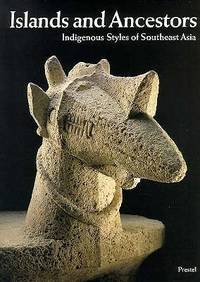
198867188Prestel Pub. New. 1988. Hardcover. 3791308998 . FREE UPGRADE to Courier/Priority Shipping Upon Request - IN STOCK AND IMMEDIATELY AVAILABLE FOR SHIPMENT - Flawless copy brand new pristine never opened -- Text in English. 362 pp. With 371 ills. 37 col. . 31 x 24 cm. -- with a bonus offer--; 1.25 x 12.25 x 9.75 Inches . Prestel Pub hardcover
NC02AA-00580F. Tennyson Neely. Collectible - Acceptable. New York: F. Tennyson Neely 1899. 1st edition. Oblong 8vo. 260pp. Illus. Fair book. Front hinge split. First signature detached. yacht racing America's Cup Inquire if you need further information. F. Tennyson Neely unknown
1950ZB831564Cooperstown etc.: American Association for State and Local History 1950. volumes 1#2 through 5#4 lacking vol. 1#3 all complete issues or complete volumes in original paper wrappers softcovers well illustrated throughout very minor ownership markings passim else very good. - If you are reading this this item is actually physically in our stock and ready for shipment once ordered. We are not bookjackers. Buyer is responsible for any additional duties taxes or fees required by recipient's country. Photos available upon request. Cooperstown, etc.: American Association for State and Local History paperback
Q-1399920529Little Brown 1930-01-01. Hardcover. New. In shrink wrap. Looks like an interesting title! Little Brown hardcover
0011131Willard Ohio. Good with no dust jacket. Softcover. On offer are two diaries covering two years in the life of a farmer in Willard Ohio named William Newton Keesy 1867-1942. William married Carrie Niekirk 1867-1928 in 1892 and they had two children Parke and Wilma. He farmed near the small Ohio town of Willard. He also served as commissioner in Huron. Following the death of his wife William moved in with his daughter Wilma and her family. Sadly the 1940 census completed two years before his death shows him living in a boarding house. When he kept these diaries at age 61-62 William Kessy lived an ordinary life looking after his wife who was very ill and would die before the end of 1928 and participating regularly in community organizations. Again from context it appears that in addition to farming he worked servicing pumps at gas stations and service weigh scales. His entries are succinct and convey a sense of the rhythm of life in small-town Ohio at that time. The following excerpts will give a flavour of these two diaries. The diaries also contain a fair amount of ephemera such as medical bills invoices etc. R and cloudy. I went to Willard and tested Standard Oil Co Bulk and Service Station Feb 15 1928. I made a thing to put coal oil barrel on and in P. M. Went over to see Herbert he is sick has been since Monday. Wilma came and her and Carrie went to W. M. A. At Dawson. I went down to in eve a little while Apr 6 1928. Hung screen door and painted in A. M. In P. M. Hoed potatoes. All kids were here in eve had ice cream. We set out tomato and cabbage plants. I went down to Clarks and got them July 4 1928. By late summer Carrie was beginning to have health problems and there are a number of references to doctor appointments a receipt from the Cleveland Clinic and a detailed list that William kept of Carries medical bills at the back of the diary. Through the autumn Carries health continued to fail but life continued for William and his adult children. Some excerpts: I went to Willard then to cemetery and over to Charleys then home then got a message from Mabel and went to Willard and in eve to Willard to a Republican meeting. Frances Riddle went with me. Carrie and Mary went over to Wilmas for dinner Oct 8 1928. Got things ready to go to Columbus in the morning to Sealer Convention. In PM I went to Delphi and Willard. Eva came out first before dinner and is going to stay until I get home from Columbus Dec 3 1928. At home all day. Carrie has been bad. Doctor was out in eve. Bob and Wilma was out in eve Dec 12 1928. Fair. Carried died this evening at 7 oclock. Parke and I cut up beef and Dora put it down Dec 28 1928. His family troubles were not over but continue in his 1929 diary. On Jan 2 1929 he notes that his 10 month old granddaughter is sick. She had contracted measles and a bronchial infection and did not recover: Stayed at Bob last night. Merle died at 5: 20 this morning Jan 30 1929. Little Merle Aileen was buried today aside of Carrie. Now she has her. Dear lord keep me so I can go to them Feb 1 1929. Despite the tragedy of 1928 and 1929 William perseveres. He spends a lot of time with Wilma and her husband Bob and Parke. He also continues with his daily tasks as was necessary at the time. Some excerpts: Frank and I cleaned the chicken coop then I went to Attica and brought Eva and Minnie out and Dora and Wilma came over and they divided up Carries wearing apparel and then took them home Feb 18 1929. I went to Norwalk by way of Younges and home to Willard and got car greased and shaved and hair cut and got oil changed and car greased. Bob and I got all of my things last evening May 3 1929. At election then out to Parks and to Grange in eve Nov 5 1929. Got ready for Christmas. Parks were down in eve. I got 2 pairs of socks and a tie from Parkes and a desk light from Bob and Wilma Dec 24 1929. For a social historian these diaries provide a real look at one aspect of life in small town America in the early part of the 20th Century. He keeps detailed cash account listings at the back of both diaries and the ephemera helps shed light on economic information from the time. There are numerous references to family friends and neighbours for this to be a good resource for genealogists. The 1928 diary measures 5.5x3.4 inches is 183 pages and 100% complete. Overall Good. The 1929 diary measures 6x3.4 inches is 183 pages and 100% complete. Overall Good. Williams handwriting is particularly legible for a male diarist. ; Manuscripts; 24mo 5" - 6" tall; 183 pages; Signed by Author . paperback
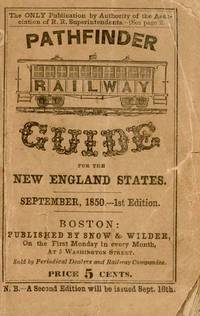
185046378Boston: Snow & Wilder Publishers 1850. 1850. First edition with the words in print "September 1850 - 1st Edition" on the front cover noting that "A Second Edition will be issued Sept. 16th." Publisher's illustrated wrappers showing a railway carriage 110 pp. of schedules plus 18 pp. of advertisements and a two-sided folding map at the front. The booklet measures 2 3/4" x 4 1/4" and the map when unfolded measures 7" x 9 1/4." One side of the map details the railroad lines of New England and the verso shows the city of Boston. Some small tears and small chips to the extremities else a very good copy. Snow & Wilder, Publishers, 1850. unknown
1720523641720. Amsterdam Chez Pierre Humbert 1720 12° 15 1 328 pp.; 1 pp.331-583; 17 pp. Catalgoue des Livres Impres Chez Pierre Humbert . 12 gefalt. Kupferstichtafeln; Ledereinband d.Zt.; Rücken erneuert; feines Exemplar. PREMIERE EDITION FRANCAISE ! Pierre Coste 1668-1747 "the translator spent many years in England where he fled on the revocation of the Edict of Nantes and where he became intimate with Locke. His translations were of durable service and helped to introduce english thought to the French of the XVIIIth century" Babson Babson 139; Wallis 186; Dibner 148; PMM 172; Horblit N° 79b all 1st engl. Ed. unknown
177619583Leipzig, Junius, 1776. 2 Teile in 1 Bd. XIII S., 1 Bl., 568 S., 4 Bll. 16 mehrfach gefalt. Kupfertafeln. Gr.-8°. Mod. HLdr. unter Verwendung der Reste des alten Materials (etw. berieben).
1728177<b>4to 288 x 218 mms. pp. 50 407 408 blank engraved vignette on title-page other engraved vignettes and illustrations in text by John Pine after John Grison 12 folding engraved plates. FIRST EDITION. The subscriber s list is also present. Full contemporary calf boards are slightly worn which has been professionally rebacked by the Heritage Bindery. Henry Pemberton was tasked with bringing Newtonian philosophy to the layman with this work which was completed and published a year after Newton s death. Small blind- stamp from the Meadville theological school library on the title page. </b> S. Palmer hardcover
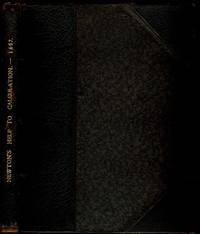
1657MS0005<p>1004 pages with tables and title within ruled boarder. Small quarto 7 1/2" x 5 3/4" bound in 20th century half green morocco with gilt lettering to spine over marbled boards. Thomash & Williams N33; Wing N1060 First edition.<br /><br />John Newton remained loyal to the king during the protectorate and supported himself by his eminent skill in mathematics and astronomy. At the Restoration he obtained the degree of D.D. and was in 1661 made king's chaplain and rector of Ross in Herefordshire where he died on 25 Dec. 1678. He was appointed canon of Hereford in 1673 and held the rectory of Upminster in Essex from 1662. He was the author of several works on arithmetic and astronomy designed to facilitate the use of decimal notation and logarithmic methods. He was also an advocate of educational reform in grammar schools; he protested against the narrowness of the system which taught Latin and nothing else to boys ignorant of their mother tongue; and complained that hardly any grammar-school masters were competent to teach arithmetic geometry and astronomy. With the object of supplying the means of teaching a wider and more practical curriculum he wrote school-books on these subjects and also on logic and rhetoric.</p><p>The following is a list of his works in chronological order; they are all in English: 1. <em>'Institutio Mathematica.' Decimal tables of natural sines tangents and secants and of logarithms; solution of plane and spherical triangles; with applications to astronomy dialling and navigation</em> 1654. 2. <em>'Astronomia Britannica' so called because decimals are used and the calculations are made for the meridian of London.</em> In two books dedicated to the Earl of Warwick who was an admiral of the fleet 1657. This and the foregoing work were printed by William Leybourn q. v. 3. <em>'Help to Calculation</em>' 1657. 4. <em>'Sixteenpence in the Pound' an interest table</em> 1657. 5.<em> 'Trigonometria Britannica'</em> in two books one of them from the Latin of Henry Gellibrand 1658. 6. <em>'Chiliades centum Logarithmorum</em>' 1659. 7.<em> 'Geometrical Trigonometry' </em>1659. 8. <em>'Mathematical Elements</em>' three parts 1660. 9.<em> 'A Perpetual Diary or Almanac</em>' 1662. 10. <em>'Description of Use of Carpenter's Rule</em>' 1667. 11. <em>'Ephemerides of Interest and Rate of Money at 6 per cent.'</em> 1667. 12.<em> 'Chiliades centum Logarithmorum et Tabula partium Proportionalium'</em> 1667. 13. <em>'The Scale of Interest: or the Use of Decimal Fractions and Table of Logarithms' composed and published for the use of an English mathematical and grammar school to be set up at Ross in Herefordshire</em> 1668. This book contains two dedications one to the Archbishop of Canterbury and the Bishops of London and Hereford the other to Lord Scudamore and other property owners about Ross. <em>His views on grammar-school education are expounded in a preface of thirty-six pages</em>. 14. <em>'School Pastime for Young Children</em>' dedicated to Thomas Foley 1669 contains a preface of eighteen pages on the education of infants. 15. <em>'Art of Practical Gauging</em>' 1669. 16. <em>'Introduction to the Art of Logic'</em> 1671 dedicated to Henry Milberne. 17.<em> 'Introduction to the Art of Rhetoric'</em> 1671. 18. <em>'The Art of Natural Arithmetic</em>' 1671. 19. '<em>The English Academy or a brief Introduction to the Seven Liberal Arts</em>' 1677. 20. <em>'Introduction to Geography</em>' 1678. 21. <em>'Cosmography</em>' 1679. 22. <em>'Introduction to Astronomy.</em>' The present work published by Joseph Moxon for sale in his instrument shop is designed to aid in the conversion from sexagesimal to decimal numbers so that problems in astronomy navigation etc. can more easily be solved using the standard logarithmic tables. After a short introduction the majority of the volume is taken up by the tables.<br /><br /><strong>Condition:</strong><br /><br />Points and spine ends rubbed ink stamp to title verso else very good.</p> Printed by Joseph Moxon hardcover
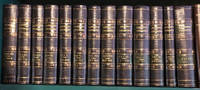
181361937London: Printed for G. Kearsley J. Walker J. Stockdale R. Lea et al. 1813. Large 8vo. In 13 volumes 12 volumes of text with plates bound separately in extra volume. Uniformly bound in contemporary black half calf over dark green cloth. Gilt decoration & blind-stamped panels to spines. Marbled endpapers. Some rubbing & wear to spines & corners. Boards clean. All internally clean. All bindings firm. With 370 plates. Small tear to one plate. Plates plain without any colour in this copy. . Very Good. Half Calf. 1813. Printed for G. Kearsley, J. Walker, J. Stockdale, R. Lea, et al. 1813 unknown
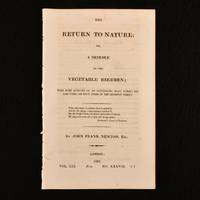
1821907F32London: The Pamphleteer 1821 . First edition. Unbound. Very Good. 9.5" by 5.5". None. A very scarce edition of John Frank Newton's highly influential early nineteenth century argument in favour of vegetarianism. A vanishingly scarce contemporary edition of John Frank Newton's important work.First published in 1811 this edition appeared as No. XXXVIII in Vol. XIX of 'The Pamphleteer' and here appears unbound.A pioneering work on vegetarianism in his work Newton explains his view that the natural food of man is vegetables and that animal flesh is unhealthy. In his work he uses personal anecdotes and explains that many members of his household adopted the diet for between three and four years prior to the publication of the work.The work influenced fellow vegetarian Percy Bysshe Shelley providing the basis of his 'A Vindication of the Natural Diet' and prompting Mary Shelley's depiction of the Creature as a herbivore in 'Frankenstein'.With the stamp of the pamphlet collection of the British Library to the verso of the title page.One of the more unusual claims in the work is that a vegetarian diet may eradicate syphilis. Unbound. Externally exceptionally bright. Stamp to verso of title page. Internally firmly bound. Pages clean and bright. Very Good The Pamphleteer unknown
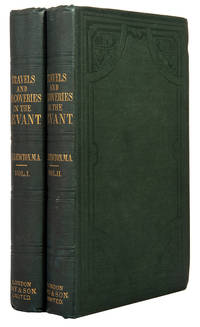
106123London Day 1865. . First edition. 2 volumes 8vo xiv 2 360; xiv 2 275 pp. 41 plates and maps some folding original blind-stamped green cloth gilt a fine set.<br /> Newton was vice-consul at Mitylene and resided in the Levant from 1852-1859. The expeditions to Asia Minor took place between 1856-1859 and were mostly concerned with the excavations of the Mausoleum at Halicarnassus. The present work contains the popular account of these digs together with Newton's life in Mitylene the local inhabitants etc. Newton also carried out excavations at Kalymnos.<br /><br />The plates include views in Rhodes Cos Kalymnos and Mitylene as well as illustrations of the sculptures from the mausoleum.<br /> Atabey 869; Blackmer 1193. London, Day, 1865. hardcover
1716102764Londres, J. Senex, 1716, in-8, [2]-443-[1 errata] pp. 9 pl. dép, Basane havane mouchetée de l'époque, plats ornés à froid, dos consolidé à l'adhésif, Première publication en anglais d'une sélection exhaustive des Principia, avec le récit du Dr Halley sur les comètes illustré de 9 planches dépliantes gravées de figures de comètes par Senex. Le théologien et mathématicien William Whiston (1667-1752), qui par cette publication popularisa auprès du grand public l'oeuvre de Newton, fut comme Edmond Halley un des premiers partisans de la périodicité des comètes. Assistant de Newton à l'université de Cambridge, il lui succéda à la Chaire de professeur lucasien de mathématiques. Il est surnommé le "Wicked Willie Whiston" (le méchant Willie Whiston) par Swift après avoir été expulsé de l'université pour hérésie et pour ses opinions ariennes, pour les mêmes raisons il ne sera jamais admis à la Royal Society dont Newton était le président. Étiquette ex-libris armoriée gravée sur cuivre au contreplat de Patrick Hume (1641-1724), ancien lord chancelier d'Écosse : "Lord High Chancelor of Scotland", 1702. Dos consolidé, planches légèrement brunies, sans le feuillet de faux-titre, titre découpé et collé sur un feuillet, adhésif et petites déchirures au premier f. de texte, reliure un peu lâche. Babson 127. Couverture rigide
2008DADAX0521739535Cambridge University Press 2008-10-23. 1. paperback. New. 8.25x8.00x11.00. Buy with confidence. Excellent Customer Service & Return policy. Cambridge University Press paperback
169745644Leipzig, Grosse & Gleditsch, 1697. 4to. No wrappers. In: ""Acta Eruditorum Anno MDCXCVII"", No V, May-issue. Pp. 193-240 (entire issue offered). With titlepage to the volume 1697. Leibniz: pp. 201-205. Johann Bernoulli: pp. 206-211. Jacob Bernoulli: pp. 211-214. Newton: pp. 223-224. As usual, some leaves with browning.
169745644Leipzig Grosse & Gleditsch 1697. 4to. No wrappers. In: "Acta Eruditorum Anno MDCXCVII" No V May-issue. Pp. 193-240 entire issue offered. With titlepage to the volume 1697. Leibniz: pp. 201-205. Johann Bernoulli: pp. 206-211. Jacob Bernoulli: pp. 211-214. Newton: pp. 223-224. As usual some leaves with browning. <br/><br/><em>First appearance of the famous issue of Acta Eruditorum in which the 4 solutions by the 4 most eminent mathematicians at the time were printed together. There were in all 5 solutions to the posed problem and Newton's solution was first printed in the Philosophical Transactions January 1697 and reprinted here. The solution proposed by L'Hopital not printed here was not published until 1988.The brachistochrone problem was posed by Johann Bernoulli in Acta Eruditorum in June 1696. He introduced the problem as follows: "I Johann Bernoulli address the most brilliant mathematicians in the world. Nothing is more attractive to intelligent people than an honest challenging problem whose possible solution will bestow fame and remain as a lasting monument. Following the example set by Pascal Fermat etc. I hope to gain the gratitude of the whole scientific community by placing before the finest mathematicians of our time a problem which will test their methods and the strength of their intellect. If someone communicates to me the solution of the proposed problem I shall publicly declare him worthy of praise." Johann Bernoulli and Leibniz deliberately tempted Newton with this problem. It is not surprising given the dispute over the calculus that Johann Bernoulli had included these words in his challenge:- ."there are fewer who are likely to solve our excellent problems aye fewer even among the very mathematicians who boast that they. have wonderfully extended its bounds by means of the golden theorems which they thought were known to no one but which in fact had long previously been published by others."According to Newton's biographer Conduitt he solved the problem in an evening after returning home from the Royal Mint. Newton: . "in the midst of the hurry of the great recoinage did not come home till four in the afternoon from the Tower very much tired but did not sleep till he had solved it which was by four in the morning."Newton send his solution to his friend Charles Montague and Montague published anonymously in the Transactions. Newton's solution presented here in the Acta is also anonymous. The episode did not please Newton as he later wrote: "I do not love to be dunned pestered and teased by foreigners about mathematical things ." After the competition Johann Bernoulli said ". my elder brother made up the fourth of these after Leibniz himself and Newton that the three great nations Germany England and France each one of their own to unite with myself in such a beautiful search all finding the same truth."Struik Edt. "A Source Book in Mathematics 1200-1800 pp. 391 ff. </em> unknown
0170233316New. Brand new and still unused unknown
0520009290New. Brand new and still unused unknown
0521536200New. Brand new and still unused unknown
0817307362New. Brand new and still unused unknown